
Table of Contents (10)
Getting Lost in a Grid: My First Night With Never’s End
I booted up the Never’s End demo expecting a cute Final Fantasy Tactics tribute I’d poke at for an hour. Three hours later I was still nudging tiles a few degrees hotter or colder, trying to figure out how to steam-cook a squad of bandits without turning my own spear into a torch. That’s when it clicked: this isn’t just another tactics game with elemental combos – it’s a straight-up simulation toy box that somehow remains readable and friendly.
Never’s End is a tactical RPG from Hypersect that lives somewhere between Final Fantasy Tactics, Divinity: Original Sin, and an elaborate diorama you’re afraid to bump. It runs on a grid, but that grid is an open world, not just a series of isolated battle maps. Every tile tracks temperature, moisture, and terrain type, and your spells don’t just do “fire damage” – they literally move heat around the board.
I played the public demo on PC via Steam on a mid-range rig (RTX 3060, 1440p monitor, mouse and keyboard). Over two evenings I cleared the tutorial fights, experimented with the heat system in a desert and tundra map, and messed around with a small outpost hub. It was enough to see where Hypersect is going, and enough to make me a little obsessed.
FF Tactics Bones, Divinity Brain
Structurally, Never’s End looks familiar at first. You’ve got turn-based, grid-based battles, elevation, facing, melee and ranged weapons, and small squads. If you’ve played FFT, Tactics Ogre, Triangle Strategy, or Fell Seal, you’ll settle in quickly.
The twist is how much the game cares about the state of each tile. Every square knows how hot it is, how wet it is, and what material it’s made of. Spells and abilities don’t just change HP bars – they change those states, and those changes ripple outward.
In one early fight, I was trying to cross a patch of deep sand that chewed up my stamina (more on that system in a bit). The director’s tooltip casually mentioned I could “compress” the sand. I dropped a heat spell, watched the sand’s temperature spike, and a turn later it had baked into sandstone – now normal movement cost, no more slogging. It wasn’t some scripted tutorial gimmick; it felt like I’d actually altered the map.
That’s the Divinity: Original Sin part – you’re constantly thinking in verbs like heat, cool, evaporate, condense, ignite, instead of just “cast Fireball”. But it never spiraled into chaos the way some systemic games can, because the UI is quietly doing a ton of work in the background.
The Heat System: More Thermodynamics Than Fire & Ice
The standout mechanic in the demo is heat manipulation. You’re not just creating fire or ice; you’re literally transferring heat between tiles and units. Think of it like dragging little temperature sliders around the map.
One of my favorite moments: I had an enemy swordsman pinned behind a rock. Instead of lobbing a basic damage spell, I siphoned heat from the rock behind him and dumped it into the sand in front of him. That tile turned into a scorching hotspot, and on his turn, the game predicted he’d instinctively step back off the burning ground. That retreat popped him right into a crossfire between my archer and a spear user waiting on higher ground.
Another time, I got cocky. I overheated an enemy carrying a wooden staff, already a little warm from standing near a brazier. The temperature tooltip on his weapon ticked up past its ignition point, and the staff lit up… which was great until he ran straight at my frontliner. One hit later, my own character’s clothing was on fire, and I had to spend precious actions cooling the tile beneath them with a water spell so they could drop and roll it out. It was a perfect “oh, this system really doesn’t care who it helps” moment.
The best part is how easily the game communicates all this. Hover over any tile, and you’ll see its temperature, moisture, material, and any status icons. Hover over a character, and you get their personal temperature and how “close” they are to thresholds like freezing, exhaustion, or ignition. There’s even a little prediction panel that shows potential outcomes when you queue up an ability: arrows, status icons, and color-coded tiles forecast what’s likely to happen.
This could have been a messy wall of numbers. Instead, it’s clean and almost toy-like. You can read a battlefield at a glance, then dive deeper when you want to get nerdy.
Two Action Resources: Time and Stamina
Never’s End also walks away from the classic “AP pool” many tactics games lean on. Every character runs on two separate resources: time and stamina.
Time is your per-turn budget. You spend it to move, attack, cast, or interact, and it fully refreshes when the character’s turn comes back around. Stamina is more like long-term exertion: heavier weapons, sprinting through bad terrain, and certain powerful abilities chew through it, and it doesn’t snap back to full every turn.
In practice, this creates a cool rhythm. Early in a fight, I’d happily burn time on repositioning tricks and cheap pokes, keeping stamina costs low. Mid-battle, I’d break out big stamina-draining moves to secure openings. By the late game, my frontline bruiser might be low on stamina, forcing me to pull them back and lean on casters or environmental shenanigans instead of just face-tanking everything.
Temperature ties into this too. Overheating an enemy makes their actions chew up more stamina; chilling them can slow how quickly they regain effectiveness. At one point I cornered a tough armored foe. Instead of trying to break through their defense, I just kept spiking the temperature around them and watching their stamina bar shrivel. By the time they staggered out of the heat bubble, they were too exhausted to do much before my archer finished the job.
It’s the kind of system that could easily feel like busywork, but because the UI surfaces both bars clearly and lets you preview costs, it becomes a satisfying puzzle. You’re not just asking, “Can I kill this enemy this turn?” You’re asking, “How tired can I make them three turns from now?”
The Open-World Grid Is a Clever Shake-Up
One of the more subtle but important shifts: there’s no traditional “world map > battle map” jump. Everything happens on the same gridded, diorama-like world. You freely walk your party around between fights, then drop into tactical mode when you bump into trouble or choose to engage.
In the demo, this mostly meant wandering between a small outpost, a nearby crypt, and some wilderness pockets while skirmishes popped up along the way. But even in that limited slice, it felt different from the genre norm. Because the environment persists, your actions can scar the landscape. Sand paths you hardened earlier, scorched patches of grass, frozen puddles you created to slow enemies – they’re all still there when you come back.
There’s also a light town-building and possession angle teased in the demo. You can hop into the bodies of certain townsfolk, each with randomized traits, and then drag them (and their quirks) into your broader war effort. One worker I possessed had a trait that made them more resistant to heat but extra flammable if their equipment ever ignited. That pushed me to experiment with fire-heavy strategies in one run and avoid them entirely in another.
It’s still early days, so I don’t know how far the “open world tactics” idea will go – I didn’t hit any massive, multi-stage assaults or roaming bosses in the demo – but the foundation is promising. It feels closer to a tiny, systemic sandbox than a linear string of handcrafted tactical puzzles.
It’s still early days, so I don’t know how far the “open world tactics” idea will go – I didn’t hit any massive, multi-stage assaults or roaming bosses in the demo – but the foundation is promising. It feels closer to a tiny, systemic sandbox than a linear string of handcrafted tactical puzzles.
🎮 Get This Game at the Best Price
Compare prices instantly and save up to 80% on Steam keys with Kinguin — trusted by 15+ million gamers worldwide.
*Affiliate link — supports our independent coverage at no extra cost to you
UI, Tutorials, and Why This Isn’t As Intimidating As It Sounds
Reading all this, you’d be forgiven for thinking Never’s End sounds terrifyingly complex. What surprised me most is that it isn’t, at least not in the demo. The tutorial is sharp and quick: a handful of compact encounters that each spotlight a mechanic, then let you play with it without nagging you every turn.
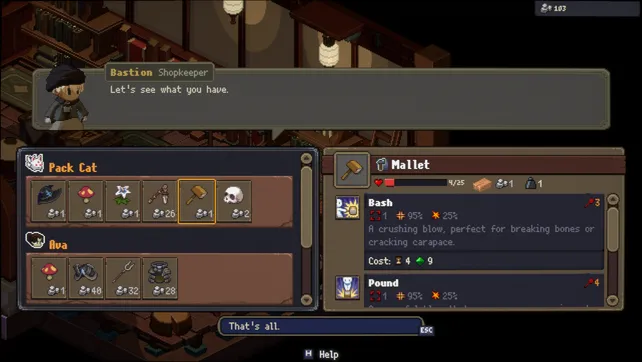
The star of the show is the “hint” mode. Hover your cursor over literally anything – a tile, a character, a weapon icon, a UI glyph you forgot the meaning of – and a contextual tooltip pops up. It explains what that property does, what thresholds matter (“Ignites at X temperature”), and often hints at possible interactions (“Dry wood burns faster”). It feels like having a rulebook open on the table, except it’s always pointing you to the relevant page.
Crucially, it stops short of playing the game for you. It’ll tell you “this tile is hot enough to cause burn damage,” but it won’t magically highlight the “correct” move. You still have to weigh whether that burn is worth risking the nearby explosive barrel, or whether you can cool it down before your own melee unit steps in.
There’s no traditional “undo turn” button, at least in the demo build I played. You commit to your move and live with it. Combined with what appears to be some form of permadeath for certain units, that’s going to sting for perfectionists. I definitely had one moment where I accidentally pushed an enemy into a burning tile that also set off a chain reaction and torched my favorite possessed villager. Watching them crumble felt awful… but it also taught me something about how quickly fire can spread across dry brush tiles.
If you’re used to tactics games that let you meticulously rewind until you get the perfect outcome, this will be an adjustment. Personally, I kind of loved it. The systems are transparent enough that I always felt like I understood why something went wrong, and those failures made later victories taste better.
A Diorama You Can Burn, Freeze, and Flood
Visually, Never’s End lands right in that sweet spot between retro and modern. Masayoshi Nishimura’s character designs – if you’ve played Octopath Traveler or Triangle Strategy, you’ll recognize the DNA – are rendered as thick, sprite-like 3D models that pop against the gently tilt-shifted environments.
Everything looks like a lovingly crafted tabletop setup. Miniature houses, chunky trees, small clusters of rocks all arranged on a visible grid – it gives the impression that you could reach into your monitor and physically nudge pieces around. Then you set that cute little forest on fire and watch embers flick across tiles based on wind and elevation, and the illusion is complete: this is your toy box, and you’re absolutely going to break it.
On my PC, the demo ran smoothly at 1440p with no notable hitches. Spell effects have just enough flair to sell the physicality of changing states – sizzling heat-distortion when a tile overheats, a soft mist rolling out when you rapidly cool moist ground – but they never become visual noise that hides the grid.
The soundtrack, from what the demo shows, leans into moody, slightly off-kilter beats. It’s not trying to be full orchestral bombast; it’s more “lofi tactics beats to think three turns ahead to”, with occasional sharper stings when big abilities go off. It fits the game’s vibe: thoughtful, a little weird, and more about mood than spectacle.
Where I’m Excited – and Where I’m Cautious
After a few hours, two things stood out as Never’s End’s biggest strengths: its systemic depth, and how accessible it makes that depth. It scratches the same part of my brain that loves breaking Divinity: Original Sin 2’s encounters in half with a clever environmental chain reaction, but it does so with clearer visual language and less menu diving.
I’m also intrigued by the open-world structure and the possession/town angle. The idea of building up a motley crew of possessed villagers, each with weird traits and vulnerabilities that interact with the environment, has a lot of potential. If the full game pays off on that, it could be something really special.
My worries mostly live in the “we’ll see at launch” category. The more systemic you make a tactics game, the harder it is to maintain interesting encounter design over dozens of hours. It’s one thing to give players heat and moisture toys in a handful of handcrafted demo maps; it’s another to keep surprising them in hour 40, after they’ve seen every trick in the book.
There’s also the question of difficulty tuning. With permanent consequences and no undo, there’s a fine line between “hard but fair” and “I just lost 90 minutes to a chain reaction I couldn’t reasonably predict.” Right now, the robust tooltip system and clear UI keep things on the right side of that line, but late-game encounters could stress that.
Finally, the release plan is still a bit hazy. The demo is out now on PC via Steam, and Hypersect is aiming to bring the full game to PC and PlayStation 5 sometime in 2026, but there’s no firm date yet. That’s not a red flag, just something to keep in mind if you’re itching for a full campaign.
Who Should Keep an Eye on Never’s End?
If you’re the kind of player who paused Divinity: Original Sin 2 mid-fight to stare at a cluster of barrels and think, “If I electrify that puddle, then freeze that steam cloud…”, this is absolutely for you. Never’s End is very systems-first. Story beats are light in the demo, and there’s no lavish cutscene spectacle; the draw is in tinkering with the battlefield.
Fans of classic grid tactics games will feel at home with positioning, elevation, and weapon matchups, but you need to be comfortable with experimentation and occasional failure. There’s no safety net of endless rewinds, and the best moments often come from a plan half-working and forcing you to improvise.
If you prefer super-scripted, puzzle-like tactics encounters with one “correct” solution (think Into the Breach on the hardest difficulties), Never’s End might feel a bit loose and messy. Its sandbox nature means sometimes you’ll steamroll a fight because you discovered a particularly nasty combo; other times, you’ll accidentally invent a new way to set your own party on fire.
FinalBoss // Gear
Level up your setup
01Top-rated gaming headsetson Amazon→02High-refresh gaming monitorson Amazon→03Gaming chairson Amazon→04Discounted game keyson Kinguin→Affiliate links · As an Amazon Associate, FinalBoss earns from qualifying purchases.
Want to Level Up Your Gaming?
Get access to exclusive strategies, hidden tips, and pro-level insights that we don't share publicly.
Ultimate Reviews Strategy Guide + Weekly Pro Tips