
Table of Contents (7)
Ninja Gaiden 4’s combat is built to keep players engaged, not safely out of reach
The short answer: Ninja Gaiden 4’s “don’t hide” battle philosophy is about making close-range pressure readable enough to answer. The CEDEC 2026 session described a workflow that starts with the intended split-second feeling of a fight, translates that feeling into enemy and player specifications, then tests those rules in simulations before a full encounter is built.
That matters because “aggressive combat” is often used as a lazy shorthand for mobs with inflated health, attacks from off-camera, and particle effects doing their level best to obscure the one thing a player needs to see. The Ninja Gaiden 4 approach is more disciplined. Pressure is the goal, but pressure needs a rhythm. A player should feel trapped for a moment, recognize the immediate danger, then commit to a response with enough precision that success feels earned.
CEDEC 2026 framed the game around player experience first
The July 22 CEDEC 2026 session at Pacifico Yokohama North, titled How We Built Non-Stealthy Battle Action in Ninja Gaiden 4, used the game as a case study for player-first 3D action design. Team NINJA producer and director Nakao appeared alongside enemy and combat design lead Takuma Ishikawa, whose background includes combat-direction work at PlatinumGames.
The key Japanese term, shinobanai, translates roughly to “don’t sneak” or “don’t hide.” It describes a combat structure that refuses to make stealth, waiting for AI resets, or endlessly circling an arena into the dominant solution. Encounters are meant to keep the player in the pocket: moving, recognizing threats, making defensive reads, and converting a narrow opening into offense.
That does not turn every fight into button-mashing. It puts more value on clarity. If several enemies are applying pressure from different angles, their attacks need distinct priorities, timings, sounds, and visual tells. Otherwise the player is reacting to noise rather than making a decision.
The battle-flow specifications behind the pressure
| Design element | Working target | What it means in play |
|---|---|---|
| Moment-to-moment pressure | Roughly 1-2 seconds of immediate danger | The player is regularly forced to prioritize one threat instead of drifting through a safe combat lull. |
| High-priority threat cadence | Under 1.3 seconds on Normal; under 0.9 seconds on Hard | Higher difficulty raises pressure through tighter scheduling and placement rather than relying only on tougher enemy stats. |
| Telegraph hierarchy | At least two clearly distinct threat levels | Routine attacks and lethal attacks need different visual or audio language, such as a stance shift, red glow, camera response, or voice cue. |
| Defensive response | Fast, but committed | Dodge and Fatal Flash-style defensive timing can solve danger, but cannot safely cover every possibility at once. |
| Enemy role definition | Explicit job per archetype | A gap-closer, projectile harasser, grab specialist, and anti-air punisher create pressure differently instead of becoming four versions of the same attacker. |
The useful unit of design is a short burst of panic
The session’s most useful idea is the small combat window: around 1 to 2 seconds where multiple dangers emerge and the player needs to select one answer. The intended feeling is controlled panic. There is enough incoming pressure to demand attention, while the relevant cue remains visible long enough for a skilled reaction.

That is a far more practical starting point than writing “make combat intense” in a design document and hoping it survives production. A vague instruction produces vague enemies. A time-bounded combat problem can be specified: how frequently an enemy threatens, how long it telegraphs, which direction it attacks from, whether it can overlap another enemy’s lethal move, and what player response is expected to beat it.
Enemy specifications function as behavior contracts. A bruiser can own close-range space. A harasser can force movement with projectiles. A grab-focused enemy can punish predictable evasion. The important part is the interaction between those roles. Four enemies acting at their maximum aggression all at once may sound difficult on paper, but it usually creates visual sludge and accidental damage. Good encounter pressure has turn-taking baked into it.
Simulating the timeline catches bad fights before production buries the problem
Ninja Gaiden 4’s process puts encounter timing into early simulations and combat sandboxes. Designers can map a four-enemy pack as overlapping timelines: a bruiser’s heavy swing every 2.5 seconds, a ranged harasser firing every 1.8 seconds, a grab attempt around every 4.2 seconds, and a support action on a longer interval. The point is not to lock a final fight to a spreadsheet. It is to identify collision points before animation, VFX, stage hazards, and final enemy assets make revision expensive.
A grab telegraph landing alongside a tracking projectile can create a meaningful choice. An unblockable-style attack, a projectile, a buff, and a second grab all reaching their lethal phase together creates a mess unless each threat has a deliberate escape route. The simulation exposes that distinction early.
When the timing looks unfair, the fix can be surprisingly surgical: lengthen a telegraph, shift an AI cooldown, keep one enemy outside its engagement range for a beat, or assign two archetypes roles that do not peak at the same moment. This is where battle flow is made. Final implementation should be validating the feel, not discovering that the whole encounter cannot be read.
Readability is the real cost of removing the hiding place
A stealth-heavy action game gives players ways to lower the temperature. Break line of sight, wait for patrol patterns to settle, isolate a target, or reset the space. Ninja Gaiden 4’s stated design direction keeps the temperature high, so enemy readability has to carry far more weight.
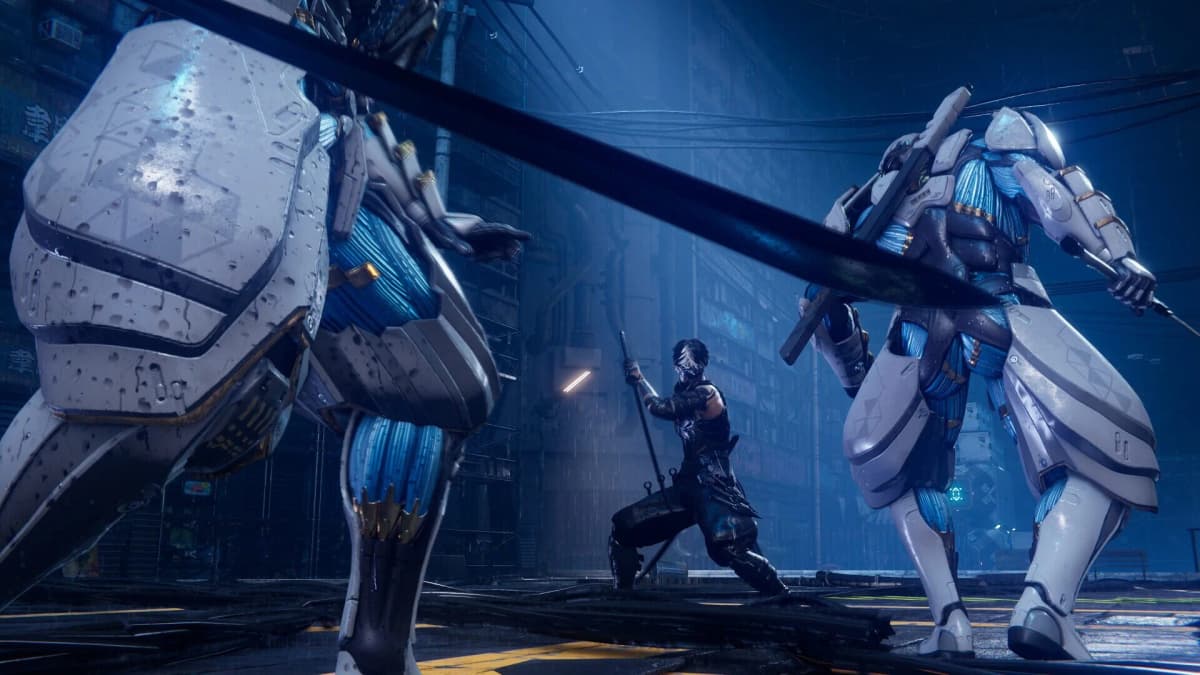
Silhouette, movement vocabulary, attack startup, sound cues, and severity indicators all become functional combat information. A ranged enemy needs to look and behave differently from a close-range punisher before the player has memorized every move. The player cannot make a good response if two attack classes share the same visual language or if an important cue is buried beneath a louder, less dangerous one.
The separate fighting-game discussion around blocking reaches a similar conclusion from the player side. Defense is often treated as the dull part of action systems because it asks for restraint, recognition, and timing rather than a flashy combo. The familiar complaint that nobody paid $60 to block captures the mindset problem neatly. Yet learning to recognize an overhead or hold defense at the right moment expands a player’s options.
Ninja Gaiden 4 applies that same principle to high-speed action. Its defensive commitments are meant to be active decisions inside an aggressive fight. A readable telegraph gives the player responsibility as well as opportunity. The system cannot provide a safe answer for every threat simultaneously without draining the tension out of the encounter.
The limitation is part of the design challenge
A “don’t hide” philosophy leaves little room for encounters that only become manageable after players retreat, reset enemy behavior, or exploit an AI blind spot. That makes every layer of presentation more important. If camera work, effects, enemy overlap, or stage geometry conceals a lethal cue, the design has failed its own contract.
It also asks more of the player than a system built around passive safety. The intended lesson is not merely to survive longer. It is to build defensive competence: spot the danger, identify its priority, and choose a committed answer before the next scheduled threat arrives.
FinalBoss // Gear
Level up your setup
01Top-rated gaming headsetson Amazon→02High-refresh gaming monitorson Amazon→03Gaming chairson Amazon→04Discounted game keyson Kinguin→Affiliate links · As an Amazon Associate, FinalBoss earns from qualifying purchases.
Want to Level Up Your Gaming?
Get access to exclusive strategies, hidden tips, and pro-level insights that we don't share publicly.
Ultimate Tech Strategy Guide + Weekly Pro Tips