
NVIDIA’s March 17, 2026 DLSS 5 announcement drew a line that the company cannot quietly step back from. DLSS 5 is being sold as neural rendering that can infuse pixels with photoreal lighting and materials, placing it well beyond the familiar job of reconstructing a cleaner image from fewer rendered pixels. That is precisely why the “AI filter” backlash matters. A system can add detail to a frame while making the frame less faithful to the game’s intended look.
The jokes about “yassified” characters and AI beauty filters were crude, but the diagnosis was accurate. Players were reacting to faces that looked altered, materials that looked airbrushed into plastic, and lighting that seemed to replace an authored palette with generic high-end gloss. Technical sharpness does not excuse visual vandalism. If a rendering feature changes a character’s apparent age, skin texture, mood, or identity, it has crossed from image reconstruction into creative interpretation.
I want better performance. I want image quality that holds together at lower internal resolutions. I want a graphics pipeline that stops forcing PC players to choose between a clean presentation and a sensible frame rate. But I have no patience for the idea that every image should be pushed toward the same synthetic version of “photoreal.” Games need detail that serves their own visual language, not detail that advertises the neural network responsible for it.
Table of Contents (5)
DLSS 5 Has a Different Burden Than an Upscaler
Traditional upscaling has always had a straightforward test: does it preserve the image the game was already trying to make? It can fail through ghosting, shimmer, instability, or loss of fine detail, but its purpose is clear. It should reconstruct the developer-authored frame as convincingly as possible.
DLSS 5 creates a harder problem because NVIDIA’s own language promises more than reconstruction. Photoreal lighting and material enhancement sound impressive in a presentation. They also describe the exact territory where art direction lives. A material’s roughness, a face’s imperfect texture, a deliberate color grade, and the density of a shadow are not empty technical gaps waiting for AI to improve them. They are choices.
That is why the community response during the March 17 to March 19 reveal cycle landed so sharply. The objection was never that games should stay blurry, low-detail, or inefficient. The objection was that a neural rendering pass appeared capable of treating a finished visual identity as raw material for a more conventionally photoreal image. That is a design failure, even if the resulting screenshot contains more pores, reflections, and surface noise.
NVIDIA has committed DLSS 5 to 15 announced games. That scale raises the stakes. A feature that works only when a studio builds careful artistic boundaries around it might still be useful. A feature that assumes every game benefits from the same visual enhancement philosophy will flatten those games into a branded house style. Hardware companies should not get to impose a house style on developers through a graphics toggle.
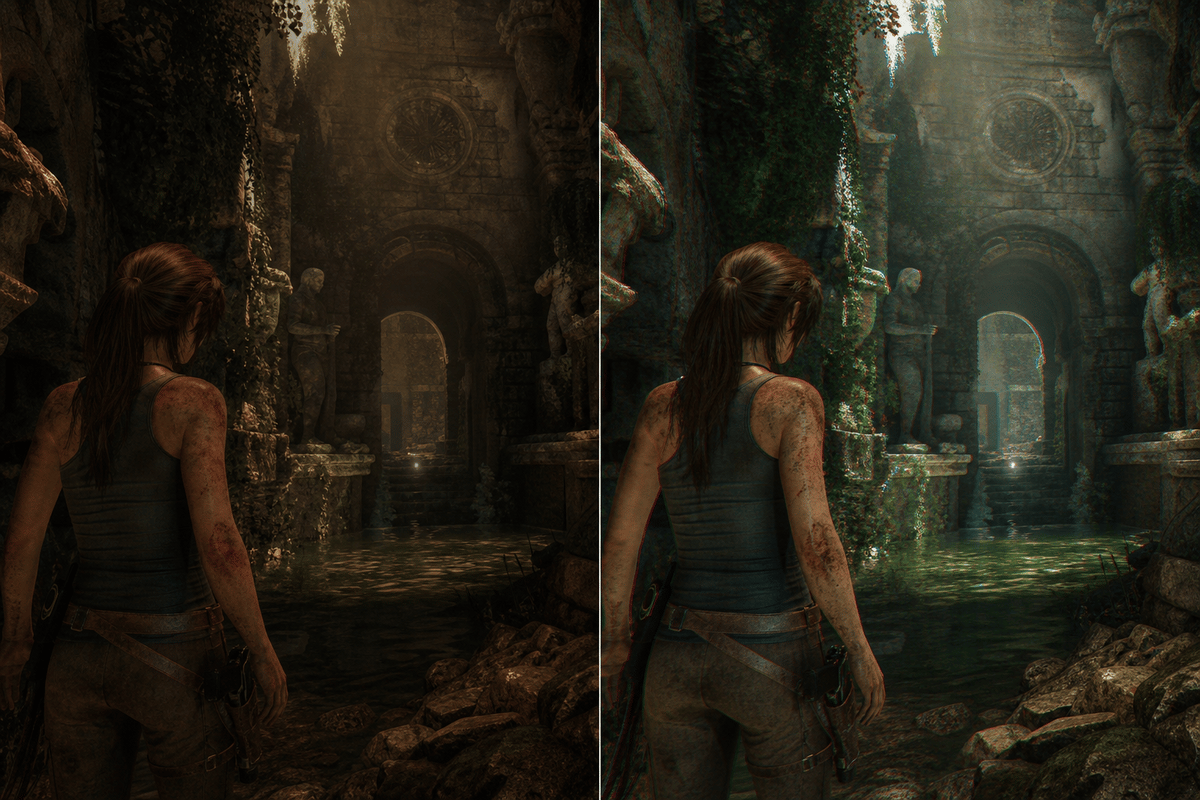
Faces, Materials, and Lighting Are the Failure Points
Players notice a bad face before they notice a technical explanation. Facial identity is fragile. Small changes to skin detail, the softness of an eye area, lip texture, expression lines, or hair edges can make a character feel like a different person. An AI pass that “improves” those details can make a deliberately weathered face look cosmetically smoothed, can make stylized skin look waxy, or can add texture that reads as age where the original model did not intend it.
Materials create the same risk at a broader scale. A painted wall, cloth costume, damp stone floor, or rough metal panel should reflect the game’s authored balance of texture, lighting, and color. Adding more speculative surface detail may make those objects look more expensive in isolation while breaking their relationship to the rest of the scene. That is how an image becomes homogenized: every surface starts chasing a polished, high-frequency realism that ignores the world around it.
Lighting is where the filter comparison becomes impossible to dismiss. Color grading and contrast establish atmosphere. A warm dusk, a sickly interior light, a heavy shadow, or a deliberately muted palette often carries more narrative weight than geometric complexity. If neural enhancement brightens, smooths, or relights that image toward generic clarity, the game loses information even as the frame gains pixels.
| Visual area | What art-direction-friendly rendering should do | What should count as a failure |
|---|---|---|
| Faces | Preserve perceived age, identity, expression, and authored skin treatment. | Changing facial texture or proportions until characters look cosmetically altered or artificially aged. |
| Materials | Resolve existing texture detail while retaining the intended roughness, paintwork, and surface response. | Replacing distinct material work with glossy, plastic, or uniformly hyper-detailed surfaces. |
| Lighting | Maintain the developer’s color grade, shadow density, palette, and scene contrast. | Brightening, flattening, or photorealizing a scene until its atmosphere is materially different. |
| Motion | Keep details stable from frame to frame during movement, camera pans, and close-ups. | Generating flickering details, shifting facial features, or unstable textures that a still screenshot hides. |
That table should be the baseline for DLSS 5, not an unreasonable demand from purists. A frame that looks attractive when paused can still fail catastrophically in motion. Games are moving images. A character’s face changing texture during a conversation, a coat becoming glossier as the camera rotates, or shadows adjusting their artistic weight between frames is far more damaging than a modest reduction in theoretical image detail.
The Experimental Runtime Is a Warning, Not a Performance Benchmark
The unofficial DLSS 5 experiments have made this argument uglier and more immediate. Modders have injected an experimental NVIDIA DLSS 5 runtime into unsupported games through a DLSSNR library identified by Windows as Nvidia DLSSNR version 310.8.0.0. The process has produced visibly artificial faces, inconsistent scene treatment, and clashes with features such as Ray Reconstruction and HDR.
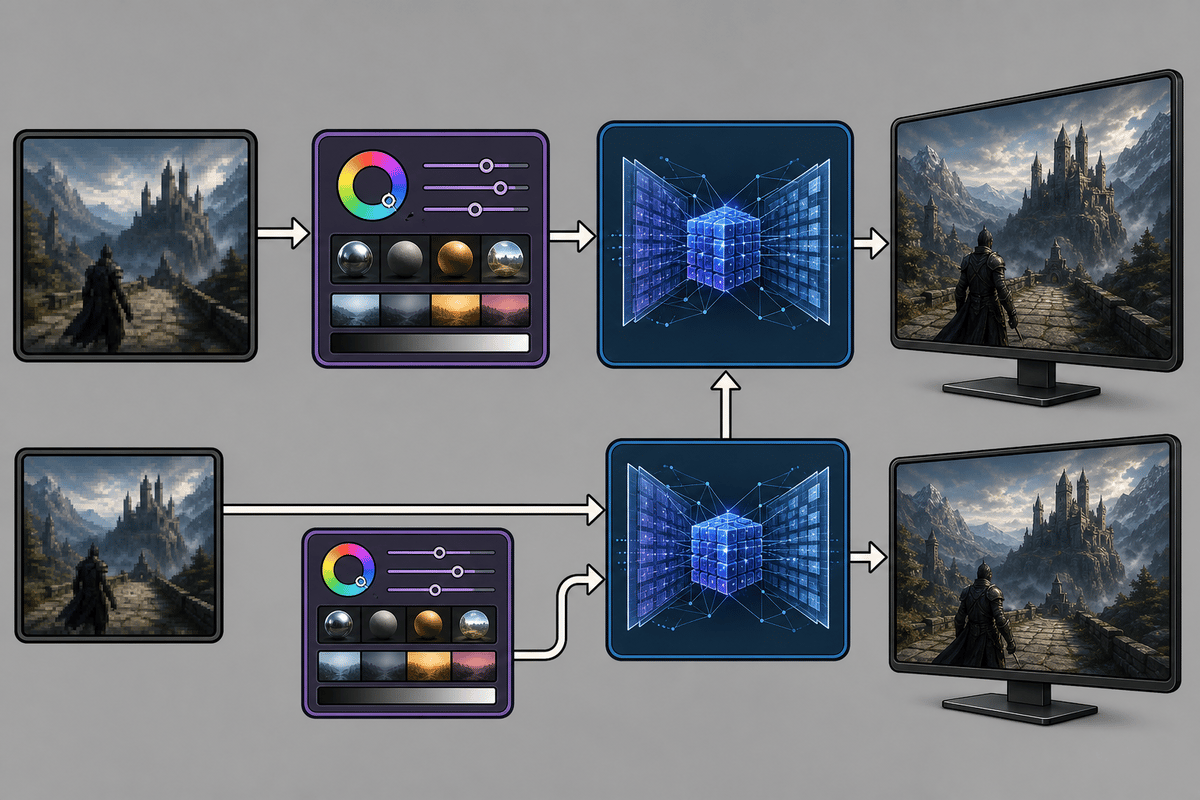
One test on a GeForce RTX 5070 Ti dropped from roughly 71 frames per second to roughly 35 frames per second when the experimental effect was enabled. That result does not establish the performance profile of a finished DLSS 5 implementation. An injected runtime lacks the per-game integration, tuning, masks, and optimization that a shipped game requires. Treating one unofficial test as final hardware guidance would be foolish.
The visual problem carries more weight. Experimental code is still capable of revealing what a technology is attempting to do to the image. When the neural pass runs after upscaling and other processes, it becomes a finishing layer with the power to reinterpret an already-composed frame. That is the danger behind the screenshots. The issue is not whether an unofficial build is polished. The issue is whether the underlying design allows an AI system to overrule an artist’s choices after the conventional rendering pipeline has already completed its work.
A rough experimental runtime deserves skepticism. It does not deserve dismissal. The bad examples are a useful stress test because they show where developer control has to be strongest: close-up characters, textured surfaces, cinematic lighting, HUD-adjacent areas, and scenes with aggressive grading. Any feature that works only in sterile showcase shots is not ready for real games.
NVIDIA’s Controls Need to Be Meaningful, Visible, and Separate
NVIDIA says developers retain artistic control over DLSS 5’s final output. The proposed tools include intensity controls, color grading adjustments, and masking for areas where the effect should not apply. The model also uses game color and motion vectors, giving it more grounding than a free-floating image generator working from a screenshot.
Those are useful ingredients. They are not proof of a safe system. “Developer control” can mean anything from a deep suite of production tools to a handful of late-stage sliders that teams barely have time to test before release. A mask is only protective if developers can create and validate it across every lighting condition, camera angle, animation state, and cutscene. An intensity slider is only meaningful if its low setting genuinely preserves the source image instead of quietly applying a lighter beauty pass.
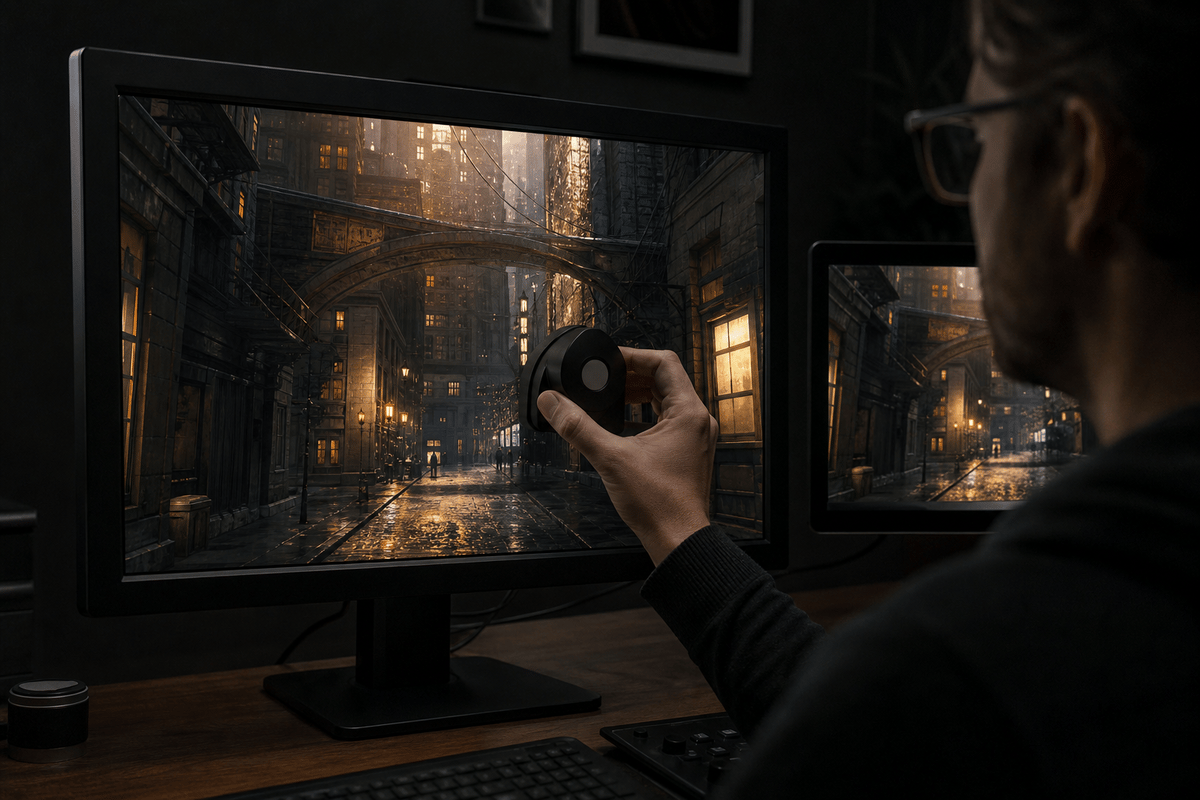
DLSS 5 needs a stricter standard than a broad promise about artistic control. NVIDIA should require its integrations to separate performance reconstruction from neural appearance enhancement. A player selecting a quality or performance preset deserves to know whether they are choosing a lower internal resolution, a reconstruction method, frame generation, or a system that may alter faces and materials. Folding all of that under one cheerful DLSS label would be evasive.
- DLSS 5 should provide a clearly labeled setting that disables neural appearance enhancement while retaining conventional reconstruction where possible.
- Any stronger material or lighting reinterpretation should be a separate, opt-in visual mode rather than the invisible default.
- Developers should be able to exclude faces, hair, UI elements, text, cinematic focal points, and heavily stylized materials through robust masks.
- Every shipped implementation should be tested in motion, including close-up dialogue scenes, rapid camera movement, high-contrast interiors, and HDR output.
- Games should disclose the performance cost of each DLSS 5 mode at fixed output resolutions, rather than implying that every AI rendering stage automatically improves frame rate.
- Studios should provide unambiguous comparison tools so players can inspect the authored image against the enhanced result without relying on compressed trailers.
The second and third points matter most. Players need a real choice, and artists need the ability to protect the parts of a scene where identity and atmosphere matter more than algorithmic embellishment. A neural renderer can be aggressive on background detail while staying out of a character’s face. It can reconstruct a difficult moving image without repainting the emotional center of a cutscene. There is no technical virtue in treating every pixel as equally available for intervention.
A Better DLSS 5 Would Be Less Visible
The best version of DLSS 5 will not create a new visual signature. It will preserve a game’s own signature under difficult rendering conditions. Players should notice stable motion, clean edges, coherent detail, and stronger performance. They should not notice that every character has acquired the same AI complexion or that every material has been nudged toward showroom sheen.
That is the point NVIDIA needs to absorb before DLSS 5 becomes a standard checkbox in PC settings menus. The company has correctly identified that neural rendering can do more than conventional upscaling. The remaining question is whether it can resist doing too much. Photorealism is not a universal upgrade path. In a medium built on authored worlds, the rendering technology should serve the world on screen rather than insist on remaking it.
If DLSS 5 preserves the authored frame under motion, it earns its place. If it has to smooth, beautify, and gloss over every scene to demonstrate intelligence, it belongs behind an opt-in menu with an honest label.
FinalBoss // Gear
Level up your setup
01Graphics cardson Amazon→02Gaming laptopson Amazon→03High-refresh gaming monitorson Amazon→04Discounted game keyson Kinguin→
Affiliate links · As an Amazon Associate, FinalBoss earns from qualifying purchases.
Want to Level Up Your Gaming?
Get access to exclusive strategies, hidden tips, and pro-level insights that we don't share publicly.
Ultimate Gaming Strategy Guide + Weekly Pro Tips