
Table of Contents (9)
The moment I realized Nvidia had no idea what we actually value
I was halfway through the DLSS 5 reveal, coffee in hand, expecting the usual tech flex: some ray-traced reflections, cleaner upscaling, the standard “look, more frames” pitch. Instead, I watched a familiar Resident Evil character’s face literally morph into a different person. Sharpened cheekbones, glossy lips, weirdly airbrushed skin – like someone slapped a TikTok beauty filter on a survival horror game. That was the instant I thought: Nvidia has flat-out lost the plot.
This wasn’t “we made path-tracing cheaper” or “we improved performance so your old card can hang on a bit longer.” This was Nvidia swaggering onstage and basically saying: these games you love? They’re wrong. Their lighting is wrong. Their faces are wrong. Don’t worry, our AI will fix them for you.
And the more clips I watched – the “yassified” Hogwarts kid who suddenly looked like a 28-year-old soap actor, the professor aged up like a caricature, the Assassin’s Creed scene with its moody shadows nuked into flat daylight – the more it stopped feeling like graphics tech and started feeling like vandalism.
I’ve been playing PC games long enough to remember when “better graphics” meant awe, not dread. Seeing Half-Life 2 for the first time. Watching the jump from PS1 to PS2. Or booting up Shenmue and feeling like I’d stepped into a living diorama. I’m not anti-tech; I live for that next “holy hell” moment. DLSS 5 could absolutely have been one of those. Technically, under the AI slop, there’s something wild there. But the way Nvidia chose to show it off? That’s where nvidia lost plot completely in this game of trust with actual players and artists.
DLSS 5 isn’t just a filter – but it absolutely looks like one
To be clear, under the hood DLSS 5 is a big deal. This isn’t just fake frames or simple upscaling. It’s a “real-time neural rendering model” that takes the game’s actual geometry, materials, motion vectors, all that low-level data, and slaps on AI-driven lighting, reflections, skin shading, materials – basically an extra generative graphics pass on top of whatever the engine already did.
Digital Foundry, who got hands-on time with DLSS 5, were impressed by the lighting specifically. Specular highlights on skin, subsurface scattering, more convincing indirect light – all that tech-nerd candy. And honestly, if you freeze-frame some of the lighting-only shots, you can see why they’re excited. There’s a hint of that “next-gen finally arrived” feeling we’ve been missing for a while.
But none of that matters if the first thing everyone notices is “why does this character suddenly look like an AI-generated Instagram model?” The announcement trailer cranked every dial to 11: over-sharpened edges, boosted contrast, saturated colors, softened skin, eye highlights turned up to “anime protagonist.” It’s like Nvidia went out of their way to trigger every anxiety players already have about AI art.
Developers and artists didn’t hold back either. You had Respawn’s Steve Karolewics calling it an airbrush filter with overbearing sharpness and contrast. Character artists pointing out how DLSS 5 was blowing out focal points, flattening compositions, and smearing everything into the same high-gloss “AAA promo render” look. When multiple pros start using the phrase “AI slop” unprompted, you’ve really nailed the tone of the reveal, haven’t you?
Nvidia insists this isn’t a post-process filter, and on a technical level they’re right. It’s anchored to geometry, it has per-material control, it’s not just a LUT slapped on at the end. But as a player, I don’t see code paths or SDK options. I see someone took Grace from Resident Evil Requiem and gave her shiny lip gloss and smoothed-out skin like she’s doing a makeup brand collab. I see Hogwarts lighting going from moody boarding school fantasy to high-budget Netflix teen drama. Whatever the pipeline details are, the end result screams “filter” to the people actually playing these games.
“Artists are in control” rings hollow in a year of layoffs
Once the backlash hit, Nvidia went into damage control. PR people stressed that devs have “detailed artistic control” – sliders, color grading, masking, the works. Bethesda rushed to clarify that what we saw for Starfield was “a very early look” and that their art team will tune it to fit their vision, and that it’ll be optional for players. Nvidia’s CEO Jensen Huang even came out swinging, saying critics are “completely wrong” and that DLSS 5 can be used to make toon shaders, stylized looks – not just hyper-photoreal filters.
I don’t doubt the sliders exist. I’m sure the SDK docs are thick enough to use as a stand for your RTX box. That’s not the issue. The issue is power and incentives.

We’re in a moment where studios are firing artists, animators, and entire QA teams after shipping successful games. Where every few weeks there’s another story about “using AI to speed up asset production.” Where executives sit on investor calls and talk about “efficiencies” while hundreds of devs are wondering if next quarter’s restructuring notice has their name on it.
Drop DLSS 5 into that context and tell me with a straight face that “artists will stay in control” is enough. Whose hand do you think will be on those sliders in two years – the art director, or the producer who needs to hit a content milestone with five fewer environment artists than they had last project? When Nvidia pitches “photoreal lighting and materials at low cost,” you know exactly what kind of conversations that sparks in boardrooms.
And this is where the nvidia lost plot feeling really hits me. They’re not reading the room. They just spent years shoving frame generation and AI gimmicks into every marketing beat while GPU prices floated into absurdity, and now they roll out a tool that literally overwrites the visual identity of games… and act shocked when devs and players see it as a threat rather than a gift.
Homogenized “AI slop” is my personal nightmare for game art
The thing that upsets me most about DLSS 5 as presented isn’t just the disrespect to existing games; it’s what it hints at for the future. If this tech takes off the way Nvidia hopes, we’re staring down a world where half the industry’s art direction slowly gets sanded down into the same photoreal mush.
Think about the games that actually stick in your head visually. Jet Set Radio’s cel shading. Persona’s graphic UI and color blocking. The grime of Dark Souls, the dreamy haze of Shadow of the Colossus, the almost stage-play lighting of Shenmue. None of those are “correct” in a physically-based rendering sense. They’re choices. They’re vibes.
Now imagine every big-budget game getting the same AI-driven “enhancement” pass on top. Skin that always wants to look a bit dewy and cinematic. Lighting that insists on filling in shadows the art team carefully left harsh. Materials that push towards “realistic” instead of “appropriate.” Noise and micro-detail everywhere because the neural net thinks that’s what high-end photos look like.
That’s what artists are already calling out: loss of focal points, crushed silhouettes, everything fighting for your attention at the same intensity. Visual language gets flattened. Your eyes stop knowing where to look because the model’s job isn’t to respect composition, it’s to maximize “detail” according to whatever training set Nvidia fed it.
That’s what artists are already calling out: loss of focal points, crushed silhouettes, everything fighting for your attention at the same intensity. Visual language gets flattened. Your eyes stop knowing where to look because the model’s job isn’t to respect composition, it’s to maximize “detail” according to whatever training set Nvidia fed it.
🎮 Get This Game at the Best Price
Compare prices instantly and save up to 80% on Steam keys with Kinguin — trusted by 15+ million gamers worldwide.
*Affiliate link — supports our independent coverage at no extra cost to you
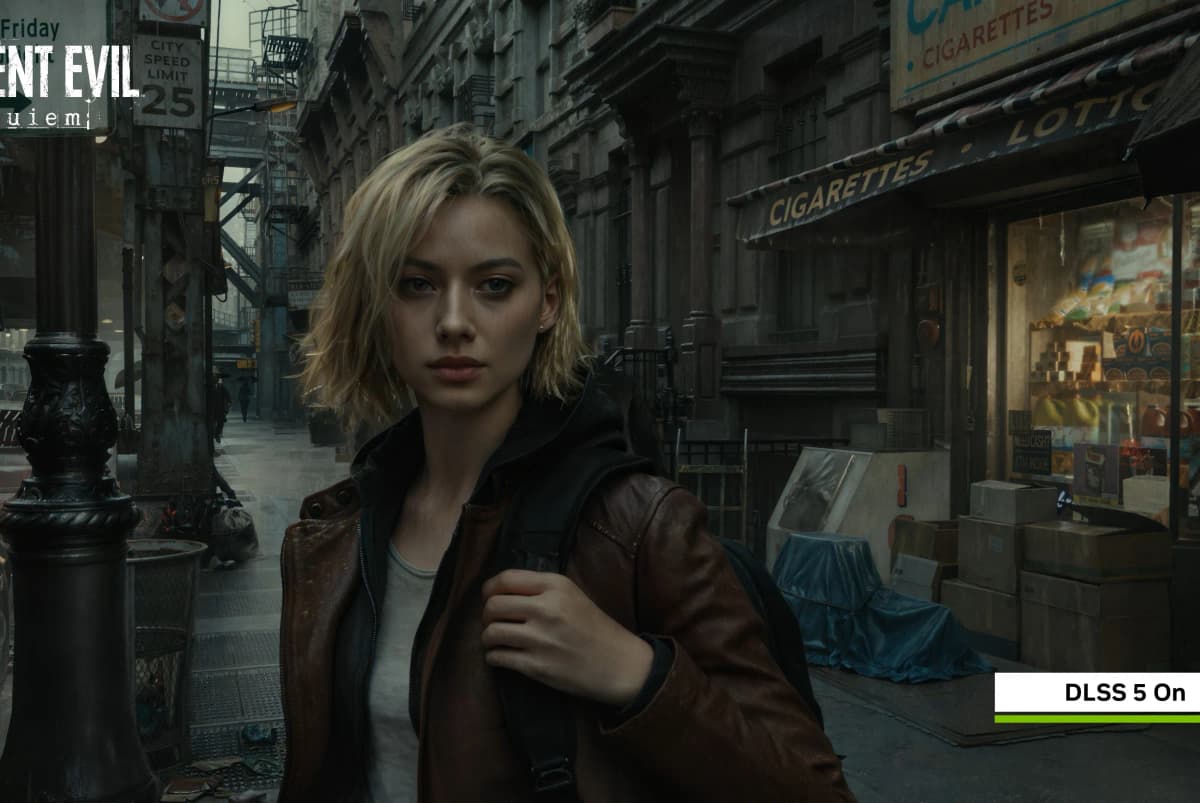
And yeah, Nvidia says you can dial it back. But let’s be real: once marketing teams have screenshots of the “maxed out” mode, that’s what ends up in trailers and box art equivalents. That’s what execs start calling the “DLSS 5 quality target.” That’s the preset players see as the “best” setting in a menu. We all know how this goes.
The wild thing: Nvidia could have sold this as pure future magic
What really stings is how easily this could’ve gone differently. There’s an alternate timeline where DLSS 5 is the coolest thing Nvidia’s done since real-time ray tracing, and I’m writing a totally different article about how I can’t wait for next-gen games that use it properly.
Imagine if the GTC 2026 keynote ended with a bespoke tech demo built from the ground up around DLSS 5. Not a single existing IP. No “remastered” faces. Just a brand-new environment and cast designed to sing with this lighting model. Base render on the left: solid but plain, think PS4-era fidelity. DLSS 5 render on the right: light wrapping around objects, skin catching stray reflections correctly, stone walls with subtle depth and bounce light that makes your brain go “yeah, that’s how that would actually look.”
Then Jensen hits a key and the whole thing toggles on and off in real time. “Here’s the wild part,” he says. “The base pass runs on a current midrange GPU. DLSS 5 is a second layer that turns that into this next-gen look. Devs don’t need a brand new engine. They don’t need to overhaul their pipelines. They just need to integrate our SDK.”
No yassified Hogwarts students. No Resident Evil heroine turned into a glossy promo render. Just pure promise: this is what your next game could look like if you design for it. Play to the strengths instead of trampling over hard-won art direction from teams shipping games right now.
In that universe, I’m hyped. I’m telling friends this might finally be the step change we haven’t really felt since the early HD era. Instead, Nvidia stapled DLSS 5 onto the same DLSS branding that already pissed people off with frame generation “fake frames,” and then chose to show it off by rewriting games we already love. That’s not just tone-deaf; that’s nvidia lost plot game marketing at its purest.
Trust was already low – this poured gasoline on it
Context matters so much here. We’re not in 2013 where everyone still thinks new tech is automatically good. We’re in 2026, the year where AI is synonymous with layoffs, content mills, and tools that quietly phase humans out of the loop.
On the gaming side, we’ve just come off years of GPUs being absurdly expensive, AI data centers hoovering up RAM supplies, and graphics tech that seems more focused on selling you an upgrade than on making games actually look or feel better. DLSS “fake frames” was already a meme. Google tried to jump into AI-powered gaming and instantly faceplanted into a backlash. People are tired, broke, and suspicious.
So when the company at the center of AI and gaming decides to demonstrate its latest breakthrough by literally rewriting the look of current games and then tells critics they’re “completely wrong,” it doesn’t come across as confident. It comes across as arrogant. It sounds like, “We know better than the people who made and play these games.”

And that sucks, because the core idea behind DLSS 5 – using AI not just to upscale, but to do more advanced lighting and material simulation in real time – is absolutely the direction graphics are heading. I want that future. I just don’t want it delivered by a company that shrugs off the people pointing out that the way they’re applying it is steamrolling over artistic intent.
Where I draw the line as a player
If DLSS 5 ships in a game I’m playing and it’s exposed as a toggle, here’s my rule: if I can tell at a glance that it’s changed the mood, the faces, or the visual language of the game, I’m turning it off. I don’t care how “correct” the subsurface scattering is if it makes a horror game look like a perfume ad. I don’t care how impressive the GI is if it melts the studio’s color palette into that same AI-driven near-photoreal soup.
But if a dev uses it like a smarter form of ray tracing – quiet, respectful, in service of what’s already there rather than fighting it – I’m in. If the art team talks about it as “another brush in the toolbox” rather than “we just let DLSS 5 handle the lighting,” I’ll give it a shot. I’ve been around long enough to remember people freaking out about normal mapping “ruining” stylized games, and those tools turned into standard practice once artists got comfortable with them.
The difference is who’s steering. Right now, Nvidia is very loudly at the wheel, pointing at side-by-side shots that scream “look how wrong this shipped game was before we fixed it.” That’s backwards. The studio should be the one deciding when – or if – to show off DLSS 5. The artists should be the ones saying, “Here’s how we used it to make our world more readable, more atmospheric, more us.”
Nvidia can fix this – but they have to admit what they messed up
I don’t think DLSS 5 itself is doomed. The SDK is out; big partners like Capcom, Bethesda, and EA are already poking at it. By the time we see it in shipping games this fall, the implementations might be far subtler than the cursed announcement reel. In a weird way, I’m rooting for that, because buried under the PR disaster is genuinely exciting tech.
But Nvidia needs to stop pretending the backlash is just a misunderstanding by “completely wrong” critics. The problem isn’t that we don’t get it. The problem is that we do get it, and we don’t like what they chose to show us. They advertised DLSS 5 as a way to overwrite shipped art, to “improve” faces, to strip shadows from levels that were composed around them. That’s not an accident. That’s a value statement.
If they’re serious about this being a tool for artists rather than a replacement for them, the next wave of messaging needs to look very different. No more yassified side-by-sides. No more implying base games are ugly until AI saves them. Show us original demos. Put actual art directors on stage talking about where DLSS 5 helped and where they told it to back off. Admit that yes, used badly, it turns everything into AI slop – and that they’re working with devs to avoid that.
Until then, DLSS 5 will be the update that proved, more than any keynote line or stock price, that Nvidia lost the plot about what players and artists actually care about. Not more detail. Not more fake frames. Not AI deciding that “realistic” is always better. We care about games looking like themselves. If your tech can’t respect that, I don’t care how advanced it is – it’s going straight in my settings menu trash bin.
FinalBoss // Gear
Level up your setup
01Graphics cardson Amazon→02Gaming laptopson Amazon→03High-refresh gaming monitorson Amazon→04Discounted game keyson Kinguin→Affiliate links · As an Amazon Associate, FinalBoss earns from qualifying purchases.
Want to Level Up Your Gaming?
Get access to exclusive strategies, hidden tips, and pro-level insights that we don't share publicly.
Ultimate Gaming Strategy Guide + Weekly Pro Tips