
Table of Contents (10)
The moment I realized something was very wrong with DLSS 5
I didn’t need a tech breakdown or pixel-counting graphs to know DLSS 5 was a problem. All it took was one face.
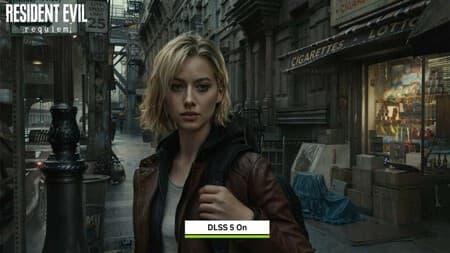
Watching that now-infamous Digital Foundry video on Nvidia’s new DLSS 5-style AI pass, I saw a Resident Evil character I knew instantly… and yet didn’t recognize at all. Same scene, same pose, same framing – but her expression, her skin, her lighting, the whole emotional read of the shot had been quietly swapped out for something smoother, cleaner, blander. It looked like someone had run a “make it hot for Instagram” filter over a horror game.
This is the part where people usually say, “Relax, it’s early tech, it’ll get better.” No. That’s exactly the problem. It’s not that DLSS 5 looks technically rough right now. It’s that the entire idea – an AI layer that “corrects” the art direction to make videojuegos vean ultra, ultra-pleasing, ultra-photoreal, ultra-market-tested – is a fundamental slap in the face to what game art is supposed to be.
And the fact Nvidia can stand on a GTC stage, run this on monstrous dual RTX 5090 setups, and have anyone in the room nodding along like this is the inevitable “future of graphics” honestly scares me more than any zombie ever has.
I grew up chasing sharper graphics – this isn’t that
I’m not anti-tech. I’m the kind of idiot who stayed up at 3am tweaking ini files so the PC port of some janky PS3 game would stop shimmering. I’ve watched Digital Foundry since they were doing 720p vs 1080p face-offs. I celebrated when DLSS 2 went from the blurry mess of DLSS 1 to something genuinely impressive.
So when I say DLSS 5 crosses a line, it’s not because I want games to look worse, or because I don’t “get” AI. It’s because I’ve spent years seeing what happens when you let the framerate tail wag the artistic dog. And this time, the dog isn’t just wagging. It’s being replaced with a plastic, AI-generated clone.
Let’s be clear about what Nvidia actually showed behind closed doors at GTC and then via Digital Foundry’s coverage. This isn’t just temporal upscaling anymore. This is a full-blown AI post-process pass trying to impose its own ideas of “better lighting”, “cleaner materials”, and “ideal faces” on top of the actual rendered image. They even needed two RTX 5090s for some demos – one to run the game, one to run the DLSS 5 pass – because the thing is so heavy right now.
And the result? Characters smoothed into uncanny Instagram models. Horror scenes relit like a Netflix sitcom. Materials and skin tones pushed towards some algorithm’s idea of perfection. People have already been calling it a Snapchat filter for AAA games, and they’re not wrong.
The worst part is that Nvidia keeps framing this like a gift to devs and players: “next-gen photo-realistic lighting”, “visuals as the artists always imagined them”. I don’t buy that for a second. I think DLSS 5 is about rewriting what counts as “good graphics” so that anything that doesn’t go through their proprietary AI filter starts to feel old, cheap, and “wrong” to a younger audience.
“Correcting” art direction is not a feature – it’s vandalism
The Resident Evil example in particular stuck in my throat. The whole point of that series’ recent art direction has been embracing unease: harsh light, sickly skin tones, faces that look like real people with real flaws. That’s horror. That’s what makes it land.
DLSS 5 comes in and quietly says, “No, actually… let’s fix that.” Suddenly the character’s face is softened, the pores are blurred, the lips reshaped, the eyes given this dead glossy sheen like a beauty render from some CG commercial. The shadows get lifted, the contrast flattening out. The shot doesn’t just look different; it feels different. The fear leaks out of it.
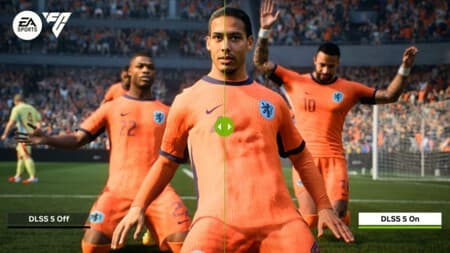
And this is what Nvidia is bragging about. This is the selling point. “Look how much better it looks now!” Better to who? Better according to what taste? Because it sure as hell isn’t the taste of the character artists who sculpted every wrinkle by hand or the lighting artists who spent weeks balancing that one key light for maximum dread.
We’ve spent decades telling devs to trust their vision, fight back against publisher notes, hold the line when marketers demand “more mainstream appeal”. Now we’re just going to shrug and let a black box neural network rewrite their work because it makes the game “ultra” on an Nvidia slide?
No. There’s a point where “graphics technology” turns into straight-up vandalism. When your post-process starts altering faces, moods, and lighting choices, you’re no longer optimizing a game. You’re overriding it.
The Caravaggio problem: AI that hates shadows and nuance
Part of what made the DLSS 5 footage so unsettling for me was the lighting. Not the quality of the math behind it, but the taste embedded in it. Everything was pushed brighter, clearer, more evenly lit – like the system had learned “more visible equals more impressive” from whatever training data Nvidia fed it.
It reminded me of those people who go to a museum, take a photo of a Caravaggio on their phone, then run it through an auto-contrast tool to “fix” it. All the dramatic shadows, the mystery, the negative space – gone. What you’re left with is technically high-visibility, but artistically dead.
Games live and die on that same subtlety. Think of the way Control bathes you in harsh office fluorescents until you finally step into a room that’s swallowed by darkness. Or how FromSoftware games lean into murk, fog, and vague outlines instead of crisp HDR tourist shots. That’s not a flaw you solve with “better global illumination”; it’s a choice.
But an AI shadow-trained on glossy promo screenshots, CG trailers, Marvel movies, and whatever else it scraped is never going to respect that choice. It’s going to see all those dark frames and say, “Underexposed. Fix it.” It’s going to see visible skin texture and say, “Noise. Smooth it.” It’s going to see a stylized color palette and drag it back towards some median “realistic” look.
And if you think I’m exaggerating, go rewatch the DLSS 5 clips that have leaked or been captured from Nvidia’s demos. There’s a very obvious aesthetic gravity to them. Different games, different engines, even different genres begin to look like they’ve all been shot through the same digital lens. That’s not an accident. That’s exactly what homogenization looks like in practice.
This isn’t just ugly – it’s economically dangerous for artists
There’s another layer to this that nobody at Nvidia wants to talk about, and it’s money.
This isn’t just ugly – it’s economically dangerous for artists
There’s another layer to this that nobody at Nvidia wants to talk about, and it’s money.
🎮 Get This Game at the Best Price
Compare prices instantly and save up to 80% on Steam keys with Kinguin — trusted by 15+ million gamers worldwide.
*Affiliate link — supports our independent coverage at no extra cost to you
If you’re an executive looking at ballooning budgets on a AAA project, you know where a big chunk of that burn goes: senior character artists, lighting directors, environment leads, concept teams – people who’ve spent decades honing an eye for form, texture, and mood. The people who make your game recognizable at a glance.
Now imagine someone pitches you this: “We can hire cheaper, less experienced teams, crank out serviceable assets, and then let Nvidia’s AI filter clean it all up at the end. The AI will ‘fix’ the lighting, tweak the faces, unify the look. Players will think it’s the same or even better. We’ll call it an ‘ultra’ mode for enthusiasts.”
Tell me you don’t see the appeal if you’re sitting in a boardroom staring at a spreadsheet. Tell me you don’t think some publisher is already having that conversation behind closed doors.
Because once you accept the premise that the final image is just raw material for an AI beautification pass, the entire power dynamic shifts. The human artists no longer own the look of the game; they just provide the input data. The big decisions about “what this world actually looks like” move upstream to the people tuning a proprietary Nvidia pipeline – or worse, remain implicit in the datasets and loss functions that trained it.
It’s not just that veteran artists get squeezed out. It’s that the kind of art you can even get away with making shrinks. Why design a weird, angular, painterly character if you know the dominant PC platform filter is going to try and morph them into a glossy, smoothed-out human mannequin? Why craft harsh lighting or stylized color if you know the AI layer will treat it as an error state?
People keep saying “It’s optional, calm down.” Go look at any tech trend in games. Optional settings become defaults. Defaults become expectations. Expectations become review scores and Steam complaints. If DLSS 5 becomes the way PC games are “meant” to be seen on high-end hardware, where do you think that leaves any team that wants to look deliberately rough, grungy, or off-kilter?
We’ve seen this movie before with DLSS 1 – and it sucked
What really kills me is how familiar the rollout pattern feels.
DLSS 1 hit back in 2018–2019 with glowing controlled demos, breathless talk about “AI-powered resolution miracles”, and handpicked games that showcased best-case scenarios under perfect lab conditions. Then it landed in the real world and, surprise: it was blurry garbage most of the time, an ugly compromise that made your shiny RTX card feel pointless.
We had to suffer through that phase so Nvidia could iterate their way to DLSS 2, which actually solved a real problem – higher performance without obliterating the original image. That was the good version of this story: a tech that respected the base art and tried to reconstruct it more intelligently.
DLSS 5 feels like the evil twin of that arc. The same “access echo” effect – carefully curated demos at GTC, Digital Foundry being granted early looks on monster hardware that nobody owns, then the wider audience reacting with “wait, what the hell am I actually looking at?” when off-screen captures leak out.

But this time, the flaw isn’t just that it looks soft or buggy. It’s conceptual. DLSS 1 was a bad tool trying to solve a sensible goal. DLSS 5 is a powerful tool pointed at the wrong target. More compute, more AI, more RTX 5090s… all in service of sanding down the rough edges that give games their identity.
The “future of graphics” I actually want
I’m not nostalgic for the PS2 fog days. I want games that look better, run better, feel better. But my definition of “better” has changed a lot since I was a kid comparing bump maps in Doom 3.
These days, the games that stay in my head aren’t the ones that chased photoreal perfection. They’re the ones that committed to a look so hard you could recognize a single screenshot from across the room:
- The cold, brutalist weirdness of Control.
- The painterly surrealism of Journey.
- The miserable, damp weight of Dark Souls’ Lordran.
- The VHS rot and grain in all those lo-fi indie horror projects.
None of those need an AI to make them look more “ultra”. They need hardware that can respect their choices, render them cleanly at the intended resolution, and get out of the way.
So when I see Nvidia trying to sell a future where their proprietary filter becomes the last word on “high-end” visuals – and remember, DLSS 5 is Nvidia-only, so if you build around it you’re implicitly building a forked artistic experience – I’m out. I don’t want a future where the PC version of a game has a fundamentally different mood because some AI decided to brighten every shadow and Botox every cheekbone.
Where I draw the line with DLSS 5 (and what I’ll actually do)
This is where it stops being an abstract rant and turns into a hard personal rule.
If DLSS 5 ships in the state and spirit we’ve seen in these demos – altering faces, moods, and lighting to chase some “perfect” Nvidia aesthetic – I’m not using it. I don’t care if it gets me 120 fps at 8K. I’d rather drop settings, lower resolution, or play on a weaker GPU than let a black box rewrite the art direction of the games I care about.
Practically, that means a few things for me:
- I’m sticking to reconstruction tech that respects the source. DLSS 2, FSR, XeSS – anything that tries to rebuild the image instead of reinventing it. The moment an “ultra” mode starts pushing faces and lighting around, it’s off.
- I’m going to pay more attention to PC graphics menus. If DLSS 5-style filters are bundled in as the default “quality” preset, I’m diving in and disabling them before I even start a new game.
- I’ll reward studios that say no. If a dev publicly commits to preserving their intended look and only using AI tech in service of that – not in defiance of it – that actually matters to my purchase decisions now.
- I’m going to be louder about what “good graphics” means. When friends ask if a game “looks next-gen”, I’m not pointing to some shiny Nvidia demo. I’m pointing to games with coherent, gutsy art direction – even if they don’t make your GPU sweat.
Because underneath all the marketing nonsense, the choice really is that simple. Either we let “making videojuegos vean ultra” become synonymous with generic, AI-polished slop that smooths every world into the same plastic sheen, or we draw a clear line and say: the art comes first.
DLSS 5 can be as technically astounding as Nvidia wants. If its core purpose is to correct, override, and homogenize the work of human artists, then it’s not the future of graphics. It’s the start of a future where all games look like each other – and I’m not interested in playing that.
FinalBoss // Gear
Level up your setup
01Graphics cardson Amazon→02Gaming laptopson Amazon→03High-refresh gaming monitorson Amazon→04Discounted game keyson Kinguin→Affiliate links · As an Amazon Associate, FinalBoss earns from qualifying purchases.
Want to Level Up Your Gaming?
Get access to exclusive strategies, hidden tips, and pro-level insights that we don't share publicly.
Ultimate Gaming Strategy Guide + Weekly Pro Tips