
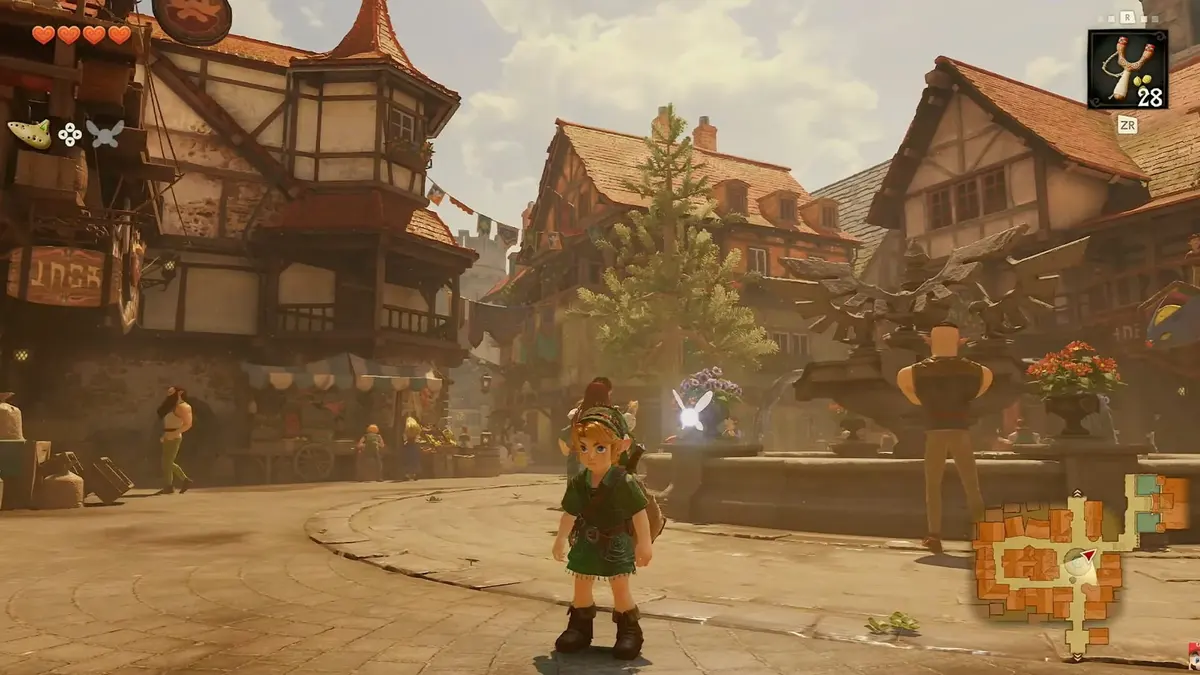
On September 8, Nintendo put an old limitation back on screen and called it preservation. The Legend of Zelda: Ocarina of Time Remake, shown during the Zelda 40th Anniversary Direct, keeps loading screens between certain major areas, including the transition from Kokiri Forest to Hyrule Field. Nintendo’s explanation was blunt: “This is something we intentionally kept to preserve the essence of the original game.”
I think that is the wrong call. The remake is scheduled for Nintendo Switch 2 on November 5, 2026, and its footage shows a game willing to modernize nearly every interaction surrounding those old boundaries. Nintendo has improved movement, expanded Castle Town into a freely explorable 3D space, added fully voiced cutscenes, allowed the day-night cycle to continue in town, and given Link modern traversal tools. Retaining a visible interruption between major zones turns one of those upgrades into a contradiction.
Nintendo has every right to preserve Ocarina of Time’s geography, pacing, and sense of entering distinct regions. It does not need to preserve the machinery that once made those regions possible on Nintendo 64 hardware.
Table of Contents (6)
An Old Boundary Is Not Sacred Design
Hyrule Field matters because it feels like a release. Kokiri Forest is enclosed, intimate, and controlled. The field opens the game outward. That contrast is part of Ocarina of Time’s identity, and Nintendo is correct to protect it. The problem is treating a loading screen as the source of that feeling.
The original transition worked because the player was moving from one kind of space into another. The music, scale, camera, horizon, and sudden freedom did the real work. The loading screen existed because the Nintendo 64 had to stop and prepare the next area. That limitation became familiar through repetition, but familiarity does not make it artistically essential.
A remake has an obligation to distinguish between original intent and original compromise. Ocarina of Time’s intent was never “make the player wait before Hyrule Field.” Its intent was to make Hyrule Field feel enormous after Kokiri Forest. Nintendo could preserve that contrast through a narrowed path, a shifting camera, a controlled reveal of the horizon, a change in music, or a brief traversal sequence. The old emotional beat survives without freezing the journey.
That distinction matters because remakes are at their best when they protect the effect, not every piece of old plumbing that once delivered it. If the feeling is “the world just got bigger,” there are a dozen modern ways to stage that feeling without reproducing the pause that an older machine required. A boundary can remain a boundary even if the handoff becomes invisible, or at least more elegant.
Calling the load “essence” avoids that distinction. It bundles a hardware constraint into the game’s creative DNA, then asks players to applaud restraint that serves neither the old design nor the new platform. Nintendo’s stated rationale is clear enough: preserve the essence of the original game. My issue is not that the company values essence. My issue is that it has identified the wrong part of the experience as essential.
The Rest of the Remake Makes the Pause Look Worse
Loading screens would be easier to accept in a strict visual restoration that left Ocarina of Time’s controls, camera, and structure untouched. That is not what Nintendo showed. Link can hold the A button to roll into a dash for faster travel. The camera can move freely around town. Castle Town is now a full 3D environment rather than a sequence of fixed views. Link can manually jump with a button press. The item interface allows faster swapping through a single-button system.
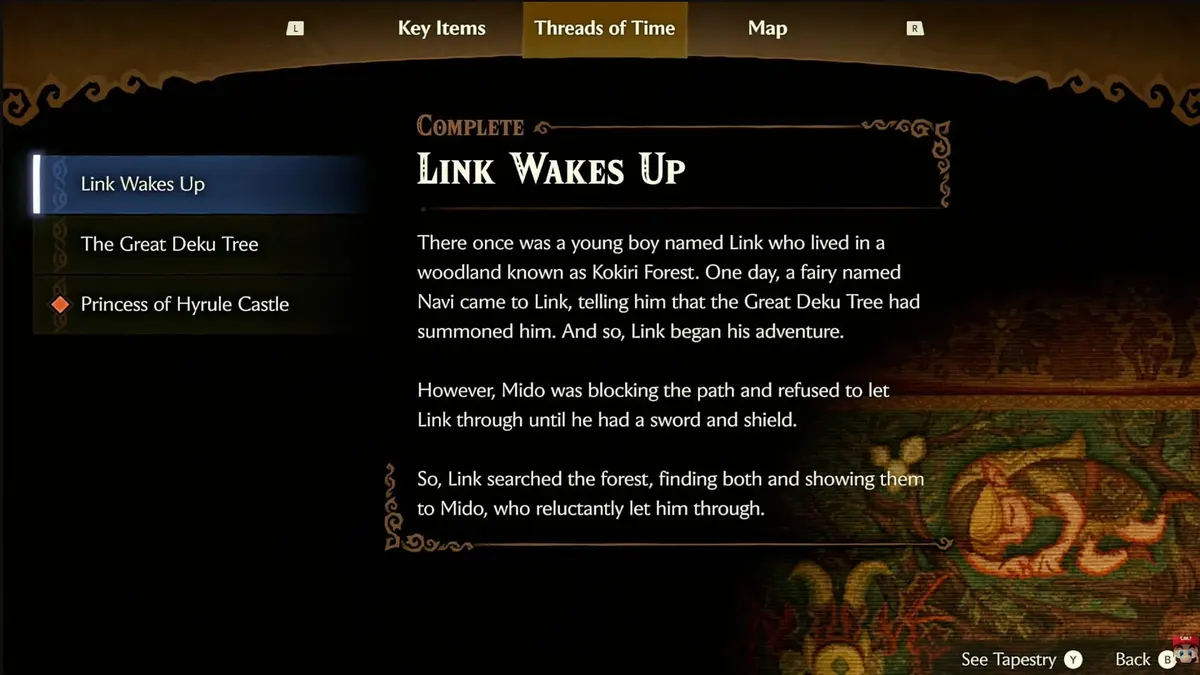
Those changes are useful because they remove friction. They respect what players expect from a remake released decades after the original. Nintendo is effectively saying that modern movement, modern camera control, clearer item management, a Thread of Time objective system, and voiced storytelling are compatible with Ocarina of Time’s identity. That judgment is correct. Thread of Time, in particular, is basically quest-log guidance: a cleaner way to show story progress and the next objective. No one would mistake that for Nintendo 64 purity, and that is fine. It is a smart modernization.
The loading-screen decision sits outside that logic. Faster movement makes every forced stop more conspicuous. A player who can dash across a region, move the camera freely, dive underwater after spotting something below, and use motion aiming for the slingshot will feel the break at a zone border more sharply than a player navigating the original Nintendo 64 controls ever did.
And the footage keeps piling on examples. The day-night cycle no longer stops in Castle Town, which means time keeps moving through places that were once structurally frozen. Certain events now happen during day or night in ways that make the world feel more alive. A tapestry gradually fills in as the adventure continues. Those are the touches of a remake trying to make Hyrule feel continuous, inhabited, and responsive. They are not the choices of a team afraid to touch the original.
Nintendo also added a Switch 2 microphone interaction that recognizes melodies Link has learned. The remake can listen for a player humming or singing and respond by playing the appropriate song, including an interaction that calls Link’s horse. The Sunong can change the time of day. That is a bold piece of platform-specific modernization. It makes the decision to preserve a loading screen feel less like fidelity and more like selective nostalgia.
That is the contradiction at the center of this remake. Nintendo wants the benefit of modern comfort in nearly every moment when the player is moving, aiming, navigating, or following the story. Then, at major regional borders, it suddenly wants the player to remember 1998. The result is not a coherent design philosophy. It is a smooth game with a few intentionally rough seams left exposed.
The Current Design Already Admits a Better Compromise
The footage establishes an important distinction: loading remains for major area transitions, while some smaller transitions such as entering shops happen without a loading screen. Nintendo has already decided that uninterrupted movement improves parts of Ocarina of Time. The question is why the same principle stops at the border between Kokiri Forest and Hyrule Field.
That split is important because it keeps the argument honest. This is not a case of loading screens everywhere, or a full remake built around constant interruption. It is more selective than that. Once you are inside an area, some micro-transitions appear much smoother than before. Shop entry is the obvious example. So the real debate is narrower, and more interesting: should major area boundaries still present a visible stop when so much else has been modernized?
That selective approach also confirms the issue is structural policy rather than a blanket commitment to historical accuracy. Nintendo wants certain regions to remain segmented. Fine. Segmentation can be valuable. The remake can still make Kokiri Forest, Hyrule Field, Castle Town, and other locations feel like authored spaces with their own rhythm and visual identity.
But segmentation does not require a plain loading interruption. A cinematic transition could preserve the sense of crossing into a new region while maintaining motion. A short camera-led passage could conceal the handoff between spaces. A visualized travel beat could retain the original cadence without presenting the player with a hard stop. Nintendo could also provide a transition setting for people who want the classic rhythm and people who want uninterrupted exploration.
No such option has been announced, and no patch plan has been published for altering the loading behavior. That leaves the current solution looking less like a carefully tuned compromise and more like the safest possible version of one. Keep the old boundary, keep the old interruption, and attach a reverent explanation to it.
The frustrating part is that Nintendo is already halfway to a stronger middle path. Seamless shop entry says the remake understands that constant loading is not sacred. Modern camera movement says the remake understands that older presentation rules can be replaced without destroying identity. The game has already opened the door. It just refuses to walk all the way through it.
“Pacing” Is a Real Defense, but It Does Not Win the Argument
The strongest case for Nintendo’s choice is stronger than simple nostalgia. Ocarina of Time is built around distinct spaces with clear emotional roles. Kokiri Forest is safety and childhood. Hyrule Field is possibility. Castle Town is civilization. A pause between areas can create a mental reset, preparing the player for the next place rather than allowing the whole map to blur into one continuous environment.
There is value in that rhythm. The original game did not need every area to behave as one giant uninterrupted landscape. Its world is memorable partly because locations have strong boundaries. Nintendo should defend those boundaries. If “preserve the essence” means protecting the cadence of entering a new place, that is a serious argument, not a joke.
Yet the loading screen itself remains a poor instrument for achieving that effect. In the footage shown, it reads less like dramatic staging and more like an administrative pause. It marks a handoff. It can create a beat of separation. But it is still a blunt tool compared with camera direction, music shifts, environmental funnels, or animation-led transitions that could create the same reset with more grace.
This matters most during repeated travel. A single trip from Kokiri Forest to Hyrule Field can carry nostalgia. Repeated crossings during exploration, side activities, quest progress, and return visits turn that nostalgia into routine friction. The more Nintendo encourages movement with faster dashing and broader 3D spaces, the more it asks players to notice the very interruption it could have avoided.
The remake’s own systems may amplify that problem. If players are moving around more freely, chasing time-sensitive events, using Sunong to shift the time of day, checking Thread of Time for the next destination, and revisiting areas with more fluid controls, then the border crossings become more frequent points of contrast. Not game-breaking contrast. Not catastrophic design failure. Just an old pause made unusually visible by the game surrounding it.
That is why I do not buy the idea that the loading screen itself is the dramatic moment. The dramatic moment is still the release into Hyrule Field, the tonal change, the widening horizon, the sense that the map has suddenly become larger than your immediate understanding of it. Preserve that. Stage that. Protect that. The blank interruption that used to sit next to it is not the same thing.
Accessibility Should Mean Reducing Unnecessary Friction
Predictable breaks can help players who benefit from clear transitions between environments. A distinct pause may offer a moment to orient themselves before a new space begins. That is a legitimate design consideration, and it fits Nintendo’s broader claim that zones have their own identity.
It still does not justify making the interruption mandatory. Players dealing with fatigue, attention limits, sensory sensitivity, or simple impatience benefit from fewer repeated barriers between actions. A remake with modern guidance tools such as Thread of Time already understands that clarity and continuity matter. Locking everyone into one transition behavior ignores the range of ways people move through a long adventure.
This is where an optional approach would have real value. Keep a classic presentation for players who want the old cadence. Offer a shorter or more stylized transition for players who want the least interruption possible. No confirmed accessibility option for loading transitions has been shown, and that absence makes Nintendo’s position feel narrower than it needs to be.
Accessibility is not only about adding more menus. Sometimes it is about asking whether an inherited bit of friction deserves to remain mandatory when the rest of the game is clearly trying to smooth the player’s path. In this case, the answer should be no.
Nintendo Is Protecting the Wrong Part of Ocarina of Time
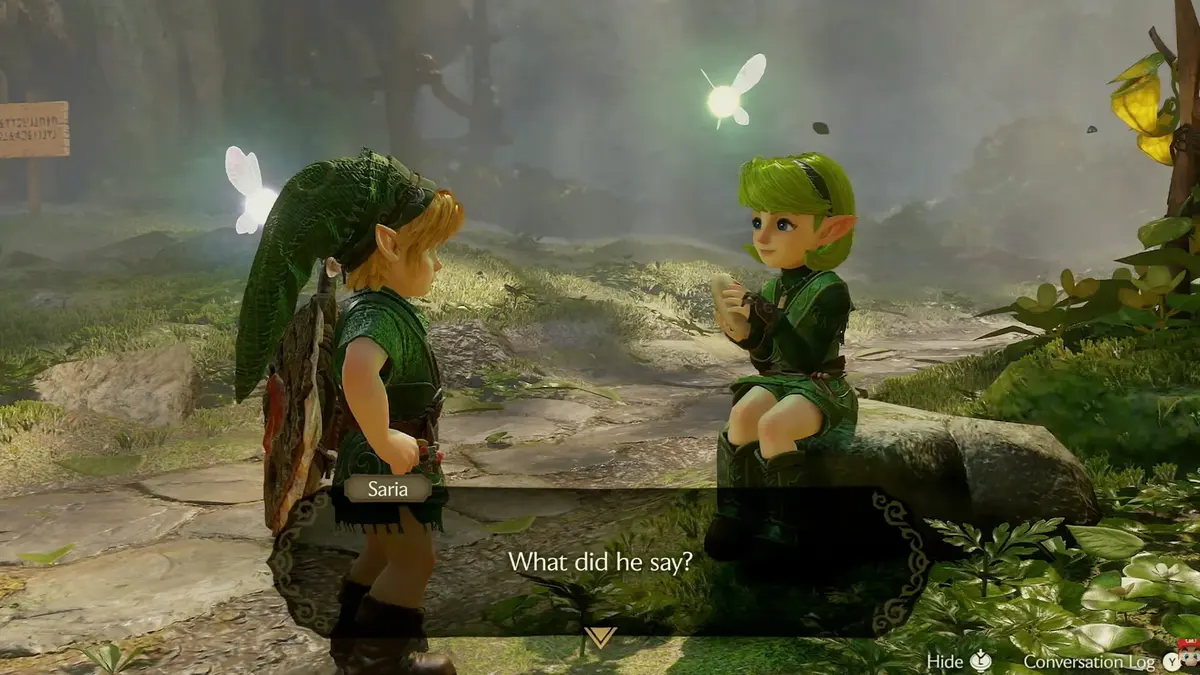
The Ocarina of Time Remake looks committed to preserving the parts that deserve preservation. Its world visuals are striking. Its day-night cycle continues through Castle Town. Its larger towns have space to breathe. Na’vi remains at Link’s side as a fairy companion, offering guidance about enemies such as Deku Babas. Familiar tools such as Deku Nuts and the slingshot remain meaningful within a more readable, modern interface.
Even the smaller details suggest thoughtful updating rather than museum-glass reverence. Deku Nuts are still practical stun items, but the interface presents equipment more cleanly. The slingshot still comes from a treasure chest and still solves classic Zelda problems, but aiming can use motion controls. These are not radical reinventions. They are respectful conveniences. They make the old design easier to inhabit without diluting what made it memorable.
That is the real essence: recognizable places, deliberate adventure pacing, iconic tools, clear emotional transitions, and a world built around discovery. Nintendo has already demonstrated that these ideas can survive updated controls, modern cameras, voice acting, objective guidance, motion controls, and new Switch 2 interactions.
What does not need preservation is the visible reminder of how the Nintendo 64 once had to carve the world into chunks. A remake should be allowed to remember the original without reenacting every technical pause that came with it. In fact, that is part of the remake’s job. It should separate memory from limitation, then keep the first thing while improving the second.
On November 5, the loading screen between Kokiri Forest and Hyrule Field will not make Ocarina of Time more faithful. It will make Nintendo’s otherwise ambitious modernization look selectively timid. Original Hyrule’s shape, mood, and deliberate pacing are worth carrying forward. The old machinery that stopped the journey is not.
FinalBoss // Gear
Level up your setup
01Retro consoleson Amazon→028BitDo controllerson Amazon→03Capture cards (Elgato & more)on Amazon→04Discounted game keyson Kinguin→Affiliate links · As an Amazon Associate, FinalBoss earns from qualifying purchases.
Want to Level Up Your Gaming?
Get access to exclusive strategies, hidden tips, and pro-level insights that we don't share publicly.
Ultimate Gaming Strategy Guide + Weekly Pro Tips