
My first hour with Octopath Traveler 0 was pure chaos: a festival gone wrong, strangers torching my hometown, and my freshly created protagonist being handed a god-tier ring like it was a cursed family heirloom nobody wanted. Within 30 minutes, Wishvale was ash, three terrifying weirdos had walked off with their own divine bling, and I’d already died in combat because I treated the first “real” encounter like a warm-up. It wasn’t.
I’ve finished both previous Octopath games and bounced off their postgame grinds, so I came into 0 expecting more of the same: strong combat, patchy writing, pretty dioramas. What I didn’t expect was how hard the new eight-person party system would sink its claws into me, or how often I’d think “I’m done for tonight” and then end up pushing one more boss because I’d just thought of a slightly more degenerate party setup to try.
After about 60 hours on Switch 2 (mostly docked, some handheld), I’m convinced Octopath Traveler 0 has the best combat in the series by a mile, wrapped around a story that swings from genuinely gripping to clumsy and uncomfortable. It’s a strange mix: bold mechanical evolution, conservative structure, mature themes that sometimes hit hard and sometimes feel stuck in the 90s. But when the game’s in its element—during those long, demanding boss fights where you’re frantically juggling eight characters—it’s fantastic.
Table of Contents (9)
Key Takeaways
- Combat is phenomenal: eight-character parties, front/back rows, and deep job tinkering make every big fight a puzzle.
- The new player-created protagonist and revenge hook start strong but get diluted by choppy, episodic pacing.
- Villains are memorable and genuinely nasty, though some “mature” topics are handled with all the nuance of a SNES-era script.
- Town-building in Wishvale is a surprisingly satisfying side loop that feeds directly into combat progression.
- Visuals lean muddy and washed-out, especially in handheld, and path actions (special dialogue prompts that yield bonuses) feel underused.
- Expect real grinding and stiff difficulty that encourages system mastery rather than mindless overleveling.
Starting in ashes: character creation, villains, and weird pacing
Octopath Traveler 0’s first big swing is the character creator. Instead of choosing from eight pre-written heroes, you build your own protagonist and they’re locked into your party for the whole game. The tools are barebones—hair, eyes, a few face options—but rendered in HD-2D pixel art it’s just enough to feel like “your” character. Mine ended up looking like a slightly too-clean mercenary who’d wandered into the wrong JRPG (Japanese role-playing game). I named him, picked a starting job, and then watched the game immediately destroy his life.
Wishvale, your hometown, is mid-celebration when Tytos and Auguste show up. They’re clearly bad news from the first frame: one’s a war hero with the kind of smile politicians and cult leaders share, the other is a theatrical dandy who feels like he walked straight off an opera poster. They raze the town, and when the smoke clears, an elder thrusts a divine ring onto your finger and dubs you the Ringbearer. Two more rings belong to those attackers, and a third sits with Lady Herminia—a noble whose name everyone spits like a curse.
These three villains anchor the early game. Herminia is decadence personified; Auguste is a twisted playwright who feeds on human suffering; Tytos is the whistle-clean soldier whose legend hides rot. Watching them weave cruelty and manipulation is compelling, and Auguste’s vampiric vibe gave me big FF6 energy. But some adult themes—especially around exploitation—land with the subtlety of a brick. There were moments where I thought, “This would not fly if it weren’t hiding behind pixels and bloom lighting.”
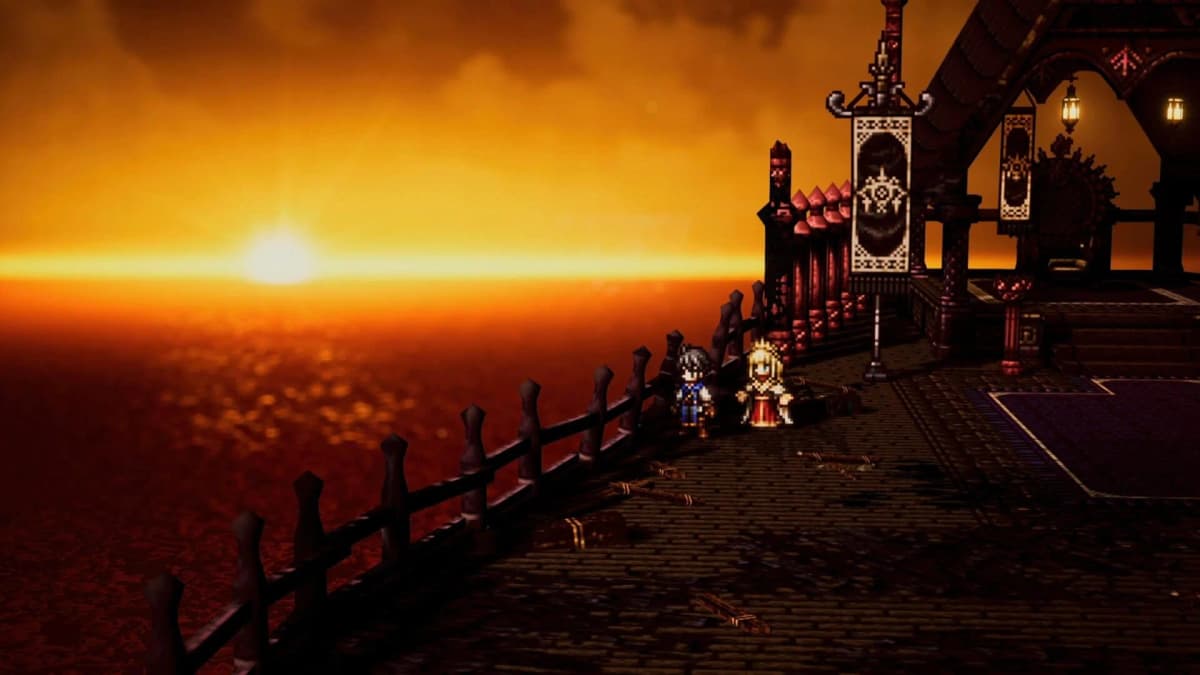
Structurally, 0 inherits the chapter swap system: each Master (Wealth, Fame, Power) has its own arc, and you zigzag between quests instead of clearing one story straight through. On paper, it keeps things fresh; in practice, you keep stepping away from cliffhangers to chase another villain, diluting the initial revenge drive. Only after avenging Wishvale and rebuilding half the town does the plot pivot into royal intrigue—and I’ll admit, I checked out emotionally until the combat hooks reeled me back in.
Eight seats, one stage: the best combat Octopath has ever had
Mechanically, this is where Octopath Traveler 0 absolutely sings. The core turn-based system—find enemy weaknesses, break their guard, then dish out boosted damage—remains intact. The twist: an eight-character party split into a front row (active hitters and tanks) and a back row (safe build-up zones for Battle Points, or BP). You can tag characters in or out on the fly, even mid-break, to chain extra nukes or clutch heals. Suddenly, every fight is a plate-spinning marathon.
Layered on that is a robust job system. Every recruitable face brings a fixed profession and two weapon types: Apothecaries heal, Dancers buff, Hunters shred armor, and so on. Your custom protagonist can learn any job’s skills, acting as the wild card. Bosses assume you’ll cover every element and weapon, so if you roll in with a four-man squad, expect curb-stomps. I remember one midgame boss who flipped resistances every turn—fixing my lineup into an eight-piece jigsaw puzzle turned that encounter from slog to triumph.

The difficulty curve is deliberate. Normal mobs keep you sharp; bosses will punish lazy setups. XP gains drop off if you simply overlevel, nudging you toward mastering buffs, debuffs, and row swapping instead of brute force. When you finally topple a boss with a perfectly timed, multi-character combo, it feels earned in a way most JRPG victories aren’t.
Grinding and Mastery Skills: the old-school grind, with a twist
Let’s not sugarcoat it: Octopath Traveler 0 is grind-heavy. I fought every random battle I stumbled into, cleared half the sidequests, and still had to farm levels before certain boss fights. Leveling feels as deliberate as SNES-era RPGs and will test you if you hate repetition.
The silver lining is Mastery Skills. Once you fully unlock a job’s skill list on a character, extra Job Points can buy “copies” of those skills for other characters. That’s when things go from “deep” to “spreadsheet territory.” I ended up with a back-row Dancer-slash-Cleric who healed, buffed, and lobbed a stolen Hunter skill for emergency armor breaks. Obsessive tinkerers will salivate; casual players can master just enough to clear the story and skip the math.
Rebuilding Wishvale: a cozy break between boss attempts
One of my favorite surprises in Octopath Traveler 0 has nothing to do with combat: it’s the town-building system. After the opening disaster, your crater of a hometown becomes a hub. Story-critical characters double as shopkeepers, and as you explore you can recruit merchants, artisans, even entertainers to move in.

Everything sits on a simple grid. You plop buildings down, shuffle them for adjacency bonuses, and use special materials from optional dungeons to unlock upgrades. Before long, Wishvale transforms from a smoking crater into a bustling outpost, complete with discounted gear, advanced crafting recipes, and bonus XP modifiers. It never feels like busywork—every new resident or shop level-up directly feeds into better loot, tougher gear, and more combat options.
Voice work is surprisingly solid—when it shows up
Octopath 0 opts for mostly silent-protagonist scenes, but major story beats come with full voice-over. The English cast is hit-or-miss: Tytos’s silky “hero” façade is spot-on, and Auguste’s actor nails that creepily theatrical cadence. Herminia’s performance sells her twisted aristocrat vibe, though some side NPCs never speak beyond grunts and yelps. A Japanese audio track is available, but it mirrors the same limited scope. It’s enough to heighten big moments without draining hours into endless chatter—though I wouldn’t have minded more of it.
Tech and Performance on Switch 2
On my Switch 2, Octopath Traveler 0 hovers around a locked 30 fps in docked mode, with only the most chaotic, particle-heavy boss fights dipping into the high 20s. Handheld drops can be more noticeable—enemies and effects get a touch blurrier—but it never feels unplayable. Load times are snappy, rarely stretching beyond a handful of seconds when fast-traveling or booting up, and I averaged around four hours battery life in handheld before needing to recharge. There’s no dedicated performance versus fidelity mode, but the HD-2D visuals hold up nicely on a big screen—just expect slightly muddier colors when you switch to portable.
How to approach the difficulty
- Rotate all eight characters: bosses assume you’ll cover every elemental and weapon weakness.
- Invest in Mastery Skills for key utilities (heals, buffs, armor breaks) on your custom hero.
- Grind selectively: focus on sidequests that reward rare crafting mats and XP spheres.
- Experiment with row swapping mid-battle—don’t keep a beaten-up tank in front just because you like their skill tree.
- Use Wishvale’s shop bonuses: discounted consumables and gear tweak builds without extra grind.
Conclusion
Octopath Traveler 0 is a weird, thrilling juxtaposition: combat so finely tuned it could be its own game, wrapped around a story that sometimes hits emotional highs and sometimes stumbles into dated territory. If you live for crunchy turn-based puzzles, eight-character shuffles, and old-school grinds, you’ll lose dozens of hours here. But if pacing hiccups and mature themes handled without finesse give you pause, be ready for an uneven ride.
Verdict: Recommended for combat obsessives, mixed feelings for story fans.
Score: 9/10
FinalBoss // Gear
Level up your setup
01Top-rated gaming headsetson Amazon→02High-refresh gaming monitorson Amazon→03Gaming chairson Amazon→04Discounted game keyson Kinguin→Affiliate links · As an Amazon Associate, FinalBoss earns from qualifying purchases.
Want to Level Up Your Gaming?
Get access to exclusive strategies, hidden tips, and pro-level insights that we don't share publicly.
Ultimate Reviews Strategy Guide + Weekly Pro Tips