
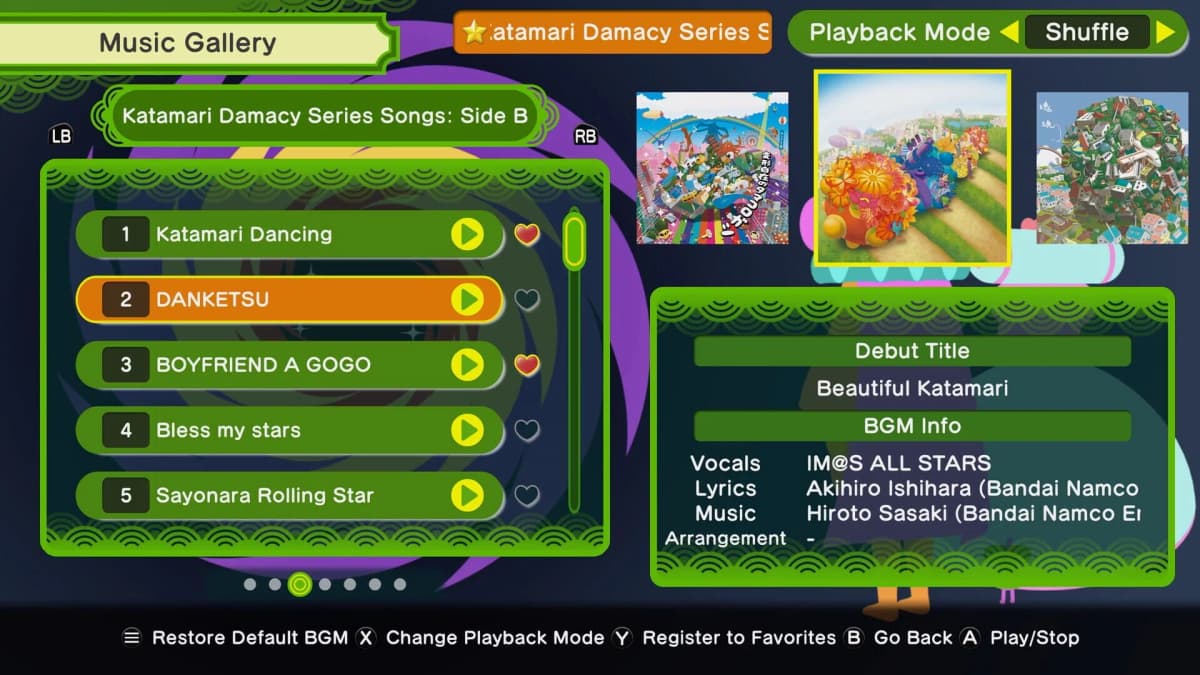
Once Upon a Katamari on Switch 2 raises the resolution and frame-rate ceilings, but its save, DLC, HDR, and multiplayer rules make it a less seamless upgrade than the platform label implies. The key decision is whether smoother play outweighs version-specific ownership limits.
Once Upon a Katamari arrives on Nintendo Switch 2 on October 8, 2026 with three stated technical ceilings: up to 4K output in TV mode, up to 1080p in handheld mode, and up to 60 frames per second. Those figures place it well ahead of the original Switch release, listed at 1080p docked, 720p portable, and 30 FPS.
The important qualifier is the word “up to.” These are maximum targets, not a promise that every stage, challenge, and activity will hold one fixed rendering profile. Challenge gameplay does not run in 4K. Buyers should treat the Switch 2 version as the higher-capability edition, rather than assume a locked 4K/60 mode across the entire game.
Table of Contents (11)
At-a-glance pre-order checklist, with the transfer limit first
If you only need the buying answer, start here. The most important practical rule is not the 4K number. It is the save-transfer rule. Once Upon a Katamari does let you move Switch save data to Switch 2, but only if no save data already exists on the Switch 2 destination. After that, the rest of the version split comes into focus fast: there is no cross-save, no HDR, and existing Switch DLC does not carry over to Switch 2.
| Feature | Original Nintendo Switch version | Nintendo Switch 2 version | What it means in practice |
|---|---|---|---|
| Save transfer to Switch 2 | Can transfer forward under a condition | Accepts a Switch save only if no Switch 2 save already exists | Transfer your existing save first. Do not create a casual Switch 2 file and expect to overwrite it later. |
| Save transfer back to Switch | Not applicable | Not supported | This is migration, not a two-way cloud-style sync. |
| Cross-save across platforms | Not supported | Not supported | Nintendo, PlayStation, Xbox, and Steam progress does not function as one shared save ecosystem. |
| Existing Switch DLC | Usable on Switch | Does not carry over | DLC ownership is tied to the version purchased, so upgrading hardware does not preserve add-on ownership. |
| TV-mode output | 1080p | Up to 3840×2160 | Switch 2 can output at 4K, though challenge gameplay may run below that ceiling. |
| Handheld output | 720p | Up to 1080p | Handheld play has a higher output ceiling on the newer hardware. |
| Frame-rate target | 30 FPS | Up to 60 FPS | The upgrade is most relevant to motion clarity and controller response during constant rolling. |
| HDR | Not supported | Not supported | A compatible HDR display does not unlock an HDR mode here. |
| Online compatibility | Can play online with Switch 2 owners | Can play online with Switch owners | Friends do not all need to upgrade hardware for Nintendo-platform online sessions. |
| Online player count | One to four players online | One to four players online | Multiplayer plans still revolve around Nintendo Switch Online rather than local same-system play. |
The Switch 2 version answers the performance question, not every ownership question
The basic platform decision is straightforward. The Switch 2 edition has a substantially higher visual and motion ceiling than the original Switch version. At the same time, it does not provide HDR, it does not maintain cross-platform saves, and existing Switch DLC cannot be used on Switch 2. Save migration also has a specific setup condition that can cause avoidable trouble if it is handled in the wrong order.
For a player buying fresh, the Switch 2 version is the cleaner technical choice. For someone who already owns the Switch version and paid DLC, the calculation is more complicated: the higher frame-rate target comes with a separate DLC entitlement and a one-way save-transfer process.
That is why the usual shorthand of “better version on better hardware” is incomplete here. There is free update-style support for the Switch release on Switch 2, and the newer hardware version clearly pushes the game further on output resolution and frame-rate targets. But the account and content rules do not behave like a single seamless library. If you are the kind of player who double-dips without thinking, this is one of the rare cases where slowing down for five minutes before purchase can save both progress headaches and an unnecessary DLC rebuy.
The cleanest way to read the offer is this: Switch 2 solves the performance-side question, not the ownership-side question. Those are separate buying decisions, and Bandai Namco has drawn the line very clearly.
Up to 4K is an output target, not a blanket image-quality guarantee
The 4K figure is useful, but it needs to be read precisely. The Switch 2 version supports up to 3840×2160 in TV mode. That establishes the maximum output resolution. It does not by itself disclose the internal rendering resolution, dynamic-resolution behaviour, or the exact image-quality settings used to reach that output.
That distinction matters because “4K” often gets turned into a whole stack of assumptions: native pixel rendering, one locked resolution, high-end reconstruction, and no performance tradeoffs. None of that comes bundled automatically with a maximum output figure. The known exception already tells you as much: challenge gameplay does not run in 4K.
So what can a buyer say with confidence? The Switch 2 release has the higher TV-mode ceiling, and that matters most for players who use the system on a television more than in handheld mode. A higher output target gives the game more headroom than the original Switch version’s 1080p docked spec. What it does not do is answer every question about how each activity reaches that result.
The same caution applies to any claim about how much “cleaner” or “sharper” the game will look in all circumstances. The official limits support a higher-capability presentation, but they do not establish one fixed image-quality profile for every map, challenge, and online session. That sounds like a technical nitpick until you remember how often platform marketing flattens all modes into one easy slogan.
Handheld mode is easier to interpret. The Switch 2 target is up to 1080p, compared with 720p on Switch. That is a direct increase in the maximum output target for portable play. It does not need extra storytelling around it. If you spend most of your time rolling on the couch or on the move, the newer hardware has the stronger handheld spec on paper.
The other useful limit to keep in mind is that Bandai Namco has not set out a single universal docked-versus-handheld performance chart for every game state. That means no responsible buyer should assume undocumented extras like separate graphics modes, perfectly consistent 4K output, or some hidden quality preset split. The stated ceilings are meaningful. They are also just ceilings.
The 60 FPS target is the substantial gameplay upgrade
The jump from 30 FPS to up to 60 FPS is more consequential than the resolution headline for active play. A 30 FPS game presents a new frame every 33.3 milliseconds. At 60 FPS, that interval falls to 16.7 milliseconds. The practical result is smoother visible motion and a tighter visual link between control input and the rolling ball’s response.
Katamari movement makes that upgrade more than a box bullet point. You are constantly turning, correcting your line, grazing props, scooping up clutter, and dealing with a ball that changes size as it absorbs more of the environment. At 30 FPS, that flow is readable but chunkier. A 60 FPS target reduces the size of each visual step in the motion.
This is the part of the Switch 2 spec sheet that should matter most to players who care about how the game feels rather than how the menu screenshots look. A brighter buzzword does not automatically beat a frame-rate improvement in a game built around rolling momentum. If you have ever bounced off a physics-heavy or movement-heavy game because it felt a touch sluggish, the 60 FPS target is the more practical reason to look at the new version.
There is still no basis for claiming a locked 60 FPS in every gameplay state. “Up to 60 FPS” describes a ceiling. It leaves open how the game behaves during effects-heavy moments, object-dense scenes, online sessions, or specific challenge setups. Until full performance analysis exists, the disciplined expectation is improved fluidity over the Switch version, rather than a guaranteed 60 FPS line across the entire game.
That restraint matters because frame-rate marketing has become elastic to the point of parody. A maximum target is useful information, but it is not frame-time data. Stable frame pacing matters as much as the headline number, and nothing in the launch details establishes exact frame-time consistency. So the smart read is not “this will definitely hold 60 everywhere.” It is “this version has a materially higher motion ceiling than the original Switch release.”
That is still a strong upgrade pitch. It is simply a stronger pitch when phrased honestly.
No HDR means the display upgrade has a firm boundary
HDR is not supported on Switch 2. This is a simple line item, but it deserves to be stated plainly because 4K output on newer hardware often leads people to assume a broader display upgrade than they are actually getting.
Resolution and HDR solve different problems. Resolution increases the amount of spatial detail the image can present. HDR, or high dynamic range, expands the range between darker and brighter parts of the picture and can preserve more colour volume on compatible displays. Once Upon a Katamari can benefit from the former through its higher output ceiling, but it does not offer the latter.
That does not make the Switch 2 version a bad presentation. It simply defines the limits of the upgrade. The visual story here is sharper output targets and a higher frame-rate target, not a full display-pipeline overhaul.
For existing Switch players, HDR’s absence is not a regression because the original version did not offer it either. For new buyers choosing between platforms, though, it is one more reason to separate the confirmed benefits from the imagined ones. If HDR support is one of your must-have features for a modern console release, this game is not trying to meet that demand.
That is also why the order of importance matters. First ask whether the higher frame-rate target and higher docked output target matter to you. Then ask whether the missing HDR, save rules, and DLC wall are acceptable tradeoffs. Reversing that order tends to muddy what the upgrade is actually offering.
Switch and Switch 2 players can share online sessions
Online multiplayer supports one to four players and requires a Nintendo Switch Online membership. The useful compatibility rule is favourable: Nintendo Switch and Nintendo Switch 2 owners can play online together.
That removes the most common platform-split problem. A household or friend group does not need to replace every original Switch before arranging an online session. Someone playing the 30 FPS Switch edition can still join players using the higher-target Switch 2 version, as long as everyone is inside Nintendo’s online ecosystem and has the required membership.
The limit matters just as much as the convenience. There is no broader cross-platform multiplayer bridge with PlayStation, Xbox, or Steam. The compatibility path runs between Switch and Switch 2 only. If your friend group is spread across console families and PC, do not read “online multiplayer” as a universal shared pool.
Local play is listed as one player, while online play is listed as one to four players. In plain terms, multiplayer planning revolves around online support rather than assuming a couch co-op fallback. If you were hoping the Switch 2 release would quietly open up a more flexible local setup, that is not what the published details describe.
This is also one of the few places where the ownership split is less annoying than expected. Bandai Namco is asking players to respect version boundaries for saves and DLC, but not forcing friend groups into an all-or-nothing hardware migration for online play. That will matter more than the 4K bullet point for plenty of households.
The broader game also includes a four-player competitive KatamariBall mode, which helps explain why the online compatibility note is so relevant. If multiplayer is part of your reason for buying, the good news is that the Nintendo-side player base is not split by generation.
Save transfer is a one-way migration with a destination-save restriction
The save-data policy is the main practical trap in this upgrade. Switch save data can transfer to Switch 2, but only if no save data is already present on the Switch 2 system. The sequence matters: establish the intended Switch save, transfer it to the new system, then begin using the Switch 2 version.
Creating a Switch 2 save before initiating the transfer can block the migration route because the destination is no longer empty. For a game where progress is tied to collection and completion, starting a new file casually before moving the existing one is an unnecessary risk.
The process is also one-way. A save moved from Switch to Switch 2 cannot transfer back to Switch. That has a clear consequence for shared-device arrangements or for players who bounce between hardware out of habit. Once you move active progression forward, the original Switch should be treated as the old endpoint rather than a fully interchangeable fallback system.
There is no cross-platform save compatibility across Nintendo, PlayStation, Xbox, and Steam. Moving from a Nintendo version to another platform, or maintaining one shared profile across several platforms, requires separate saves. The Switch-to-Switch 2 path is a controlled migration inside Nintendo’s ecosystem, not ongoing account-level synchronization.
- Safe order of operations: finish or keep the Switch save you want, transfer that save to Switch 2 while the destination has no existing save data, then start playing on Switch 2.
- Unsafe assumption: creating a quick Switch 2 file now and replacing it later with your old Switch progress.
- Practical consequence: decide which system will be your main home for progress before you start splitting time between both.
This is not a niche technicality. It is the part of the purchase most likely to annoy ordinary players, because it collides with normal behaviour. Plenty of people buy a new version, boot it up immediately, and sort out the old save later. Here, that impulse can create a needless problem. If you only remember one warning from this entire article, make it that one.
DLC does not follow the upgrade
Existing DLC purchased for the Nintendo Switch version cannot be used on Nintendo Switch 2. This is the sharpest ownership limitation in the package. Buying the new version does not bring previously purchased Switch add-ons along with it.
The Rolling LIVE Highlights DLC launches alongside the Switch 2 release on October 8, 2026. It adds 10 challenges, six new characters, 12 songs, and 18 accessories. It is available separately across Switch 2, Switch, PlayStation 5, Xbox Series X|S, and Steam, with the relevant version needing its own purchase.
That structure is routine from a storefront-accounting perspective and still irritating from a buyer perspective. The game can bridge online play between Switch generations, yet add-on ownership stops at the version boundary. Anyone who already bought Switch DLC should include the cost and inconvenience of repurchasing applicable content when comparing editions.
This is also where the free update-style support for the Switch version on Switch 2 needs to be read carefully. Yes, Bandai Namco is not walling off the newer hardware from the existing release. No, that does not mean all ownership rights blur together after the fact. The version line still matters for DLC, and it still matters enough to change the value equation for returning players.
If you are a newcomer, that is mostly background noise. If you are an existing owner with money already sunk into extras, it is central. The Switch 2 edition is technically the more appealing place to play, but technically better does not automatically mean economically cleaner.
Other buying details worth noticing before launch
A few smaller details are worth keeping in the same mental checklist because they affect how the package feels in real use. Switch 2 support includes mouse controls. That is not the headline feature, but it is a concrete platform-specific addition, and players who like experimental control options may care more about that than the jump from 1080p to 4K output.
There is also a physical-release wrinkle. The Switch 2 physical version has been described as a game-key card bundle that includes the DLC rather than a full cartridge-style content package. For buyers who prefer complete-on-cart ownership or who pay close attention to how much of a purchase lives on local media versus a download entitlement, that distinction matters. It does not make the release bad; it simply means “physical” does not automatically equal fully self-contained.
Storage is another minor but relevant note. Store metadata for the original Switch version lists the base game at 3.2 GB in one region and 3.3 GB in another. That should be read as region-dependent listing information rather than one universal size promise, but it does at least suggest this is not a massive install by current standards. If you are managing a crowded system storage setup, that is mildly reassuring without being a hard spec for every region and version.
The bigger point is that the buying case gets stronger when you separate what is confirmed from what is not. This release already has enough concrete details to make a smart decision without inventing extra certainty around undocumented performance behaviour.
- Confirmed: up to 4K output in TV mode on Switch 2, up to 1080p in handheld mode, up to 60 FPS, no HDR, Switch and Switch 2 online compatibility, no cross-platform saves, one-way save transfer from Switch to Switch 2 if the destination has no existing save, and Switch DLC not carrying over to Switch 2.
- Also confirmed: release date of October 8, 2026, the Rolling LIVE Highlights DLC launch alongside that version, mouse controls on Switch 2, and one-to-four-player online support.
- Not established by the launch details: exact real-world frame-time behaviour in every scene, one fixed resolution-and-frame-rate combination across all activities, or any broader cross-play arrangement beyond Switch and Switch 2.
That technical boundary-setting is not me being fussy for sport. It is the difference between useful hardware reporting and wish-casting. When a publisher says “up to,” your job as a buyer is to read the ceiling as a ceiling.
Buying checklist before pre-ordering
- Answer the save question first: if you already play on Switch, transfer that save to Switch 2 before any Switch 2 save data exists.
- Choose Switch 2 for the technical ceiling: its targets are up to 4K docked, up to 1080p handheld, and up to 60 FPS.
- Do not buy for HDR: the game does not support it on Switch 2.
- Keep online plans within Nintendo hardware: Switch and Switch 2 users can play together online, up to four players, with Nintendo Switch Online.
- Assume the transfer is permanent for practical purposes: Switch 2 saves cannot transfer back to the original Switch.
- Budget for DLC again if upgrading: existing Switch DLC cannot be used with the Switch 2 version, including version-specific purchases of Rolling LIVE Highlights.
- Check your format preference: if physical ownership details matter to you, note the game-key card bundle wrinkle before ordering.
Who should buy the Switch 2 version
The Switch 2 edition is the sensible purchase for newcomers with access to Nintendo’s new hardware. Its resolution and frame-rate targets are materially better than the original Switch profile, and its online compatibility preserves sessions with friends who have not upgraded.
It is also the better fit for players who place motion smoothness ahead of absolute certainty around 4K image quality. The 60 FPS ceiling has more direct gameplay value than a resolution label, particularly in a game built around continuous directional movement and rapidly changing object density.
Existing Switch owners should pause before treating it as a frictionless upgrade. The decisive questions are concrete: whether prior DLC needs to be repurchased, whether the save has been transferred before a Switch 2 file exists, and whether the player accepts a one-way move away from the original Switch version.
If those ownership limits do not bother you, the Switch 2 case is easy. It is the higher-capability version, and the 30-to-60 FPS jump is the standout reason to care. If those limits do bother you, the answer is not “never upgrade.” It is “upgrade deliberately.” Handle the save first, price in the DLC reality, and judge the new version for what it actually promises rather than what the platform label makes easy to assume.
FinalBoss // Gear
Level up your setup
01Best-selling Switch 2 gameson Amazon→02Switch 2 accessorieson Amazon→038BitDo controllerson Amazon→04Discounted game keyson Kinguin→Affiliate links · As an Amazon Associate, FinalBoss earns from qualifying purchases.
Want to Level Up Your Gaming?
Get access to exclusive strategies, hidden tips, and pro-level insights that we don't share publicly.
Ultimate Tech Strategy Guide + Weekly Pro Tips