
Table of Contents (8)
The First Time My SNES Lied To Me
I still remember the first time I booted Star Fox on an actual CRT, not an emulator, not a YouTube video, but a chunky grey SNES that was supposed to be a “16-bit” machine. I’d just been playing Super Mario World – perfect sprites, parallax backgrounds, cute little Koopas doing their looped animations. And then I slammed in this weird, heavy cartridge with a fat PCB and suddenly my console was spitting out real-time 3D polygons like it had no business doing.
Even as a kid, something about it felt… wrong in the best possible way. The framerate was janky, the polygons were naked and untextured, the horizon was a pixel soup of dithering and fog – and yet it felt like I’d accidentally time-travelled a hardware generation ahead. This was 1993. On the living room SNES. Not on some office PC running Doom, not in an arcade cabinet blasting Daytona USA into your retinas. On the same plastic box that ran Pilotwings and Super Ghouls ’n Ghosts.
So when people throw out that lazy line that “Nintendo is always behind the times” – too scared of power, too slow to adopt new tech – I always come back to Star Fox. Because that little grey cart, stuffed with the Super FX chip, is Nintendo doing the exact opposite of playing it safe. It’s a full-blown hardware experiment shoved into retail, and it helped drag the company kicking and screaming into 3D long before Super Mario 64 showed up to take all the credit.
Star Fox Wasn’t Just a Game, It Was a Hardware Hack
Here’s the bit that still blows my mind: Star Fox isn’t really an “SNES game” in the way we normally use that phrase. It’s an SNES-plus-one. Every cartridge shipped with a Super FX coprocessor baked into the board, effectively turning your console into a Frankenstein hybrid every time you pressed power.
The base SNES simply couldn’t push those 3D shapes at playable speeds. The Super FX (the original GSU-1 variant in Star Fox) was a RISC chip designed specifically to chew through geometry and effects. Contemporary technical docs put it at up to around 40x faster at certain 3D math operations than the SNES CPU alone. That’s not some tiny optimization – that’s the difference between “laughable slideshow” and “barely holding 20 frames per second, but somehow still exhilarating”.
Within brutal constraints, too. The first Super FX chips were capped to a 192-line display height, working within the SNES’s awkward video modes and VRAM transfer limits. You’re talking roughly a million operations per frame at ~20 FPS, varnished over with clever design tricks: on-rails camera, tight corridors, minimal draw distance, enemy waves choreographed like a shmup.
That’s why Star Fox felt so immediate despite all the technical smoke and mirrors. Nintendo cleverly framed it as a third-person, on-rails shooter instead of a free-roaming sim. You had full movement inside a box, but that box let the hardware breathe. It’s the exact same kind of “design bent around hardware” philosophy that later made the Game Boy Link Cable the beating heart of Pokémon – turn a limitation into the whole point.
Argonaut + Nintendo: The Unlikely Fusion That Made It Happen
Another thing the modern myth gets wrong: this wasn’t Nintendo sitting alone in Kyoto dreaming this stuff up. Star Fox exists because a bunch of British hardware nerds basically turned up at Nintendo’s door and said, “We can make your boxes do things your own engineers say they can’t.”
Argonaut Software – a tiny team in North West London – had already cut their teeth on 3D with Starglider on Atari and Amiga. They impressed Nintendo by doing the very thing console makers traditionally hate: breaking their protections. They reverse-engineered the Game Boy well enough to pitch 3D tech and prove they understood Nintendo’s hardware at a frighteningly deep level. Instead of suing them into hell, Nintendo did something radically un-Nintendo by today’s risk-averse standards: it hired them.
The division of labour on Star Fox was clear and clever. Argonaut handled the technology and low-level programming – building the Super FX chip, writing the engines – while Nintendo, with Shigeru Miyamoto producing, layered story, character, and that meticulous pacing the company is famous for.
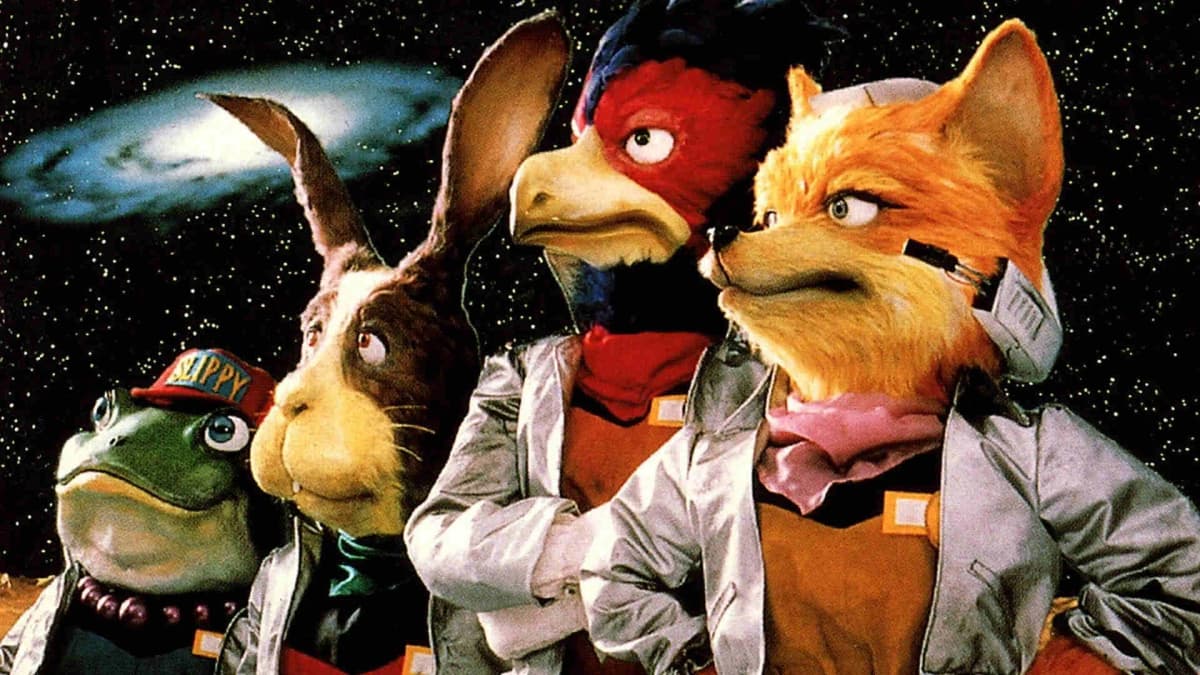
Miyamoto, being Miyamoto, refused to settle for some sterile sci-fi flight sim. He pulled from Japanese folklore, from a shrine near Nintendo’s headquarters, to turn the cast into anthropomorphic animals – Fox, Falco, Peppy, Slippy – wrapping Western polygonal tech in a uniquely Japanese sensibility. The inspirations are obvious (Star Wars, Thunderbirds, Star Trek), but Star Fox doesn’t feel like a copy of any of them. It’s too weird, too earnest, too… Nintendo.
This East–West hybrid is what makes Star Fox so interesting historically. It’s not “Nintendo was always conservative and eventually dipped a toe into 3D when Sony forced their hand.” It’s Nintendo betting on a bunch of outsiders, letting them solder weird chips into cartridges, and releasing it under one of their biggest brand umbrellas. That’s not caution. That’s a calculated hardware gamble.
That First Boss Fight: 16-Bit Terror, 32-Bit Ambition
Look, I’m not going to pretend Star Fox plays as smoothly in 2026 as it did in 1993. The framerate chugs, the input latency is real, and after you’ve seen what modern 3D shooters can do, the illusion cracks wide open. But if you actually sit down with it on original hardware and let your brain adjust, there’s a moment that still absolutely lands.
The first major boss fight kicks in, alarms blare, the soundtrack flips from heroic swagger to this ominous, pulsing march. The music shift is pure Sega arcade melodrama, but running on a console that’s very obviously straining to keep the entire scene from collapsing. The sense of scale is completely out of step with what the SNES “should” be doing. This isn’t just a cute Mode 7 trick like Pilotwings. It feels like a proto-console version of the PC and arcade stuff you only saw in magazines.
That’s the moment that sold me on the idea that 3D wasn’t just some PC sideshow. It could work in the living room, with a pad, on the couch. It made the shift to Super Mario 64 later feel less like a lightning strike and more like a logical next step.
The Super FX Legacy Is Way Bigger Than Eight Weird Carts
On paper, the Super FX line is almost a failure. Only eight official games ever shipped with some variant of the chip. The sequel silicon, Super FX2 (GSU-2), arrived around 1995 and powered games like Doom, Winter Gold, and Yoshi’s Island (yes, that gorgeous morphing, scaling insanity is riding the same family of chip), plus the fully finished but shelved-for-decades Star Fox 2.
Cartridge cost, manufacturing complexity, and the simple fact that Nintendo had already set its sights on the Nintendo 64 meant Super FX never became the mainstream 3D standard for SNES. You got curios like Stunt Race FX, some very scrappy takes on 3D racing, and then the hardware experiment was effectively over.
If you judge Super FX purely by retail catalog, yeah, it looks like a weird tangent. But that’s missing what it really was: an R&D stepping stone disguised as a product line. Argonaut’s work proved a couple of vital points for Nintendo’s internal calculus:
- Real-time 3D on a home console wasn’t a pipe dream; it was just insanely expensive and hard.
- Players would tolerate rough performance if the design wrapped around the limitations elegantly.
- The company needed native 3D hardware in its next machine if it wanted to keep up.
Miyamoto has said in various interviews that the early 3D experiments on SNES – Star Fox specifically – helped shape Nintendo’s approach going into N64 and Super Mario 64. We don’t have a single smoking-gun document that says, “Because of Star Fox, we greenlit Mario in 3D,” and I’m not going to pretend we do. But look at the timing and the talent flow. Some of the key Argonaut developers were hired by Nintendo. Dylan Cuthbert went on to work in Japan and later founded Q-Games, which kept nudging at experimental Nintendo hardware for years.
So no, Star Fox didn’t “create” Super Mario 64. But it did stress-test the company’s appetite for console 3D, expose all the pain points, and give their designers real data instead of theory. That matters. That accelerates decisions. It’s the same way the humble Game Boy Link Cable accidentally laid the rails for Pokémon – a cheap little cable forcing an entire design philosophy built around trading and battling, which then becomes a multibillion-dollar juggernaut.
Here’s the Conflict: Star Fox Aged Badly, The Idea Didn’t
Here’s where I have to be honest: if you hand someone Star Fox in 2026 with zero context, there’s a real chance they bounce off it in five minutes. The frame rate is rough. The draw distance is a joke compared to even early N64. You feel the CPU choking every time too many enemies pop in. Some of the Super FX showcase levels are more impressive on a technical level than they are actually fun to play by modern standards.
And Nintendo clearly knew, even then, that this wasn’t a long-term solution. You don’t build a dynasty on silicon you have to wedge into every cart like a tiny, pricey parasite. You also don’t base your whole third-party ecosystem on tech that only your in-house R&D and one partnered studio can really exploit. So Super FX was always going to be a short-lived bridge rather than a destination.
The part that stings is how quickly Nintendo seemed willing to bury some of that work. Star Fox 2 was completed for Super FX2 and then quietly shelved as the company pivoted toward the N64, only emerging decades later via the SNES Classic and then other retro re-releases. As a fan, that’s maddening – the most advanced expression of the tech, with true all-range 3D movement and surprisingly forward-thinking design, locked away because it might “confuse the brand” next to Lylat Wars (Star Fox 64).
And let’s be blunt: the Star Fox franchise hasn’t exactly enjoyed a glorious 3D trajectory since. You’ve got Star Fox 64, which refined the template brilliantly. Then a long line of half-measures, reboots, and identity crises – Adventures, Assault, the Wii U’s motion-control headache that was Star Fox Zero. For a series that literally started life as a technology showcase, it’s mostly been chasing nostalgia and retelling the same Lylat War instead of leading the charge into the next weird idea.
Why This Matters Now, When Everyone’s Obsessed With 4K and Ray Tracing
So why drag all this up now? Because the industry’s memory is depressingly short. Right now there’s renewed chatter about Star Fox again – rumors of a new entry circling the inevitable “Switch 2”, Fox McCloud being teased for cameos in broader Nintendo media, and retro hardware getting more love than it has in years. We’re suddenly very keen to celebrate how “timeless” these games are, while quietly sanding off the experimental wobble that made them matter in the first place.
Meanwhile, modern Nintendo is in a weird spot. They’ll take massive platform-level swings – the Wii’s motion controls, the Switch’s hybrid design – but when it comes to raw bleeding-edge tech, they’re happy to sit out the arms race. No native ray tracing, no 120 FPS ambitions, none of the HDR bravado you see from Sony and Microsoft. That’s fine, to a point. I don’t need Mario at 8K with realtime caustics.
But the Star Fox era proves something important: Nintendo is at its best when it’s not just “behind” or “ahead” but sideways – doing weird, risky things with hardware that force new design. The Super FX chip, like the Link Cable, is exactly that kind of gamble. It wasn’t about chasing specs for marketing bullet points. It was about doing one impossible-seeming thing, even if the rest of the package creaked under the strain.
That’s what I want from any new Star Fox on a next-gen Switch. Not just another HD remaster of Corneria with nicer explosions, but a game that once again bends the hardware in uncomfortable ways. Maybe that’s wild large-scale space battles streaming seamless systems. Maybe it’s VR-style cockpit immersion without the headset. Maybe it’s something I’m too boring to imagine – but it needs to be more than just 4K rails-shooter comfort food.
Calling BS on the “Nintendo Is Always Behind” Myth
This is where I get a bit tired of the discourse. The storytelling around Nintendo has flattened into this predictable script: “They’re charming but underpowered. Late to online. Late to 4K. Late to everything.” And yeah, there’s truth in parts of that. Their online infrastructure is a joke compared to their competitors. Their hardware power has been a generation behind for years.
But to pretend that Nintendo has always been some timid, turtle-paced follower is historically illiterate. Star Fox and the Super FX chip are Exhibit A. Who else, in the early ’90s, was willing to bolt a whole extra processor into standard retail cartridges to do something their console was never specced for? Who else partnered with a tiny foreign studio, let them co-design the guts of that chip, and then handed one of their most famous directors to shepherd the result?
Was it perfect? Absolutely not. The game’s performance is rough, the tech path was a dead end, and the franchise has since lost its way. But that’s what real experimentation looks like. It’s messy, it’s wasteful, and sometimes the thing that actually ships is less important than the lessons it burns into the company’s brain.
FinalBoss // Gear
Level up your setup
01Best-selling Switch 2 gameson Amazon→02Switch 2 accessorieson Amazon→038BitDo controllerson Amazon→04Discounted game keyson Kinguin→Affiliate links · As an Amazon Associate, FinalBoss earns from qualifying purchases.
Want to Level Up Your Gaming?
Get access to exclusive strategies, hidden tips, and pro-level insights that we don't share publicly.
Ultimate Gaming Strategy Guide + Weekly Pro Tips