
Table of Contents (9)
The night Phantasy Star Online made me fear the “Revive” button
I still remember the exact sound my Dreamcast made when it disconnected that night. That little whine from the modem, the music cutting out, my heart dropping through the floor. Somewhere on a virtual raft, in the middle of a boss fight against De Rol Le, my levelled-to-hell Ranger was lying face down… and my best weapon was lying next to his corpse, completely up for grabs.
If you never played Phantasy Star Online on Dreamcast, that probably sounds dramatic. But for those of us who did, you already know: dying in PSO wasn’t just “you lost some XP” or “you’ll respawn at the bonfire”. Death meant you dropped all your money and the weapon you had equipped. In an online party. With three other players who could pick it up and keep it. Forever.
Everyone talks about Dark Souls like it invented “brutal punishment” in games. Honestly? PSO on Dreamcast was crueller. FromSoftware makes you lose currency. PSO made you lose your identity – the actual weapon you’d farmed for days. And whether you got it back didn’t depend on your skill. It depended on whether the strangers you were playing with decided to be decent human beings.
Dreamcast, dial‑up, and the first time I trusted strangers
For context, this was early 2000s console gaming. Sega was bowing out of the hardware war, the PlayStation 2 was steamrolling everything, and the Dreamcast felt like a doomed spaceship full of weird, brilliant ideas. I was a console kid. No EverQuest, no Ultima Online, no LAN parties. Online gaming, for me, was “maybe some Quake III on Dreamcast if the line didn’t drop”.
Then Phantasy Star Online landed, and suddenly my poor 33k modem was screaming every night. Four‑player co‑op dungeon runs. Lobbies full of Japanese, American, European players bouncing symbol chats and canned phrases off each other. Auto‑translation that barely worked, swear filters everyone immediately broke, and a vibe that felt closer to being in a strange, noisy arcade than a living room.
On paper, PSO was simple: pick a class (Hunter, Ranger, Force), pick a race, drop onto the planet Ragol with up to three other players, and clear rooms of monsters until the boss appears. Underneath that, though, was one design decision that completely redefined what “online play” meant to me: the death penalty. It’s not just that it was harsh. It’s that it was socially harsh.
Death in PSO was nastier than anything in Dark Souls
Here’s how it worked. You’re chopping through enemies, hands sweating, inventory full of gear and Meseta. You misjudge a dragon’s jump, or you eat one too many purple projectiles from De Rol Le, and your HP hits zero. You don’t just slump and respawn in some safe room. Your character’s body hits the ground, and:
- You drop all the money you’re carrying.
- You drop the weapon you have equipped.
- All of it stays on the ground, in the instance, like loot.
If you’re alone offline, fine. You slog back through the level, pick up your stuff, and curse your own stupidity. Online, though? Your party can see that glowing weapon on the ground the second you die. They can click it before anyone even thinks about casting a revive spell. Nothing in the system forces them to give it back.
Compare that to Dark Souls. When you die, your souls or runes hit the floor, sure, but they’re effectively tagged: only you can reclaim them. No one’s swooping in from another dimension to swipe your +10 weapon. The punishment is harsh but contained. PSO’s penalty was chaotic. It turned every death into a trust exercise. Did you really believe these three randoms from who‑knows‑where were going to give back the Spread Needle you’d been hunting for weeks?
How a cruel system created real trust
This is the bit modern design completely underestimates: harsh punishment doesn’t just create “difficulty”. It creates dependency. In PSO, you couldn’t just treat other players as moving damage numbers. You had to look at them – their class, gear, the way they behaved in the lobby – and ask yourself, “If I die, is this person going to screw me?”
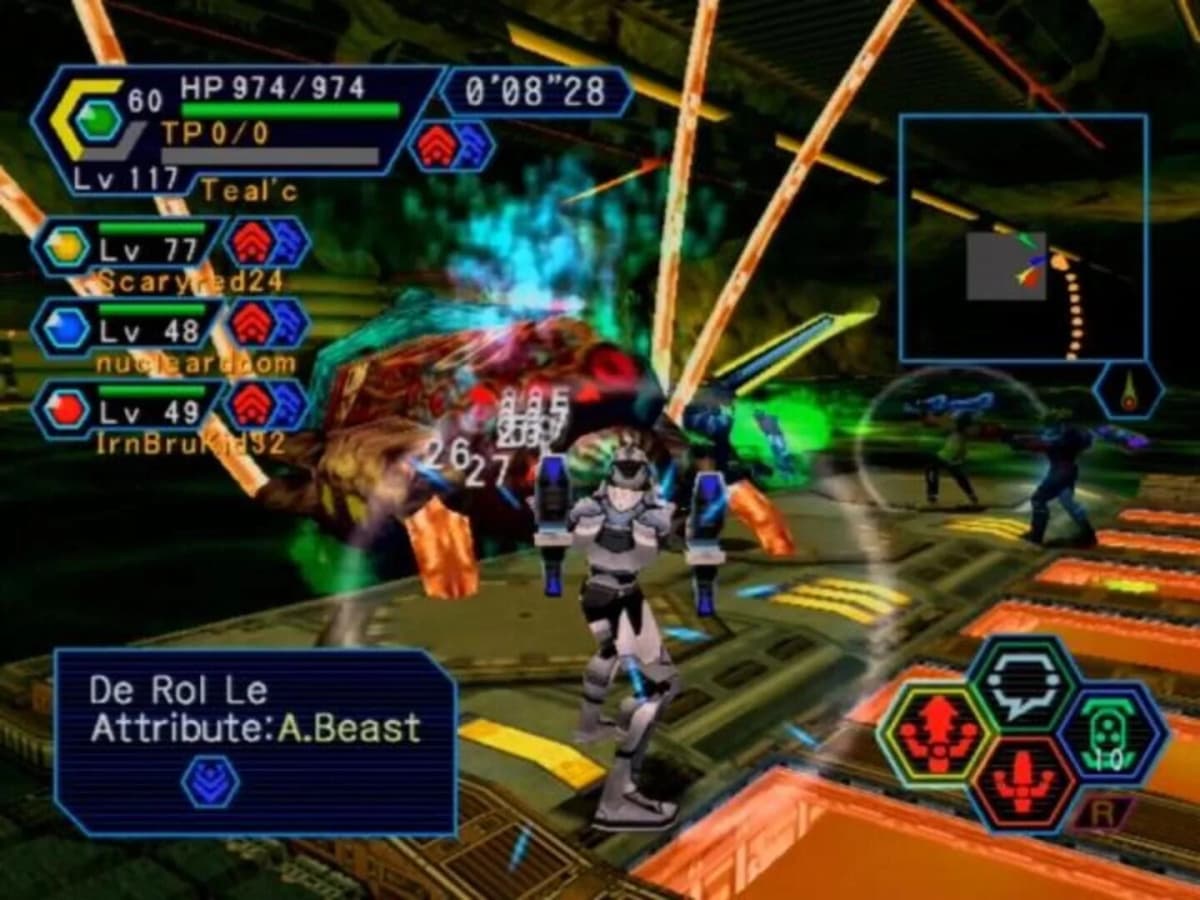
That’s why the lobby phase in PSO mattered. You didn’t instantly mash “Start Mission”. You chilled. You spammed symbol chats. You typed clumsily on the chunky Dreamcast keyboard. You checked levels, traded low‑tier gear, flexed your Mag like a proud parent, and tried to sense who was cool and who felt like a walking red flag.
One of the purest gestures in that game was when a stranger handed you a Scape Doll before a run. For anyone who missed it: a Scape Doll is a consumable that auto‑revives you once when you die. Giving one away was like saying, “I care whether you make it back alive, and I care enough to pay for it.” In a world where a single death could cost you your main weapon, that tiny pixelated doll meant more than any emote or friend request.
The betrayals hurt more than any boss
Of course, systems like this bring out the worst in people as well as the best. I had nights where PSO felt less like a co‑op RPG and more like a psychological thriller.
There was one Dragon fight in particular that still winds me up. We’d been farming the Forest for hours. I’d finally pulled a rare rifle I was obsessed with, tuned my build around it, and we decided to do “one last run” before calling it. The Dragon does its burrow‑and‑jump routine, the frame rate wobbles a bit over dial‑up, I mistime a roll, and I’m paste on the floor. My gun hits the dirt next to me. Before the Force in our party even moves toward my body, the Hunter sprints over, snatches the weapon, and literally types “lol” in chat. Then he finishes the boss and disconnects.
That was it. No report button. No support ticket. No rollback. That gun was just gone. The anger I felt that night was unreal. Not at the game, but at the person on the other end of that connection. Someone had willingly spent an hour with us, joked in the lobby, grabbed heals when he needed them, then cashed out the second the system let him. It was vile. It was also, in a horrible way, proof that the system meant something. Losing that rifle stung because the game had convinced me these other players mattered.
When a stranger saved my Spread Needle (and my faith in people)
The flip side is that PSO also gave me some of the most unexpectedly wholesome moments I’ve ever had in a game.
One night, I finally got my hands on a Spread Needle – the holy grail for my trigger‑happy Ranger brain. We jump into a high‑level Ruins run, everything’s going fine until it very suddenly isn’t. Too many enemies, too much knockback, and I get chain‑stunned to death. I see the death animation. I see the weapon pop off my character. Then I see another player – a guy going by a simple, forgettable name – sprint over and grab it before anything else in the room moves.
My stomach dropped. This was it again. Another hour, another rare gone. Except this time, the Force in the party revives me, we clear the room, and that same player walks over and calmly drops the Spread Needle at my feet. No big speech. No bragging. Just a quick “np” in chat and back to business.
I cannot overstate how much that meant at the time. This wasn’t “the game gives everyone personal loot, of course he couldn’t steal it”. This was a conscious choice not to take advantage of a broken, abusable system. PSO forced people into moral decisions way more interesting than any dialogue tree: when the game gives you the chance to be a bastard, do you take it?
Modern MMOs feel safer… and weirdly hollow
Sega didn’t keep that brutality forever. By the time Phantasy Star Online Episode I & II rolled around on GameCube and Xbox, dying “only” cost you your Meseta. In PSO2 and especially New Genesis, the penalty is basically cosmetic. You die, you get up, you keep going. It’s efficient, it’s friendly, it respects your time – and it stripped out the very mechanic that made me bond with strangers in the first place.
I understand why it happened. Free‑to‑play MMOs and live‑service games can’t afford to scare people away with vicious loss mechanics. Players bounce off hard stuff instantly now; they’re spoiled for choice. But somewhere along the way, “respecting the player” turned into wrapping them in bubble wrap. Death became a slap on the wrist instead of a punch to the gut.
The result is that modern online games are full of people, but weirdly short on trust. You queue up. You match with five, nine, twenty‑three others. You clear content. If someone disconnects right before the end, who cares? Nobody’s really at risk. You don’t need to look at anyone and think, “Can I rely on you when it actually matters?” Because, mechanically, it almost never actually matters.
“Toxicity” vs stakes: the nuance designers keep dodging
Now, I’m not blind to the other side of this. That Hunter who robbed me back in the Dragon fight? That’s toxicity, plain and simple. Full‑loot style penalties invite awful behaviour. If PSO launched today with the same design, it would be a social media bonfire within 24 hours. Clips of players stealing gear would be everywhere, and Sega would hotfix the hell out of it.
But here’s the thing: you don’t have to go all the way to “steal a guy’s main weapon” to put real stakes into co‑op. A scaled‑down version of PSO’s death penalty could still do the job. Shared repair bills. Temporary debuffs that only team support skills can clear. Optional “hardcore” instances where any dropped loot must be assigned back to its original owner, but everyone still feels the fear for a second when it hits the floor.
Instead, most studios just sand everything down. They see bad behaviour and remove the system that enabled anything at all to matter. That’s the part that annoys me. The answer to “some people are jerks” isn’t to turn every MMO into a theme park ride where nothing can go wrong. It’s to design around the tension, not erase it.
What PSO really taught me about “trust”
When I think back on Phantasy Star Online now, I don’t primarily remember the grind, or the mag raising, or even the bosses. I remember staring at my CRT at 2 AM, on a noisy phone line my parents were definitely going to yell about, weighing up whether to press “Join” on a lobby full of strangers. I remember that little knot in my stomach as I equipped my favourite gun before a Ruins run, knowing a single mistake could put it in someone else’s backpack.
PSO taught me “trust” in a way no co‑op game has since, because the game actually asked me to trust people. It put something valuable on the line and stepped back. Sometimes I got burned. Sometimes I got blindsided by generosity. Both outcomes felt real in a way “+5% repair cost” never will.
We romanticise difficulty all the time now. “This game is the Dark Souls of X.” Cool. But difficulty without meaningful loss is just choreography. What PSO nailed – and what almost everyone else has run away from – is the idea that loss can be shared. That your failure can hurt someone else, and their choice can save or screw you. That’s what made that little Dreamcast MMO revolutionary for me. Not the netcode, not the lobby music. The simple, terrifying moment when your body hits the ground, your weapon hits the floor, and you realise your fate is in someone else’s hands.
FinalBoss // Gear
Level up your setup
01Top-rated gaming headsetson Amazon→02High-refresh gaming monitorson Amazon→03Gaming chairson Amazon→04Discounted game keyson Kinguin→Affiliate links · As an Amazon Associate, FinalBoss earns from qualifying purchases.
Want to Level Up Your Gaming?
Get access to exclusive strategies, hidden tips, and pro-level insights that we don't share publicly.
Ultimate Gaming Strategy Guide + Weekly Pro Tips