
The moment Pokémon Pokopia really got under my skin wasn’t some big story twist. It was when I walked out of that starting cave, expecting the usual cozy tutorial area, and instead saw Kanto’s corpse.
Red brick roads, cracked and half-buried. A Pokémon Center, gutted and silent, with empty foundation plots beside it like gravestones. Paths I know by muscle memory – north, east, west – choked off by rubble. An elevated road to the east that should’ve been full of cyclists and NPCs is just… dead air and rust. I’m a Ditto pretending to be human, standing in what’s basically Fuchsia City’s ghost, and it hits me: “Oh. They killed Kanto.”
I’ve marched through Kanto so many times that usually, when The Pokémon Company says “We’re going back to Gen 1!”, I roll my eyes. I’ve seen the Game Boy pixels, the GBA repaint, the 3D remake, the Let’s Go nostalgia tour. I’ve seen the Pikachu merch, the Charizard shrines, the endless “You remember this, right?” callbacks. I’m supposed to clap like a trained Psyduck every time they dust off Vermilion City again.
But Pokopia is the first time in years that returning to Kanto didn’t feel like a marketing strategy. It felt like grief. It felt like coming home after the hurricane, realizing the house is still technically there, but the life you had in it is gone. And that’s exactly why this game works, and why I’m planting my flag with this opinion: Pokémon Pokopia is the first Gen 1 nostalgia play in a long time that isn’t bullshit. It makes Kanto hurt a little, and that’s what finally makes it meaningful.
Table of Contents (7)
I’m tired of nostalgia that just points at itself
Before Pokopia, I was basically immune to Kanto fanservice. I grew up there – late-’90s cartridge in a beat-up Game Boy, staring at that washed-out screen in the back of my parents’ car. I know that map better than some real-world cities I’ve lived in. But after decades of “Hey remember this route?” and “Look, it’s the S.S. Anne again!”, the magic wore off.
Most nostalgia in big franchises is just set dressing. A poster on the wall. A line of dialogue referencing “that time in Cerulean.” A faithful recreation of some 8-bit town layout in high-res 3D. It feels like walking through a museum curated by a brand team, not revisiting a place that meant something to you.
This is the same reason stuff like The Super Mario Bros. Movie bounced off me. Yeah, I get it, that’s World 1-1. Nice. And? The Easter eggs don’t say anything about Mario, or about me, or about what those games meant to a kid trying to escape his shitty week of school. They’re trivia answers. They’re decorative. It’s nostalgia as wallpaper.
Pokémon has leaned on that crutch hard. Every gen, there’s a new batch of “Guess who’s back!” Kanto favorites, and I’m supposed to cheer when Krabby shows up in HD for the thousandth time. And look, I love Gengar and the Eeveelutions as much as anyone – I’m not above squealing when they appear – but after a while it stops feeling like a reunion and starts feeling like you’re being sold your childhood back, one limited-time event at a time.
So going into this, I honestly expected to be writing a scathing opinion: Pokémon Pokopia piece about Game Freak (well, Omega Force this time) strip-mining Kanto again. Instead, I got blindsided by a game that actually understands what nostalgia is good for: not a cheap serotonin hit, but a way to talk about loss, memory, and rebuilding.
Pokopia’s Kanto is a crime scene, not a theme park
The genius move is simple but brutal: this isn’t “classic Kanto, but 4K!” – it’s Kanto after the end of the world. Humans bailed to space. The land’s been wrecked by some unspecified cataclysm. You’re not a bright-eyed trainer; you’re a Ditto in a human disguise, waking up in the ruins with a job: rebuild this place so Pokémon can live here again, and maybe send something – anything – back to humanity to say, “We’re still here.”
That one choice reframes every callback. When I stumbled onto the wreck of the S.S. Anne, half-buried off a beach with the waves gnawing at its hull, it didn’t feel like, “Oh hey, it’s that boat!” It felt like seeing a childhood photo album soaked in floodwater. I can overlay the memory of that pristine Game Boy deck – the seasick captain, the trash cans, the fancy cabins – over the rust and moss and sand now clogging its corridors. The nostalgia isn’t a pat on the head; it’s a punch to the gut.
Pokopia plays this trick constantly. The Celadon department store smashed into Saffron’s skyline in some Frankenstein mash-up, landmarks fused and broken. Pewter’s museum, half-there and half-not, with missing fossils that your brain instantly fills in because you remember
The uncanny valley between “I know this place” and “This is wrong” is exactly where the game lives. It’s not just showing you Kanto; it’s asking, “What do you do when the place you loved doesn’t exist anymore? What’s your responsibility then?”
Restoration as gameplay, not just metaphor
All of this would be artsy fluff if the actual rebuilding mechanics were shallow, but they’re not. This thing has more in common with Animal Crossing and Dragon Quest Builders than with a mainline Pokémon game, and that’s exactly why it works.
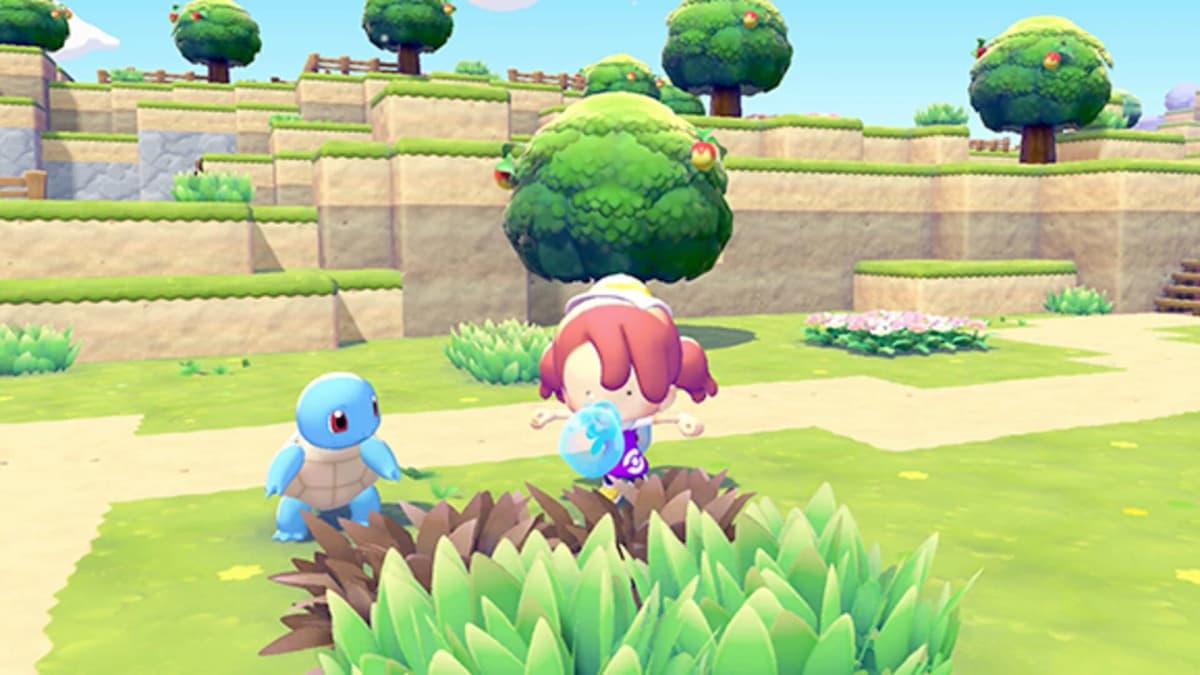
You’re not battling trainers; you’re renovating a dead planet. You use Pokémon moves as tools: Bulbasaur’s Leafage to coax grass back into barren soil, Squirtle’s Water Gun to hydrate cracked earth, fire types to warm cold biomes, rock smashers to carve new paths. These moves cost PP that only fully refills each in-game day, which forces a rhythm: you can’t just spam restoration, you have to plan it. Do I regrow this forest now or save the last few points in case a new area opens up tonight?
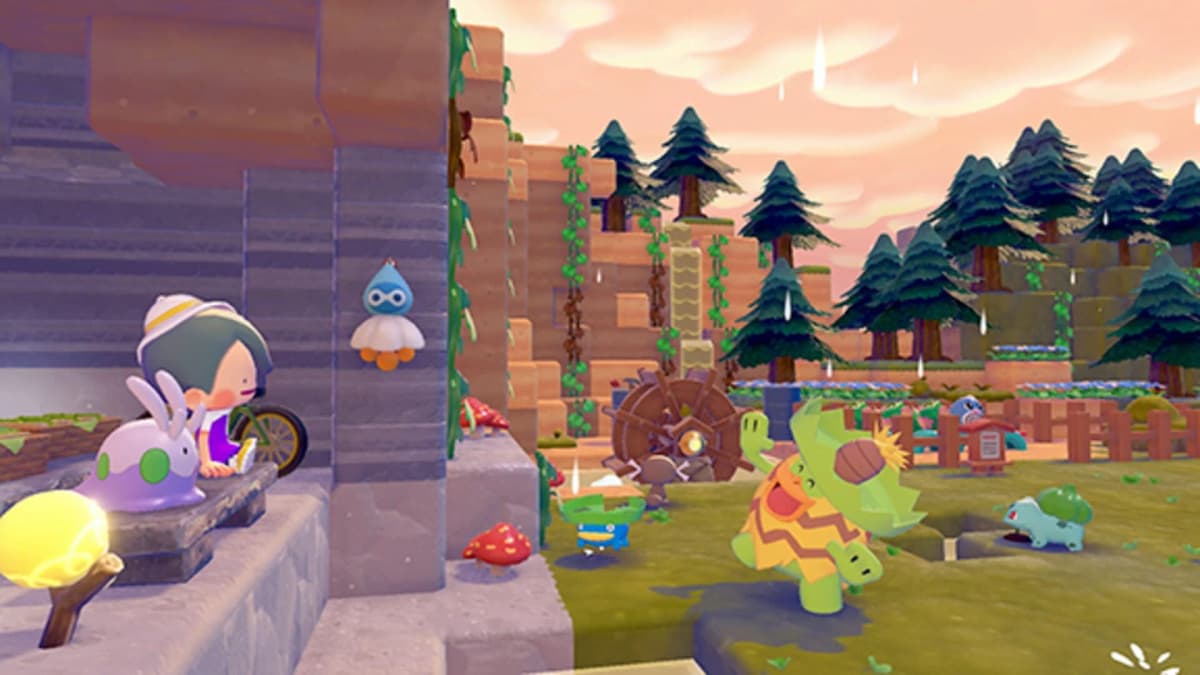
Pokémon’s satisfaction isn’t passive flavor text; it’s a system. Different species have daily requests – more water, more shade, a specific decoration – and their happiness actually changes with weather and time. Leave fire types in constant rain without shelter? They sulk. Let a water Pokémon’s pond dry out? It bails. Nostalgia here is tied to responsibility. These aren’t just “my childhood favorites”; they’re beings whose comfort depends on me understanding what kind of Kanto they remember and trying to build something that honors it.
On top of that, Pokopia gives you a ridiculous amount of freedom with construction. Stack blocks Minecraft-style, outsource bulk building to your Pokémon, design homes and town squares from scratch, or just gently nudge the default layouts. Every time you rebuild a landmark, you’re forced to choose: do I recreate what was as faithfully as possible, or do I rebuild it the way I wish it had been?
Here’s the kicker: you can’t ever truly recreate Kanto 1:1. Some items aren’t in the game. Some fossils don’t exist. Whole chunks of city are merged, twisted, or lost. That “impossible restoration” is the point. You’re not a museum curator; you’re someone grieving an old world and daring to make a new one anyway.
Human Records and the ache of a world that moved on without you
The most brutal thing in Pokopia isn’t a ruined city; it’s a piece of paper.
Scattered across the world are Human Records – old magazines, flyers, letters, little slices of a Kanto that was actually lived in. A newsletter from the Pokémon Fan Club recruiting new members. An earnest schoolkid’s recycling slogan contest entry. A trade mag interviewing overworked Pokémon Center nurses about their shifts. Fishing siblings geeking out over the latest rare catch in a handwritten note.
None of these are grand lore bombs. They’re aggressively mundane, and that’s what makes them hurt. When you read them in the shadow of dead towns, they hit like reverse nostalgia: instead of remembering your own childhood, you’re mourning someone else’s. You’re piecing together how busy, noisy, messy Kanto used to be, and how utterly quiet it is now that humans are sealed up in some orbital safety bunker.
As a Ditto, you’re literally playing pretend – mimicking a human shape, reading their mail, rebuilding their favorite spots based on secondhand memories. It’s a brilliant meta-layer: the game basically says, “You, the player, are doing the same thing. You’re a grown-ass adult trying to cosplay the kid who first walked through Pallet Town.” Human Records make that cosplay self-aware. They remind you that your mental snapshot of Kanto is frozen in time, but life there kept going… until it didn’t.
The rocket, the time capsule, and why I ugly-cried at a Pokémon game in 2026
All the building, all the Human Records, all the habitat micromanagement – it’s all pointing at one goal you don’t fully understand at first: that towering structure on the shore, where you keep stuffing items you’ve crafted, collected, and cared about. It’s framed as this big communal project without a clear payoff. You’re just told, basically, “Fill it with things that show what this world has become.”
The last thing I shoved into that tower was a photo. My Ditto avatar and a Squirtle dozing beside me – my first proper partner in Pokopia, mirroring my first proper partner in Pokémon Blue decades ago. It felt cute and a bit on the nose, but whatever, it fit. Then the game ripped my heart out: the tower unfolds, reconfigures, and ignites. It’s a rocket. All my chosen artifacts – resources, crafted goods, dumb little decorations, that stupid perfect photo – are blasting into space as a time capsule for the humans who left.
And that’s when the flood happened. Because it’s not subtle anymore: this isn’t just “send them supplies.” It’s “send them proof of life.” It’s “Hey, you didn’t lose everything. We carried it for you. We rebuilt something for when you’re ready to come home, even if it’s not the same.”
Sitting there watching the credits roll, I wasn’t thinking about PP meters or habitat values. I was thinking about the first house I ever lived in, that I still occasionally walk past when I visit my hometown, peeking like a creep from across the road. The curtains are different, the garden’s changed, my Sega Mega Drive is long gone, my grandad’s yellow teddy bear isn’t on that shelf anymore. But that house is still a node in my internal map, the way Kanto is. It doesn’t exist the way I remember it, and it never will again.
Pokopia grabbed that feeling and weaponized it. It made me realize I don’t actually want Kanto preserved in mint condition like some museum piece. That’s what a lot of official remakes and rehashes have tried to do, and that’s why they started feeling so hollow. I want Kanto that remembers me back, that has scars and gaps and missing fossils and weird new structures. I want a world that forces me to accept I can’t go back, only forward – but I can choose what I send ahead, what traces of “home” I leave for whoever comes next.
Pokopia nails what everyone else keeps fumbling: nostalgia with teeth
There’s a trend right now toward “cozy” restoration games – PowerWash Simulator, Unpacking, Animal Crossing’s endless island renovation slog. I’ve sunk brain-melting hours into all of them. They’re soothing, sure, but they rarely have the emotional weight Pokopia hits you with. You clean the thing, you arrange the room, you design the town – end of story.
Pokopia borrows their best tricks (relaxing loops, satisfying checklists, real-time day/night/weather cycles, even optional co-op so you and your friends can co-restore Kanto), but adds a crucial layer: this isn’t a blank canvas. It’s your old canvas, burned and waterlogged, and you’re repainting with memory as much as with blocks and items. Every design choice is haunted by the version that used to exist.
That’s why, for me, this stands out not just as “a good spin-off,” but as a template for how long-running franchises should be using their history. Don’t just parade the greatest hits. Break them. Question them. Let players mourn them a little, and then hand them the tools to build something new from the rubble. Opinion: Pokémon Pokopia isn’t just a cute experiment – it’s the first time in ages that this series has treated my nostalgia like an emotion instead of a resource to be mined.
Where I draw the line with future Kanto fanservice
Here’s where this game has permanently changed me: I’m done accepting lazy Kanto throwbacks. If the next big Pokémon project tells me we’re going “back to the beginning” and all that means is another safe, glossy retread of the same map, I’m out. I’ve seen what it looks like when the devs actually take a risk with that sacred cow, and now I can’t unsee it.
Pokopia proves you can respect people’s memories without embalming them. It acknowledges Kanto as that shared second home for a whole generation of players, but it isn’t afraid to flood it, fracture it, and ask us to care enough to roll up our sleeves and fix what we can. It says: you can never have your exact childhood back, but you can build something worth missing for someone else.
That’s the kind of nostalgia I’ll happily pay for. Not the empty calories of another “remember this area?” showcase, but a game that makes me sit with the uncomfortable truth that time passed, things broke, and yet… there’s still something here worth saving.
So yeah, Pokémon Pokopia broke me a bit. In a good way. After hundreds of hours across every region, it took a ruined Kanto and a Ditto in borrowed human skin to remind me why this series mattered to me in the first place – and why I never want to see nostalgia wasted on hollow fanservice again.
FinalBoss // Gear
Level up your setup
01Best-selling Switch 2 gameson Amazon→02Switch 2 accessorieson Amazon→038BitDo controllerson Amazon→04Discounted game keyson Kinguin→
Affiliate links · As an Amazon Associate, FinalBoss earns from qualifying purchases.
Want to Level Up Your Gaming?
Get access to exclusive strategies, hidden tips, and pro-level insights that we don't share publicly.
Ultimate Gaming Strategy Guide + Weekly Pro Tips