
Table of Contents (12)
What Pokémon Pokopia Actually Is
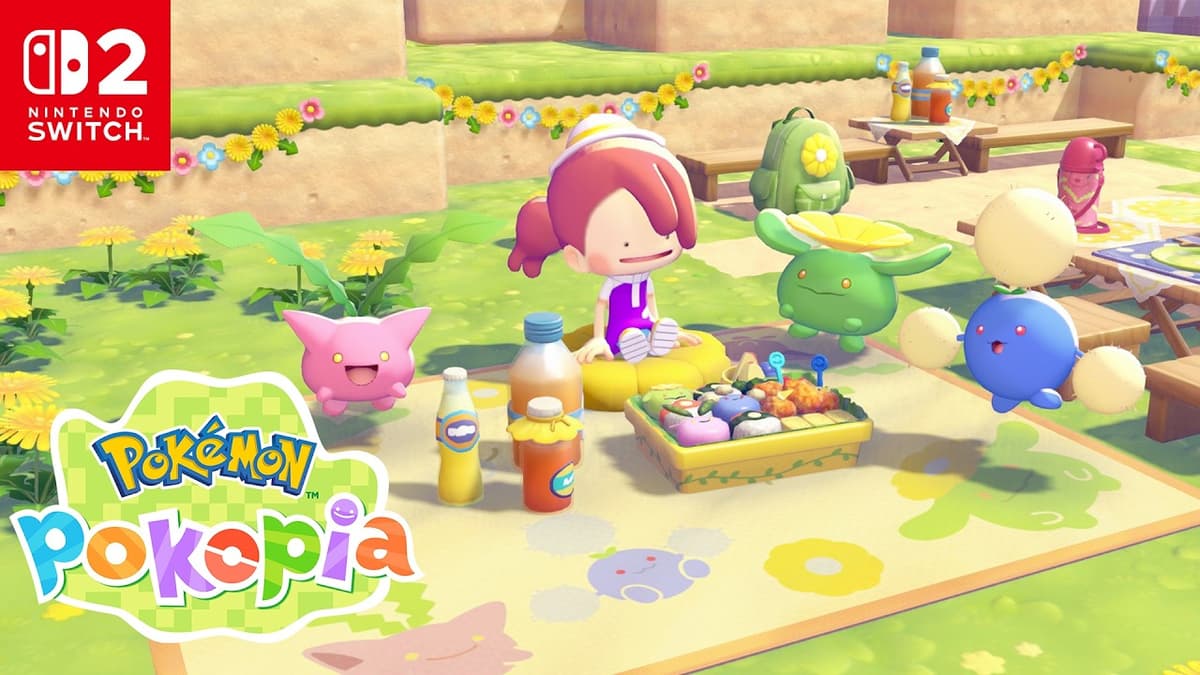
Pokémon Pokopia is not a traditional Pokémon RPG. There are no trainer battles, no eight Gyms, and no Elite Four. Instead, it plays like a post‑apocalyptic life sim on Nintendo Switch 2: you control a Ditto working with Professor Tangrowth to restore ruined regions of Kanto by building habitats, farming, crafting, and managing Pokémon companions.
This guide serves as a systems overview and hub. It focuses on how the main mechanics fit together: Important Requests, habitats and the Habitat Dex, Ditto transformations, farming and key crops (like Tomatoes), electricity and base infrastructure, companion specialties, co‑op, and late‑game completion goals such as legendaries and shinies.
Core Structure: Regions, Important Requests, and Time Travel
The game is organized into large, semi-open regions that you gradually restore. Early progression starts in the Withered Wasteland and eventually reaches areas like Sparkling Skylands, coastal zones such as Bleak Beach, and rocky uplands like Rocky Ridges. Each region is anchored by two main pillars:
- Important Requests: main quests that push the story forward
- Habitat restoration: optional but strongly encouraged, feeding into both progression and completion
Important Requests are always clearly marked in your journal. These include tasks like:
- Rebuilding the local Pokémon Center
- Completing the Team Initiation Challenge
- Unlocking major traversal routes between regions
- Story-critical builds for legendary encounters (notably Ho-Oh)
You are not locked out of content permanently. A light time travel mechanic lets you revisit earlier phases of regions to clean up missed collectibles, optimize habitat layouts, or trigger time-specific events. In practice, this means you can prioritize story progression without fear of permanently missing side content, then loop back for 100% completion.
Getting Started: Early-Game Priorities
The opening hours in the Withered Wasteland establish the core loop. To avoid common inefficiencies, early priorities should be:
- Clear the first few Important Requests until you unlock basic building, farming plots, and your first real habitat slot.
- Stabilize food and materials through a small, consistent farm (Tomatoes and a second crop you like to cook with).
- Recruit a couple of reliable companions with useful specialties (mining, watering, carrying).
- Place your first habitat thoughtfully instead of dropping it at random; you can move things later, but layout discipline pays off.
Use the early phase to learn the rhythm of the day: explore in the morning for new materials, return to base around midday to craft and build, then manage your habitats and companions in the evening. This pattern fits well with how Important Requests routinely send you back and forth between frontier areas and your central base.
Habitats and the Habitat Dex
Habitats are the defining system of Pokémon Pokopia. Each one is essentially a handcrafted biome slice that attracts certain species if its conditions are met. They drive:
- Which Pokémon appear in your settlement
- Resource generation rates (berries, materials, crafted byproducts)
- Progress in the Habitat Dex, the game’s record of every layout you have successfully built
Each habitat is defined by a combination of terrain, placed objects, and sometimes nearby infrastructure (like water sources or power). The Habitat Dex logs not just “you made a Forest Nest,” but the specific thresholds you hit to qualify it as such. For efficient progression:
- Specialize early habitats: for example, dedicate one to Grass-types and one to Rock/Ground-types rather than mixing everything into a single catch-all zone.
- Leave space for upgrades: most habitats benefit from added structures later; don’t box them in tightly with permanent buildings.
- Use the Dex as a checklist: each new layout you unlock typically opens up at least one new species and sometimes new materials.
- Sync habitats with Important Requests: some story quests explicitly ask for specific species or resource types; pre-aligning habitats with those needs reduces backtracking.
Players aiming for completion should treat the Habitat Dex like a second Pokédex. Filling it is slower but unlocks a broad range of species, including some that do not appear in the overworld until particular habitat conditions exist.
Important Requests and Region Progression
Main Requests form a linear backbone through each region, even though the surrounding content is open-ended. A typical region flow looks like:
- Initial survey: escort or follow Professor Tangrowth while you map the ruined zone.
- Critical infrastructure: rebuild a Pokémon Center or equivalent hub, sometimes with an attached farm or workshop.
- Environmental restoration: construct one or more signature habitats that change the region’s look (e.g., converting dead scrubland into a wetland).
- Challenge or trial: complete the local Team Initiation Challenge or an equivalent test that often uses Ditto’s movement abilities.
- Capstone encounter: usually tied to a key Pokémon, with Ho-Oh being heavily featured in the overarching story.
For efficient progression, it is usually correct to stay slightly ahead on Important Requests while never neglecting your base infrastructure. Many later quests assume you have a decent material stockpile, a working set of habitats, and at least a few movement abilities unlocked for Ditto.
Ditto Transformations and Movement Abilities
You play as Ditto, and its ability to adopt different forms effectively replaces HM-style field moves from older games. Specific abilities are learned through story beats and side quests in particular regions, including:
- Surf: water traversal in coastal and lake areas
- Glide: extended air mobility, critical in Sparkling Skylands
- Rollout: fast ground traversal and breaking certain obstacles
- Waterfall: vertical water routes and secret cliff paths
- Camouflage: stealth-focused interactions and certain puzzle solutions
- Roto-tiller / earth-shaping skills: for terraforming and advanced farming layouts
- Postgame traversal (e.g. magnet-style elevation): used for late-game hidden areas and legendaries
Each region tends to highlight one or two of these abilities, and many optional treasures sit just off the critical path behind traversal checks. A simple rule for exploration efficiency is:
- Do a light sweep of each area when you first arrive.
- Return for a thorough sweep after you earn the region’s signature movement ability (for example, after unlocking Glide in Sparkling Skylands).
This approach keeps you from wasting time on cliffs, rivers, or ruins that are impossible to fully explore until Ditto’s toolkit expands.
Farming, Berries, and Key Crops (Tomatoes Included)
Farming underpins both your day-to-day economy and many Requests. Crops provide:
- Ingredients for cooking and Pokémon food
- Materials requested by NPCs
- Input for certain building recipes
- Passive happiness and productivity boosts when used in habitats
Tomatoes are one of the most important early-game crops. Various guides and in-game hints converge on three uses:
- They are required for early Important Requests and side quests.
- They show up in several low-tier but high-value recipes for selling or trading.
- Some Pokémon strongly prefer tomato-based dishes, indirectly boosting their work output.
Practical farming guidelines:
- Lock in a tomato line as soon as you gain access to seeds and basic plots; do not rotate them out completely even when you unlock rarer crops.
- Automate watering as soon as your electricity and companion systems allow, to free up your own time for exploration.
- Segment fields by crop type to make harvesting more efficient and to pair certain fields with habitats that benefit from those plants.
- Use berries both as direct treats and as recipe components; they are a steady way to maintain Pokémon happiness without expensive items.
As your farm scales, it becomes a passive engine that feeds building materials, request fulfillment, and companion morale. It is worth over-investing in infrastructure here compared to many other cozy-life games, because habitats and Important Requests lean heavily on crop outputs.
Electricity and Base Infrastructure
Many advanced structures in Pokémon Pokopia require power. The electricity system is straightforward but easy to under-plan:
- Generators or equivalent power sources convert fuel or environmental inputs into electricity.
- Cables or conduits link these to Pokémon Centers, workshops, automated farm tools, and certain habitat devices.
- Power range and capacity limit how much you can run off a single source, encouraging deliberate layout design.
For practical base design:
- Cluster high-demand buildings (Pokémon Center, workshops, cooking stations) close to your main generator hub.
- Reserve a separate power line for farm automation so that a single overload does not shut down your core facilities.
- Consider future expansion when placing power lines; leave corridors free for additional cables and devices.
- Watch for Important Requests that upgrade your grid capacity; these can remove earlier limits and let you centralize instead of scattering micro-bases everywhere.
Electricity is one of the key reasons to keep pushing main Requests: many of the most efficient tools for farming and habitat maintenance are locked behind power-dependent structures that only become available after specific story milestones.
Pokémon Companions, Specialties, and Behavior
Pokémon in Pokopia are not battle units; they are workers, neighbors, and environmental actors. Each species brings one or more specialties, such as:
- Mining ores and crystals
- Watering crops or moving water
- Carrying materials or harvests
- Tending specific habitat types (e.g., forests, wetlands, rocky areas)
Emergent behavior is a major design goal. Pokémon wander, interact with each other, and respond to how you arrange habitats and objects. A few rules of thumb improve companion efficiency:
- Assign roles explicitly where possible instead of leaving everyone on “free roam.”
- Match species to environment; Pokémon working in preferred habitats move faster and waste less time idling.
- Use food, berries, and habitat décor to keep happiness high, as unhappy Pokémon underperform at their tasks.
- Rotate specialists when you move your focus (for example, reassign miners to help with construction during a building-heavy Request chain).
The absence of battle systems means your evaluation of a Pokémon is mostly about its utility in your current projects and how it fits visually and behaviorally into your settlement. The Pokédex and Habitat Dex together help you spot gaps in specialties or biome coverage.
Multiplayer and Co-op Considerations
Pokémon Pokopia supports co-op, which can significantly speed up both building and exploration. Practical uses of multiplayer include:
- Division of labor: one player handles base construction and farming while another scouts new regions, collects materials, or chases Important Requests.
- Shared traversal: players with more Ditto abilities can “shepherd” less advanced partners through regions, effectively boosting their exploration early.
- Efficient habitat testing: two players can simultaneously adjust objects and watch behavior to quickly lock in Habitat Dex entries.
Because time travel and region states are important, it is worth checking how your current host’s world state aligns with your own goals before committing to long co-op sessions. Focused, task-oriented co-op yields the best progression per hour.
Shinies, Legendaries, and 100% Completion
Beyond the main story, Pokopia leans into completionist goals:
- Pokédex completion: requires thorough exploration of every region, full use of Ditto’s abilities, and engagement with postgame content, puzzles, and secrets.
- Habitat Dex completion: demands experimenting with layout variants, not just “one of each biome.”
- Ditto form collection: several transformations and traversal moves remain optional and are locked to late-game or postgame quests.
- Legendary Pokémon: Ho-Oh is central, with other legendaries tied to extended chains or hidden areas, often accessible only after postgame Ditto upgrades.
- Shiny hunting: while the exact odds and methods align more with overworld observation and habitat manipulation than repetitive battles, shinies are present and naturally slot into the game’s slow, observational pacing.
Full 100% runs documented in longform video walkthroughs demonstrate that this is a multi-dozen-hour task, especially once you account for hidden quests and events that are easy to overlook on a straightforward story run.
Practical Next Steps
For players just starting Pokémon Pokopia, the most efficient path is to:
- Progress Important Requests in the Withered Wasteland until you unlock basic building, farming, and your first habitat slot.
- Stabilize your economy with a tomato-focused early farm and a couple of well-placed habitats that attract productive species.
- Acquire and practice Ditto’s early movement abilities, then systematically revisit partially explored areas when new traversal options unlock.
- Invest early in electricity and automation so base maintenance consumes less of your day cycle.
- Use the Pokédex and Habitat Dex together to guide which regions, species, and habitats you target next.
Approached this way, the game’s systems reinforce each other: habitats feed resources, resources fuel Important Requests, Requests unlock movement and infrastructure, and those in turn enable deeper habitat and Pokédex completion. Understanding that loop early makes the entire experience more coherent and reduces the amount of rework needed later in the run.
FinalBoss // Gear
Level up your setup
01Best-selling Switch 2 gameson Amazon→02Switch 2 accessorieson Amazon→038BitDo controllerson Amazon→04Discounted game keyson Kinguin→Affiliate links · As an Amazon Associate, FinalBoss earns from qualifying purchases.
Want to Level Up Your Gaming?
Get access to exclusive strategies, hidden tips, and pro-level insights that we don't share publicly.
Ultimate Guide Strategy Guide + Weekly Pro Tips