
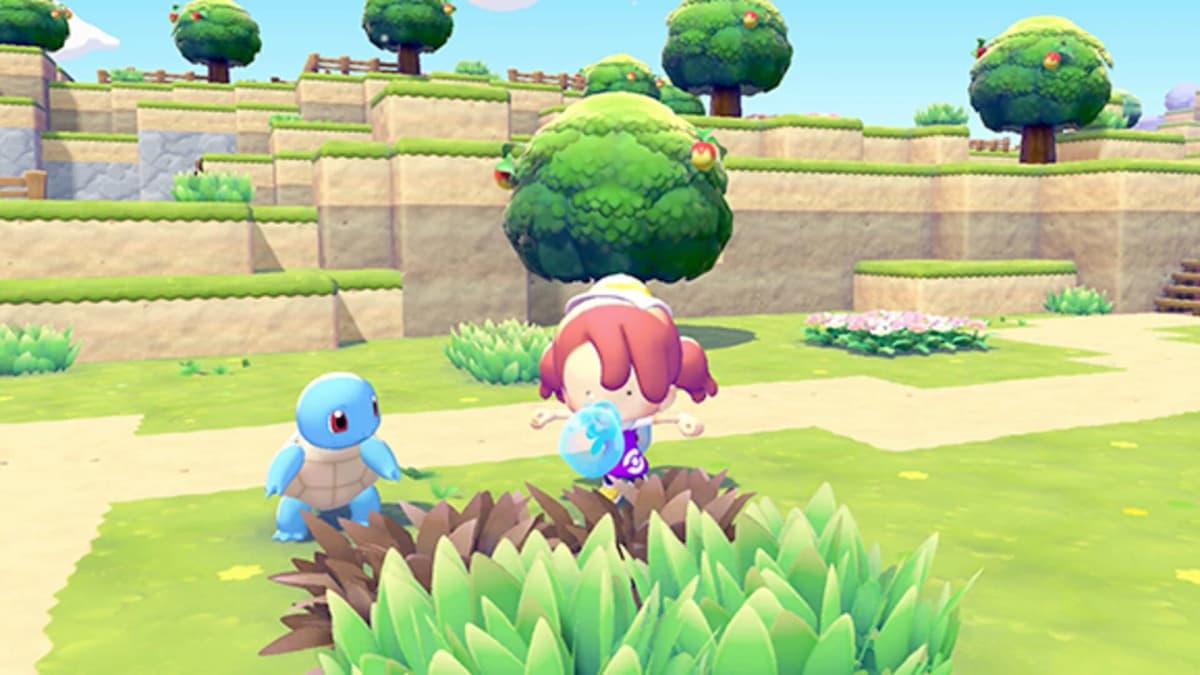
There are 12 Legendary and Mythical Pokémon in Pokémon Pokopia, and every one of them is unlocked through one of four systems: the main story, Palette Town building kits, Drifloon’s Dream Islands, or a crafted bell rung at the right moment. Mew sits outside all of that on its own slate hunt, and Volcanion is a party trick in Rocky Ridges. Once you can see the structure, chasing all twelve stops feeling random and starts feeling like a checklist.
Table of Contents (21)
The full roster (all 12)
| Pokémon | System | Short version |
|---|---|---|
| Kyogre | Main story | Restore rain in Withered Wasteland, then meet it at the repaired docks. |
| Articuno | Building kit | Complete the Freezing Chambers in Palette Town. |
| Zapdos | Building kit | Complete the Abandoned Power Plant. |
| Moltres | Building kit | Complete the Altar of Flame. |
| Raikou | Dream Island | Pikachu Doll → ocean/stormy island, central caves. |
| Entei | Dream Island | Arcanine Doll → volcanic island. |
| Suicune | Dream Island | Eevee Doll → lake island; break the ice blocks in the caves. |
| Ho-Oh | Bell | All three birds, then ring the Rainbow Bell when it flies over. |
| Lugia | Bell | All three beasts, then ring the Tidal Bell when it flies over. |
| Mewtwo | Dream Island or building | Dragonite Doll island, or finish all four floors of the Skyland Building. |
| Mew | Slates | Fill the underground Unown shrine with Mysterious Slates. |
| Volcanion | Party event | Rocky Ridges, Mood 100, Grand Curry, fireworks cannon. |
Two names you may have seen on fan lists that are not part of the confirmed twelve: Heatran and Jirachi. Jirachi was a limited-time event Pokémon (more on that below) and Heatran does not appear in the roster the major Pokédex round-ups agree on. If a guide tells you to build a Heatran habitat to unlock a legendary, treat it as unverified.
Patch state, July 2026
The live build is Ver. 1.1.1 (18 June 2026). Nothing since launch has changed how legendaries unlock, but two patch notes matter here:
- Ver. 1.0.5 (15 May 2026) fixed a bug where Lugia would not register in the Pokédex. If you befriended Lugia before mid-May and it never showed up in your dex, that’s why — the fix is in.
- Ver. 2.0.0 arrives August 2026 and adds the Dive move, letting Ditto explore underwater for the first time. Unlocking it means clearing the “Raise the environment level!” request in Bleak Beach with jump and Surf already learned. No legendary has been announced alongside it, but underwater areas are the obvious place for one, so hold off on declaring your run complete.
The Wish Upon a Jirachi event ran 23 June to 8 July 2026 and has ended. If you missed it, Jirachi is not currently obtainable; there is no permanent unlock path. We covered the mechanics in our Wish Upon a Jirachi walkthrough, which is worth reading if only because a rerun is plausible.
Before you start: the gates that actually block people
- Main story: push far enough that Drifloon joins your hub. Most Dream Island and building-kit content is dead until then.
- Environment Level: Palette Town needs a decent population and Environment Level before the big building kits show up in the shop at all. This is the single most common reason a legendary “won’t trigger.”
- Mobility: Rock Smash and a decent traveller companion, because both Slate hunting and the Dream Island caves are exploration-heavy.
- Materials: Rare Pokémetal is the bottleneck on both bells. Start banking it before you need it.
Save manually before any major trigger — ringing a bell, firing the cannon, stepping onto a suspicious platform. Pokopia is generous about second chances, but not universally.
Kyogre — the one you get by accident
Kyogre isn’t optional and it isn’t hidden. It’s the payoff of “Yawn Up A Storm”, the Withered Wasteland main quest that ends the region’s drought:
- Raise humidity to 100% — Water Gun on dry ground and withered trees, break cracked rocks to get springs flowing, place water habitats, plant flowers.
- Build the Rain Dance Site Squirtle asks for: two Castform Weather Charms, a plate, and food on it.
- Lead Squirtle there so it performs Rain Dance.
- Ask Slowpoke near the Pokémon Center ruins for his 100-point yawn. That triggers the storm.
- Head to the fishing docks, repair the bridge and walls, and talk to Kyogre. That conversation makes the rainfall permanent.
Kyogre can turn up again later in watery areas of Withered Wasteland and Bleak Beach when you get the “large presence from the ocean” prompt. The full weather system is worth understanding properly — it gates a lot more than one legendary, and we go deep on it in the habitats and rain guide.
The three birds — Palette Town building kits
Articuno, Zapdos and Moltres aren’t hunted. They’re housed. Each one has a corresponding large structure you complete in Palette Town from a Building Kit, and the bird moves in once the build is finished:
- Freezing Chambers → Articuno
- Abandoned Power Plant → Zapdos
- Altar of Flame → Moltres
The loop is the same for all three: get the kit, place it in Palette Town, feed it the required construction materials, and when the structure completes, the bird appears inside. Talk to it to befriend it and assign it a habitat.
The kits appear in the shop as Environment Level rises, which is why players who rushed the story find the birds “missing.” They’re not missing; you haven’t unlocked the kits yet.
The three beasts and Mewtwo — Drifloon’s Dream Islands
Getting access
Progress Withered Wasteland until Drifloon gives you a request. Complete it and Dream Islands open up. From then on you talk to Drifloon, hand it a Pokémon doll, and it sends you to the island template that doll corresponds to. You get one Dream Island trip per in-game day, so don’t waste one going in with the wrong doll.
Dolls come from the Palette Town Pokémon Center as Environment Level rises, or at random from glowing ground spots around the map.
Which doll for which legendary
- Pikachu Doll → the ocean/stormy island. Raikou is in the central cave system.
- Eevee Doll → the lake island. Suicune sits deep in the caves behind ice blocks you have to break.
- Arcanine Doll → the volcanic island. Entei roams near the lava.
- Dragonite Doll → the laboratory/ruin island. Mewtwo is deep inside, past the heavy resource nodes.
The doll controls the island template and its loot table — it does not guarantee the legendary. That’s the part everyone gets wrong and then blames on bad luck.
The Pokédex trick that stops the wasted runs
This is the single most useful thing in this guide. As soon as you land on a Dream Island, before you walk anywhere:
- Open the Pokédex.
- Press Y for filters.
- Set Registration Status to All and Location to In this area.
- Look at the list. If there’s a “?” entry alongside Ditto and Drifloon, a legendary is on this island.
No “?”, no legendary — treat the trip as a resource run and go home. This turns “I spent a full in-game week chasing Entei” into a ten-second check per visit. When the “?” is there, head straight for the central cave system in the island’s main rock formation, smash destructible blocks, and keep pushing inward. Legendaries sit in the deep chambers, not on the surface.
Mewtwo’s second route
If the Dragonite Doll isn’t cooperating, there’s a non-random path: accept the late-game “Rebuild The Huge Building” quest and complete all four floors, each with its own material and specialty requirements. When the structure becomes the finished Skyland Building, Mewtwo appears on the rooftop. Go up, talk to it, done. It’s slower but it’s deterministic, which for a lot of players is the better trade.
The bells — Ho-Oh and Lugia
Both cover legends work identically: complete a trio, craft a bell, ring it while the bird is overhead.
Lugia (Tidal Bell)
- Prerequisite: befriend all three beasts — Raikou, Entei, Suicune.
- Craft: 5 Rare Pokémetal + 5 Silver Feathers.
- Use: wait until Lugia passes over your settlement, place the bell in an open spot or on high ground, and ring it. Lugia descends; talk to it to befriend.
Ho-Oh (Rainbow Bell)
- Prerequisite: befriend all three birds via the Palette Town builds.
- Craft: Rare Pokémetal + Rainbow Feathers. Rainbow Feathers come from flying Pokémon with the Litter specialty — Dartrix is the source people rely on, and it’s a Rocky Ridges resident.
- Use: same ritual. Wait for the flyover, place, ring, talk.
Farming Rainbow Feathers is the actual time cost here, not the bell. Get a Dartrix settled in a habitat early and let the feathers accumulate while you do everything else.
Mew — the Unown slate hunt
Mew is the longest chain in the game and it’s pure exploration.
- Head north of Withered Wasteland, toward the tunnel near the windmill area, and look for a cracked dirt wall.
- Break through and descend into an underground shrine with a mural showing all 27 Unown shapes, punctuation forms included. Interacting tells you the mural needs Mysterious Slates.
- Slates come from breaking glowing blocks anywhere in the world. Bring a Pokémon with the Search specialty and use the Dowsing Machine — both raise your hit rate substantially, and without them this becomes miserable.
- Each slate has an Unown symbol on its back. Match it to the correct slot on the mural.
- Fill the mural and Mew appears in a cutscene. Talk to it to befriend.
Because this one is a genuine grind with its own puzzle layer, we split it into a dedicated walkthrough: how to unlock Mew and solve the slate puzzle.
Volcanion — the Rocky Ridges party
Volcanion is the strangest unlock in the game because it’s a celebration, not a hunt.
First encounter (story):
- Work through Stereo Rotom’s quest chain in Rocky Ridges. Rotom lives in the “music and magazines” habitat — CD player, CD rack, magazine rack.
- His chain ends in “Time to Party!”, which requires the area at 100 Mood.
- Cook Grand Curry with Chef Dente and four Pokémon helpers.
- When the party fires, go straight to the volcanic peak. Do not wander off — the encounter is tied to the party’s afterglow and leaving the area can cost you the trigger.
Re-summoning it afterwards:
- Buy an additional cooking pot from the PC Shop and place it at your previous party site in Rocky Ridges.
- Add 15 Leppa Berries, 15 Wheat, 5 Honey.
- Bring Chef Dente plus four other Pokémon, and push Mood back to 100 with decorations or Hype-specialty Pokémon.
- Cook (roughly seven minutes) and start the party.
- Build a cannon from 1 Iron Ingot + 1 Vine and a firework from 1 Pokémetal + 1 Sturdy Stick + 1 Stone + 1 Paint.
- Fire it during the celebration. Volcanion turns up asking to join in, and once you accept it lives in Rocky Ridges permanently.
Volcanion is a Burn specialist with no habitat furniture requirement, which makes it unusually easy to place once you have it. The rest of the region is dense enough that we gave it its own breakdown: every Rocky Ridges Pokémon and how to spawn them.
FAQ
How many legendaries are in Pokopia?
Twelve: Kyogre, Articuno, Zapdos, Moltres, Raikou, Entei, Suicune, Ho-Oh, Lugia, Mewtwo, Mew and Volcanion. Jirachi was event-only and the event closed on 8 July 2026.
Can I still get Jirachi?
Not currently. Wish Upon a Jirachi ran 23 June to 8 July 2026 and there is no permanent unlock. Watch for a rerun.
Why isn’t a legendary spawning on my Dream Island?
Because it isn’t there. Dolls choose the island template, not the spawn. Open the Pokédex, press Y, filter Registration Status to All and Location to “In this area” — if there’s no “?” entry, that island has no legendary and the run is a material run.
My Lugia never registered in the Pokédex.
That was a real bug, fixed in Ver. 1.0.5 on 15 May 2026. Make sure you’re on the current build (Ver. 1.1.1) and it should resolve.
Is there a faster order to do all of this?
Yes: Kyogre falls out of the main story for free, so start there. Then run building kits for the birds while Environment Level climbs, because those are deterministic. Use Dream Island days opportunistically for the beasts — one Pokédex check per trip, no wasted afternoons. Slate hunting runs in the background of everything else. Save the bells for last, since Rare Pokémetal is the real bottleneck.
For the Dream Island system specifically — island templates, loot tables, and what else is worth farming while you’re there — see our Dream Island deep dive. Everything else we’ve written about the game lives on the Pokémon Pokopia hub.
FinalBoss // Gear
Level up your setup
01Best-selling Switch 2 gameson Amazon→02Switch 2 accessorieson Amazon→038BitDo controllerson Amazon→04Discounted game keyson Kinguin→Affiliate links · As an Amazon Associate, FinalBoss earns from qualifying purchases.
Want to Level Up Your Gaming?
Get access to exclusive strategies, hidden tips, and pro-level insights that we don't share publicly.
Ultimate Guide Strategy Guide + Weekly Pro Tips