
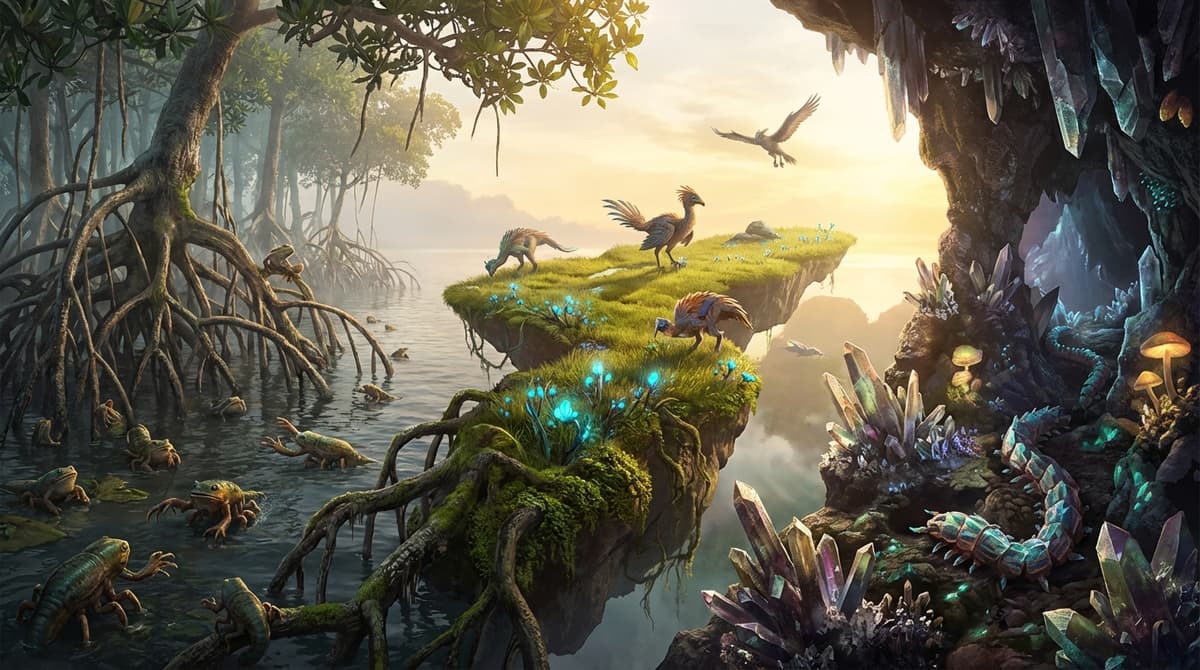
Pokémon Pokopia has 209 habitats in the Habitat Dex, not a couple of dozen “types” — and once you know that number, the whole system reads differently. Every Tall Grass variant, every hot spring, every shaded corner is its own dex entry with its own spawn table. A “perfect-looking” island with almost nothing living on it isn’t unlucky; it’s a handful of habitats built over and over. This guide covers how habitats actually resolve spawns, how weather and rain fit in, and the single most underused trick in the game: light level overrides day/night restrictions.
Table of Contents (22)
The short version
- 209 habitats in the Habitat Dex, plus a handful of event-only habitats that appear in the data on top of that.
- Every Tall Grass variant is a separate habitat — plain, tree-shaded, boulder-shaded, hydrated, seaside, elevated. Different entries, different spawn pools.
- A spawn resolves from habitat + environment (elevation, water, heat) + time of day + weather. Miss one and the Pokémon simply never appears.
- Light beats time. Build a habitat in a dark cave and night-only Pokémon can spawn during the day. Flood a habitat with light and day-only Pokémon can spawn at night. This is the biggest lever in the system.
- Rain and sun are craftable. Rain Dance Site and Sunny Day Site, both built from two Castform Weather Charms plus a plate and food. Bring a Water-type for rain, a Burn-specialty Pokémon for sun.
- Build each habitat in multiples. Spawns arrive faster and habitat level climbs faster. This is the community’s most repeated finding and it holds up.
- Current build: Ver. 1.1.1 (18 June 2026), which fixed real problems with high item counts in one area — relevant if you’re building at scale.
Correcting the habitat count
You’ll still find guides quoting “28 habitat types” or similar, usually split into main-island and Cloud Island buckets. That framing is wrong and it costs you spawns, because it encourages you to think in broad families and stop optimising once you’ve built “a grass one.”
The Habitat Dex holds 209 entries. Serebii, Game8, Eurogamer, Nintendo Life and Polygon all land on the same figure. Fan compendia list a slightly higher number — around 214 — because a handful of entries are tied to event data rather than being permanently available. So: 209 to plan around, a few more that come and go.
The practical consequence: habitats you’d assume are cosmetic variations of each other are separate dex entries pulling from different pools. Tree-shaded tall grass is not “tall grass with a tree on it.” It’s habitat #002, and it attracts Pokémon that stop by to relax in shade.
How a spawn is actually decided
Think of every spawn as the output of a formula:
Habitat entry + Environment (elevation, water proximity, heat) + Light level + Time of day + Weather
If one input is wrong, the Pokémon you want will not appear no matter how long you wait. That’s the whole reason habitat hunting feels random to people who haven’t isolated the variables.
Tall Grass: six habitats, not one
| # | Habitat | What defines it |
|---|---|---|
| 001 | Tall Grass | Plain patch. The baseline pool, good for small Pokémon. |
| 002 | Tree-shaded tall grass | Cooler, shaded. Attracts species that come to relax. |
| 003 | Boulder-shaded tall grass | Grass beside a large boulder. Hide-and-seek species. |
| 004 | Hydrated tall grass | Water’s edge. Pulls aquatic-adjacent species into a grass pool. |
| 005 | Seaside tall grass | Near sea spray. Salt-tolerant and coastal species. |
| 006 | Elevated tall grass | High elevation, cool, windy. Mountain and cold-leaning species. |
Six entries from the same base terrain. Adding a tree to a grass patch isn’t decoration, it’s a habitat conversion — which is also why accidentally dropping a boulder next to your carefully-planned grass cluster can change what spawns there.
Elevation and temperature are encoded in the habitat, not tracked separately
Pokopia doesn’t expose a temperature number. It bakes environmental conditions into the habitat identity. “Elevated tall grass” carries its own description about high elevation and cool wind; there are hot-air-current zones and high-altitude flowerbeds elsewhere in the dex. You don’t tune a temperature slider — you build the habitat that already encodes the condition you want.
Red Tall Grass is the useful exception worth experimenting with, because it adapts to elevation. Plant one red cluster low and an identical one high, then compare. It’s the cheapest way to see altitude affecting your spawns without rebuilding anything.
Light level: the override most players never find
This is the single most valuable mechanic in this guide. Many Pokémon in Pokopia have day or night requirements, and the game runs on the real-world clock — so a night-only species normally means playing at night. Except:
- If a habitat is in a dark place — a cave, an underground room — night-exclusive Pokémon can spawn during the day.
- If a habitat is surrounded by bright light, day-exclusive Pokémon can spawn at night.
That turns lighting into a spawn tool. A dark cave build is a permanent night zone; a heavily-lit plaza is a permanent day zone. Streetlights cost 2 Pokémetal to duplicate at the 3D Printer, which makes mass lighting one of the cheapest optimisations available — see our 3D Printer duplication guide for the printing loop.
Night generally leans toward Dark and Ghost-type encounters, so if your dex is thin in those, a roofed dark habitat is the fix rather than a sleep schedule.
Weather, and how to control it
Weather is the other global filter. Some species are boosted in specific weather, some are locked to it, and some vanish in it. The one confirmed rain-exclusive people cite is Goodra, which appears only in certain habitats while it’s raining — but there’s no published master table of weather-locked spawns, so treat rain as a variable to test rather than a checklist you can look up.
The good news is you don’t have to wait for weather. You can build it.
Castform Weather Charms
Both weather sites run on Castform Weather Charms. You get them by:
- Finding one on a Dream Island in the windmill tower starting area.
- Digging up large lost relics.
- Buying them from the PC Shop once your Withered Wasteland Environment Level is high enough. This is the reliable source — shop stock scales with Environment Level.
Rain Dance Site
- Build: two Castform charms set to rainy form, hung on the wall either side, plus a plate on the ground with food on it (a Leppa Berry works).
- Trigger: bring a Water-type — Squirtle is the standard — and it eats the food and performs Rain Dance.
Sunny Day Site
- Build: identical items, but flip the Castform charms to sunny form.
- Trigger: bring a Burn-specialty Pokémon to clear the clouds.
Between the two you have on-demand weather, which means weather-gated habitat entries stop being a waiting game. Building both sites early is worth more than almost any decorative project.
Restoring rain in Withered Wasteland
Before any of that, Withered Wasteland has to get its rain back, and that’s a main-quest chain — “Yawn Up A Storm”:
- Raise humidity to 100%. Water Gun on dry ground, grass and withered trees. Break cracked rocks and walls to open springs and get rivers flowing. Place water habitats like the Horsea Fountain. Plant wildflowers and Field of Flowers habitats — Bulbasaur speeds their growth.
- Build the Rain Dance Site when Squirtle requests it (two Castform charms, plate, food).
- Lead Squirtle there so it eats and performs Rain Dance, starting the rain party.
- Ask Slowpoke, near the Pokémon Center ruins, for his 100-point yawn. At true 100% humidity, this triggers the storm. If you’re told to keep going, you’re not actually at 100 — add more water and flowers.
- Meet Kyogre. A cutscene puts it at the docks. Repair the bridge and walls, go talk to it, and the rainfall becomes permanent.
What restoring rain buys you:
- Rescuing Onix in the northeast cave, which the rain softens and floods enough to reach.
- Bleak Beach opens via the gate near the Pokémon Center.
- Rocky Ridges opens via the northeast cave tunnel gate.
- The Wasteland stops being a static environment and gets a proper weather cycle. Habitats that felt dead start producing.
Once rain is running, letting it fall for a while gradually moistens the whole region on its own — no further work needed. It stops when enough water has soaked in, and you bring it back any time with the Rain Dance Site. Our area unlock guide covers the full biome sequence this kicks off.
Building a habitat test lab (and why one giant field fails)
The mistake almost everyone makes early is building one enormous mega-field. When multiple habitat types overlap, you cannot tell what’s doing the work, and you’ll spend hours guessing. Build small isolated labs instead:
- A 5×5 cluster of one Tall Grass variant with nothing else nearby.
- A small pond with a couple of reeds, well away from your forests.
- A single cave entrance with minimal decoration around it.
For weather testing specifically, set up one dedicated pair on your main island:
- Test patch: mid-elevation, near a small body of water, 5–9 tiles of a single Tall Grass variant, plus one or two neutral items (rocks, logs) so you don’t accidentally create a forest or cave habitat on top of it.
- Control patch: an identical cluster a short walk away, slightly higher and further from water.
Then run cycles: note what spawns on each patch in sun, trigger rain, note what changes. Species that only appear on the water-adjacent patch during rain are your rain-biased or rain-locked spawns for that combination. Formalising it turns “is this Pokémon rare or weather-locked?” into an answer you can act on.
One genuine open question: players regularly ask whether rain-dependent habitats need to be left uncovered so the rain can physically reach them. There’s no official confirmation either way. Until there is, the safe build is to leave rain habitats unroofed — it costs nothing and removes the variable. The inverse is worth remembering too: roofing a habitat is how you create the darkness that unlocks night-only spawns during the day.
Cloud Islands and the Varied Terrain change
Cloud Islands host their own Habitat Dex entries and their own materials — Moss Rock, for instance, is a Cloud Island pickup that gates certain builds back home. They follow the same time-of-day and weather rules as ground habitats, so nothing you’ve learned stops applying up there.
What did change: Ver. 1.0.5 (15 May 2026) added a Varied Terrain option to the Cloud Island generator, so generated islands can have real elevation changes instead of being flat. For a system where elevation is baked into habitat identity, that’s a meaningful upgrade — elevated-variant habitats are now buildable on generated islands rather than only on hand-terraformed ground.
What the recent patches changed
| Version | Date | Habitat impact |
|---|---|---|
| 1.0.5 | 15 May 2026 | Varied Terrain for Cloud Islands (elevation). Fixed a Heatran habitat comfort bug that blocked completion. |
| 1.1.0 | 9 Jun 2026 | Adjusted Pokémon behaviour in habitats for more natural movement and reactions; tweaked placement limits. |
| 1.1.1 | 18 Jun 2026 | Fixed problems when placed items in an area exceed a certain limit. Relevant if you build at volume. |
| 2.0.0 | Aug 2026 (announced) | Adds the Dive move so Ditto can explore underwater. Expect new habitat entries below the waterline. |
If you’re following a guide written in March or April, the 1.1.0 behaviour changes are why spawn timings may not match what you read. The rules didn’t change; the pacing did.
Three habits that fix a dead island
- Build in multiples. Once you know a habitat recipe, build as many copies as the habitat lists Pokémon for. Spawns come faster and habitat level rises faster. This is the biggest single throughput gain available.
- Get Mosslax settled. Its food buffs raise your chance of rare items and habitat spawns across the board — a multiplier on everything else you’re doing.
- Diversify before you scale. Six Tall Grass variants beats sixty tiles of one. Variety is what fills the dex; volume is what fills the island.
FAQ
How many habitats are in Pokopia?
209 in the Habitat Dex, plus a small number of event-only habitats in the data. Guides quoting “28 types” are using an outdated or invented framing.
How do I make it rain on demand?
Build a Rain Dance Site — two Castform Weather Charms in rainy form, a plate, and food on it — then bring a Water-type like Squirtle to perform Rain Dance. A Sunny Day Site with the charms flipped to sunny form and a Burn-specialty Pokémon does the reverse.
Which Pokémon only spawn in rain?
Goodra is the confirmed rain-locked example in specific habitats. There’s no complete published list of weather-gated spawns, so build the test-and-control patch setup and check the Habitat Dex entries for the species you’re chasing.
Do rain habitats need to be uncovered?
Unconfirmed. No official source addresses it. Leave rain habitats unroofed as a precaution — and remember that roofing a habitat is deliberately useful elsewhere, because darkness lets night-only Pokémon spawn in daylight.
Can I get night Pokémon without playing at night?
Yes. Build the habitat in a cave or a dark enclosed space. Light level overrides the normal day/night restriction, so night-exclusive species can appear during the day. The same trick works in reverse with heavy lighting for day-only species.
My island looks great but nothing spawns. What’s wrong?
Almost always overlap and repetition — too many copies of the same habitat, or several habitat types blurring into one another so nothing resolves cleanly. Break it into small isolated clusters, diversify the variants, and add lighting or shade to control the time-of-day filter.
For everything else — legendaries, events, region rosters — see our Pokémon Pokopia hub, and the region with the densest habitat requirements in the game gets its own breakdown in every Rocky Ridges Pokémon and how to spawn them.
FinalBoss // Gear
Level up your setup
01Best-selling Switch 2 gameson Amazon→02Switch 2 accessorieson Amazon→038BitDo controllerson Amazon→04Discounted game keyson Kinguin→Affiliate links · As an Amazon Associate, FinalBoss earns from qualifying purchases.
Want to Level Up Your Gaming?
Get access to exclusive strategies, hidden tips, and pro-level insights that we don't share publicly.
Ultimate Guide Strategy Guide + Weekly Pro Tips