
Table of Contents (13)
The Pokémon Link Cable Was Basically a Design Document
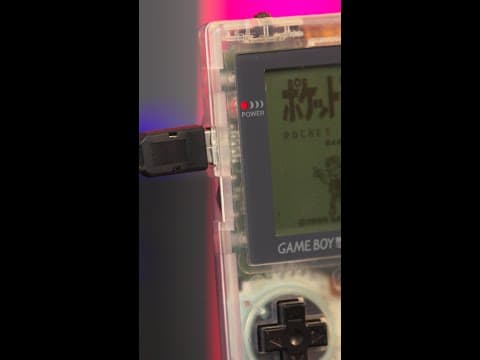
My earliest memory of “online” gaming wasn’t dial-up, LAN parties, or even the first time I logged into an MMO. It was handing a friend my battered grey Game Boy, lining up that weird little port, and clicking in a translucent purple Game Link cable so we could trade a Kadabra for a Machoke.
The trade took ages. We’d already mashed through the “Waiting…” screen, watched the little pixel Poké Balls creep along the cable animation, and still just… waited. It felt deliberate, ritualistic, almost sacred. Years later I learned the truth: the Game Boy’s link port was crawling along at roughly 8 kbit/s – about 1 kilobyte per second.
The magic wasn’t just the monsters. It was the limitation. That pathetic little serial connection – one data line, barely any bandwidth, and a short physical tether – quietly dictated what Pokémon could be. It forced turn-based combat, slow, meaningful trades, and face-to-face social engineering that turned a niche 8-bit RPG into a global culture.
By 2026 we live in a world where any random gacha game can spin up real-time 100‑player raids over Wi‑Fi. Meanwhile, mainline Pokémon is still fundamentally the same: one-on-one or small-party turn-based battles, tiny squads of six, and a trading flow that intentionally feels like a queue, not a firehose.
It took me a while to realise how much of that is inertia from a cable that shipped in 1989.
What the Game Link Cable Actually Could (and Couldn’t) Do
Before diving into design, it helps to treat the link cable like what it really was: not a vibe, not a metaphor, but a crude physical network stack.
Specifications
These numbers look almost like a joke next to modern Wi‑Fi, where a basic home router casually throws hundreds of megabits per second around the room. But on Game Boy, the link cable wasn’t an extra. It was the constraint.
Pokémon’s designers had to build a multiplayer experience that:
- Fit into a tiny bandwidth budget where sending even a few hundred bytes was noticeable.
- Survived on a noisy, timing-sensitive, single-wire serial link that could easily desync.
- Worked with only two players at a time standing less than a meter apart.
Everything about early Pokémon multiplayer – down to how long a trade drags out, and why battle turns look the way they do – follows from that.
Trading as a Bottleneck: When “Gotta Catch ‘Em All” Meets 1 KB/s
One of the smartest, and frankly gutsiest, decisions Game Freak ever made was declaring that the original Pokédex could not be completed on a single cartridge. Version exclusives, starter choices, and trade-only evolutions baked the link cable into the main quest.
This wasn’t just a marketing trick to sell more carts. With an 8 kbit/s pipe, Pokémon’s data model had to be tight. A creature record – species, moves, stats, nicknames, IDs, maybe some checksum – still ends up in the tens or low hundreds of bytes once you include protocol padding and safety checks. At a kilobyte per second, sending even a single monster is non-trivial.
So instead of streaming data constantly, the games structure trading as a ceremony:
- Both players walk to a Pokémon Center and enter a dedicated “Cable Club”.
- The game performs a careful handshake to sync versions and party data.
- You each pick a single Pokémon, confirm the choice, and lock it in.
- The transfer animates slowly, with obvious “something is happening” feedback.
Under the hood, the game is doing exactly what the animation shows: shoving a tiny blob of data, one bit at a time, through a fragile wire. That delay isn’t just tolerable – it adds weight:
- Trading a rare monster feels like a commitment because it literally takes time.
- Each trade is one-to-one; there’s no easy way to mass-duplicate or dump boxes at once.
- The friction keeps the social economy small-scale and human. You remember who you got which Pokémon from.
In playground terms, the cable enforced a slow barter economy. Completing your Pokédex or evolving a Haunter into Gengar wasn’t just about grinding; it was about navigating a local network of actual people who happened to own different versions or be willing trading partners.
From a modern networking perspective, that’s absurd. Today a server could host millions of concurrent trades per minute. But if Pokémon Red and Blue had launched with that kind of connectivity, the feel of “trading” would be totally different. It would be a database operation, not a shared event.
Why Pokémon Battles Are Turn-Based, Not Real-Time Brawls
There are a lot of good design reasons to make Pokémon battles turn-based: readability, strategy, accessibility for kids, the ability to think through counters and status effects. But when you’re tethered to a serial cable with a single data line, turn-based combat isn’t just a choice; it’s the only thing that makes sense.
The original Game Boy link protocol is extremely timing-sensitive. Both devices have to stay in lockstep, sending and receiving bits in rhythm. If you tried to do fast, real-time movement and attacks for multiple entities, you’d either:
- Burn a huge share of your bandwidth constantly syncing positions and actions, or
- Risk frequent desyncs where the two games disagreed about what just happened.
Turn-based battles solve all of that almost elegantly by accident. A full “turn” can be represented as a tiny bundle of decisions:
- Which move did you select?
- Did you switch Pokémon?
- What random seeds and status effects apply this round?
Once both players lock in their choice, the games exchange just enough data to agree on the outcome and then independently play out the animations. Crucially, they don’t need to stream every frame over the wire. Both Game Boys are running local copies of the battle logic; the cable is only there to sync decisions and results at well-defined boundaries.
This pattern extends forward. On Game Boy Color, the link port gained a higher-speed mode for some titles, but Pokémon still behaved like it lived in the low-bandwidth world: discrete turns, occasional sync points, modest data payloads. On Game Boy Advance, even with a faster port and multi-tap hubs, Gen III still built its battles and trades around these safe sync moments rather than continuous data streams.
From a design perspective, the limit is almost a gift. It forces Pokémon to be readable and stepwise. You can walk away from a battle for a minute, come back, and still understand exactly what’s happening. High-speed action games don’t have that luxury.
Short Cable, Small World: How Hardware Forced Local Social Design
The other thing the Game Link cable absolutely refused to do was stretch. The official Nintendo cables were roughly a meter long. Third-party brands pushed 3 meters or so, but too much extra length and signal integrity started to fall apart. For Pokémon, that meant multiplayer was quite literally arm’s length only.
This created all sorts of side effects you won’t see captured in spec sheets:
- Trading almost always happened in person: at school, on the bus, in a sibling’s bedroom.
- Knowledge about version exclusives and trade evolutions spread by word of mouth and magazines, not system messages.
- Social dynamics – who had which version, who owned the link cable, who was trusted – mattered as much as in-game power.
Other Game Boy games used the link cable for competitive matches, sure, but Pokémon turned the physical tether into infrastructure for a playground economy. The fact that you physically couldn’t trade with someone across town baked scarcity and locality into the meta.
There’s a lovely symmetry here: the Game Boy itself was underpowered and limited, but also cheap and portable. That combination made it incredibly common: multiple kids in the same class could own one. Pair that with a short cable, and you’ve essentially forced Nintendo’s designers to lean into co-located, inter-generational rituals – older siblings helping younger ones, parents supervising trades, grandparents trying to make sense of it all.
Game Freak Kept the Philosophy Even as the Hardware Moved On
From a pure hardware standpoint, Pokémon gradually escaped the worst linkage constraints pretty early:
- Gen II (Gold/Silver/Crystal) kept the same port but introduced higher-speed link modes on Game Boy Color for some titles.
- Gen III (Ruby/Sapphire/FireRed/LeafGreen/Emerald) moved to the Game Boy Advance port, which could push into six-figure baud rates and support up to four players through hub adapters.
- GBA Wireless Adapters even supported local RF lobbies with dozens of players visible at once (Pokémon Center plazas that looked eerily like proto-MMO hubs).
Yet the core shape of Pokémon multiplayer didn’t suddenly become chaotic or massive:
- Trades remained mostly one-for-one, with deliberate confirmation steps.
- Battles still revolved around teams of six and strictly turn-based exchanges.
- Even when four-player battles appeared, they were structured as ordered, sequential turns, not free-for-all brawls.
There were practical reasons – UI complexity, game balance, the difficulty of managing more than six creatures in your head – but that original cable-era mindset lingered. Multiplayer was still treated like a special mode you stepped into, not the substrate everything else ran on.
The irony is that as soon as hardware opened the door to more ambitious connectivity, the software had to make awkward compromises. The jump from Gen II to Gen III infamously severed direct trading compatibility because of how the underlying systems changed, even though all of these games ran on broadly similar handhelds. The developers ended up inventing things like “time capsule” style workarounds in later re-releases and transfer systems, precisely because the original cable assumptions and data models weren’t designed for a world where everything was interoperable forever.
From Cables to Wi‑Fi: Modern Pokémon Still Acts Like Bandwidth Is Scarce
On Nintendo DS, 3DS, and Switch, Pokémon finally broke free of literal cables. We got the Global Trade Station, Wonder Trade, Surprise Trade, Y‑Comm, Union Rooms, raids, and constant internet connectivity. Under the hood, these systems can move vastly more data than a Game Boy could dream of. Yet the series behaves like it still runs on that original 8 kbit/s leash.
Some examples that always strike me:
- Trading is still serialized. Even in Surprise Trade/Switch-era systems, you submit one Pokémon at a time, wait, and then get one result. There’s no “stream 30 trades in parallel”.
- Battles are still strictly turn-based. Online ranked matches layer on timers and rules, but the underlying model is identical to Link Cable days: choose a move, commit, watch animations play locally.
- Teams are still tiny. Party-of-six limits remain hard-coded, even though the network could handle larger squads or simultaneous multi-Pokémon control.
From a networking perspective, the limits are completely artificial now. Pokémon Sword and Shield or Scarlet and Violet could absolutely handle real-time positioning data for dozens of players in a raid arena. They already do instancing and state sync for things like wild area interactions and raid dens.
Yet the designers repeatedly choose not to. Instead, mass features tend to be asynchronous or heavily rate-limited:
- Surprise Trade and Wonder Trade set strict per-trade pacing.
- Online events time-gate encounters and distribution instead of letting you spam attempts infinitely.
- Most modern systems preserve the feeling that each Pokémon is a singular object, not one of a flood of JSON rows in a database.
It starts to look less like laziness and more like a philosophical holdover: that the ritual of scarcity created by the Game Link cable is part of what makes Pokémon feel like Pokémon.
What If Pokémon Ignored Its Link Cable Legacy?
Thought experiment: imagine designing a Pokémon-like game from scratch in 2026, with no historical baggage, on hardware that assumes ubiquitous high-speed networking from day one.
Without the cable’s constraints, a bunch of things that are currently “obviously Pokémon” suddenly become negotiable:
- Trading could be bulk and near-instant – drag-select 20 Pokémon, hit “List on market”, receive dozens of responses in seconds.
- Battles could be real-time arena fights with direct joystick movement, cooldown-based abilities, and live dodging.
- Party size could scale up: squads of 12, or entire pens of monsters active at once, with server-driven AI.
- Raids could be 50‑player spectacles where buffs, heals, and positioning all happen continuous-time instead of in locked turns.
Most modern online games lean into exactly this, because their infrastructures make it cheap. But if you apply this to Pokémon, the identity starts to wobble.
Pokémon as we know it leans on limited information and deliberate pace. You can’t react mid-turn. You can’t change your choice once the move is locked. You can’t flood a server with infinite duplicate shinies in a second without hitting some bottleneck the designers placed there on purpose. This slowness – originally vehicle for surviving a microscopic serial bandwidth – now functions as a kind of friction against exploitation and burnout.
If Pokémon embraced full-speed modern networking without restraint, it would gain and lose in equal measure:
- Trading economies would explode, but individual catches might feel disposable.
- Battles could be more kinetic, but also more chaotic and harder to parse, especially for younger players.
- Collection goals would be faster to complete, but maybe less memorable; filling a Pokédex from an auto-matching market is very different from begging your one friend with Blue for that version-exclusive.
The original cable didn’t care about any of this. It was just slow. But slowness ended up being a surprisingly good match for a series built on long-term attachment, gentle pacing, and social negotiation across generations.
The Hidden Benefits of Staying A Little Bit “Stuck in the Past”
Pokémon’s persistence with turn-based battles and relatively constrained trading is often framed as conservatism or risk aversion. There’s definitely some of that; when a franchise is as big as Pokémon, every change is a gamble. But there are quiet benefits to carrying the Link Cable’s DNA forward.
From my own experience using modern systems like Surprise Trade and online ranked ladders, a few upsides stand out:
- Comprehensibility: Because the core flow is the same as it was on Game Boy, it’s relatively easy to onboard new players (including kids) even 30 years later. “Pick a move, wait, see what happens” hasn’t changed.
- Inter-generational continuity: The rituals older fans remember – trading to evolve, six Pokémon per team, dramatic one-hit KOs that you watch play out – are still there when they introduce the games to the next generation.
- Identity protection: Pokémon doesn’t have to compete with every other real-time battler on their terms. Its battle system feels like it belongs to a different lineage.
And then there’s the simple fact that these constraints create stories. The Game Link cable practically forced people into the same physical space, which is how you end up with memories like “that one summer at my grandparents’ where we finally got all 150,” or “the cousin who always showed up with level 100 monsters and wrecked everyone.”
Modern online features try to echo that – raid nights with friends, community days, special transfer events – but the most enduring anecdotes still have that cable-era texture: slow, local, personal.
Where the Cable Legacy Starts to Hurt
All that said, the ghost of the Game Link cable isn’t purely benevolent. There are moments where hanging onto the past becomes a burden.
- Clunky online UX: Many of Pokémon’s online systems feel one or two generations behind what the hardware could comfortably support. Simple things like grouping up with specific friends or organising tournaments are more awkward than they need to be.
- Transfer spaghetti: Moving Pokémon forward across generations is still convoluted, with apps, services, and odd rules about what can and can’t move. Some of that stems from how rigid the early data models were – they simply weren’t built for infinite forward compatibility.
- Missed experimentation: There’s room in the franchise for bolder takes on combat and trading built for modern networks, but mainline entries tiptoe around anything that looks too real-time or massively-multiplayer.
Part of me would love to see a genuine “high-bandwidth Pokémon” experiment in a side project: something that leans hard into live raids, large (>6) parties, and frictionless trading, with the understanding that it’s exploring a parallel future where the Link Cable never existed.
At the same time, I understand why the main series hasn’t gone there yet. Once you normalise instant, bulk everything, it’s hard to go back to slow, deliberate rituals. And those rituals are one of the few things that no other monster-collecting game has fully replicated.
Pros & Cons of Pokémon’s Low-Bandwidth Heritage
So What Happens as Hardware Marches On?
The Game Link cable is long dead as a piece of hardware, but it’s very much alive as design gravity. Nintendo’s next hardware, whatever shape “Switch 2” ultimately takes, will almost certainly push wireless bandwidth, latency, and background connectivity even further. Pokémon will have more technical headroom than ever to break free of its inherited limits.
The interesting part is not whether it can, but how much it wants to.
The legacy of that 8 kbit/s serial port has effectively become a design philosophy:
- Preference for discrete, turn-based interactions over continuous streams.
- Deliberate friction in trading and collection to maintain attachment and scarcity.
- A bias toward small, legible groups (teams of six, modest player counts) instead of massive crowds.
None of that technically requires low bandwidth anymore, but it started there. The question over the next decade is how Pokémon balances that heritage with the expectations of players raised on instant matchmaking and endless live updates.
My hunch is that the mainline series will keep its core “Link Cable logic” – one-on-one turns, small squads, ritualized trades – and experiment around the edges. More flexible raid systems, richer co-op overworlds, and smarter, less clunky online lobbies feel likely. A wholesale jump to real-time action or MMO-scale battles feels much less so.
In other words: Pokémon may quietly upgrade the imaginary cable behind the scenes, but it will probably keep pretending that somewhere, deep in the code, two Game Boys are still whispering to each other at 1 kilobyte per second.
Not really a number, but call it 10/10 for influence.
VERDICT
The original Game Boy Game Link cable wasn’t just a peripheral; it was the invisible skeleton of Pokémon’s design. Its tiny bandwidth and short reach forced trades to be slow, battles to be turn-based, and multiplayer to be intimate and local. Those constraints accidentally produced a set of rituals – one-to-one trades, six-Pokémon teams, deliberate pacing – that still define the series decades and several hardware generations later. Modern networking could blow those limits away, but doing so wholesale would risk erasing a big part of what makes Pokémon feel like Pokémon.
FinalBoss // Gear
Level up your setup
01Top-rated gaming headsetson Amazon→02High-refresh gaming monitorson Amazon→03Gaming chairson Amazon→04Discounted game keyson Kinguin→Affiliate links · As an Amazon Associate, FinalBoss earns from qualifying purchases.