
Table of Contents (9)
Prime Monster turns nastiness into a rules-based toy, and that’s the point
I didn’t want another political pop-culture catharsis. Then I fired up Prime Monster’s free Steam demo and found a game that actually explains why political nastiness feels unstoppable. You don’t just read about smear campaigns and blackmail here—you play them, card by card, all while the Shrieker of the House, a Grim Reaper–style enforcer, glares over your shoulder. It’s sharp satire, and the demo shows Cavalier Game Studios mostly knows how to land it.
Key Takeaways
- Satire through systems: Prime Monster turns misconduct—like playing a “Smear Journalist” or “Leaked Documents” card—into a resource you trade for votes, oversight, or violence.
- Gameplay over gags: Rally allies, stoke scandals, or bribe opponents—each sleazy tactic has instant, measurable effects on your scandal meter and public support.
- The Shrieker’s role: A run-ending enforcer mechanic promises consequences. How harshly it punishes you will decide if this satire punches up or just normalizes corruption.
- Try it now: The Steam demo is live, and the full game is slated for later this year.
Why the satire works (and where it could stumble)
Political games often rely on caricature—over-the-top villains, punchline headlines, zero stakes. Prime Monster avoids that trap by turning unethical moves into currency. Drop a “Bribe Lobbyist” card to win over a vote, or unleash “Public Shaming” to neutralize a rival. Every crooked play yields points, but also inches your scandal meter upward. That mechanical clarity forces you to weigh “is an extra 5 reputation worth a 10-point scandal spike?”
But satire needs pushback. If you breeze past consequences, nastiness becomes the obvious optimal path, and the message gets lost. The demo’s Shrieker of the House mostly hollers warnings, rarely slapping you with real penalties. It’s funny in a mock-parliament sense—but it also raises a red flag: will the full game make scandal a true threat, or just an amusing nuisance? I’d like to see a tuning target: say, every 20 scandal points triggers a mandatory vote that can instantly end your run.
Gameplay: card roguelike design that teaches you how politics feels
Prime Monster sits at the crossroads of card roguelike and political sim. Each “run” is a legislative session. You pick from a deck that might include “Leaked Documents,” “Campaign Rally,” or “Blackmail Evidence.” In my first run—as an orc legislator battling a troll opposition—playing “Smear Campaign” removed three public support from my enemy and filled my “Rage Meter,” unlocking violence-based cards like “Assassination Attempt.” The loop is addictive: press your advantage, stoke or quell outrage, gamble on higher-risk moves.
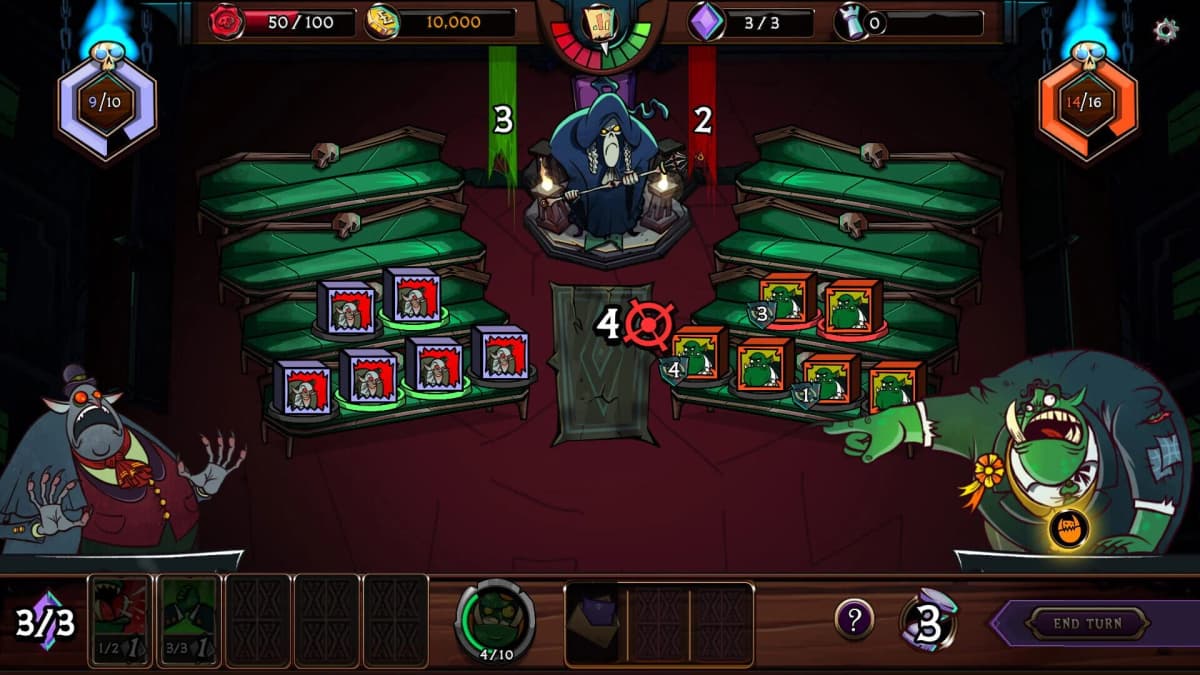
Cavalier Game Studios’ pedigree—remember The Sexy Brutale’s time-loop murder mysteries?—shows in the tightness of these systems. There’s no wasted text or clumsy UI. Every action feels intentional and loaded with moral weight. The scandal meter’s color shifts from green to toxic red, reminding you that each push for power carries a cost.
Comparing Prime Monster with other card-roguelikes
If you’ve played Slay the Spire, you know how an “Impervious” card or “Whirlwind” combo can feel ruthless but abstract. Prime Monster goes deeper: it ties every card to a real-world political tactic. Instead of abstract damage, you deal “reputation loss” or “legal threat.” Compared to Inscryption—which breaks the fourth wall to interrogate player agency—Prime Monster forces you to interrogate your own appetite for dirty tricks.
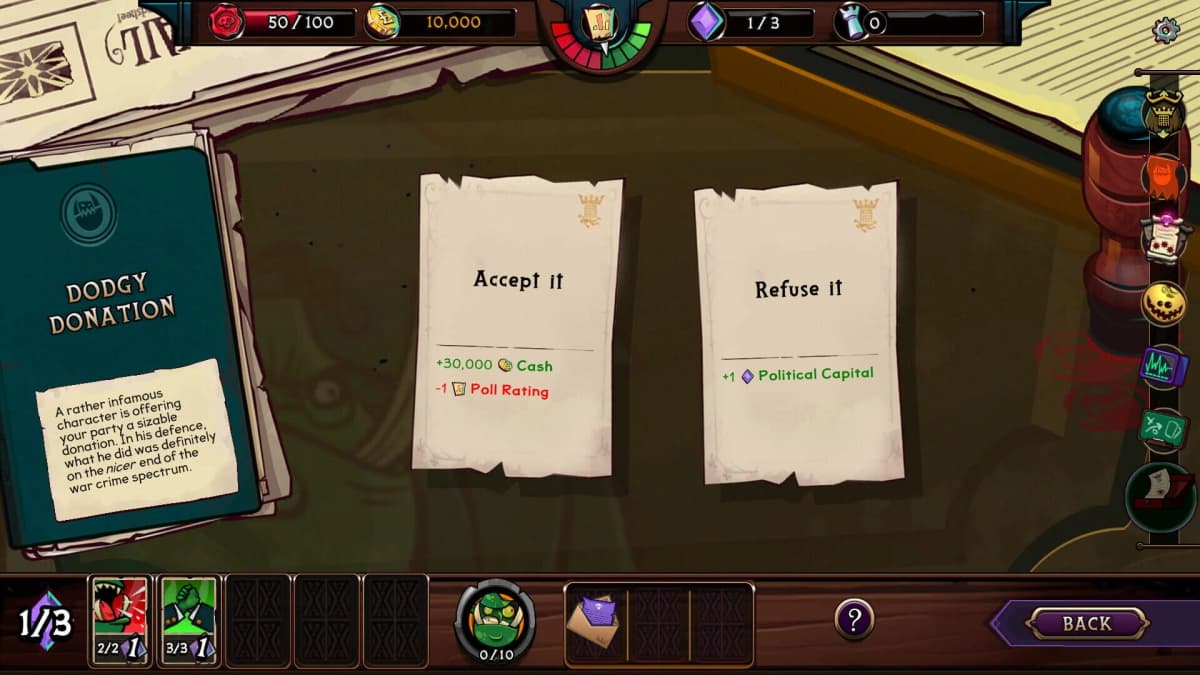
Meanwhile, most policy sims (like the Democracy series) treat scandal as a static meter—you tweak budgets, pass laws, and watch numbers. Here, you’re actively buying and selling scandals. That makes the satire feel lived-in: you’re complicit in the system you claim to despise. It’s a rare moment where mechanics do the heavy lifting rather than an exposition dump about corruption.
The uncomfortable observation PR hopes you miss
The demo dishes up laugh-out-loud card names and alliances with goblinoid factions—but then it hands you the most efficient move: smear a journalist. It’s fun. That’s the point. But it’s also the risk: when the easiest path to victory mirrors real-world incentives that erode trust, you start to wonder if you’re learning anything or just reveling in nastiness.
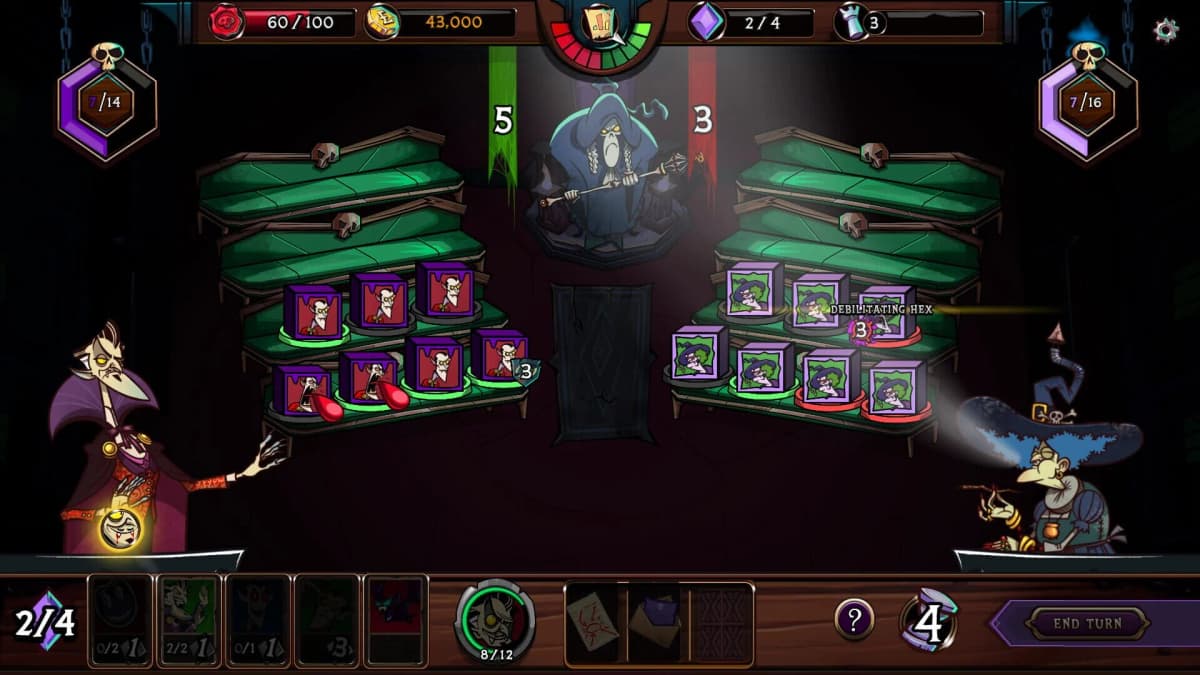
Whether the satire lands will come down to tuning. If crossing the line costs you decisive runs—forcing you to rethink strategy—Prime Monster will punch up at real-world cynicism. If it merely leaves you chuckling before rewarding you with more dirty cards, its critique might backfire, normalizing the very behavior it means to lampoon.
Questions for the PR rep
- Scandal scaling: Does the Shrieker ever end runs automatically, or is it just a soft cutoff? What thresholds trigger real penalties?
- Card balance: How many “blackmail” or “smear” cards per deck? Will rarer, more punitive cards like “Judicial Overhaul” appear to punish repeat offenders?
- Narrative impact: Do NPCs or factions remember your tactics across runs, leading to evolving consequences or alliances?
- Replay incentives: Beyond leaderboards, what design ensures you’re not just chasing the highest scandal meter again and again?
What to watch next
- Demo patches: Look for developer diaries on how the scandal and Shrieker systems will be tightened before launch.
- Release date firming up: Cavalier says “later this year”—a set date tells us if there’s time for meaningful tuning.
- Pricing model: Will this be a full-price single-player campaign, or lean on expansions and DLC? Pricing affects how players risk runs.
- Community feedback: Watch Steam forums and Reddit. If players find smear tactics too powerful or oddly nerfed, that will predict the final balance.
Conclusion
Prime Monster’s demo is a provocative prototype: it turns smear campaigns, blackmail, and violence into tangible resources you trade in a legislative battlefield. Its satire works when the Shrieker enforcer truly keeps you in check—but if the game lets nastiness win too easily, the message could blur into celebration. For now, the demo is a must-play experiment in systems satire. Keep an eye on tuning updates, release timing, and community reactions to see whether Prime Monster ultimately critiques or indulges the political machine.
FinalBoss // Gear
Level up your setup
01Top-rated gaming headsetson Amazon→02High-refresh gaming monitorson Amazon→03Gaming chairson Amazon→04Discounted game keyson Kinguin→Affiliate links · As an Amazon Associate, FinalBoss earns from qualifying purchases.
Want to Level Up Your Gaming?
Get access to exclusive strategies, hidden tips, and pro-level insights that we don't share publicly.
Ultimate Gaming Strategy Guide + Weekly Pro Tips