
Budget direct-drive wheels have been creeping down in price, but PXN just swung hard with the V10 Ultra at $259.99 and the V10 Pro sold via regional distributors. On paper you’re getting a compact DD base at 3.2Nm, a detachable 270mm D-shaped rim with 17 buttons, and pedals-two on the Ultra, three on the Pro-plus PC/mobile tuning apps and claimed PC, Xbox, and PlayStation support. That combo at this price point definitely made me raise an eyebrow.
- Entry-level direct drive at $259.99 is aggressive-potential G29/T248 killer if the force feedback holds up.
- Both bundles cap at 3.2Nm torque—fine for beginners, well below mid-tier DD bases (5-10Nm+).
- Pro adds a clutch pedal but no mention of a load-cell brake; expect Hall sensors, not pressure-based braking.
- “Cross-platform” claims need fine print; PS/Xbox support usually means specific licensed SKUs or workarounds.
Table of Contents (6)
Breaking Down What PXN Is Actually Selling
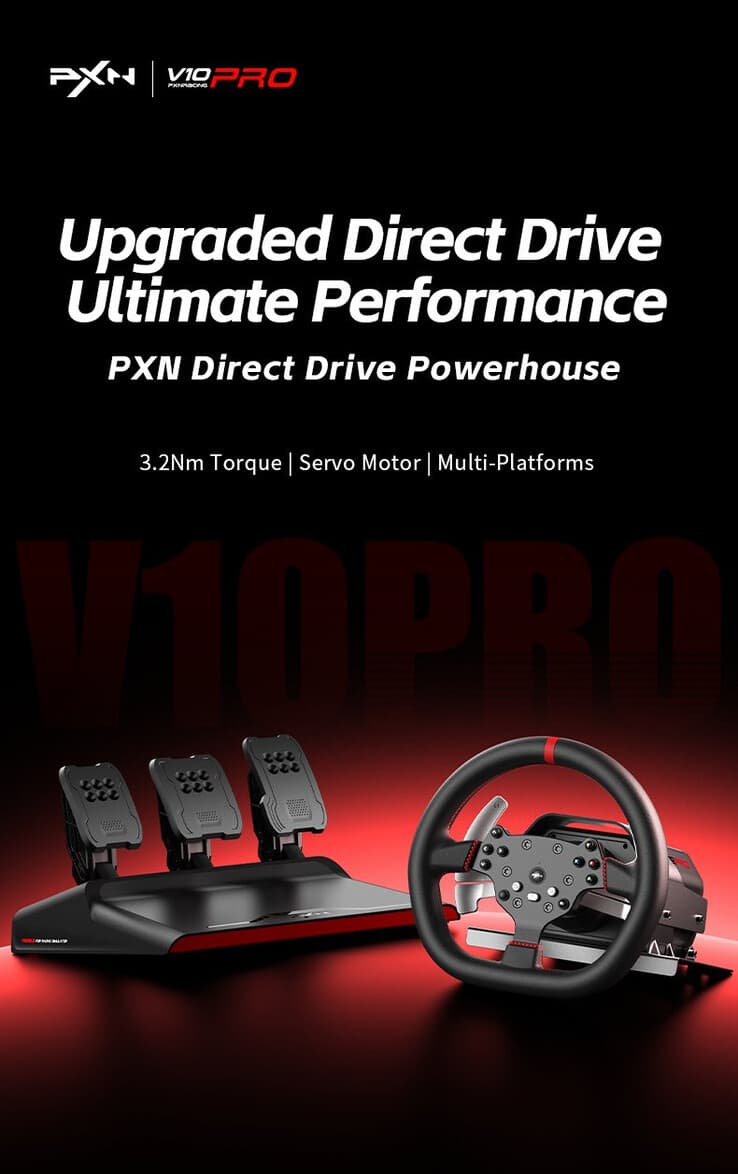
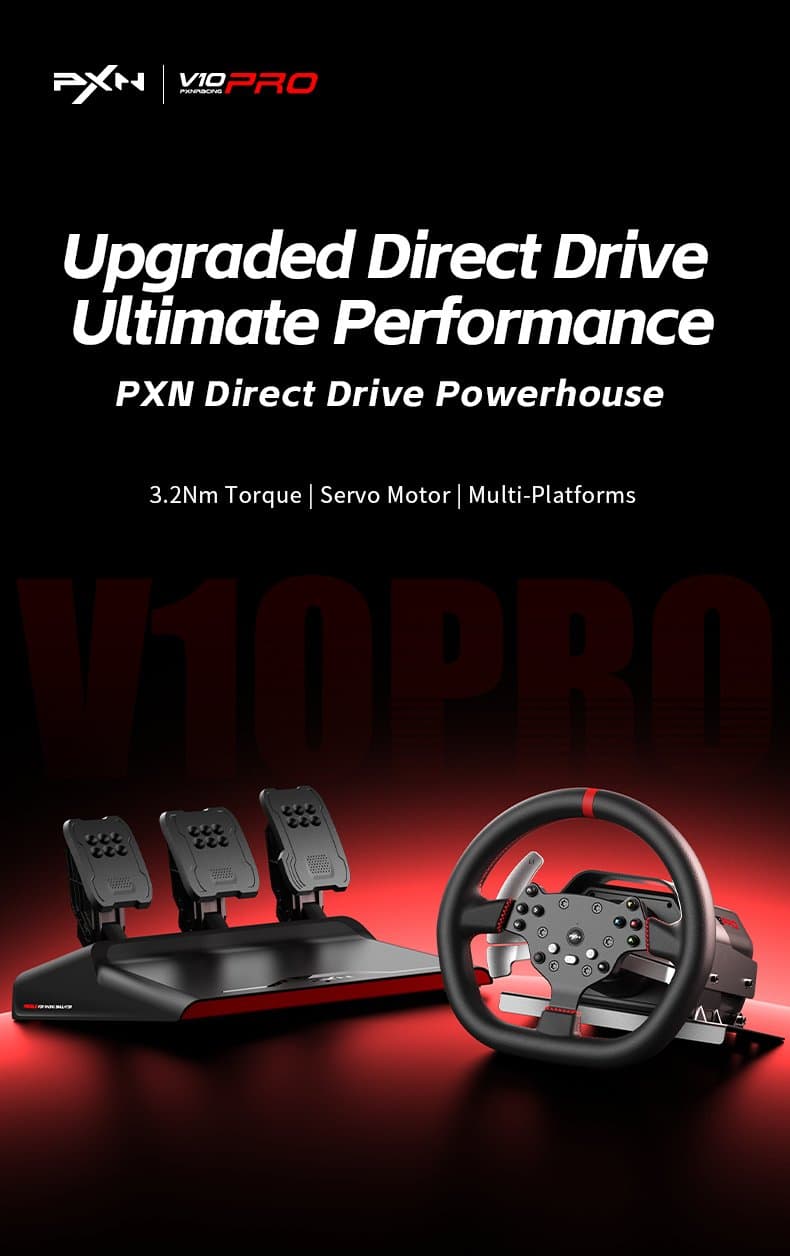
There are two bundles. The V10 Ultra is the true budget play: a 3.2Nm servo direct-drive base, a 270mm PU leather D-shaped wheel with 17 programmable buttons, aluminum paddle shifters, 15-bit steering resolution, and a two-pedal metal set (Hall-sensor brake and throttle). The V10 Pro bumps the pedals to a three-pedal set (ABS plastic) adding a clutch, but keeps the same wheel and the same 3.2Nm base. Both hook into PXN’s SimRacing software on PC and Nexus app on mobile for FFB tuning, sensitivity, and presets.
Specs that matter for day-to-day racing: 15-bit resolution (32,768 steps) should give smooth steering input, and Hall sensors beat potentiometers for longevity. Aluminum paddles at this price are a nice touch. The D-shaped 270mm rim is compact and desk-friendly, though it won’t satisfy folks who like 300mm+ round rims for rally and drifting. PXN also calls out smart thermal management and an “aerospace-grade slip ring” for wheel power and signals—marketing flourish aside, the takeaway is a tidy wired connection through the hub rather than a dangling USB.
How It Stacks Up Against the Field
Let’s talk torque. 3.2Nm is entry-level for direct drive. Fanatec’s CSL DD starts at 5Nm (8Nm with the Boost Kit). MOZA’s R3 bundle sits around 3.9Nm and the R5 at 5.5Nm. Logitech’s Pro Wheel hits ~11Nm and Thrustmaster’s T818 is ~10Nm. So the V10s won’t threaten the mid-tier or pro space. But that’s not the point—these are aimed squarely at newcomers, the people who might otherwise buy a gear/belt setup like a G29/T248/T300. If PXN can deliver clean, detailed FFB at 3.2Nm without cogging or heavy filtering, this could feel meaningfully “more connected” than those legacy belt/gear options for less money.
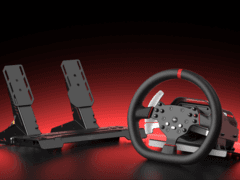
Pedals are where value bundles usually show their limits. The Ultra’s two-pedal metal set with Hall sensors is a positive, but there’s no load-cell brake in either bundle. On the Pro, you do get a clutch—great for H-pattern shifter fans—but the ABS construction may flex under heavy braking. For immersion and lap time consistency, a good brake is everything. A pressure-based load-cell upgrade path would be huge; PXN hasn’t detailed one yet. If they want this ecosystem to scale from entry to “semi-sweaty,” that’s the missing piece.
Price-wise, $259.99 for the Ultra is eyebrow-raising in a good way. Fanatec and MOZA bundles with direct drive usually land notably higher, especially when console support is involved. If the force feedback is clean and the build quality holds up, PXN just set a new floor for “real” sim hardware.
The Cross-Platform Claim: Read the Fine Print
PXN says PC, Xbox One/Series, and PlayStation compatibility. Historically, true cross-platform support in one kit is messy because Xbox and PlayStation require different licensing approaches—often the console chip lives in the wheel or base, forcing separate SKUs. Until we see a compatibility matrix and hands-on reports, assume there may be model variations or feature differences per platform. Also, mobile app tuning on console only matters if settings save to onboard profiles; otherwise it’s PC-only magic. These are the details that make or break a budget hero product.
Who This Is For (And Who Should Wait)
If you’re sim-curious and stuck between a cheap belt drive and your first DD setup, the V10 Ultra is basically screaming your name. Desk-mounted users, smaller spaces, and folks playing F1/Forza/GT with assists on will likely be happy with 3.2Nm. The Pro makes sense if you want a clutch for manual cars and heel-toe practice—but without a load-cell brake, it’s not a full leap toward “serious.”
If you already know you want heavy FFB, detailed road texture, and a long-term rig path, I’d still look at 5-8Nm bases where you can swap wheels and add a load-cell brake immediately. The V10 Ultra/Pro could be a great starter wheel you outgrow in a year—nothing wrong with that at $259 if the ride is good. But make sure there’s an upgrade path inside PXN’s ecosystem or a clear plan to move to Fanatec/MOZA/Logitech later.
What I’ll Be Testing First
- FFB quality at 3.2Nm: center fidelity, oscillation, and whether filters muddy details.
- Thermal throttling during long stints—does the motor fade after 30-60 minutes?
- Pedal feel and stability; any flex on the Pro’s ABS set, and adjustable curves via the app.
- Mounting security on a desk clamp and standard rigs; rim flex and paddle feel.
- Console behavior: profile storage, button mapping, and any platform-specific limitations.
TL;DR
PXN’s V10 Ultra/Pro aim to make direct drive genuinely affordable. At $259, the Ultra could be the new default recommendation for first-time sim racers—if the 3.2Nm base delivers clean feedback and the compatibility story checks out. The Pro’s clutch is nice, but without a load-cell brake, both kits are beginner-focused. I’m cautiously optimistic: the price is right, the features are sensible, and the competition just got a wake-up call.
FinalBoss // Gear
Level up your setup
01Top-rated gaming headsetson Amazon→02High-refresh gaming monitorson Amazon→03Gaming chairson Amazon→04Discounted game keyson Kinguin→Affiliate links · As an Amazon Associate, FinalBoss earns from qualifying purchases.
Want to Level Up Your Gaming?
Get access to exclusive strategies, hidden tips, and pro-level insights that we don't share publicly.
Ultimate Gaming Strategy Guide + Weekly Pro Tips