
QSSR adapts Sony’s AI reconstruction approach for the standard PS5, prioritizing fine-detail stability within a smaller processing budget. PSSR remains the higher-end PS5 Pro solution, and QSSR’s value depends on each game’s implementation and graphics mode.
When PlayStation Spectral Super Resolution arrived with PS5 Pro in late 2024, Sony’s machine-learning upscaling technology came with a hardware boundary. PSSR’s computational demands exceeded what the original PS5 could practically accommodate. Bringing that approach to the standard console required a less computationally expensive implementation, rather than simply unlocking the Pro’s existing upscaler.
Quick Spectral Super Resolution is that adaptation. Introduced on October 1, 2026, it brings PSSR-derived reconstruction to supported PS5 games, starting with Marvel’s Wolverine and Ghost of Yōtei. Its most useful improvement shows up while the camera moves: fine details that hold together instead of flickering, crawling or dissolving into blur.
Table of Contents (7)
QSSR and PSSR share an approach, but have different budgets
Both technologies reconstruct a higher-resolution image from a lower-resolution render. Rendering fewer pixels internally can leave developers more processing time for other work, while reconstruction attempts to preserve the detail players expect from the final output. A high-resolution signal reaching your television therefore says little about the game’s internal rendering resolution.
QSSR uses a streamlined neural-network architecture and a hand-tuned implementation built around the standard PS5’s limits. Those descriptions are compatible: the network can be simplified while the code that executes it is carefully optimized. They describe two different parts of the engineering work.
PSSR has the PS5 Pro’s more capable machine-learning hardware behind it. Sony continues to position it as the higher-quality solution. QSSR’s design aims to make related reconstruction techniques practical on the original console; identical-looking menu settings should not be taken to mean identical results.
The hardware paths differ, too. QSSR primarily uses FP16, or 16-bit floating-point mathematics, alongside packed-math instructions and optimizations for the standard PS5’s GPU. PSSR uses PS5 Pro’s dedicated machine-learning hardware and INT8-capable, or 8-bit integer, processing. Those are processing formats, not shorthand for the resolution or quality of the finished image.
| Technical distinction | QSSR | PSSR |
|---|---|---|
| Full name | Quick Spectral Super Resolution | PlayStation Spectral Super Resolution |
| Target console | Standard PlayStation 5 | PlayStation 5 Pro |
| Reconstruction approach | Performance-optimized derivative of PSSR | Sony’s higher-end machine-learning reconstruction |
| Implementation | Streamlined neural network with hand-tuned execution | More computationally demanding implementation |
| Processing resources | Primarily FP16 mathematics, packed-math instructions and standard-PS5 GPU resources | Dedicated machine-learning hardware with INT8-capable processing |
| Image-quality priority | Better fine-detail retention, temporal stability and artifact control within a tighter budget | Higher reconstruction-quality ceiling at more demanding rendering targets |
| Availability | Integrated through individual game patches; initial support in Marvel’s Wolverine and Ghost of Yōtei | Integrated into supported PS5 Pro games; also requires game-level implementation |
Neither “streamlined” nor “hand-tuned” specifies a network size or guaranteed quality difference. The useful distinction is the processing budget and hardware each implementation has available, rather than an invented percentage of “PSSR quality.”
The biggest difference should show up between frames
A screenshot can show a sharp fence even when that same fence flickers badly during a camera pan. Temporal stability describes how consistently its appearance holds together across successive frames. This is why a reconstruction upgrade can make a game look substantially cleaner without producing a dramatic change in a paused comparison.
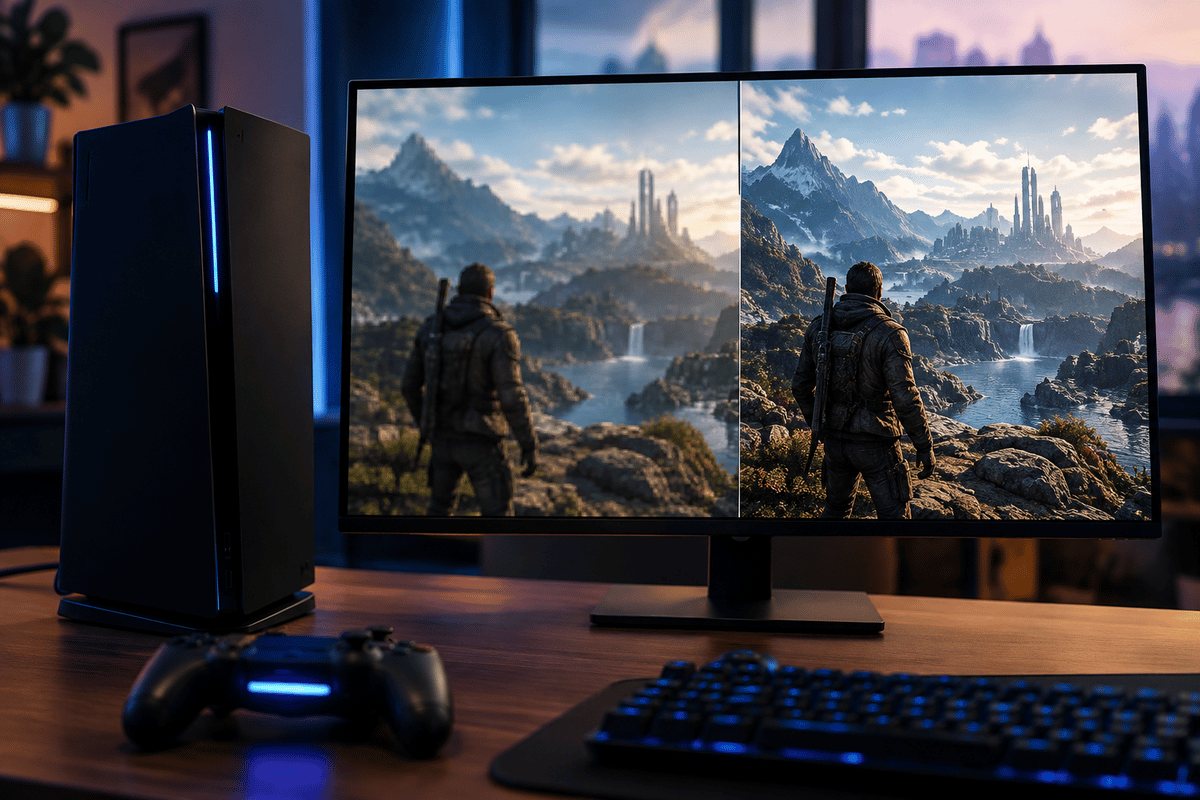
Thin geometry creates particularly difficult cases. A distant wire or narrow branch can occupy less than one pixel in the internally rendered image. Small movements change how that feature is sampled, causing it to appear, disappear or vary in brightness. Better sub-pixel preservation means the feature remains more coherent as those samples change.
In Marvel’s Wolverine, QSSR improves that coherence alongside pixel-level environmental clarity. Insomniac Games head of technology Mike Fitzgerald identifies clarity and stability as the benefits in environments including Madripoor and Shinjuku. During traversal, distant structures and small environmental features are more useful tests than a close-up of a large, already well-resolved surface.
Moving foliage is another demanding target: many small edges change position simultaneously. QSSR reduces visible breakup here in Wolverine. Ghost of Yōtei also gains fine-detail stability. The results still need judging game by game, rather than assuming the QSSR label promises a uniform transformation.
Sharper detail and fewer artifacts are separate gains
Detail retention concerns whether small features remain legible: distant geometry, surface patterns and narrow objects. Artifact control concerns errors introduced while reconstructing them, including ghost trails, smeared edges, flicker and noisy transitions. An image can improve in one area while retaining weaknesses in another.
That distinction makes television sharpening a poor substitute for evaluating QSSR. Sharpening can increase edge contrast, but it cannot restore consistent information when a thin object disappears between frames. It can also make existing flicker more conspicuous. Keep the display’s sharpening unchanged when comparing reconstruction modes.
Reflections, transparent surfaces and newly revealed background detail deserve separate inspection. These are difficult reconstruction cases because the image information changes quickly or behaves differently from solid geometry. Cleaner foliage does not guarantee equally clean reflections.
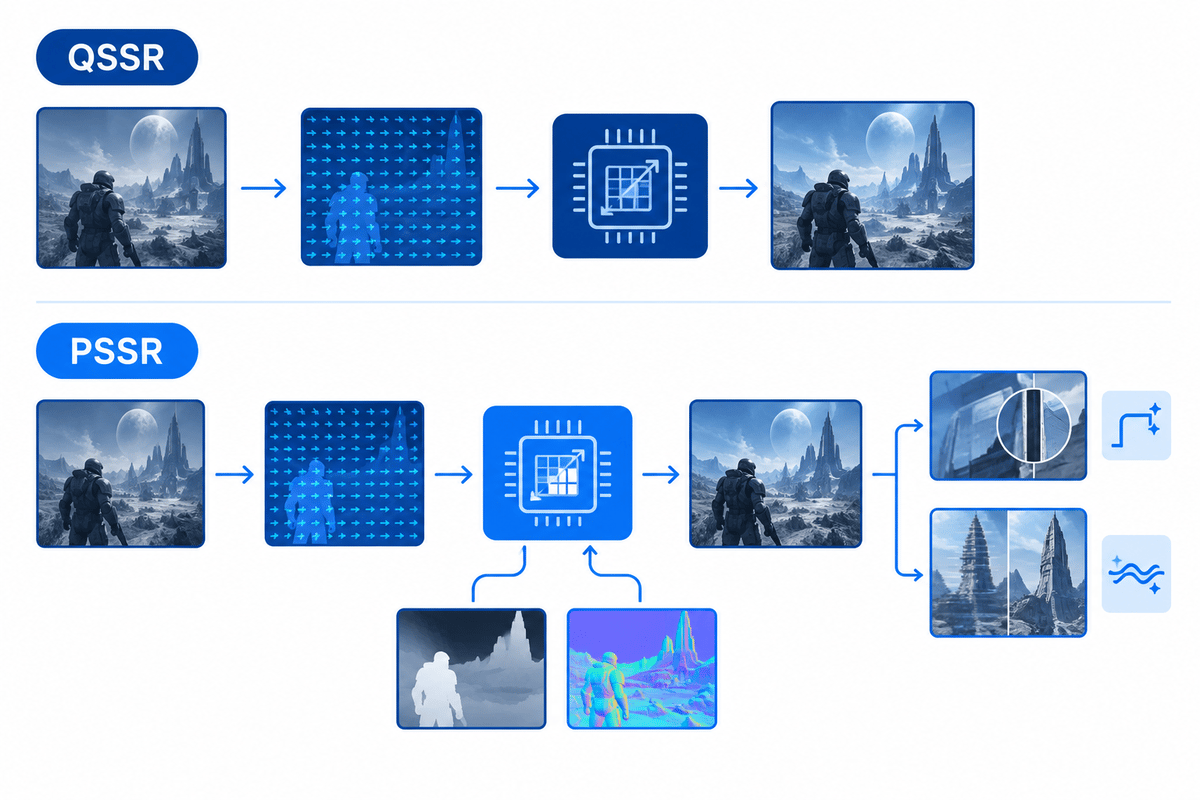
Here, AI refers to image reconstruction. QSSR estimates a higher-resolution representation of the game’s rendered image. Frame generation—creating additional frames between rendered ones—is a separate technique, not a benefit implied by QSSR support.
Reconstruction still takes time from the frame budget
“Quick” deserves scrutiny. A 60fps target allows approximately 16.7 milliseconds per frame; a 30fps target allows approximately 33.3 milliseconds. Reconstruction must share that time with the rest of the rendering workload. These are frame-budget limits, not performance measurements for either launch game.
In Marvel’s Wolverine, QSSR added approximately 1.5–1.8 milliseconds of frame time compared with Insomniac’s existing upscaler when reconstructing an 864p internal image to 1440p output in an uncapped performance-mode test with variable refresh rate (VRR) enabled. Uncapped means the test allowed frame rate to run beyond the mode’s usual limit, exposing differences that a fixed cap might conceal.
In an uncapped fidelity-mode test targeting 2160p output, the additional cost rose to approximately 4.4 milliseconds per frame. That is not another measurement of the same 864p-to-1440p workload: both the graphics mode and output target differed. It makes 1440p a more comfortable reconstruction target in these tests, but neither figure is a universal QSSR penalty.
A developer can spend processing time on better reconstruction, higher internal resolution or more demanding effects. Those choices interact. Reducing internal resolution may create room for QSSR, but it also gives the upscaler less source detail to work with. Dynamic-resolution scaling, which adjusts the internal pixel count as workload changes, can help preserve a frame-rate target by making that tradeoff automatically. Raising the output target can increase reconstruction demands without changing the underlying assets.
That makes graphics-mode comparisons essential. A cleaner image has limited appeal if it comes with distracting frame-time spikes during traversal. Conversely, unchanged frame rate with more stable fine detail is a worthwhile improvement. QSSR’s name alone promises neither outcome.
Game patches determine support and menu behavior
QSSR support begins with Marvel’s Wolverine and Ghost of Yōtei. Sony is offering the technology to PlayStation developers, but each game needs its own integration. A PS5 system update does not retrofit it into the existing library.

Marvel’s Wolverine version 1.002 enables QSSR by default. For an on/off comparison, check whether the installed patch and selected graphics mode offer a separate reconstruction toggle. Do not assume that every supported game presents QSSR as a selectable setting.
Broad developer access is not a release schedule for other titles, nor a promise that every existing PS5 game will receive a patch.
How to compare QSSR fairly
- Record the console and game version. Separate standard PS5 results from PS5 Pro results, and check that the installed game patch includes QSSR support. For Wolverine, version 1.002 is the relevant initial patch.
- Keep the graphics mode fixed. Compare performance mode with performance mode, or fidelity with fidelity. Switching modes can change internal resolution, effects and frame-rate targets alongside reconstruction.
- Check whether reconstruction can actually be toggled. If QSSR is applied automatically and no previous upscaler remains selectable, the current menu cannot provide a direct on/off test.
- Hold output settings constant. Use the same output resolution, HDR, VRR and television sharpening settings. Changing these can obscure the reconstruction difference or alter how motion looks.
- Repeat a moving scene. Use the same camera path past foliage, wires, fences or distant environmental detail. Watch for disappearing features, crawling edges and trails behind moving objects.
- Assess motion and frame delivery together. Look for reconstruction breakup during pans and uneven delivery during traversal. A VRR display can soften some fluctuations, so keep VRR consistent between comparisons.
- Evaluate the result from your normal seat. Magnified captures help explain artifacts, but the buying or graphics-mode decision should reflect what remains visible during ordinary play.
A separate PS5 Pro comparison needs its own accounting for graphics settings and rendering targets. Even if the two consoles output the same resolution, they can reconstruct from different internal resolutions and render different effects. That comparison measures the complete modes, rather than isolating QSSR against PSSR.
Who benefits — and what remains limited
Standard-PS5 players bothered by crawling foliage, flickering thin geometry and background detail that disappears during movement stand to gain the most. Wolverine provides a concrete example: QSSR improves environmental clarity and stability without requiring a PS5 Pro. Its appeal is a less distracting image in motion, not simply a sharper paused screenshot.
The limits show up in processing cost and adoption. Higher output targets demand more reconstruction time, and developers may compensate by reducing internal resolution or adjusting other rendering work. Only patched games benefit. QSSR also leaves the PS5 Pro’s hardware advantage intact; it does not turn the standard console into a software-equivalent Pro.
FinalBoss // Gear
Level up your setup
01Best-selling PS5 gameson Amazon→02DualSense controllerson Amazon→03PS5 SSD upgrades (M.2 NVMe)on Amazon→04Discounted game keyson Kinguin→Affiliate links · As an Amazon Associate, FinalBoss earns from qualifying purchases.
Want to Level Up Your Gaming?
Get access to exclusive strategies, hidden tips, and pro-level insights that we don't share publicly.
Ultimate Tech Strategy Guide + Weekly Pro Tips