
Table of Contents (11)
A Tavern, A Deck of Cards, and One Very Tired Witcher
The first time I died in Reigns: The Witcher, it wasn’t to a cursed beast or botched potion. I was pelted full of Scoia’tael arrows mid-ballad, right as Dandelion was winding up to rhyme “Geralt” with “catapult.”
I’d spent that whole run buttering up humans – siding with guards, taking contracts from suspicious nobles, looking the other way when non-humans got the short end of the stick. My “Humans” meter hit the top, the “Non-humans” meter flatlined, and suddenly my heroic tale turned into “that time the witcher got turned into a pincushion behind a tavern.” Curtain down. New song.
I’ve sunk an unhealthy amount of time into both The Witcher 3 and the original Reigns, so this crossover was always going to have its hooks in me. After about 14 hours on PC, it’s exactly the kind of snack-sized Witcher chaos I wanted while we all sit around waiting for the next “real” Witcher game – messy, funny, and occasionally maddening in that very Reigns way.
How Reigns: The Witcher Actually Plays
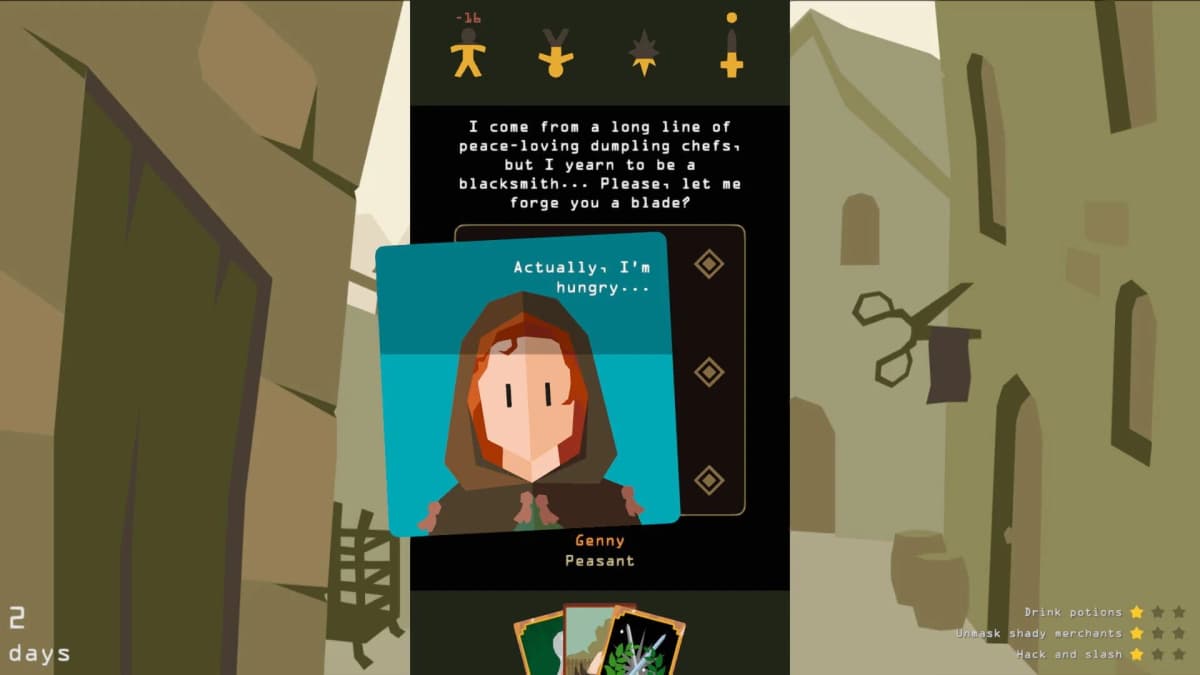
If you’ve never touched a Reigns game before, imagine a grim fantasy Tinder run by a drunk DM. Every “card” is a situation: a villager’s plea, a sorceress’ offer, a monster contract, a royal decree. You swipe left or right to choose your response, and each decision nudges a set of meters up or down.
In Reigns: The Witcher, those meters are:
- Humans – peasants, nobles, guards, the usual troublemakers
- Non-humans – dwarves, elves, Scoia’tael rebels
- Sorcerers – mages, Lodge politics, magical types with agendas
- Witcher – Geralt’s dedication to the Path and monster hunting
Let any of those meters completely empty or completely fill, and something bad happens. Too cozy with humans, and the Scoia’tael treat you like a training dummy. Too chummy with non-humans, and the city guard strings you up for treason. Ignore sorcerers, and you’ll find out exactly how creative a mage can be when she feels snubbed.
The magic of Reigns has always been in how simple the input is versus how chaotic the outcomes get. You only ever choose left or right, but the card pool is enormous, and the writers lean hard into consequences. One run I decided Geralt was done with the Path and just wanted to open a bakery. That decision echoed for cards and cards, until I ended up managing bread prices and negotiating with a troll about flour. Another time I played Hardline Witcher, took every monster contract I could, and ended up as a borderline war criminal.
The framing device is clever: you’re technically playing as Dandelion (Jaskier, if you know him from the show), sitting in a tavern, spinning wildly embellished ballads about “the legendary Geralt of Rivia.” Each run is a different performance, with Dandelion improvising based on three guiding themes called Inspirations.
Balancing Factions Without a Quest Log
What struck me after my first couple of hours is how quickly my brain stopped thinking in “moral choices” and started thinking in “meter management.” Helping a poor human village feels nice until you glance up and notice the non-human bar is scraping the bottom, and you can almost feel that elf archer taking aim in the distance.
There’s no traditional quest log, no “+5 reputation with mages” pop-ups. It’s all vibes and gut feeling, backed up by tiny meter nudges represented by subtle icons on each card. You’re constantly trying to keep everything vaguely in the middle while also chasing your run-specific goals, which is where Inspirations come in.
Inspirations: The Real Quest Log Hiding in Your Ballad
Each run starts by picking (or being assigned) three Inspirations. Think of them as the chapters or themes of the song Dandelion is about to perform. There are 51 of these in total, and they’re the backbone of progression: completing them unlocks new cards, characters, monsters, and eventually alternate endings.
They’re also where the game’s best jokes live. Examples from my sessions:
- Geralt the Equine – a run obsessed with Roach, full of cards about pampering your long-suffering horse and taking his opinions very, very seriously.
- Geralt the Baker – a mid-life-crisis Geralt deciding he’d rather knead dough than neckers, quickly escalating into economic drama.
- Geralt the Shedder – a cursed snakewoman, a tangle of moral choices, and one extremely stubborn puzzle.
Each Inspiration has an objective that isn’t always spelled out clearly. Sometimes it’s as straightforward as “be kind to Roach X times.” Other times it’s more abstract, like “find a specific resolution to this curse,” which might require not just one particular choice, but a whole sequence in the right order, with the right faction balances.
When the Game Gets Too Clever for Its Own Good
For the most part, I enjoyed treating Inspirations like little narrative puzzles. I’d spot a familiar setup, think “ok, last time I chose the pragmatic option and that failed, what if I lean fully into Witcher stoicism this time?” and slowly piece together the right outcomes over multiple runs.
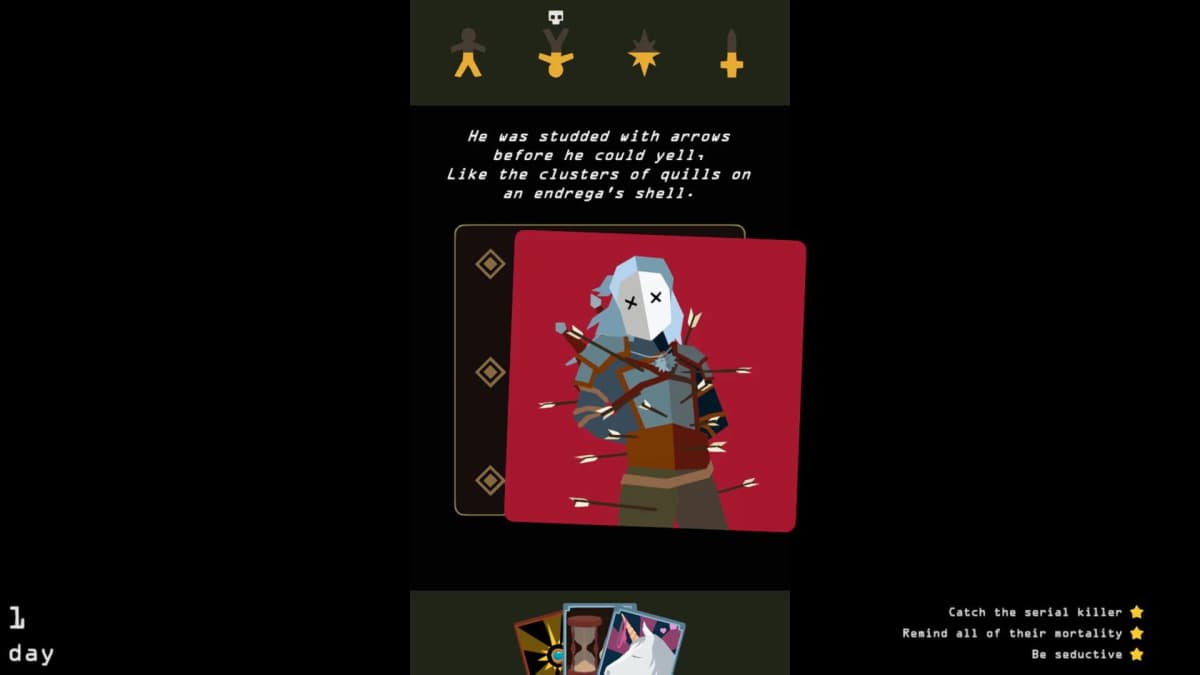
But some of them cross the line from “intriguing mystery” into “I’m mashing my head against this card again.” Geralt the Shedder was my white whale. I knew the NPC, recognized the setup, tried every seemingly reasonable combination of empathy and professionalism, and still failed to crack it for hours. The writing gets deliberately vague to preserve the twist, but with the meters also threatening to kill you at any moment, it can feel like you’re fighting the system as much as solving a story problem.
There’s a hint system of sorts in how Inspirations evolve and how cards repeat with slightly altered lines, but if you’re the kind of player who hates not understanding what the game wants from you, expect a few spikes of frustration. It’s the trade-off for a design built entirely around experimentation and countless possible little Geralt what-ifs.
The Writing: Dandelion’s Funniest Tour Yet
My biggest worry going in was tone. The Continent is, famously, miserable. Racism, pogroms, cursed swamps, child-eating beasts – it’s not exactly a natural fit for a silly card-swipe game. The trick Reigns: The Witcher pulls is embracing the one character who would absolutely turn all of this horror into comedy: Dandelion himself.
Framing every run as one of Dandelion’s ballads gives the game permission to exaggerate, parody, and remix Witcher lore without breaking anything. Of course there’s a version of events where Geralt becomes a baker, or where every single decision is somehow about Roach. Of course he once got cut in half by a portal mid-step. Are these canon? Absolutely not. Are they exactly the kinds of stories a drunk bard would insist are “totally how it happened, I swear”? Yes.
The references are constant but rarely lazy. If you’ve read the books, played the CD Projekt games, or watched the show, you’ll recognize situations and characters twisted just a few degrees for comedic effect. A familiar sorceress shows up not to angst, but to nag Geralt into attending a fancy party. A classic monster contract spirals into civic bureaucracy hell. Even grim topics – pogroms, political coups, Nilfgaardian scheming – get this slightly absurd edge that feels right for Dandelion-with-a-lute, not for Geralt-on-a-quest.
Importantly, the game doesn’t completely defang the world. Bigotry and injustice are still there; you just view them through a lens of chaotic storytelling. I had a run where I leaned too far into helping mages escape persecution and ended up juggling riots and witch hunts while Dandelion tried to spin it as a “hero saves the day” tale. The joke landed, but there was still that sting of “I tried to help and still made it worse,” which is very Witcher.
If you’re coming in expecting deep, lore-expanding narrative on the level of a mainline RPG, that’s not what this is. These are flashes, sketches, punchlines, and what-if scenarios. For me, as someone who just wanted to dip back into this world in ten-minute bursts, it was perfect.
Combat on a Falling-Tile Grid: Surprisingly Stressful
Mechanical twist time: in previous Reigns games, “duels” were basically just glorified coin tosses or stat checks. In Reigns: The Witcher, whenever your Witcher meter fills up (you’ve been a very diligent monster slayer) or a particular card demands it, you’re yanked into an actual mini-game.
Combat plays out on a vertical grid. Geralt stands on the bottom row, and you swipe left or right to move him across three lanes. From the top, tiles fall down like a slow, sinister version of a match-three game: enemy attacks, your sword strikes, signs, and hazards. When a tile reaches the bottom row, whatever’s on it triggers.
Your job is to avoid enemy attack tiles while maneuvering Geralt onto your own attack tiles and Witcher sign tiles. Every monster – drowners, leshens, trolls, dopplers and more – has its own pattern of attacks and health pool. It sounds dead simple, but the timing is what messes with you. Geralt moves at a fixed rhythm, tiles fall at their own pace, and the windows to sidestep or snag a sign can be really tight.
Signs are the real game-changer here:
- Quen lets you eat an incoming hit without consequence.
- Igni burns the target without needing a sword tile.
- Others slow enemy tiles, shove them away, or clear sections of the board.
At the start, you’re stuck with weak versions of these, and combat honestly kind of sucks. I got blindsided by an early leshen fight where the attack tiles may as well have been carpeting the board. I knew what I needed to do – bait one line of attacks, dash over to a sword tile – but my signs were too feeble and the rhythm too punishing. Game over, new life, back to the tavern.
As you win battles, your signs upgrade, and the whole system settles into that nice Reigns groove of “simple but tense.” You start to read the board at a glance, accept that sometimes you’ll tank a hit to line up a better counter, and feel properly like a witcher reading a monster’s tells.
RNG, Difficulty Spikes, and the “One More Run” Trap
The downside is that combat is one of the places where randomness bites hardest. Because the main card deck, your current meters, and which monster you face all influence when fights happen, you can occasionally get utterly wrecked by a bad matchup with underpowered signs. The game is generally pretty good at front-loading easier beasts and saving the nastier patterns for later, but not always.
I had a run where I was finally, finally on track to complete two stubborn Inspirations at once. Everything was balanced, I’d solved the narrative puzzle, and then a late-run monster fight showed up with an attack pattern I simply wasn’t equipped to handle. Ten seconds of panicked swiping later, Geralt was dead and Dandelion was probably apologizing to the crowd for the abrupt ending.
I wasn’t angry enough to quit, but I did hit that classic roguelite headspace: “I know I can do this, just one more run.” Three runs later, I’d overshot a different meter, accidentally retired Geralt into quiet obscurity, and still hadn’t nailed that Inspiration. If you love that back-and-forth between luck and mastery, it’s addictive. If you hate the idea of a random tile ruining a carefully constructed narrative setup, you’ll feel that sting more than once.
Structure, Repetition, and Song Puzzles
Reigns games live and die on repetition. You’re meant to see cards multiple times, gradually understanding how they branch and how they link to other events. Reigns: The Witcher is no different – if anything, it leans even harder into this because of the Inspiration system and the sheer number of endings and unlocks hidden in the deck.
Runs are short. Most of mine lasted between 5 and 15 minutes depending on how reckless I was with the meters. That makes it perfect for dropping in for a quick session, but if you sit down for a long evening trying to chase specific outcomes, the repetition starts to show. By the time I was 10 hours deep, certain cards triggered an almost Pavlovian eye-roll: “ah yes, here’s that village again, I know exactly what I have to say to keep the non-humans meter from exploding.”
The game does try to shake things up with “Song Puzzles” – special moments where NPCs ask Dandelion to perform a specific tale. You’re shown a short prompt and asked to pick from a set of Inspirations you’ve already completed, matching the right story to the right request. It’s a cute way to turn your meta-knowledge of past runs into actual gameplay and to remind you of the weird stuff you’ve already pulled off.
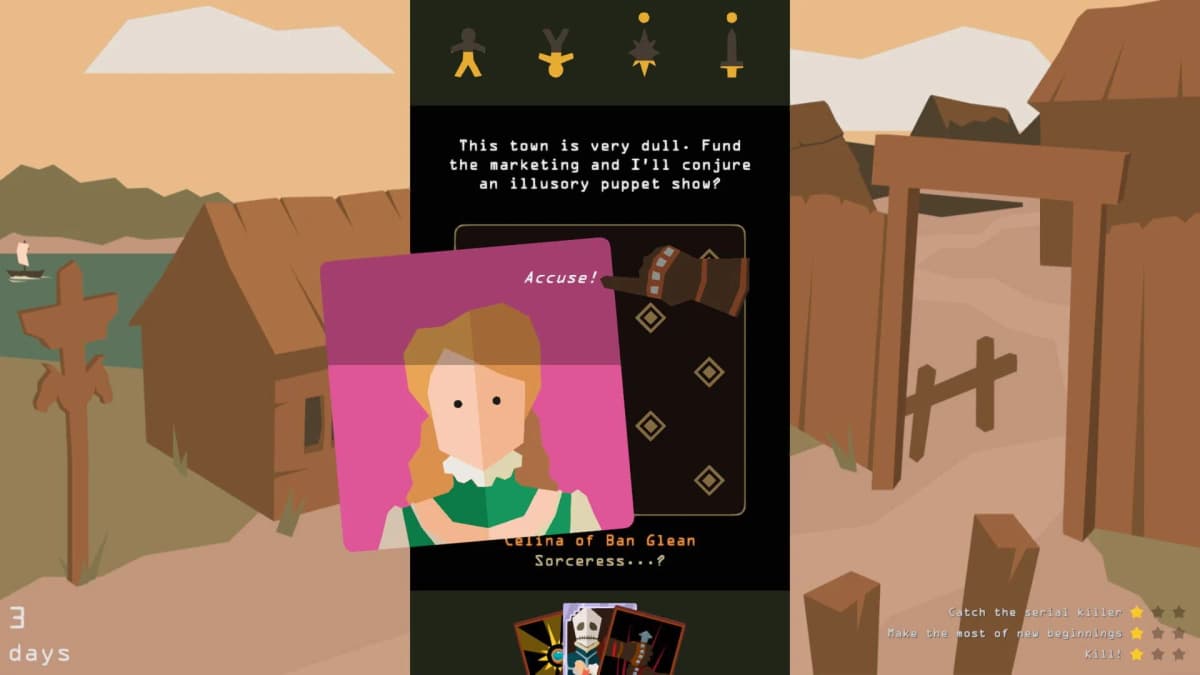
Still, if you’re the type who wants to 100% everything, be warned: those last few Inspirations and secret endings are going to ask for a lot of patience. You’ll be swiping through a sea of familiar setups hunting for that one rare branch you haven’t nailed yet.
Performance and Feel on PC
On the technical side, there isn’t much drama to report. This is a lightweight 2D game; on my mid-range PC it ran flawlessly at 1080p without a single hitch. Load times are basically instant, which matters more here than in bigger games because you’re constantly dying and restarting.
Mouse controls feel natural – you can swipe with click-and-drag or just click the left/right icons. I ended up mostly using quick mouse flicks; there’s something satisfying about physically “throwing” a bad decision off to the side and watching the meters wobble in response.
Visually, it nails a sort of storybook Witcher look: silhouettes, bold colors, exaggerated portraits of familiar faces, just enough detail to sell who’s who without overcomplicating the panel. The UI conveys the state of your meters with simple symbols and clear positions, which is crucial when one bad swipe can end a run. Audio-wise, you get jaunty tavern tunes and subtle stings when you push a faction too far or trigger a death, which really helps sell the sense that Dandelion is performing this whole fiasco live.
Who Should Actually Play This?
This is one of those weird crossovers that sounds niche on paper, but in practice hits a surprisingly wide sweet spot.
- If you love The Witcher and don’t mind the world being treated with a bit more silliness, this is a really charming way to revisit familiar characters without committing to a 100-hour RPG.
- If you love Reigns, this is easily one of the best-themed entries. The faction meters map naturally onto Witcher politics, and the addition of real-time-ish combat gives the formula a welcome twist.
- If you’re a pure story gamer who hates repetition and RNG, you might bounce off the roguelite structure and the more opaque Inspirations.
- If you’re Witcher-curious but unfamiliar, you’ll miss a lot of references, but the humor still works. You just won’t appreciate how wildly non-canon some of these ballads are.
Personally, it’s slotted perfectly into that “I have 20 minutes before bed” space. Fire it up, swipe through a couple of doomed Geralt lives, laugh at a new punchline, maybe unlock a new monster or story branch, and log off.
FinalBoss // Gear
Level up your setup
01Top-rated gaming headsetson Amazon→02High-refresh gaming monitorson Amazon→03Gaming chairson Amazon→04Discounted game keyson Kinguin→Affiliate links · As an Amazon Associate, FinalBoss earns from qualifying purchases.
Want to Level Up Your Gaming?
Get access to exclusive strategies, hidden tips, and pro-level insights that we don't share publicly.
Ultimate Reviews Strategy Guide + Weekly Pro Tips