
Table of Contents (9)
Remembering My First Night in Woodsboro
I remember the first time I watched Scream on a fuzzy VHS tape at a friend’s house. Someone’s older brother had “borrowed” it from Blockbuster, the lights were off, and the volume was way too loud for midnight in the suburbs. By the time the phone rang in that opening scene, everyone in the room had gone quiet in a way no other horror movie managed back then. Rewatching it now, 30 years later, on a far-too-crisp 4K stream, I was half-expecting the spell to be broken by dated tech and ‘90s hair.
Instead, it hit me how much this thing still hums. Scream hasn’t just aged “surprisingly well”; it’s basically the Rosetta Stone for modern horror self-awareness. The cordless landline phones, the thick CRT TVs, the video-store aisles-those are period details. The way Wes Craven and writer Kevin Williamson juggle tension, sarcasm and outright genre theory? That’s still sharper than Ghostface’s knife.
Going back to Woodsboro in 2026 isn’t just nostalgia tourism. It’s a reminder of how close the slasher was to flatlining in the mid-’90s, and how one movie that wouldn’t shut up about horror rules ended up jump-starting the whole genre.
Key Takeaways After 30 Years
- The opening 13 minutes with Drew Barrymore are still an all-timer, horror or otherwise.
- Scream’s real magic is how it balances genuine scares with self-aware comedy.
- The whodunnit plot is serviceable but conventional; it’s the tone and characters that endure.
- Some logic gaps and ‘90s attitudes pop more on rewatch, but meta-humor cushions the blow.
- Its influence on later slashers, TV, and even horror games is impossible to miss.
That Opening Call: Thirteen Perfect Minutes of Terror
Every time I revisit Scream, I tell myself I’ll pay more attention to the rest of the movie, not just the Drew Barrymore sequence. And every time, that opening completely owns the room again.
Craven stages it almost like a short film. Casey Becker (Barrymore), popcorn on the stove, phone in hand, is framed in these deceptively casual, gliding shots around the house. The camera doesn’t leap into chaos immediately; it just stalks. Subtle Dutch tilts creep in as the conversation goes from flirty to unsettling. The closer the killer’s questions get to “What’s your favorite scary movie?”, the more the lens presses into Barrymore’s face, clamping down on any sense of safety.
What struck me on this anniversary rewatch is how conversational the terror is. Roger L. Jackson’s voice performance on the phone is still chilling-amused, almost charming, then suddenly guttural and vicious. Barrymore plays her fear with this mix of teen annoyance and dawning dread; she doesn’t turn into a trembling horror-movie victim right away. It feels like someone actually realizing, in real time, that this isn’t a prank.
And then, of course, Craven yanks the rug: the star on the poster dies before the title card. Even knowing it’s coming, watching that scene again is like re-listening to a song that changed your taste in music; you can feel the entire genre pivoting while it plays. If Scream only consisted of those 13 minutes, we’d still be talking about it. Luckily, the rest mostly holds up its end of the bargain.
Meta-Horror Before It Was a Marketing Bullet Point
Seen from 2026, the idea of a horror movie that jokes about horror tropes isn’t exactly radical. We’ve had decades of meta slashers, cabin-in-the-woods deconstructions, and “elevated” horror that practically comes with a thinkpiece starter kit. But in 1996, this was borderline heresy.
Craven, who’d already toyed with the concept in New Nightmare, and Kevin Williamson understood something crucial: you could point at the formula and still make it work. The kids in Woodsboro know the rules-don’t say “I’ll be right back,” don’t have sex, don’t answer weird calls during a news-worthy murder spree—and yet they’re still pulled into the machinery of a slasher. Randy (Jamie Kennedy) literally explains how these movies work while one is happening to him.
What surprised me on this rewatch is how lightly Scream holds that meta layer. It’s not a thesis statement, it’s just the way these characters talk. The jokes about sequels, final girls, and horror clichés arrive as banter in hallways, background chatter at parties, or tossed-off asides from a fed-up Sidney Prescott (Neve Campbell), who’s frankly tired of being compared to slasher heroines. It never feels like the movie pausing to lecture you.
That’s the real balancing act here. The comedy doesn’t undercut the horror; it builds familiarity so that when things finally go wrong, it stings more. Craven lets you relax into the rhythms of teen trash talk, sarcastic reporters, and small-town gossip, then punctures it with sudden, ugly violence. One minute you’re laughing at a running joke about how horror movies are trash; the next, you’re watching a character get gutted while the soundtrack drops out. It’s tonal whiplash, but it works because the film keeps reminding you: people in horror movies never think they’re in a horror movie.
The Ensemble That Glues It All Together
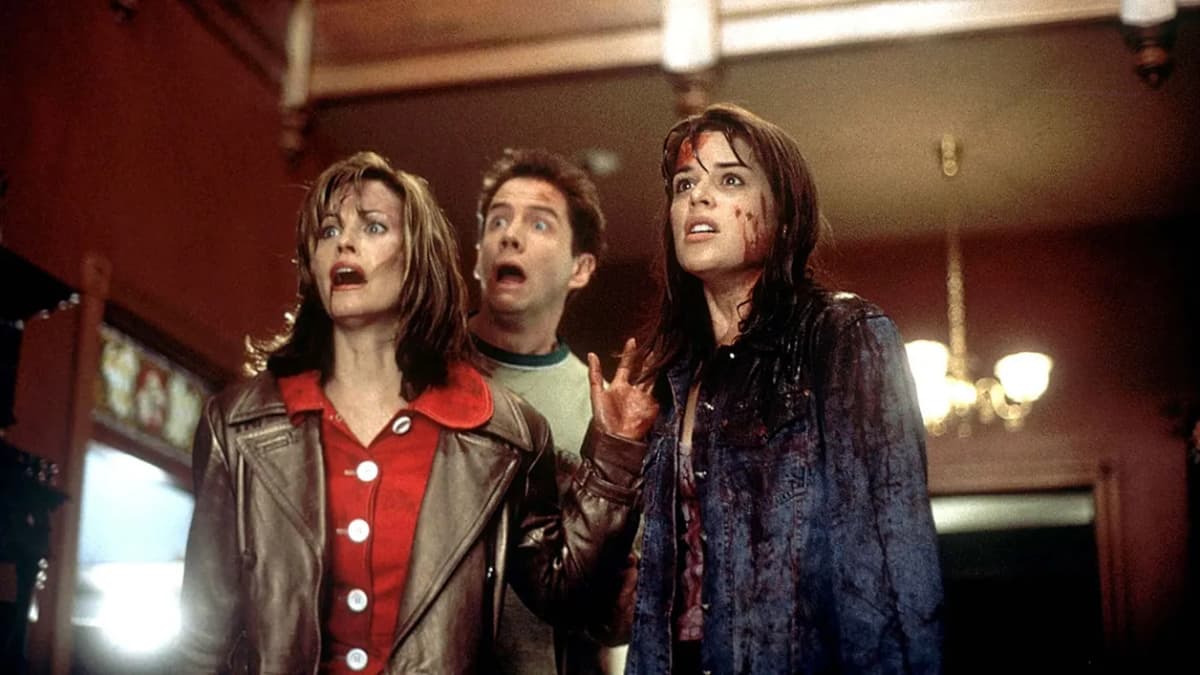
Meta jokes and clever structure don’t matter if you don’t care who’s bleeding. That’s where the cast sells Scream as more than a film-nerd exercise.
Neve Campbell’s Sidney is still one of the best “final girls” horror’s put on screen. What stands out now is how grounded she feels. She’s not a scream queen caricature; she’s exhausted. Her mother’s murder hangs over every hallway conversation, every tabloid headline, every look she gives her boyfriend Billy (Skeet Ulrich) when he pushes for intimacy she’s not ready for. Campbell plays Sidney like someone who’s already survived one horror movie before the runtime even starts.
Then there’s David Arquette’s Dewey, the town deputy who walks this tightrope between comic relief and genuine heart. On paper, he’s the bumbling cop the script can mock, but Arquette leans into Dewey’s insecurity in a way that makes him oddly endearing. He wants to be taken seriously by his boss, by his sister Tatum (Rose McGowan), by tabloid shark Gale Weathers (Courteney Cox), and by the narrative itself. Dewey’s the one character who seems aware he’s not cut out to be the swaggering movie cop, and that makes him fit perfectly in a film all about subverting types.
Speaking of Gale: Courteney Cox’s performance hits differently now that we’ve all marinated in decades of true-crime sensationalism. In ‘96, she was the punchable TV reporter chasing ratings; in 2026, she feels like a prototype for every exploitative docuseries host you’ve rolled your eyes at. Cox gives Gale just enough conscience that when she does the right thing, it feels like growth instead of a plot requirement.
Rounded out by Matthew Lillard’s unhinged Stu, Kennedy’s movie-obsessed Randy, and Ulrich’s dirtbag Billy, the cast locks into a tone that lets Scream swing between goofy and brutal without snapping. Nobody’s playing it completely straight, but nobody winks so hard they break the frame.
The Whodunnit Under the Mask: Fine, Not Fantastic
Watching Scream for the first time, the big reveal of who’s under the Ghostface mask lands as a genuine jolt. Rewatching it for the fifth or tenth time, the murder-mystery scaffolding shows its seams a bit more.
The structure is pretty classic: early shocks, a handful of suspicious side characters, some conveniently timed disappearances, and a big, talky finale where the killers explain their motives. Other than the opening curveball of killing a marquee star, the actual order of deaths and red herrings follows a familiar pattern. Someone was going to die in the garage. Someone was going to die because they went off alone at a party. Someone was going to deliver a monologue about media violence.
That’s not necessarily a failure; part of the film’s point is that it follows the rules so it can comment on them. But on this anniversary rewatch, I found myself less invested in who did it and more interested in how the movie frames that question. The whole backstory with Sidney’s mom, the tabloid scandal, and the high-school-boy rage brewing under it all is functional, yet not exactly the part of Scream that sticks in your memory. It feels like the necessary connective tissue for a story that cares more about how we consume horror than the specifics of this one case.
Plot Holes, ‘90s Attitudes, and Why Scream Mostly Gets Away With It
When you already know the twist, it becomes alarmingly easy to poke holes in Ghostface’s logistics. On this rewatch, I caught myself doing horror math: okay, if that killer is here on screen, how did they have time to stage that body across town? How is nobody soaked in beer and blood after half the party pelts them with bottles? Why is that garage door opener strong enough to haul a full-grown person to their doom like a forklift?
The honest answer is: because it makes for a good scare. Ghostface appears where he needs to appear because the film is structured for maximum shock, not airtight logistics. You only really notice once the mystery is solved and you’re watching with a stopwatch instead of a pulse.
There are also character beats that clang louder with 30 years of hindsight. Billy’s pressure on Sidney to sleep with him plays now like weaponized manipulation—an intentional red flag, sure, but still uncomfortable in a way the film doesn’t fully interrogate. Some of the throwaway jokes about assault and victim-blaming feel very ‘90s in the worst way. The movie isn’t endorsing those ideas, but it also doesn’t linger on the damage they cause.
Yet here’s where the meta sheen helps and hurts at the same time. Because Scream is constantly pointing at tropes—“look, here’s the horny boyfriend, here’s the media leech, here’s the disposable best friend”—it buys itself some leeway. You’re meant to recognize and critique these patterns as you watch. At the same time, that self-awareness can be a shield. The script can sometimes lean on “we know it’s bad, that’s the joke” instead of fully rethinking the trope.
For me, those dated edges ding the movie slightly, but they don’t break it. If anything, they highlight how much horror, and conversations around it, have evolved since Scream first carved up a generation that grew up on VHS.
Ghostface’s Long Shadow: From 90s Slashers to Horror Games
It’s one thing to say Scream revived the slasher; it’s another to zoom out and actually see the crater it left. Within a few years of its release, the multiplex was drowning in sharp-object teen movies: I Know What You Did Last Summer (also written by Williamson), Urban Legend, Cherry Falls, plus the inevitable parodies like Scary Movie. Even if you’ve never seen the original Scream, you’ve seen its DNA replayed and twisted a hundred times.
The franchise itself refuses to die, of course. Five sequels and a TV show later, Ghostface has survived shifts from VHS to streaming, landlines to smartphones, and old-school fandom to Reddit true crime sleuthing. Each new entry has tried its own flavor of meta—commentary on sequels, trilogies, reboots, and “requels”—but the first film remains the cleanest, most focused version of the idea.
Because I mostly write about games, I couldn’t help but notice how much Scream anticipates the way modern horror games talk to players. When Randy lectures everyone about horror rules, it feels like the in-game tutorial character in a slasher title, laying out mechanics you’re about to break. When characters debate the morality of watching violence, it echoes the kind of self-aware commentary you see in games like Until Dawn, The Quarry, or even Alan Wake 2, which all poke at their own genre while still trying to scare the hell out of you.
Even the basic Ghostface setup—a masked killer who’s frightening not because of supernatural powers but because they could be anyone in your friend group—is catnip for multiplayer horror. It’s hard not to see flashes of Dead by Daylight lobbies or asymmetrical “one killer, many victims” game design in the film’s party massacre finale. You’ve got players who know all the tropes, think that knowledge will save them, and still get picked off because someone else is dictating the rules of the game.
That’s Scream’s enduring trick: it makes horror feel like a game everyone thinks they’re winning until the bodies pile up.
Does Scream Still Work for First-Timers in 2026?
Rewatching a movie you grew up with is one thing; showing it to someone new is the real test. I put Scream on recently with a younger friend who’d somehow only seen the newer sequels and knew Ghostface more as a Halloween costume than a character. I was bracing for the dreaded “This is it? This is what you’ve been raving about?” reaction.
Instead, they jumped at the same beats, laughed at the same snarky lines, and immediately started comparing it to more recent meta-horror and slasher games. The old tech didn’t bother them—in fact, the absence of smartphones made some scenes feel even more claustrophobic. “Just text someone” isn’t an option when you’re trapped in a house with a killer and the phone line’s been cut.
The only moments that really pulled them out were the occasional clunky exposition dump and a couple of those ‘90s jokes that land like a brick now. But the overall verdict from a fresh set of eyes was the same as mine: this still feels alive. Not like a museum piece, but like the slightly older, cooler cousin of the horror we have now.
FinalBoss // Gear
Level up your setup
01Top-rated gaming headsetson Amazon→02High-refresh gaming monitorson Amazon→03Gaming chairson Amazon→04Discounted game keyson Kinguin→Affiliate links · As an Amazon Associate, FinalBoss earns from qualifying purchases.
Want to Level Up Your Gaming?
Get access to exclusive strategies, hidden tips, and pro-level insights that we don't share publicly.
Ultimate Reviews Strategy Guide + Weekly Pro Tips