

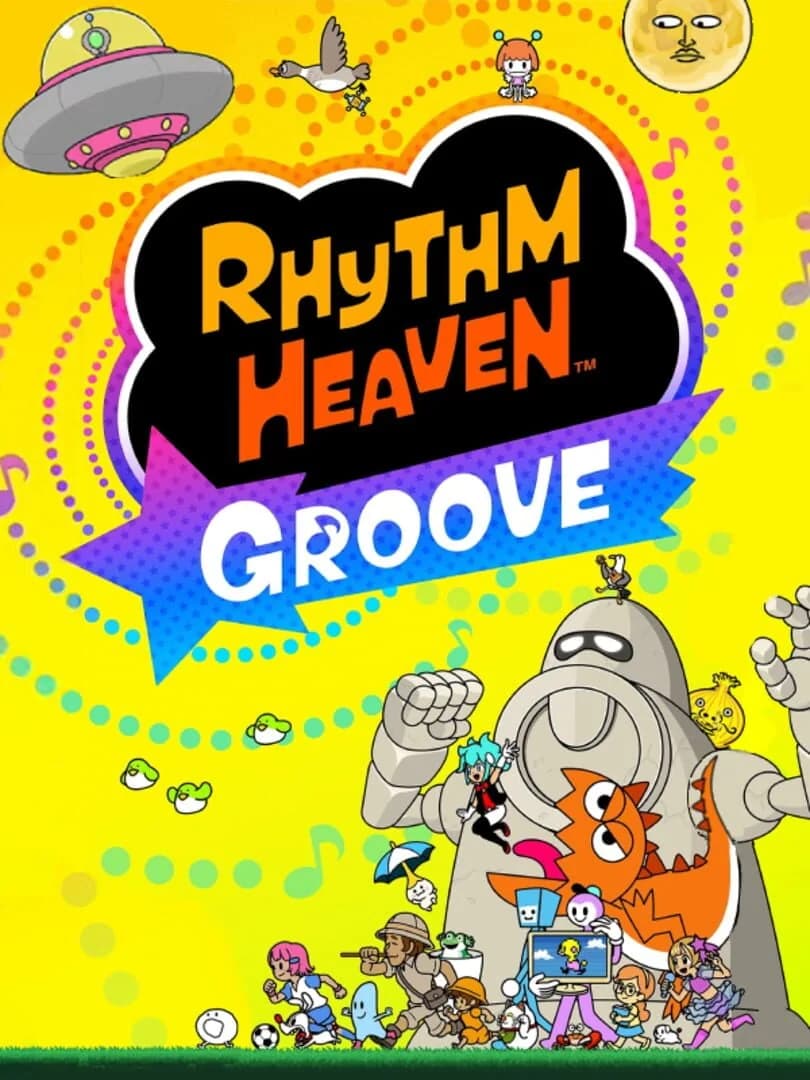
The series started as Rhythm Tengoku, a Japan-only Game Boy Advance game from 2006 that Tsunku pitched to Nintendo himself. It went to DS, then Wii, then 3DS, and stopped: Megamix landed in 2016 and that was that for a decade. Rhythm Heaven Groove — Rhythm Paradise Groove if you’re in Europe — is the return, it’s Tsunku on music again, and it arrives as the odd, low-key encore for the original Switch rather than a Switch 2 showpiece. It’s £33.99, it’s about eight hours to roll the campaign credits and closer to fifteen to see everything, and it is very good at the thing it has always been good at.
Table of Contents (4)
Eighty Mini-Games, Eight Stages, And One Very Good Trick
The structure is four mini-games to a stage and then a fifth slot that remixes those four into a single continuous run, eight stages deep. You need at least a Good on everything in a stage plus its remix to move on; an Amazing earns a medal, and medals are the currency for the Rhythm Toy Box, the Rhythm Reference, a jukebox and a pile of other unlockables. Below Good you get told to Keep Trying, which is exactly as smug as it sounds when you’ve just been beaten by a cartoon dog.
The trick that separates this from every other rhythm game is that there’s no note highway. Nothing scrolls toward a judgement line. You learn a pattern from the animation and the vocal cue, and then the game deliberately takes the picture away from you. In Disc Dog you count down from seven before telling the pup to jump, and halfway through the camera drifts off the dog and onto the woman throwing the frisbee, so the only thing left to work from is the sound. River Rocket has you firing frogs off a lily pad launcher until an amphibian wanders into frame and parks itself in front of the pads. In one beach stage you’re chaining crab hits to bury food in the sand and someone shoves a drinks can into the lens. Same idea every time: prove you’re listening, not looking. Landing a run blind is the best feeling the game has.
The variety is absurd. Hop and Slide is a chunky-pixel bunny hurdles game framed as a school programming project that glitches out and blasts into hyperspeed halfway through. A for Effort scrolls words for drinks containing the letter A across mismatched stock photography. Wiper Bosses is two little aliens dodging windscreen wipers. Football Dream is a trap-and-volley with real weight. Slice and Dice Kitchen has you catching salad ingredients for the chop, plus probably the catchiest track here — a high bar in a soundtrack that hops between shredding guitar, sustained synth and straight percussion.
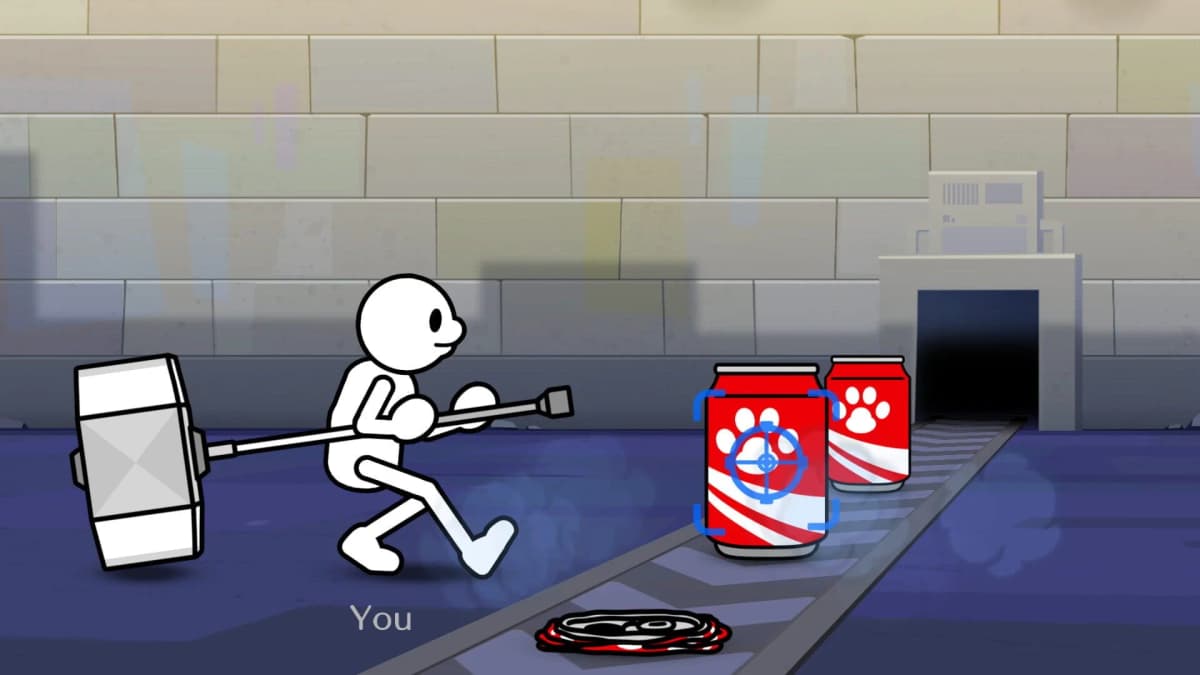
Not everything lands. Can Do, flattening cans with a hammer, and Yumbot Simulator, catching puddings off a conveyor and zapping the defective ones with laser eyes, are the two that refuse to click. There’s a split in the design nobody talks about enough: some of these are rhythm games, where once you’re in the pocket it’s hard to get wrong, and some are reaction games in rhythm clothing, where the pattern breaks and you’re just responding fast. The pure-rhythm ones are markedly better; the reaction-flavoured ones are where the frustration lives.
The remixes are the peak. In the individual games the beat sometimes sits beside the music rather than inside it — the mapping isn’t as tight as Theatrhythm, and you notice — but a remix stage stitches four songs and four control schemes into one long DJ set and everything welds together. That’s the moment the game is built for.
One structural gripe. Every mini-game runs a couple of minutes at most, and every one is preceded by a tutorial that walks the mascot through each new skill separately before layering them. It’s well built and it’s long, and the arrangement and tempo in the real stage often differ from the warm-up anyway — so you sit through the lesson and then get taught the actual thing by failing. On a fourth run at CRAZY CHA it’s an obstacle, not an on-ramp.
Beatspell Is Padding, And Here’s The Exact Reason Why
Beatspell was sold before release as the significant new thing. It isn’t. It’s a side mode, and the honest description is a light RPG on a fixed path of elemental monsters where you collect magic, items and buffs, upgrade them, and cast on the beat. The presentation is smart — spells sit on a diamond around your character so you read the different beats spatially, each node thunks out a meaty cymbal when your timing is exact, and perfect rhythm converts into a critical. Chapters unlock against medals earned elsewhere, later spells add real complexity, and once you’re locked in a battle can feel great.
Here’s the problem, and it’s structural rather than a matter of taste. A Beatspell fight is a war of attrition against a health bar, and a fight of indefinite length needs music that can loop indefinitely. So the music loops. And the single best thing about Rhythm Heaven — a two-minute song that goes somewhere, with a joke built into its arrangement — is the exact thing this mode has to give up in order to function. That’s why it feels like a grind rather than a rhythm game. It isn’t underbaked so much as fundamentally at odds with the rest of the package: the campaign is short songs with a punchline, Beatspell is a long song with a health bar.
So no, it isn’t a good addition, and I’d have taken twelve more mini-games instead. But it’s ignorable, and the game isn’t priced as though Beatspell is the point, so it costs the score less than it might have.
The Multiplayer Grid Is Better Than It Has Any Right To Be
There are 30 local multiplayer games on their own separate grid, up to four players, split between co-op and competitive, and rings rather than medals unlock their own toy box. Cake Wait is the standout and the simplest thing here: everyone counts to three in their head and swipes at the plate, closest to the millisecond takes it, first to three wins, and the loser’s reaction animation does more comedic work than most cutscenes. Tennis Quest is the co-op one — you take turns whacking a served ball at targets in your own lane, a whiff sends enemies swapping lanes, and you grind toward a boss together. Pattern Parchment has you delivering and defending packages with laser beams. Memorizing drops timed inputs entirely and asks you to pair beats on face-down cards, which is a strange and welcome thing to find in here. Elsewhere you’re racing wrestlers down a track, defending a caravan from arrows as a ninja, or tweezering hairs out of a sentient onion.
The 30 flatters it: a chunk of those unlocks are harder variants of something you just played, so it’s really ten or so ideas at three difficulty tiers each. But the Tomodachi Life text-to-speech engine reads out player names — any name inside the character limit, filters be damned — and that alone buys another hour with the right group.
Yes, The Docked Lag Is Real. Play It Handheld.
Take the position: the input and audio delay on a TV is a real problem, not a placebo, and the game knows it. Groove ships a calibration screen that asks you to tap A on the fourth beat for twenty or thirty seconds. Games that don’t have a latency problem don’t ship one of those. Run it, put the TV in game mode, do everything right, and a residual gap survives — worse, the calibration drifts, so a game you had comfortably aced starts failing you days later. Wireless headphones widen it further. Move to handheld or tabletop and everything tightens instantly; every miss becomes provably yours.
It isn’t universal — how bad it gets depends on your display, and a player who instinctively runs slightly ahead of the beat may never consciously feel it. But that’s a rough thing to have to hope for in a game that grades in milliseconds and gates half its unlockables behind Amazing ranks. Nothing about this is a Switch 2 problem specifically — the delay is on the display side of the cable, so newer hardware doesn’t buy you out of it, and no reviewer has flagged any meaningful difference between the Switch 1 and Switch 2 versions. This is a game to play with the console in your hands. There’s a demo; run its calibration on your own TV before you decide otherwise.
Two more things. It’s button-only — A plus a D-pad direction, the touchscreen unused, which reads as a downgrade if the 3DS stylus entries are your reference point. And the art keeps dropping thick-outlined cartoon characters onto photoreal backdrops; the sand in the crab stage is a photograph, and the juxtaposition is funnier than it should be.
The 8 is for the campaign: eighty mini-games and eight remixes that are still the sharpest, funniest expression of rhythm design anyone makes, held one notch below excellent by a side mode that fights the game’s own strengths and a docked experience you have to plan around.
Rhythm Heaven Groove
Eighty mini-games and eight remix stages that still make every other rhythm game look like it is reading you a chart, plus a soundtrack from the man whose idea this series was in the first place. It loses a notch for Beatspell, a side mode whose looping battle music fights the exact thing the campaign is built on, and for a docked experience that ships with a calibration screen and still cannot fully fix itself. Buy it, and play it with the console in your hands.
- No note highway; the camera hides the cue on purpose
- Remix stages fuse four songs into one run
- Tsunku soundtrack with no dead tracks
- Cake Wait and Tennis Quest carry four-player nights
- Medals feed toy boxes, jukebox and Rhythm Reference
- Docked audio and input lag; calibration drifts
- Beatspell loops its music into a grind
- Tutorials outstay their welcome every single time
- Reaction-based games weaker than pure-rhythm ones
- 30 multiplayer games are really ten, thrice
Can Do and Yumbot Simulator will still beat you, the touchscreen is gone for good, and none of it matters once a remix stage locks in. A decade was too long to wait, and this was worth it.
FinalBoss // Gear
Level up your setup
01Top-rated gaming headsetson Amazon→02High-refresh gaming monitorson Amazon→03Gaming chairson Amazon→04Discounted game keyson Kinguin→Affiliate links · As an Amazon Associate, FinalBoss earns from qualifying purchases.
Want to Level Up Your Gaming?
Get access to exclusive strategies, hidden tips, and pro-level insights that we don't share publicly.
Ultimate Reviews Strategy Guide + Weekly Pro Tips