
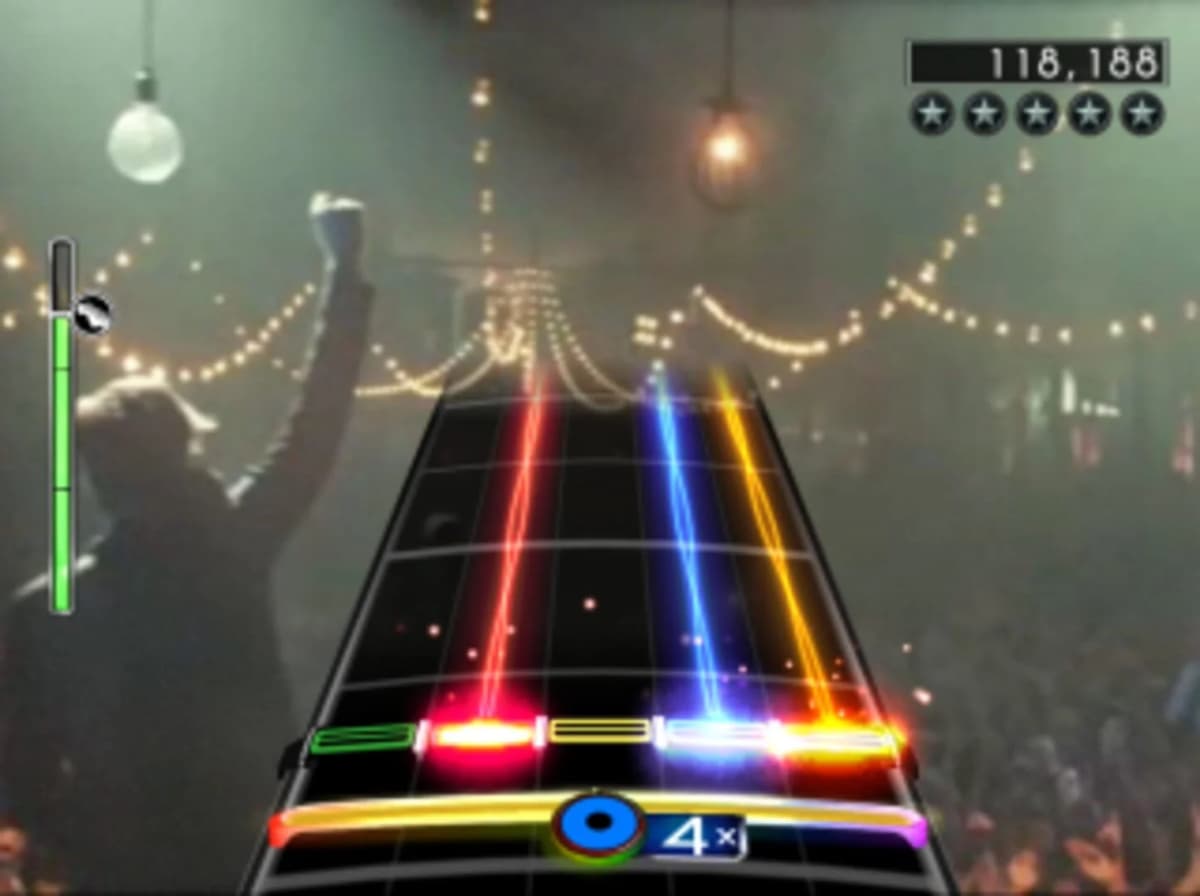
Rock Band 2 Deluxe is a fan-made overhaul of Harmonix’s Rock Band 2, played on the RPCS3 PlayStation 3 emulator or a jailbroken PS3. It runs the original five-button guitar charts, so the real question is not “which game” but “which plastic guitar will actually work with it.” That is where most buyers lose money: they grab a controller built for a different game, a different console generation, or one missing its wireless dongle.
This guide fixes the one mistake that costs the most: buying the wrong layout, the wrong platform version, or a used controller with no receiver. Get those three right and the rest is cosmetics.
Table of Contents (16)
The short version
- Use a five-button guitar. Rock Band 2 Deluxe uses the traditional five-fret Rock Band/Guitar Hero layout. The six-button Guitar Hero Live guitar does not work with it.
- Easiest new pick: the PDP Riffmaster — lightweight (~3.45 lbs), rechargeable, folding neck. Buy the correct PlayStation or Xbox/PC version.
- Enthusiast new pick: the CRKD Gibson Les Paul or SG — Hall-effect strum bar, mechanical frets, and a Legacy Mode for older games on PS3.
- Best used value: a complete Rock Band 2 guitar with its original receiver, for Xbox 360 or PS3.
- Skip: the original Guitar Hero Live guitar — wrong layout for this game and proprietary wireless.
Start with the layout: five frets, not six
Rock Band 2 Deluxe is built on Rock Band 2, which uses five colored fret buttons in a line. Every guitar you should consider for it shares that layout. This is the safe path for mixed Rock Band and Guitar Hero libraries and for PC rhythm-game clients.
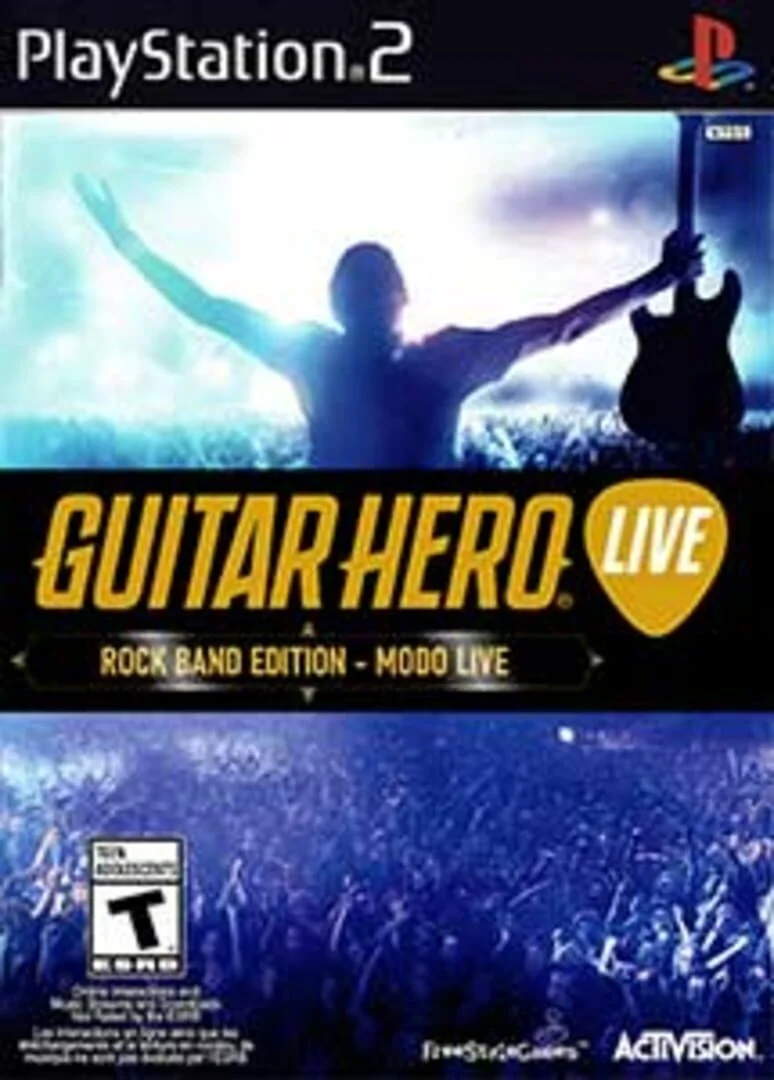
Do not confuse it with Guitar Hero Live. That is a separate 2015 Activision/FreeStyleGames title whose guitar uses six buttons in a two-rows-of-three (2×3) layout. That hardware is for Guitar Hero Live only and is incompatible with Rock Band and Rock Band 2. If a listing shows a guitar with two short rows of buttons instead of five in a line, it is the wrong controller for Rock Band 2 Deluxe.
The best new guitar controllers
PDP Riffmaster: the easiest recommendation
If your priority is plugging in and playing, the PDP Riffmaster is the cleanest modern answer. It is a top-reviewed current controller, notably light at around 3.45 lbs, with a built-in rechargeable battery and a folding neck for storage. You skip the whole used-market grind of sync buttons, battery corrosion, missing receivers, and dead strum bars.
Buy the correct PlayStation or Xbox/PC version, pair it, and you spend your time calibrating and playing instead of troubleshooting. Check the package details: some listings separate the controller from its wireless receiver.
CRKD Gibson Les Paul and SG: better feel
The CRKD Gibson line is the enthusiast buy. The Les Paul and SG controllers use a Hall-effect strum bar with mechanical clicking feedback and mechanical (EZ Glide) frets; the real-guitar switches and knobs are remapped to console inputs. Mechanical frets give a cleaner, more consistent press than older mushy membranes, and the Hall-effect strum bar uses no physical switch contact, which reduces wear over time.
These models also include Legacy Mode, which lets the controller work wirelessly on a PS3 to play older Rock Band and Guitar Hero games (and Band Hero). That is the relevant feature if you run Rock Band 2 Deluxe on a real PS3 alongside other rhythm titles. Just don’t read “legacy” as “works with everything” — check the exact platform before assuming. Pick CRKD when you want sharper input feel and will pay more for it.
The best used controllers for retro setups
Rock Band 2 guitars: the smartest used buy
For Xbox 360 and PS3, Rock Band 2 guitars are the obvious match for Rock Band 2 Deluxe, and they also work with Guitar Hero World Tour on those consoles. They already have five fret buttons, so there is no note-stream “adaptation” to worry about — that auto-adjustment (for example reducing drum lanes) applies to drum kits, not guitars. One five-button guitar covers a mixed Xbox 360/PS3 library cleanly.
Compatibility is console-specific, so don’t assume it carries to the Wii. On Wii, Guitar Hero World Tour is compatible only with previous Guitar Hero guitar controllers and supports no other peripherals — Rock Band drums and guitars are not recognized there. Treat the Wii as its own island and buy hardware made for the exact game and console you are running.
GH3, GHWT, and Band Hero guitars as budget options
Used Guitar Hero III, Guitar Hero World Tour, and Band Hero guitars are all five-button controllers, so they fit the same five-fret slot. They can be good value if you find a complete, working bundle with its receiver. These are separate titles whose first-party controllers have their own per-console compatibility, so treat them as compatibility context, not as a guarantee — and verify the model against the platform you are on.
The rule for a multi-instrument retro setup is to buy for the platform, not the logo. On Xbox 360 and PS3 a five-button guitar plus a matching drum kit covers most charts. On Wii, plan around the Wii’s near-total lack of cross-compatibility instead of hoping a guitar from another game will register.
The original Guitar Hero Live guitar: skip it for this game
Used Guitar Hero Live guitars are often cheap, which makes them tempting — but they use the six-button 2×3 layout and do not work with Rock Band 2 Deluxe. They only make sense if you specifically want to play Guitar Hero Live itself.
They are also harder to set up. The wireless guitar uses a proprietary 2.4GHz dongle, and PC use through clients like Clone Hero or YARG depends on that receiver: the Xbox 360 dongle works after a manual driver update, while other dongles need third-party software such as the Guitar Hero Live PokeMachine or GHLtar Utility. For a tinkering project that can be fine; for Rock Band 2 Deluxe it is the wrong tool.
Platform advice that saves the most money
PC and RPCS3: prioritize compatibility and calibration
Most people run Rock Band 2 Deluxe on PC through RPCS3. A modern controller with clear PC support is the safest buy. Whatever you use, run the in-game calibration pass before judging the hardware — many “bad controller” complaints are really timing problems. If you bring original retro wireless gear to PC, the dongle matters as much as the guitar: no matching receiver usually means no quick fix.
PlayStation and Xbox: buy the exact family you need
Don’t treat “Xbox” or “PlayStation” as one platform. Xbox 360 gear is not the same as Xbox One/Series support, and PS3 wireless guitars need a model-specific dongle that is not interchangeable. Second-hand PS3 guitars are routinely sold without that dongle, leaving them unusable until you track down the correct receiver. For the least friction, modern licensed hardware wins; for retro, verify both the guitar and the receiver before paying.
Wii: assume less cross-compatibility, not more
The Wii is the platform where cross-game compatibility breaks down hardest: Guitar Hero World Tour there talks only to older Guitar Hero guitars and ignores other peripherals. If a seller calls a Wii guitar “universal,” treat that as a red flag until the exact model is verified for your game.
Pre-purchase checklist
- Confirm it is a five-fret controller, not a six-button Guitar Hero Live guitar.
- Match the controller to the exact platform version, not just the brand family.
- Check whether the dongle, receiver, or sync hardware is included.
- Ask if the strum bar recenters cleanly and whether any frets double-register.
- Inspect battery compartments for corrosion on used wireless models.
- Look for neck connection issues, missing battery doors, and dead tilt sensors.
- If buying a CRKD Gibson for a real PS3, confirm Legacy Mode covers the games you play.
Common mistakes
- Buying a six-button Guitar Hero Live guitar expecting it to work with Rock Band 2 Deluxe. It uses a different layout and will not.
- Assuming Xbox 360, PS3, and Wii hardware is interchangeable. The Wii in particular recognizes almost nothing across rhythm-game lines.
- Grabbing a “cheap” PS3 wireless guitar that ships without its model-specific dongle — it is dead weight until you find the exact receiver.
- Blaming the controller before calibrating. Run the in-game calibration first.
Practical takeaway
Buy for format first, platform second, and brand last. For Rock Band 2 Deluxe that means a five-button guitar, every time. The simplest path is a PDP Riffmaster in the right platform version; for premium feel and a real-PS3 setup, a CRKD Gibson with Legacy Mode; and on a budget, a complete Rock Band 2 or other five-button Guitar Hero guitar with its original receiver. Skip the Guitar Hero Live guitar unless you actually want to play Guitar Hero Live. The right controller is the one that gets out of your way when the chart starts.
FinalBoss // Gear
Level up your setup
01Top-rated gaming headsetson Amazon→02High-refresh gaming monitorson Amazon→03Gaming chairson Amazon→04Discounted game keyson Kinguin→Affiliate links · As an Amazon Associate, FinalBoss earns from qualifying purchases.
Want to Level Up Your Gaming?
Get access to exclusive strategies, hidden tips, and pro-level insights that we don't share publicly.
Ultimate Guide Strategy Guide + Weekly Pro Tips