
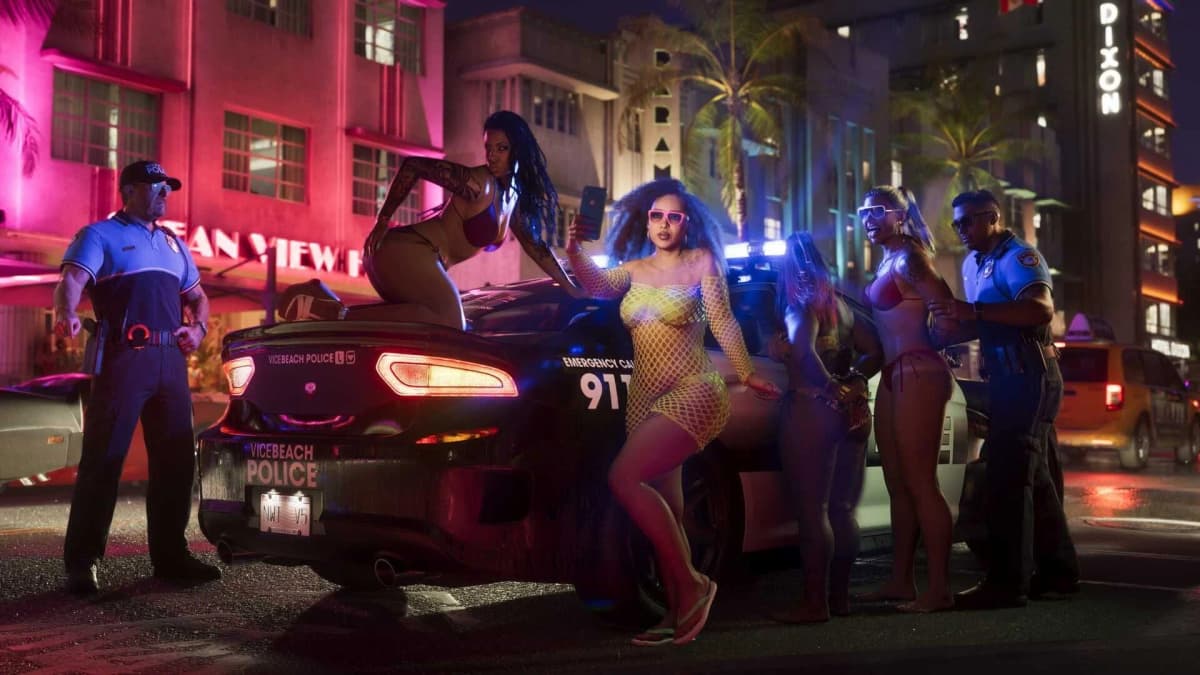
Let’s call this what it is: Rockstar is selling an $80 cardboard tombstone for the concept of game ownership. When Grand Theft Auto VI launches on November 19, 2026, the “physical” edition you’re lining up to preorder at midnight on June 25 will not contain a Blu-ray disc. It will not contain a cartridge. It will not contain anything that resembles the actual game. Crack open that glossy box and you’ll find a slip of paper with a download code. That’s the totality of your purchase. A license. A string of alphanumeric characters tied to your PlayStation or Xbox account, wrapped in plastic, and marketed as a tangible product. If that doesn’t make your blood boil, you haven’t been paying attention to how fast this industry is stripping us bare.
I still remember unwrapping Grand Theft Auto: Vice City as a kid. There was the disc, sure, but there was also the fold-out map, the manual, the sense that I had bought a thing that existed in the world. I could lend that disc to a friend. I could sell it to fund the next game. I could pop it into a PlayStation 2 twenty years later and still watch Tommy Vercetti sprint across my screen. That object meant something. It meant permanence. Rockstar’s new “physical” edition for GTA 6 obliterates that permanence, and they have the audacity to charge $79.99 for the standard version and $99.99 for the Ultimate Edition-all while handing you a product that ceases to exist the moment their servers hiccup.
Table of Contents (5)
What “Physical” Actually Means Now
We need to stop using the word “physical” like it still means something. Rockstar has redefined it to the point of parody. The box exists. The code inside does not. Once you redeem that code on the PlayStation Store or Xbox Store, the box is functionally garbage. It is not a backup. It is not an archive. It is not a thing you can trade, resell, or keep in a safe for your kids to discover in 2040. It is packaging for a digital entitlement, and the distinction matters because Rockstar is charging you a premium price for what amounts to retail theater.
And let’s be clear about the timeline here. Preorders open June 25 at midnight local time. Preloading starts November 12. The game releases November 19. That means even if you brave the crowds-or more likely, click “buy” while half-asleep-you’re not walking out with a product. You’re walking out with a homework assignment. Go home, redeem the code, tie it to your account, and then wait for your console to pull down what will almost certainly be a 100GB-plus install. Got a data cap? Live in a rural area with spotty broadband? Too bad. The box won’t save you. The box contains nothing.
The Three Things We’re Actually Losing
People keep asking why this matters if “everyone has internet anyway.” It matters because a disc-less box strips away three core pillars of ownership that digital evangelists love to dismiss until they need them.
First, offline assurance. A disc, even in the modern era of mandatory patches, is at least a local copy of the base game. If your internet goes down, if Sony’s PSN has another multi-day outage, if Microsoft’s authentication servers buckle under launch traffic, a disc gives you options. A code in a box gives you a brick. You cannot install GTA 6 from a slip of paper. You cannot play it on a plane, in a cabin, or during a network blackout. You are entirely dependent on infrastructure that has proven itself fragile time and time again.
Second, resale and trade value. The secondhand market has kept gaming affordable for decades. College students trade games to afford textbooks. Players sell finished titles to fund new ones. Friends swap discs over weekends. A boxed code destroys that ecosystem instantly. The moment you scratch off that coating and type it into your console, it’s worthless to anyone else. GameStop can’t buy it back. eBay sellers can’t list it. Your little brother can’t inherit it. This is not an accident; it is a deliberate economic neutering designed to ensure every single player pays full freight directly to Take-Two’s bottom line.

Third, and most critically, preservation. The preservation community has been screaming about this for years, and GTA 6 is now the biggest flashpoint in that fight. Physical discs are the only legal, durable backstop against corporate amnesia. When licensing agreements expire, when music rights get tangled, when a company simply decides an old game isn’t worth hosting anymore, digital-only titles vanish. We saw it with P.T. We saw it when Rockstar themselves delisted the original GTA San Andreas from Steam and replaced it with a buggy mobile port that broke mods and ruined the experience for years. A disc-less box guarantees that when the PS6 launches and Sony starts sunsetting PS5 infrastructure, your “physical” copy of GTA 6 will be exactly as playable as a movie ticket stub. It’s a souvenir, not an archive.
But Let’s Be Honest—Did We Ever Really Own It?
I’ll give the devil its due. The counterargument is sitting right there, and it’s not stupid. In 2026, a disc is often just a key. You insert it, install 90GB of data, download a day-one patch, and then pray the authentication servers are online. Sony and Microsoft have spent an entire console generation training us to treat physical media as a DRM dongle, not a product. Your digital library on PSN? It’s a license that expires when your account does. Your Xbox purchases? Tied to a server-side entitlement that can glitch, ban, or vanish. We were already renting these games in all but name.
But here is the critical difference: a disc is a legal object with first-sale rights. A disc works when the servers don’t. A disc can be resold, lent, and preserved independent of the platform holder’s whims. Replacing it with a code in a box is not a lateral move to a digital future; it is a deliberate stripping of the last remaining consumer rights we had. It is the difference between leasing an apartment and leasing an apartment while also being legally forbidden from ever subletting or selling your lease. One is practical reality. The other is contempt.
Even Retailers Know This Is a Scam
The backlash isn’t just coming from players and preservationists. Major physical retailers are refusing to stock GTA 6’s boxed code edition, and their reasoning is pure economics. A boxed code offers them no used-game revenue. They can’t accept trade-ins. They can’t put pre-owned copies on shelves. They can’t markup a secondhand market that has sustained brick-and-mortar gaming stores for thirty years. By shipping a code in a box, Rockstar is asking retailers to act as unpaid gift-card kiosks for a product that actively undermines their business model. Some are rightly telling them to pound sand.
That should tell you everything. When the stores that literally survive on selling video games decide a video game isn’t worth selling, the product has crossed from “industry evolution” into “consumer hostility.” This isn’t about adapting to a digital future. It’s about extracting maximum profit while externalizing every ounce of risk onto the player.
How to Decide What to Buy (If Anything)
So preorders open in days, and you’re probably still going to buy GTA 6. I get it. It’s GTA 6. But go in with your eyes open. Here is how I’m thinking about it, and how you should too.

Buy the box only if you are treating it as merchandise. If you want the Vintage Vice City Pack, the free month of GTA+, or whatever trinkets come with the $99.99 Ultimate Edition, and you view the cardboard as a collector’s item, fine. Display it next to your San Andreas map. But do not buy it because you think you’re securing the game. You are not. You are buying a one-time license and a keepsake.
Before you preorder, read the fine print on Sony’s and Microsoft’s store pages. Seriously. Look at what happens to your library if your account is banned. Look at the refund windows—Sony notoriously offers limited refund options once you’ve started downloading, while Microsoft is slightly more forgiving but still platform-locked. Check whether your “purchase” can be revoked. On both platforms, digital games are tied to account status and primary or home console designations. If anything happens to that account, your fancy box is a paperweight with no recourse.
As for mitigating the ownership risk, here is the uncomfortable truth: there is no mitigation that restores what Rockstar took out. Backing up to an external drive doesn’t bypass entitlement checks. Buying the code directly from the PSN Store instead of a retail box changes absolutely nothing about your rights. The only real move is financial and psychological. Budget for this as a service, not an asset. If you have fast, uncapped internet and no emotional attachment to shelves, skip the box entirely and buy digital. At least then you’re not paying for landfill-bound plastic. If you need something under the tree for a gift, the box has utility—but treat it like a gift card with extra steps, not a present that lasts.
FinalBoss // Gear
Level up your setup
01Top-rated gaming headsetson Amazon→02High-refresh gaming monitorson Amazon→03Gaming chairson Amazon→04Discounted game keyson Kinguin→
Affiliate links · As an Amazon Associate, FinalBoss earns from qualifying purchases.
Want to Level Up Your Gaming?
Get access to exclusive strategies, hidden tips, and pro-level insights that we don't share publicly.
Ultimate Gaming Strategy Guide + Weekly Pro Tips