
Table of Contents (9)
The moment Saros told me to stop playing like Returnal
About forty minutes into my Saros preview, I tried to play it like I was still on Atropos. Classic Returnal muscle memory: stay at mid-range, dash through the gaps, trace neon bullet patterns with my eyes and dance around the danger instead of through it.
Carcosa did not appreciate that.
In one of the early combat arenas, I was hopping between cover, weaving past blue orbs from turret clusters while a swarm of bat-like things dive-bombed my position. It looked familiar, it sounded familiar – hell, even the cadence of the encounter felt like Housemarque comfort food. Then the game quietly flipped the table. The projectiles stopped feeling like patterns and started feeling like a wall. Everywhere I turned, every angle was just filled with blue. No obvious gaps to exploit, no safe platform waiting for me on the edge of the arena.
Out of panic more than strategy, I slammed R1 and charged straight into the mess.
Arjun’s shield ballooned around me, humming with that very specific Housemarque energy – part particle effect, part haptic buzz – and suddenly I wasn’t dodging the storm, I was eating it. Every bullet that should have killed me instead refueled the shield meter. I barrelled through a curtain of shots, closed the gap, and straight-up decked a turret with a melee punch that sent it scattering into chunks.
That’s the exact second Saros stopped feeling like “Returnal 2 with a guy” and started feeling like its own, meaner thing.
Setup: a rescue mission, not a science project
Housemarque isn’t pretending Saros isn’t built on Returnal’s skeleton. Third-person sci-fi shooter, run-based structure, looping death, glowing pick-ups, arenas stitched together in semi-random layouts – it’s all here. But the framing this time changes the tone more than I expected.
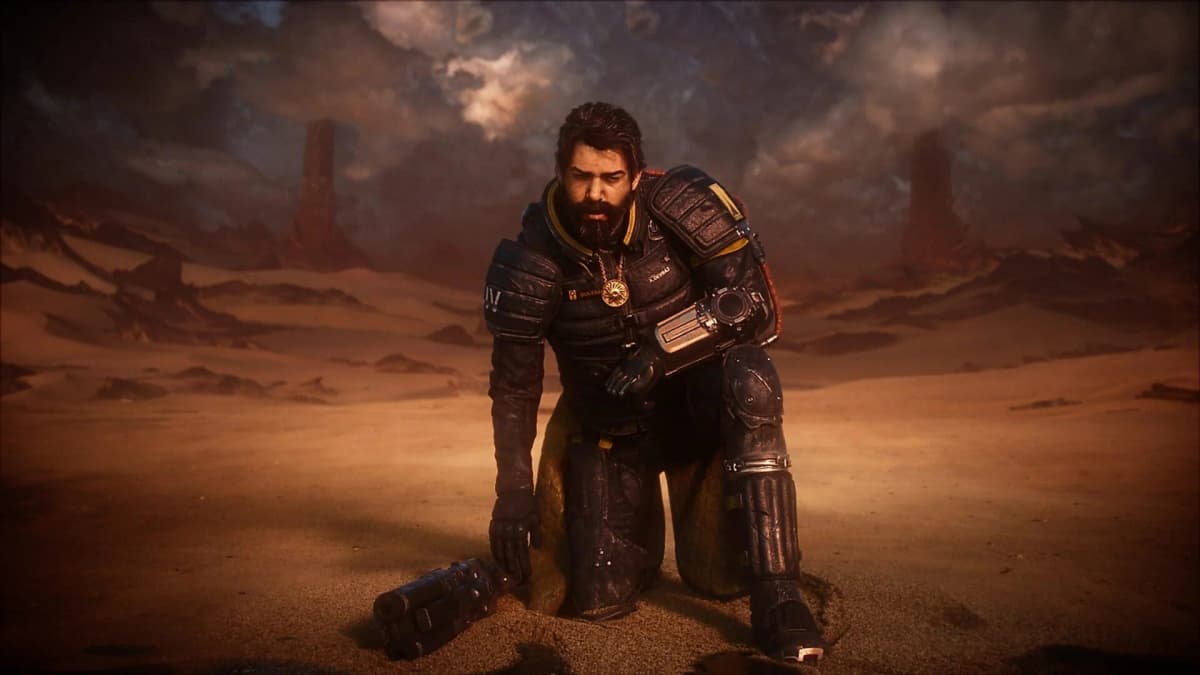
You play as Arjun Devraj, an enforcer for mega-corp Sultari, sent to the planet Carcosa to find out what the hell happened to a Lucinite mining colony, a previous investigation team, and some of his own missing comrades. Lucinite is the magic sci-fi resource here – worth trillions, deeply woven into the upgrade economy, and the reason anyone was dumb enough to settle on this cursed rock in the first place.
Arjun isn’t a wide-eyed astronaut chronicling alien ruins. From his first lines (brought to life by Rahul Kohli, who leans hard into weary determination), he’s a guy with a job, a chain of command, and a very specific person he’s looking for. There’s a woman’s voice on the radio, pulling at him from somewhere on Carcosa: “You’re so close now.” He talks like a professional – “I’ll find them, make sure everyone’s safe” – but you can hear the cracks. It’s not purely altruism, and the game knows it.
Between runs you’re not alone, either. Instead of Returnal’s isolation, Saros gives you Echelon 4, a small team holed up in a hub space called The Passage. There’s the Primary – a hovering, bureaucratic AI that feels like a passive-aggressive performance review machine – and a handful of survivors who all have their own hang-ups about Carcosa and the blazing, sickly sun hanging over it.
What struck me in my three-hour slice is how immediate the story is. In Returnal, you had to dig through logs and environmental hints to really get anywhere. Here, Housemarque is much more up front: conversations after each run, new dialogue when you unlock Lucinite upgrades, little flashes of imagery that feel more like deliberate chapter markers than random surrealism. It still has mystery, but it’s grounded in Arjun’s personality rather than pure abstraction.
Combat: from bullet hell dance to bullet-eating wrecking ball
The core loop will feel instantly familiar if you’ve touched Returnal. You’re strafing and dashing through arenas, juggling a main weapon, a heavier “power” weapon on cooldown, and an assortment of active reloads, jumps, and mid-air dodges. There’s still an adrenaline system ticking up as you survive without taking damage, rewarding good play with extra perks.
The big twist is that shield. With a tap of R1, Arjun throws up a translucent bubble that absorbs blue projectiles. There’s a stamina-style bar that drains as you hold it, but here’s the smart bit: the bullets you absorb feed that bar back. So if you’re timid and only use it for the odd stray shot, it’s a short-lived panic button. If you sprint face-first into a rain of fire, it becomes self-sustaining – at least until you push your luck too far.
Housemarque is calling this “bullet ballet,” but if we’re being honest, I felt less like a ballerina and more like a guided missile. My most successful runs happened when I stopped circling the arena and started prioritising lines. Pick a target, read the incoming arcs, put the shield up, and just commit to the route. Absorb on the way in, drop the shield at point-blank, unload, then fist their turret into scrap before pivoting toward the next cluster.
Enemies are tuned around that aggression. Those early bat-things don’t just hover; they dive and chase. Turrets overlap their fire so that cautious players are forced into narrower and narrower paths until there aren’t paths left at all. When heavier beasts show up – loping, twisted creatures that swing wide, chunky melee attacks – you start using the shield not just as a bullet sponge but as a breather: tank a few shots to escape a pincer, reset to mid-range, then go in again.
All the while, the familiar Returnal “feel” is still there under your thumbs. The active reload timing is tight but forgiving enough to nail in stressful fights, and the DualSense feedback is tuned beautifully. Firing a basic assault rifle has that same crisp thump; power weapons slam the triggers with extra resistance. Combined with the reactive haptics on the shield – there’s a distinct rattling when it’s taking heavy punishment – it’s easy to tell when you’re in control and when you’re being greedy.
A small but important detail: because the shield only works on certain projectile types, you can’t mindlessly turtle. Some shots slice through it, some ground hazards outright ignore it, and Saros delights in mixing those together. I had one arena where the floor turned into a patchwork of sizzling red acid pools while a new enemy type pumped out patterns the shield couldn’t touch. That’s when it stops feeling like a power fantasy and becomes a juggling act again.
The eclipse: when Carcosa decides it’s done playing nice
Every run eventually hits a wall, both literally and figuratively. Progress locks, the objective marker goes dark, and you get a prompt: summon the eclipse.
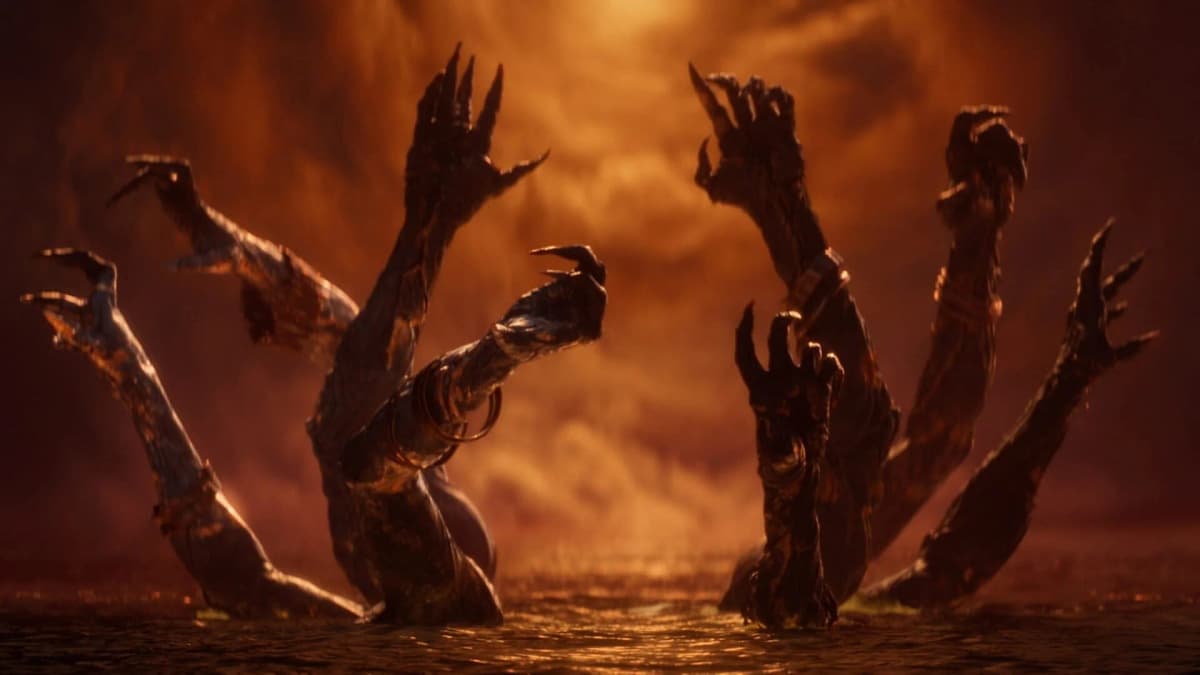
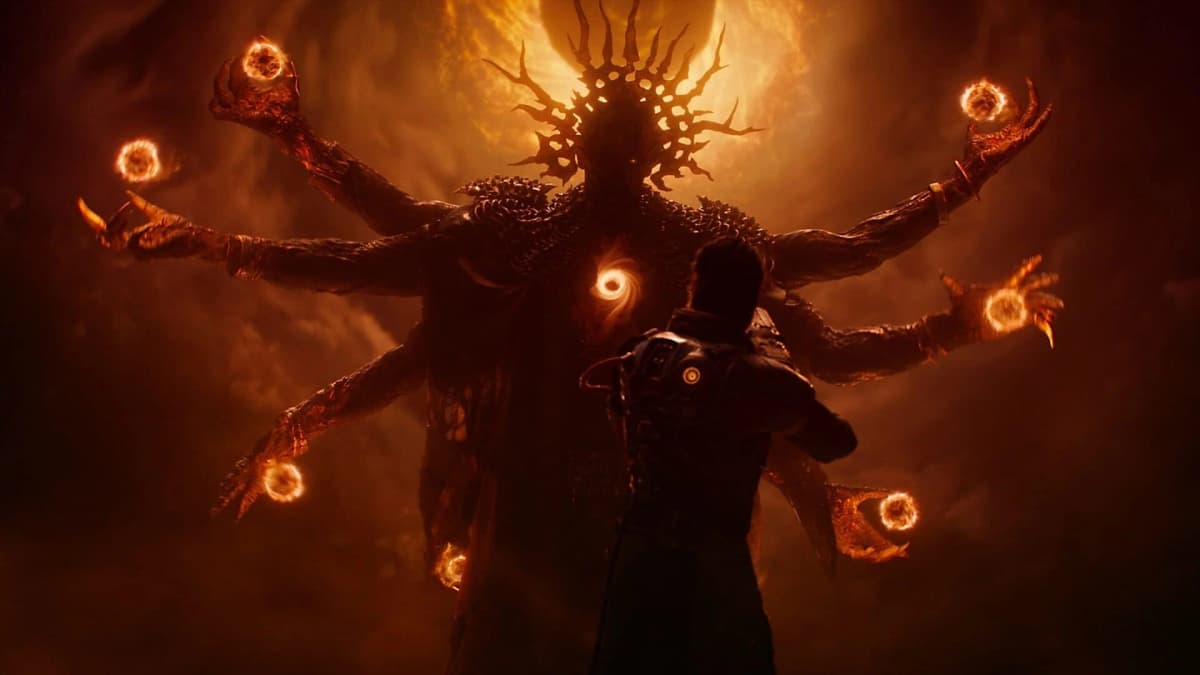
From a distance, Carcosa’s sun already feels wrong – too large, too close, its light almost sticky. Triggering the eclipse pulls it from “unsettling” to full-on “what have I done?” territory. The sky deepens into this bloody, feverish hue, the ground warps, pillars twist into jagged silhouettes, and new, corrupted flora and fauna tear through the old geometry. It’s like the planet is expelling you.
Mechanically, this is the nastiest thing Saros showed me in the preview build. Under the eclipse, certain attacks don’t just chip your health; they carve away at your maximum armor. You can’t just chug healing and carry on. The only way to claw that capacity back is through smart use of your power weapons and specific pickups, which means your mistakes linger for much longer.
And your beautiful shield? A lot less reliable. Some corrupted projectiles ignore it, others twist around its edge or explode into lingering zones that force you to reposition anyway. That moment where I’d been feeling like an invincible wrecking ball flipped into a sickly kind of dread. I found myself delaying the eclipse trigger whenever possible, grabbing every upgrade or Lucinite node I could before hitting the switch, because I knew the rest of the run would feel like being hunted.
It’s also where the Lovecraft/Chambers inspiration really comes through. Carcosa is, of course, a loaded name – echoes of The King in Yellow and all the weird fiction that spun out from it. Saros doesn’t turn into quote-heavy cosmic horror, but the eclipse phase gives the planet an identity: a living thing that shifts structure, spawns impossible architecture, and pushes its inhabitants into states that look a lot like cultish obsession with the sun.
In Returnal, environmental shifts mostly felt like tone and pacing adjustments. Here, the eclipse genuinely redefines how safe you feel in the loop. I started to treat “pre-eclipse” as my power trip and “post-eclipse” as the tax for enjoying it.
Roguelike structure and Lucinite: progress with teeth
Housemarque has clearly listened to the “Returnal was amazing but I hit a wall” crowd. Saros is still absolutely a demanding game – I died a lot during my three hours – but it’s more generous between runs without turning into a pushover.
The big meta currency this time is Lucinite, the same exotic material Sultari came here to strip-mine. You gather it all over Carcosa: from chests, from elites, from little side rooms tucked off the main path. Back in The Passage, you spend it at the Primary’s terminal on permanent upgrades.
These aren’t just +1% scraps. Early in the tree you unlock things like a literal second chance (revive on death once per run), increased shield capacity, better armor integrity, more generous Lucinite gains, and tweaks to your power weapon usage. They’re the kind of buffs that change how you mentally budget risk. When I grabbed the “free revive” upgrade, I caught myself intentionally overextending in the next run, burning that extra life to push deeper into eclipse territory and unlock more of the map.
Crucially, these upgrades never erased the tension. Saros is built around trade-offs – in the combat system and in the meta. On top of the permanent unlocks, you can enable optional modifiers that make life easier in one way and harder in another. Want looser timing on perfect reloads or a bigger pickup radius for Lucinite? Cool, but maybe you’ll keep less Lucinite when you die. Want a shield that doesn’t burn power as fast? Great, enjoy lower damage output.
This feels like Housemarque’s answer to the “accessibility vs. purity” debate Returnal sparked. Instead of simply slapping difficulty modes on top, Saros tilts the numbers through a series of very explicit bargains. It reminded me a bit of Hades’ Pact of Punishment, except inverted: here you can clandestinely help yourself… as long as you’re willing to take a hit somewhere else.
Weapons follow the same philosophy. You’ll find guns with chunky upsides – bigger mags, extra homing shots, alternate fire modes – but nearly all of them come with a downside attached: slower reload windows, more severe recoil, slightly delayed bullet travel. The preview slice didn’t go deep enough to show wild late-game builds, but even early on I was weighing choices like, “Do I want the rifle that melts armor but has a brutal reload timing in eclipse arenas?”
Narrative hooks and characters: a louder, more human Housemarque
The biggest surprise for me wasn’t the shield or the eclipse. It was how much time Saros spends just hanging out in The Passage, checking in with the survivors, and letting Arjun’s mask slip little by little.
Rahul Kohli’s performance gives Arjun a mix of dry humour and brittle focus. He keeps insisting, to the Primary and to his squadmates, that the mission and the missing colonists are all that matters. Yet the way he reacts to that mysterious woman’s voice – the way his composure evaporates for a line or two when she surfaces – hints at something far more personal driving him forward.
His team, Echelon 4, are caught in their own spirals. One member comes across at first as the calm, rational backbone of the group… until you catch him almost begging to be allowed back into the field, voice shaking with a need that sounds less like duty and more like addiction. Another swings between lucid strategy and starry-eyed talk about the sun like it’s some kind of saviour. That “duality” theme – composed one moment, unhinged the next – pops up again and again, and it meshes neatly with the planet’s shifting, unstable layout.
In three hours I obviously didn’t get full answers. But there were enough small payoffs – a throwaway line echoing something from a mid-run vision, the Primary’s corporate language slipping to reveal genuine concern, glimpses of Sultari’s ruthlessness in data logs – that I felt more anchored than I ever did in Returnal’s early hours. This isn’t just vibes and statues in the mist; it’s a story about people trying not to break in a place that’s designed to snap them.
Presentation: Carcosa at 4K/60 feels like standing too close to the sun
Housemarque already had a reputation for flashy particle work, but Saros on PS5 looks like the studio finally has a canvas big enough for its obsessions. It’s built in Unreal Engine 5 with an in-house pipeline called Graphite, and the result is a planet that’s gorgeous in a “I probably shouldn’t breathe this air” kind of way.
In normal daylight, Carcosa is all jagged rock formations, industrial ruins, and weirdly beautiful alien growths that seem to glow from within. Particle fog hangs low in certain valleys, and every impact – bullets on armor, shield scraping against a wave of projectiles – explodes into crisp, clean effects that never muddied the screen for me, even when the arena was essentially a solid mass of blue and orange.
Once the eclipse hits, the colour palette just goes feral. The whole world tips into this heavy, oppressive red-orange that somehow manages not to devolve into visual mush. Crackling fissures in the ground, molten-looking pools, writhing tendrils on the horizon – it’s all sharp enough that I could still parse enemy shapes and projectile patterns, but the emotional impact is brutal. My shoulders literally tensed up every time I stepped back out of The Passage into a post-eclipse run.
Performance-wise, the preview build ran at what felt like a solid 60fps throughout my session. Housemarque is clearly targeting that framerate as gospel again, and it shows; responsiveness is everything in a game this twitchy. If there were dips, they weren’t noticeable in the middle of fights, which is what matters.
Audio does a lot of the heavy psychological lifting. The eclipse phase in particular is haunted by distant screams and guttural howls that never quite resolve into visible enemies, making every corner feel unsafe. Arjun’s breathing picks up when his armor capacity drops, the shield has a distinct “overload” whine when it’s about to fail, and the score leans into droning, oppressive tones more than big orchestral flourishes. It fits the whole “corporate expedition into cosmic rot” mood perfectly.
Difficulty and pacing: 30-minute gauntlets with fewer brick walls
In my session, a “good” run generally lasted around 25–35 minutes, depending on how reckless I got with the eclipse. That feels intentional: Saros wants each loop to be a contained story – early confidence, mid-run overreach, late-run scramble – rather than a two-hour marathon you lose right before the finish line.
The checkpointing and meta-progression help a lot. Even on failed runs, I felt like I’d brought something back: a new Lucinite upgrade unlocked, a fresh conversation in The Passage, a slightly better understanding of how certain enemies behave under eclipse conditions. That constant trickle of progress kept me queueing up “one more run” instead of hitting a frustration point and bouncing off, like a lot of people did with Returnal.
That said, don’t come in expecting a casual shooter. Saros is still Housemarque through and through: projectile density is high, mistakes are punished hard, and the game absolutely expects you to engage with its systems instead of just cranking aim assist and vibing. If you’re allergic to repetition or to that very particular loop of death→reflection→adjustment→revenge, nothing here magically changes that.
The modifier system does at least give you tuning knobs to twist if you hit a wall. Being able to make reloads more forgiving in exchange for harsher penalties on death, for example, is the kind of deal that can keep you progressing without erasing the soul of the game. It’s not an easy mode; it’s a contract.
Who Saros is really for
With only three hours under my belt, I obviously haven’t seen how wild the later biomes or weapon builds get, and I’m curious (and a bit afraid) of what the eclipse becomes in the back half. But even this limited slice paints a pretty clear picture of the audience.
If Returnal hooked you but eventually spat you out around a difficulty spike, Saros feels like the natural second attempt: still hostile, still demanding, but more respectful of your time and more interested in giving you a character and crew to cling to between failures. The shield and Lucinite systems push you toward aggressive, creative play instead of making you feel like you’re always one mistake from disaster with nothing to show for it.
If you bounced off Returnal’s structure entirely – can’t stand runs, hate restarting, don’t enjoy mastering tight combat systems – nothing I played here is going to magically convince you. It’s still a roguelike shooter from a studio that loves arcade difficulty. The narrative is more present, but it’s not a linear story game with a “retry from checkpoint” button.
For everyone else – especially people who enjoy Hades-style runs, Dead Cells’ risk-reward decisions, or even the mental load of a good bullet hell shmup – Saros is shaping up to be that rare sequel-in-spirit that understands exactly what made its predecessor special and has the confidence to mess with it anyway.
FinalBoss // Gear
Level up your setup
01Best-selling PS5 gameson Amazon→02DualSense controllerson Amazon→03PS5 SSD upgrades (M.2 NVMe)on Amazon→04Discounted game keyson Kinguin→
Affiliate links · As an Amazon Associate, FinalBoss earns from qualifying purchases.
Want to Level Up Your Gaming?
Get access to exclusive strategies, hidden tips, and pro-level insights that we don't share publicly.
Ultimate Reviews Strategy Guide + Weekly Pro Tips