
Screamer makes a lousy elevator pitch and a terrific first lap. On paper, Milestone’s reboot sounds almost self-sabotaging: a futuristic arcade racer with anime styling, visual novel storytelling, combat attacks, and a control scheme that asks you to drift with the right stick instead of treating it like a camera nub. That is the kind of feature list that can read like a studio trying to be different for the sake of it.
Then the race starts, the first tight sequence of corners arrives, and the whole thing suddenly makes sense. Screamer’s best idea is that speed, drifting, boosting, attacking, and survival are all tied together. When it works, it feels less like a standard racer with weapons and more like a systems-heavy brawler on wheels. Every clean turn matters. Every burst of energy matters. Every mistake hurts.
The catch is that Screamer is not a clean win. It also comes wrapped in a story mode that drags its feet, visual novel scenes that often kill the trackside momentum, some genuinely maddening objective design, and PC performance issues that stop the whole package from feeling as sharp as it should. This is the most exciting Milestone game in quite a while, and also one of its most uneven. Both things are true at the same time.
Table of Contents (8)
Key takeaways
- The two-stick drifting system is weird at first, then becomes the game’s defining strength.
- Energy management ties together boosts, attacks, shields, and Overdrive in a way that makes races feel tactical as well as chaotic.
- The story campaign is long and useful as a tutorial, but its pacing and objective gating can be more frustrating than compelling.
- PC performance is a real concern in the reviewed build, and online multiplayer could not be fully assessed during the review window.
Screamer’s two-stick drift is strange, demanding, and the best thing Milestone has done in years
The first thing to understand about Screamer is that it does not want to be played like a normal modern arcade racer. You accelerate and brake with the triggers, sure, but turning properly means combining the left stick with right-stick drifting. If that sounds awkward, it absolutely is at first. The car barely rotates the way you want if you rely only on the left stick. Gentle line adjustments on straights still live there, but real cornering comes from committing to the drift input.
That decision could have been a disaster. Instead, it becomes the reason the game stands out. Once the rhythm settles in, especially on twisty circuits, Screamer stops feeling odd and starts feeling purposeful. There is a real sense of timing to it: when to begin the slide, how much angle to hold, how to keep speed without overcooking the exit. It is not sim-like, and it is not trying to be. It feels closer to learning a fighting game input than mastering a traditional racing line. Messy in theory, satisfying in practice.
What really sells the system is that drifting is not just there to look cool. It feeds the entire economy of the race. Drift well and you build energy. Shift up at the right moment under acceleration and you build more. That energy powers Impulses, which are short boosts with a very arcade, almost item-like snap to them. Use those Impulses and you fill another meter that opens the door to heavier actions: shielding yourself, or launching a brutal attack that can knock rivals out of the race for a few seconds.
That loop gives Screamer a clarity a lot of combat racers never find. Nothing feels tacked on. The game is constantly asking the same question in different forms: how well are you driving, really? Not just how fast. Not just how clean. How well are you converting skill into momentum, then momentum into pressure? That is where Screamer gets its personality.
The attack system in particular walks a nice line between power fantasy and risk. A successful hit can feel like Burnout aggression filtered through a futuristic anime lens, all velocity and impact and spite. Miss badly, though, and the move can punish you just as hard. The car lunges forward with real commitment, and if the angle is off you can end up wrecking yourself. That danger matters because it stops the combat from becoming brainless. Throwing attacks around without thinking is a good way to ruin your own race.
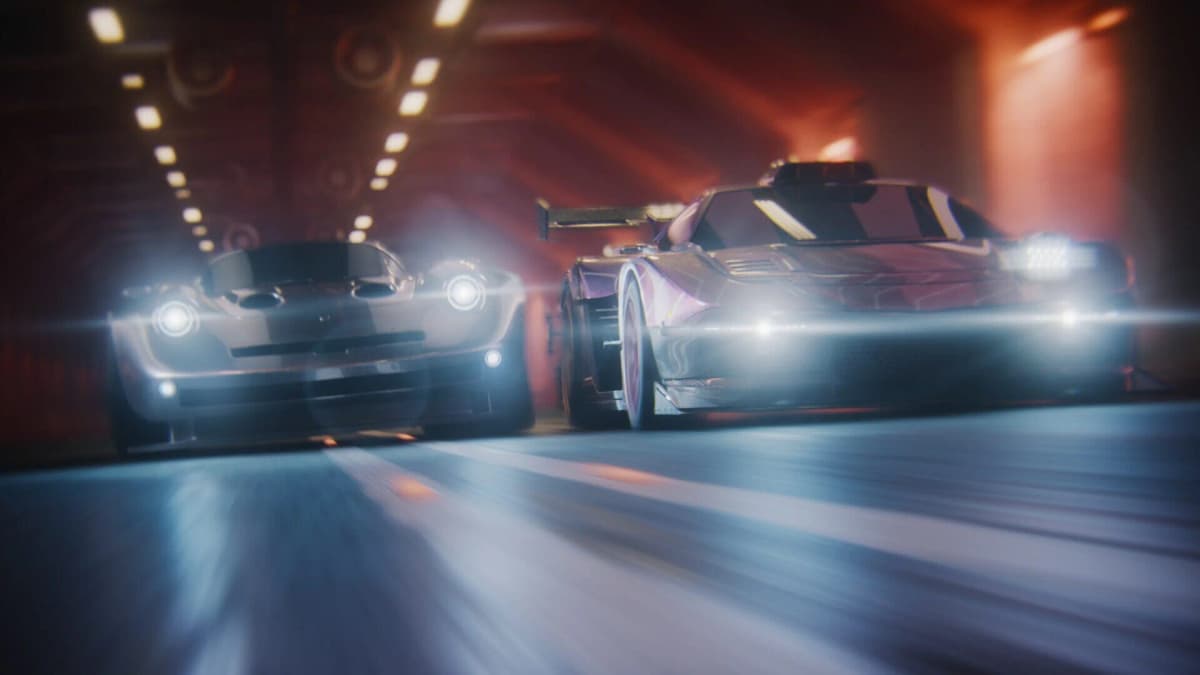
Then there is Overdrive, which is probably the single best expression of Screamer’s tone. Save enough power instead of cashing it out and the car enters a supercharged state, glowing like it is halfway through an anime transformation sequence. Speed spikes, offensive threat rises, and for a few moments you feel untouchable. Except you are not. Overdrive also makes the car extremely fragile. A light hit can blow you up. That tension turns a simple comeback mechanic into a nerve test. Sometimes the smartest choice is not to trigger it right away, and that restraint gives the game a tactical edge most arcade racers never even aim for.
The races are chaotic, but not mindless
Screamer’s racing is loud, aggressive, and packed with contact, yet it rarely feels random. There are traditional races, team events, duels, checkpoint challenges, time trials, and Overdrive-focused survival-style tests. That variety helps because the core handling model has enough bite to support different kinds of pressure. A standard race asks for consistency. Checkpoint events force urgency. Overdrive trials turn risk management into the whole point.
The game also sounds harsher than it looks at a glance. This is not one of those breezy arcade racers where you can bounce off walls, throw out a few boosts, and improvise your way to victory. Mistakes are expensive. The AI is fast, even on medium difficulty, and the highest setting appears especially strict. Blow a corner, mistime an attack, or waste Overdrive at the wrong moment and recovery can be difficult. That led to the right kind of anger in the reviewed notes: not dead-eyed annoyance, but that sharp arcade irritation that makes you grit your teeth and hit restart because you know the race was still winnable if you had driven it cleaner.
Another smart touch is that drivers and cars are not just cosmetic wrappers. Characters have unique abilities that activate in different ways, and the vehicles carry their own feel even if the game does not present every stat in a neat spreadsheet. That last part is mildly annoying if you like clear data, but on the track the differences come through. Some cars lean into stability, others feel twitchier or stronger in bursts, and that gives the roster more identity than a simple skin system would.
This is why Screamer feels so refreshing in a market crowded by simulation and sim-lite priorities. It does not chase realism. It chases friction, expression, and spectacle, and for long stretches it gets all three.
The story goes darker than expected, and that does not always help
The main campaign, The Tournament, is where Screamer becomes harder to defend. Structurally, it is ambitious. The mode runs for more than 100 episodes and can take roughly 15 to 20 hours depending on difficulty, retries, and how quickly you move through dialogue. Five teams enter a mysterious competition for a huge prize, and the cast carries enough personal baggage to fill a season of prestige TV: trauma, betrayal, romance, guilt, and story beats that flirt with self-harm and suicide. This is not lightweight Saturday-morning fluff.

The problem is not the maturity. It is the execution. Screamer keeps major context hidden for too long, and instead of building intrigue it often just creates distance. The narrative jumps between multiple important characters, which means there is no strong central anchor for a good while. Hiroshi feels like the closest thing to a lead, but the game does not fully commit. That leaves the drama feeling scattered even when individual character concepts are interesting.
The visual novel presentation does not help. There are a few proper cutscenes, but not many, and most of the storytelling comes through dialogue-heavy interludes. On their own, those scenes are fine. Placed between explosive races full of boosts, collisions, and near-misses, they can feel like somebody slamming the handbrake on the whole experience. Screamer wants the track action to be feverish and the story to be reflective. The problem is that it struggles to bridge those moods cleanly.
There are still pieces worth praising. The multilingual voice direction is a neat, memorable touch. Characters speak in different languages that reflect their backgrounds, which makes the roster feel more international and more textured than a standard all-English dub would. The cast itself is varied too: soldiers, scientists, criminals, celebrities, and people who plainly feel lost. Late in the story, there are turns that head somewhere more surprising than the early setup suggests. Even so, the campaign never sounds like the strongest reason to come to Screamer. The racing is carrying the narrative, not the other way around.
The Tournament teaches Screamer well, then trips over its own objectives
There is one major reason not to dismiss the campaign outright: it is the best tutorial the game could have had. Screamer introduces its mechanics gradually. Early races keep things simple before layering in attacks, shields, stronger energy management, and the rest of the system. For a game with controls this unusual, that pacing is smart. It gives players room to absorb the logic of the handling before the full chaos arrives.
Unfortunately, the campaign also contains the review’s clearest source of frustration: progression objectives that can feel more like blockers than challenges. Advancing the story often means meeting very specific conditions in races, and some of those demands become a real headache. Team events are the worst offenders because they ask you to rely on AI partners who do not always seem interested in helping. When failure comes from your own bad driving, Screamer can be thrillingly unforgiving. When failure comes because the objective depends on erratic teammates, it becomes much harder to excuse.
That friction matters because Screamer is a game that needs a few hours to really bloom. If the campaign’s pacing or objective design pushes players away before the handling and combat systems fully open up, the reboot could lose people before they ever reach its best material. That would be a shame, because the underlying design has real heat in it.
PC performance and mode support leave a few open questions
Outside the campaign, Screamer looks reasonably generous. Progress unlocks carry across modes, there is vehicle cosmetic customization, unlockable art, arcade play, online multiplayer, and local split-screen for up to four players. That last feature is genuinely welcome in a genre that keeps forgetting how good same-couch chaos can be.
Two caveats sit over that package. First, online could not be meaningfully judged during the review period because matches were not available, and one menu section reportedly appeared locked. So any confident claim about multiplayer longevity, matchmaking quality, or netcode would be bluffing. Second, the reviewed PC version appears to be the game’s roughest edge. The broader impression is of a content-rich, carefully built project, but Unreal Engine 5 seems to give Milestone trouble here. The exact symptoms are less important than the result: performance inconsistencies undercut a racer that depends on responsiveness, clarity, and flow. In a slower game, technical wobble is annoying. In a racer built around split-second drift timing, it hits much harder.
That technical instability is also why Screamer feels just short of a full breakthrough. The design ambition is there. The moment-to-moment action is there. The confidence in its own weirdness is absolutely there. The polish is not always there, and that gap keeps showing.
Bottom line
Screamer is the kind of game critics and players are going to split on for all the obvious reasons. It asks a lot. It does not smooth out its sharp edges. It places a genuinely inventive arcade racing system inside a package that can be clumsy, overlong, and technically shaky. But the invention matters. Milestone did not just make another competent racer with neon paint. It built a driving-combat loop that feels distinct, skill-heavy, and alive.
If all you want is a relaxed, pick-up-and-play arcade racer that stays out of your way, this is not that game. If you miss arcade racing that is willing to be a little difficult, a little unruly, and a little obsessed with its own mechanics, Screamer is easy to recommend despite the baggage. It is uneven, but it is uneven in interesting ways, and that is far better than being polished and forgettable.
FinalBoss verdict: 7.5/10. Screamer is Milestone’s boldest game in years, with one of the freshest control ideas the arcade racing genre has seen in a long time. The story mode and PC issues keep it from greatness, but the driving itself is strong enough to matter.
TL;DR
- Play it for: inventive twin-stick drifting, smart energy-based combat, demanding arcade races, and a reboot that actually takes risks.
- Be cautious if you hate: slow visual novel pacing, frustrating story objectives, strict difficulty, and performance hiccups on PC.
- Best fit: players who want an arcade racer with teeth rather than a casual weekend cruise.
- Score: 7.5/10.
FinalBoss // Gear
Level up your setup
01Racing wheels (PC & PS5)on Amazon→02High-refresh gaming monitorson Amazon→03Gaming chairson Amazon→04Discounted game keyson Kinguin→
Affiliate links · As an Amazon Associate, FinalBoss earns from qualifying purchases.
Want to Level Up Your Gaming?
Get access to exclusive strategies, hidden tips, and pro-level insights that we don't share publicly.
Ultimate Reviews Strategy Guide + Weekly Pro Tips