
Table of Contents (9)
A muddy, terrifying first hour inside a Sherman
The first thing Sherman Commander did was make me hate open fields.
I loaded it up on PC (RTX 3070, Ryzen 5 5600X, 32GB RAM, 1440p), flipped over to the simulation-style commander view, and suddenly I was peering through a cupola slit, not a slick zoomed-out camera. The horizon was a brown smear of hedgerows and smoke, the tank rocked like a ship, and the gunner kept asking for targets I couldn’t see.
About 20 minutes into the first proper mission, I crested a gentle hill a little too far. I had my infantry squad jogging bravely behind us, scouts slightly ahead in a ditch. I felt pretty clever. The next second, a German shell slammed into the glacis, the whole turret shook, and the loader yelled he’d been wounded. My right ear filled with a horrible ringing effect. I tried to reverse, but I’d over-angled; my own smoke obscured my view and I lost track of my infantry.
We limped behind a barn. The mission debrief later blamed me for “reckless exposure” and “insufficient reconnaissance”. I couldn’t even argue. That’s when it clicked: Sherman Commander isn’t about feeling like an invincible steel beast. It’s about feeling like soft meat inside thin armor, surviving because you scouted and respected line-of-sight, not because your gun is big.
Two ways to drive a coffin: Action mode vs Simulation mode
Sherman Commander gives you two main ways to control your tank: an easier, more “action” style, and a slower, more immersive simulation mode. I spent about 15 hours with the game, swapping between them depending on my mood, and they genuinely change the feel of the battlefield.
Action mode is closer to what most people will expect. You get a more generous third-person-style awareness, clearer UI markers, and it’s easier to line up shots and coordinate with your squads. You still die fast if you play stupid, but the interface helps you track threats and targets. When I wanted to focus on the RTS layer and issuing orders to infantry and other vehicles, I defaulted to this.
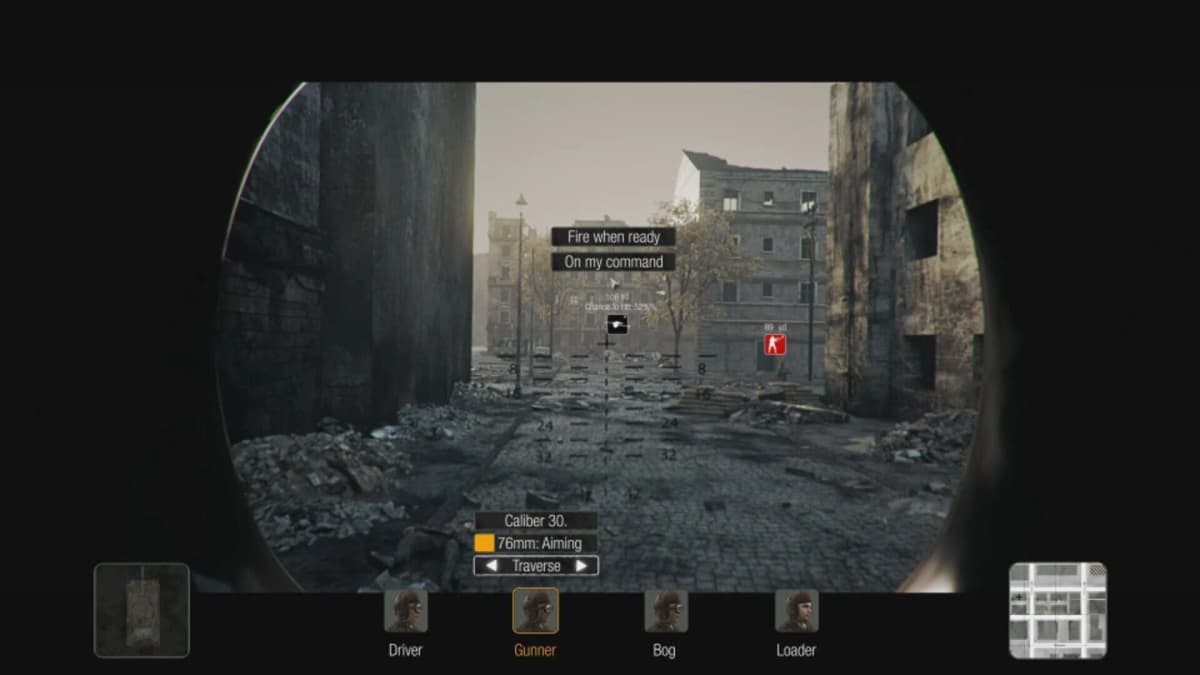
Simulation mode, though, is where the game really lodged itself in my brain. You’re essentially locked into the perspectives you’d have inside or atop a Sherman: cupola, gunsight, periscope, that kind of thing. Your field of view is cramped, turret traverse feels sluggish, and simply rotating the hull to get a better shot becomes an anxious decision because you might expose a weaker armor plate.
In sim mode, every small maneuver is a commitment. Turning 15 degrees left to “just peek” a road? You feel it in your stomach. I had one mission in a French village where I inched forward, stop-starting every few meters so my commander could scan alleys through the periscope. My infantry cleared houses house-by-house as I used the tank more as a mobile pillbox than a racing engine of destruction. It was slow, sometimes frustrating… and completely absorbing.
The nice thing is that the game lets you flip between these modes on a mission-by-mission basis. When I was tired after work and just wanted to blow stuff up with some tactical flavor, I picked action mode. When I wanted to sweat every movement and curse every bush that looked like a StuG, I went back to simulation.
RTS brain meets crew management: actually using your platoon
What really separates Sherman Commander from a straight tank sim is how central your squads are. You’re not just driving a single hero tank; you’re commanding infantry, support units, sometimes multiple Shermans, and using them like chess pieces. The game really leans on scouting and line-of-sight management, and it punishes you when you try to solo Rambo your way through.
On the tactical map, you can pause or slow time (depending on difficulty) and issue orders: send a recon team to a treeline, have your rifle squad cover a crossroads, position a second Sherman hull-down behind a ridge. It’s not as deep as a full-blown RTS like Company of Heroes, but it’s deeper than a side-feature. Pathfinding is mostly decent, and the autonomy changes the devs talked about are noticeable: squads actually seek cover instead of just jogging across open streets like targets at a carnival.
One mission that stuck with me was a defensive scenario around a rickety bridge. The objective was simple on paper: hold the crossing while German armor probed our lines. If you treat it like World of Tanks and park your Sherman in the middle of the road, you die in under a minute. What worked was treating the infantry as my eyes.
I set scouts in a clump of trees on the left flank, an MG team in a ruined farmhouse overwatching the bridge, and I parked my Sherman in a reverse-slope position behind a rise. I never actually saw the first Panzer with my tank optics; my scouts did. They called it out, the icon flickered on my map for a few seconds, and I rotated my turret toward that rough bearing, trusting their line-of-sight. When the tank finally poked its nose into my gunsight, it felt less like I’d “spotted” it and more like my platoon had ambushed it together.

That’s the sweet spot of Sherman Commander: you’re not micromanaging 20 units, but you’re also not a lone wolf. You’re a nervous leader in a noisy, half-blind machine, relying on grunts scattered around the map who can actually see more than you.
Underdog tank duels and the fear of being glass
The game really leans into the idea that the M4 Sherman was not the toughest kid on the block. German armor feels heavier and nastier; if a Panther or well-positioned anti-tank gun gets a clean shot, you often just explode. Armor angles and positioning matter more than raw aggression.
There was a duel in a German town square that pretty much sold me on the game. I’d been advancing cautiously, but I got greedy and pushed into an open square to support my infantry. A Panzer IV caught me from a diagonal angle, tagged my side armor, and instantly knocked out my tracks. My tank was now a pillbox, not a tank.
In many games, that’s a reload moment. Here, it turned into a miniature survival puzzle. I ordered my crew to pop smoke to obscure the Panzer’s view, then quickly swapped to the tactical map and told my infantry to rush a nearby building that had a side angle on the enemy. Simultaneously, I had a second Sherman swing around a back alley to try and get a flank shot.
For a few tense seconds, we were blinded, immobile, listening to the thunk of incoming shells hitting the walls around us. I could hear the Panzer trying to reposition. When the smoke cleared, my infantry had gotten into position, marked the target, and my second tank punched a round through the German’s side. That win felt earned, not because of twitch skill, but because I used all my tools.
Failure, on the other hand, stings in a good way. Get lazy with scouts, skip clearing a hedgerow, and you’ll lose your Sherman to a gun you never saw. The game isn’t unfair, but it absolutely expects you to respect every line-of-sight and every possible ambush. That can make the pacing feel slow if you’re used to faster WWII titles. This is more “crawl and check every corner” than “rush to the next objective marker”.
Failure, on the other hand, stings in a good way. Get lazy with scouts, skip clearing a hedgerow, and you’ll lose your Sherman to a gun you never saw. The game isn’t unfair, but it absolutely expects you to respect every line-of-sight and every possible ambush. That can make the pacing feel slow if you’re used to faster WWII titles. This is more “crawl and check every corner” than “rush to the next objective marker”.
🎮 Get This Game at the Best Price
Compare prices instantly and save up to 80% on Steam keys with Kinguin — trusted by 15+ million gamers worldwide.
*Affiliate link — supports our independent coverage at no extra cost to you
Campaign structure, missions, and how it actually feels to progress
The campaign runs through familiar WWII theaters – North African sand and dust, European towns, eventually into more built-up German areas. It’s not a story-driven game in the sense of long cutscenes or a cast of named characters; you get briefings, objectives, some radio chatter, and that’s about it. The “narrative” is mostly what happens moment-to-moment in missions.
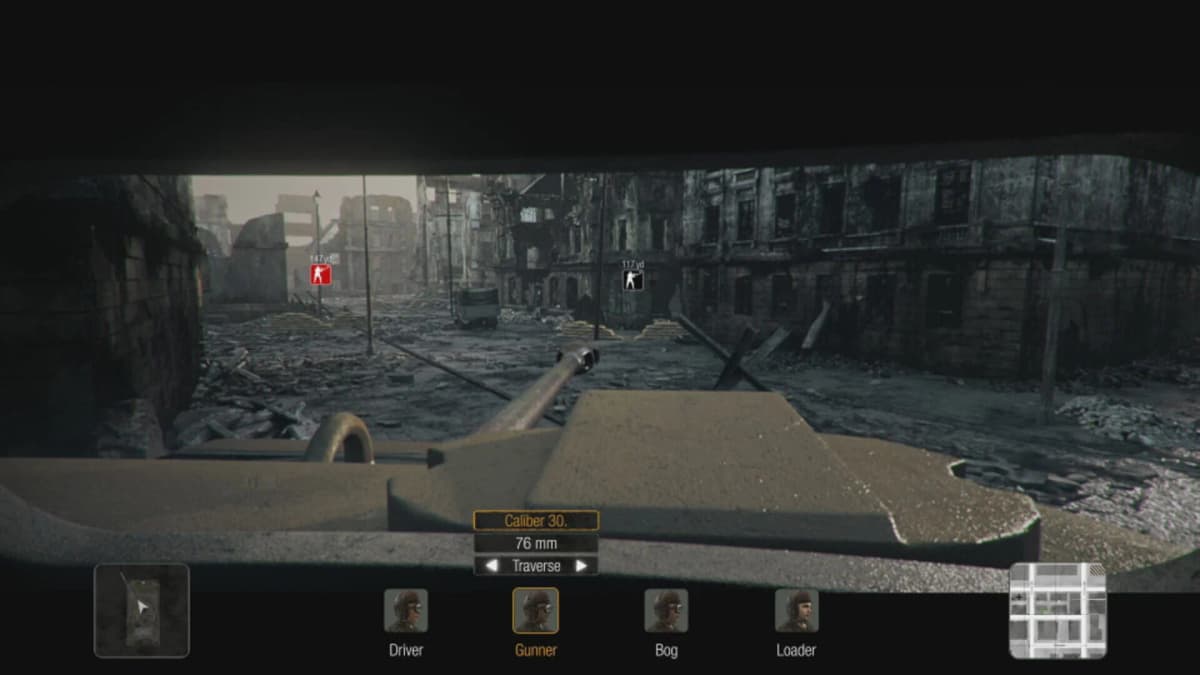
That said, there is a satisfying sense of escalation. Early on, you’re learning to just keep your Sherman alive and coordinate with a couple of infantry squads. As you move deeper into the campaign, the scenarios widen: holding multiple capture points, protecting allied armor, pushing through layered defenses. The AI isn’t genius, but it will flank you, relocate, and exploit gaps if you slack on recon.
One thing I appreciated is that not every mission is a pure offensive slugfest. Some of the more memorable ones are defensive holds and fragile escorts, which really force you to play the information game. When you’re on defense, that “fog of war” feeling gets even heavier because you’re constantly wondering where the next armor push will come from and whether your scouts will see it in time.
Progression is mostly about unlocking and tweaking tools rather than turning your Sherman into a fantasy beast. You can tune loadouts, get different ammo types, and slightly improve comfort and survivability, but it never stops feeling like you’re driving a relatively vulnerable machine. I’m glad the devs resisted the urge to turn it into an RPG grindfest; it stays grounded and skill-based.
Difficulty spikes, learning curve, and those “what just killed me?” moments
I won’t pretend Sherman Commander is welcoming to everyone right away. The learning curve is sharp at the start, especially if you jump directly into simulation mode. The UI is functional but occasionally cluttered, and in the first couple of hours I lost tanks simply because I couldn’t process what the game was trying to tell me fast enough: who spotted what, where the shot came from, which squad needed new orders.
After about three hours, though, it started to click. The key for me was fully embracing the rhythm the game wants: stop, observe, move a little, reposition scouts, check the tactical map, then push. Missions that initially felt like unfair ambush fests turned into tense but manageable puzzles once I slowed down and planned like an RTS player instead of a tank driver with ADD.
Even then, there are occasional difficulty spikes. I hit one mission in a denser urban area where enemy AT guns were set up at extremely mean angles. Getting through without losing at least one Sherman felt borderline impossible at first. Eventually I cheesed it a bit by sending sacrificial infantry to bait shots and reveal positions, which felt grim but also kind of thematically appropriate for WWII tactics.
If you’re coming from more arcade-style titles, be prepared for frustration while you adapt. But when the systems finally mesh in your head, those “I have no idea what killed me” moments start to dwindle, and you can often replay a failure and point to the one greedy move or lazy scout order that doomed you.
Performance, visuals, and sound: solid, not flashy
On my machine at 1440p, I was mostly sitting between 60-90 fps on high settings, with some dips during heavier effects (smoke, explosions in dense towns). The system requirements on paper are quite high for what you get visually, and I can see this being an issue if you’re on an older rig. Nothing game-breaking on my end, but it’s not especially well-optimized for low-end hardware either.
Visually, Sherman Commander aims for grounded and functional rather than eye-candy. The tanks look good up close, with enough detail on armor plates, tracks, and weathering to sell the realism. Terrain and buildings vary from “pretty decent” to “a bit plain”, especially in open countryside. This isn’t a photo-real competitor to the biggest budget war games, and that’s fine; the tension comes more from visibility and positioning than from spectacular vistas.
The real MVP for me is the audio. The interior of the Sherman feels cramped because of how it sounds: metal clanks, the engine’s low rumble, the sharp slam of the breech, the shouted crew callouts. When a shell hits nearby, the dull thunk and ringing in your ears sells the impact far more than any screen shake. Radio chatter from infantry and other tanks helps build situational awareness when your own eyes can’t see everything.
UI-wise, it’s a mixed bag. Most of the crucial information is there – sight lines, spotted enemies, squad status – but sometimes icons overlap or blend into the background, especially in busy town maps. I had a few cases where an AT gun icon got lost in the clutter and I drove straight into its kill zone. That’s partially on me, but some subtle UX polishing would go a long way.
Who Sherman Commander is really for
If your ideal WWII game is sprinting through corridors with an SMG and racking up 50 kills a match, Sherman Commander is going to feel slow and maybe even boring. The game asks you to enjoy the spaces between shots: the crawl forward, the scanning, the careful repositioning of scouts. It’s more about anxiety and planning than about spectacle.
On the other hand, if you’ve ever played a tank sim and thought, “I wish my AI infantry actually mattered,” or you’ve played an RTS and wished you could climb inside your main battle tank, this is almost exactly that fantasy. It hits a niche that sits somewhere between Steel Beasts, older Close Combat-style tactics games, and the slower, more thoughtful missions of something like the Men of War series.
It’s single-player only right now, so if you were hoping for multiplayer tank platoon shenanigans, that’s not here. For me, that’s fine — the joy is in mentally arguing with myself as a commander, not yelling at human teammates — but it’s worth noting.
FinalBoss // Gear
Level up your setup
01Top-rated gaming headsetson Amazon→02High-refresh gaming monitorson Amazon→03Gaming chairson Amazon→04Discounted game keyson Kinguin→Affiliate links · As an Amazon Associate, FinalBoss earns from qualifying purchases.
Want to Level Up Your Gaming?
Get access to exclusive strategies, hidden tips, and pro-level insights that we don't share publicly.
Ultimate Reviews Strategy Guide + Weekly Pro Tips