
Table of Contents (9)
Living With the Shokz OpenFit Pro: When “Background” Earbuds Steal the Show
Going into the Shokz OpenFit Pro, I thought I knew exactly what I was getting: a super comfy, open‑ear pair I’d use for runs and dog walks, while my “real” in‑ears with proper ANC stayed in charge of music and focus time.
That’s not how it played out. Over a couple of weeks of daily use-runs, commutes, writing sessions, a few too many late‑night YouTube spirals-these things quietly took over. Not because of the ANC (which is basically a checkbox feature) or the microphone (it’s fine, nothing more), but because the sound is way better than open‑ear buds have any right to be, and the comfort is absurd.
Transparency note: Shokz provided a sample of the OpenFit Pro for testing, with no say over the verdict or text and no early access to this review. I’ve been using them as my primary everyday earbuds since unboxing.
Design & Comfort: The First Open‑Ears I Forget I’m Wearing
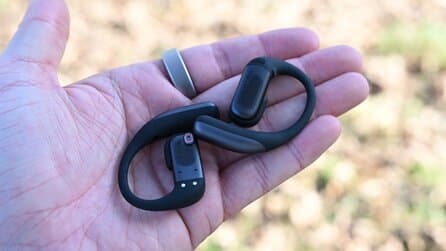
My first impression, right out of the case, was how normal the OpenFit Pro feel. They don’t do the bone‑conduction clamp thing Shokz is known for, and they’re not weird half‑in‑ear tips like some other “open” experiments. They’re classic ear‑hooks with small speaker pods that sit just outside your ear canal.
I slipped them on for an afternoon of writing and kept waiting for that usual slow burn of irritation I get from in‑ear tips. It never came. No pressure, no itch, no “I need to pop these out for a minute” moment. At one point I stood up to walk away from my desk and instinctively reached for my ears to take them out… and they were already there. That’s pretty much the OpenFit Pro’s whole pitch in one moment.
The ear‑hooks are flexible but not flimsy, and the pods feel solid without being heavy. The whole thing gives off “these will survive being chucked in a gym bag” energy without ever feeling cheap. The same goes for the case: it’s this small, flat, almost makeup‑compact‑style box that disappears in a jeans pocket or the tiny front pouch of a running belt. No chunky pebble, no weird bulge.
In terms of comfort hierarchy, for me it now goes: OpenFit Pro at the top, then classic open earbuds like Nothing’s Ear Open, then a big gap, and then proper in‑ears. If you’ve ever yanked your AirPods or in‑ears out mid‑run because your ear canal just needed a break, you know why that matters.
Everyday Features That Actually Matter: Wear Detection, Multipoint, Real Buttons
Comfort is the hook, but the quality‑of‑life stuff is what made me stop swapping back to my regular buds.
Wear detection works like it should, which sounds boring but is secretly massive. Pop them on and the music starts. Take one off, it pauses. That puts them in the same convenience lane as AirPods, without needing to be locked into one ecosystem.
Then there’s multipoint. I constantly bounce between an iPhone for calls and an Android phone for testing games and apps. On the OpenFit Pro, the switch is seamless enough that I stopped thinking about it. Watching a video on my Android test phone, Slack call comes in on the iPhone, audio hops over in a beat or two. No manual reconnect dance, no diving into Bluetooth menus. For people living across multiple devices, that alone can be a selling point.
Shokz also made the right choice going with physical buttons instead of touch sensors. Each earbud has a clicky button you can feel immediately with your finger, even mid‑run with sweaty hands. No accidental pausing when you adjust the fit, no weird ghost touches. Through the companion app you can remap what single, double and long presses do, so you can decide whether ANC toggle, track skip, or voice assistant is more important.
The Shokz app itself is blissfully simple. No bloated anime mascots, no labyrinth of half‑explained options. EQ presets, custom controls, the spatial audio toggles-everything is on the first or second screen. If you’ve used some of the more chaotic headphone apps out there, that calm design is a relief.

Sound Quality: “Open‑Ear” Finally Stops Being an Excuse
This is where the OpenFit Pro blindsided me. I went in expecting “good enough for jogging” and ended up happily using them on the couch at night instead of my normal in‑ears. For open‑ear earbuds, the sound is honestly impressive.
Bass is where open designs usually fall on their face. You don’t have a sealed ear canal, so you can’t get that physical thump. The OpenFit Pro obviously don’t hit like a pair of properly isolated in‑ears (if you want full sub‑bass rumble like AirPods Pro or a high‑end IEM, that still lives in closed designs), but Shokz has pushed the low end right up to the line of what’s possible here.
On Avicii’s Addicted To You, the kick drum and bass line feel present and defined without ever swallowing the rest of the mix. It has more low‑end body than I expected from something literally not sitting inside my ear canal, but still stays on the “airy” side rather than “punch you in the skull.” That’s honestly a sweet spot for long sessions: your head doesn’t feel like it’s being pressurized, but the track still has drive.
The mids and highs are where the OpenFit Pro really earn their keep. Vocals come through clean and natural, and details in guitars and synths don’t smear together. Toto’s Africa is a great test track here: those layered harmonies, percussion, and subtle effects can turn into a mush on cheaper buds. On the OpenFit Pro, the song unfolds into distinct layers, almost like someone placed two tiny speakers just off your ears rather than plugging them up.
It’s not all perfect. Push the volume into the “probably bad for your hearing” zone and the upper treble can get a little sharp, especially on modern pop or brighter rock mixes. With something like Linkin Park’s more wall‑of‑sound style tracks, the dense guitars and stacked samples don’t quite have the same weight and shimmer they do on closed earbuds. The whole thing feels a bit flatter, less brilliant. For me, that only showed up when I was really stressing them; at normal listening levels, they’re surprisingly balanced.
The short version: for podcasts, EDM, pop, acoustic, and most gaming soundtracks, these are more than good enough. For critical listening or if you live on bass‑heavy hip‑hop and metal, you’ll still want a closed‑back option in your bag—but I stopped feeling like I was compromising every time I chose the OpenFit Pro for convenience.
Spatial Audio, Dolby Atmos & Head‑Tracking: Fun, but Not Essential
Inside the Shokz app you can enable Dolby Atmos and a spatial audio mode with head‑tracking. On paper, that sounds slightly overkill for open‑ear buds; in practice, it’s a neat extra, with caveats.
Turn Atmos on and the already wide, open nature of the sound gets even more exaggerated. Instruments feel more “around” you instead of left‑right. For some tracks, it’s genuinely cool—you can pick out where certain percussion or backing vocals are placed in a way that standard stereo doesn’t always nail.

The trade‑off is that there’s a subtle loss of clarity. The bass thickens up a bit, but the overall picture gets slightly fuzzier. On longer listening sessions, I gravitated back to the regular stereo mode; the “wow” factor of spatial audio faded faster than my appreciation for a clean, consistent soundstage.
Head‑tracking works as advertised: turn your head, and the virtual “stage” stays in front. It’s a cool party trick and can be immersive for movies, but it’s not a killer feature. Think of it as a bonus mode to mess around with, not the reason to buy these.
ANC (Kind Of) and Noise: Don’t Buy These for Isolation
Here’s where expectations need a hard reset. Shokz calls it “open‑ear noise reduction,” and that’s about as honest a label as you can put on it. If you’re hoping for AirPods‑Pro‑in‑an‑airplane levels of silence, you’re going to be disappointed.
With the noise reduction toggled on, the OpenFit Pro gently soften low, constant sounds: the rumble of distant traffic, the hum of a fan, the white noise of a nearby stream. You’re still hearing your environment—it just loses a bit of low‑end weight. That’s it.
Crucially, you also get a noticeable background hiss from the earbuds themselves when the mode is active. It’s not thunderous, but in a quiet room I found it more distracting than helpful. On a train or a busy street, the ambient noise just dwarfs whatever small benefit you gain.
Because of that, I ended up turning noise reduction off almost entirely. Shokz isn’t lying: this is not traditional ANC. It’s a small comfort feature for specific situations, not a real isolation tool. If blocking out loud conversations or office chaos is your top priority, you’re in the wrong product category.
Battery Life: Open‑Ear Marathoner
Shokz claims up to 12 hours of listening on a single charge with the noise reduction off, and in testing that’s basically what I got. My best run landed at roughly 11 hours and 43 minutes before they finally died—close enough that I’m happy to call their spec honest.
Flip the noise reduction on and that number is cut about in half. For me, that was one more reason to leave it disabled. The whole appeal of these buds is that you can just wear them constantly: workday, commute, evening walk, maybe a quick late‑night game session, all without babysitting the battery. With ANC off, that’s exactly how they behave.
The case adds enough juice to bring total playback time up to about 50 hours without noise reduction or roughly 24 hours with it on, according to Shokz. In practice that meant I was charging the case once every several days even with heavy daily use. As long as you’re not the kind of person who lets every gadget drop to 0% because the charger is “too far away,” you’re not going to stress about battery here.
Microphone & Calls: Fine for Quick Chats, Not for Your Next Podcast
The mic story is way less exciting. In a quiet room, your voice is perfectly intelligible—just thin. There’s a boxy, slightly metallic character to it, like you’re talking from the bottom of a plastic cup. Compared to speaking directly into a phone mic or a proper USB microphone, the OpenFit Pro sound clearly worse.
On one test call, I swapped between my phone mic and the Shokz mid‑conversation. The reaction on the other end was immediate: “Yeah, whatever you just switched to sounds more tinny.” That tracks with how most Bluetooth earbuds behave, and the OpenFit Pro don’t really escape that gravitational pull.
The good news: for short work calls, Discord chats, or a quick “I’m five minutes away” phone call, they’re absolutely fine. If you’re hoping they’ll double as a broadcast‑quality streamer mic or replace your headset for hours of meetings every day, they won’t.
Who the Shokz OpenFit Pro Are Really For
After a couple of weeks rotating the OpenFit Pro through my usual use cases, the target audience is pretty clear.
If you’re a runner or cyclist, these are kind of a dream. You get a legitimately good, balanced sound without sacrificing the ability to hear cars, bikes, pedestrians, or your own footsteps. No sweaty ear canals, no constant reseating the buds because each stride loosens the seal.
If you’re someone who hates the feeling of in‑ears but still wants better audio than a tiny phone speaker, the OpenFit Pro are worth a serious look. They finally make “open‑ear” sound like more than a compromise.
On the flip side, if you:
- ride a loud train or bus and want to drown it out,
- work in a chaotic office and need a silence bubble, or
- prioritize call quality over everything else,
then you’re still better off with a traditional in‑ear or over‑ear headset with strong ANC and a better mic. Think of these as your all‑day, “live in the world” earbuds, not your isolation chamber.
FinalBoss // Gear
Level up your setup
01Top-rated gaming headsetson Amazon→02High-refresh gaming monitorson Amazon→03Gaming chairson Amazon→04Discounted game keyson Kinguin→Affiliate links · As an Amazon Associate, FinalBoss earns from qualifying purchases.
Want to Level Up Your Gaming?
Get access to exclusive strategies, hidden tips, and pro-level insights that we don't share publicly.
Ultimate Reviews Strategy Guide + Weekly Pro Tips