
Table of Contents (7)
A glass demon, a skateboard, and a moon to eat
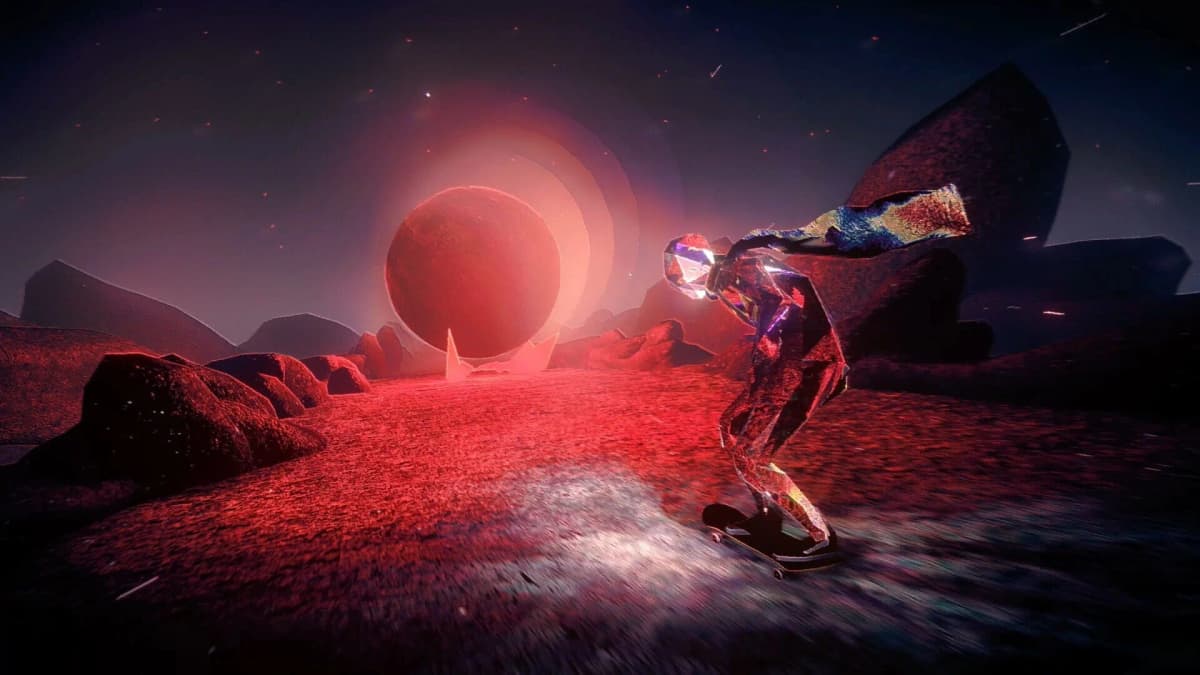
The first thing Skate Story did was kill me before I even landed my first ollie. I pushed off, oversteered into a curb, and my character – a demon made entirely of glass – exploded into glittering shards across the underworld pavement. The second thing it did was make that failure look so good that I immediately hit restart with a stupid grin on my face.
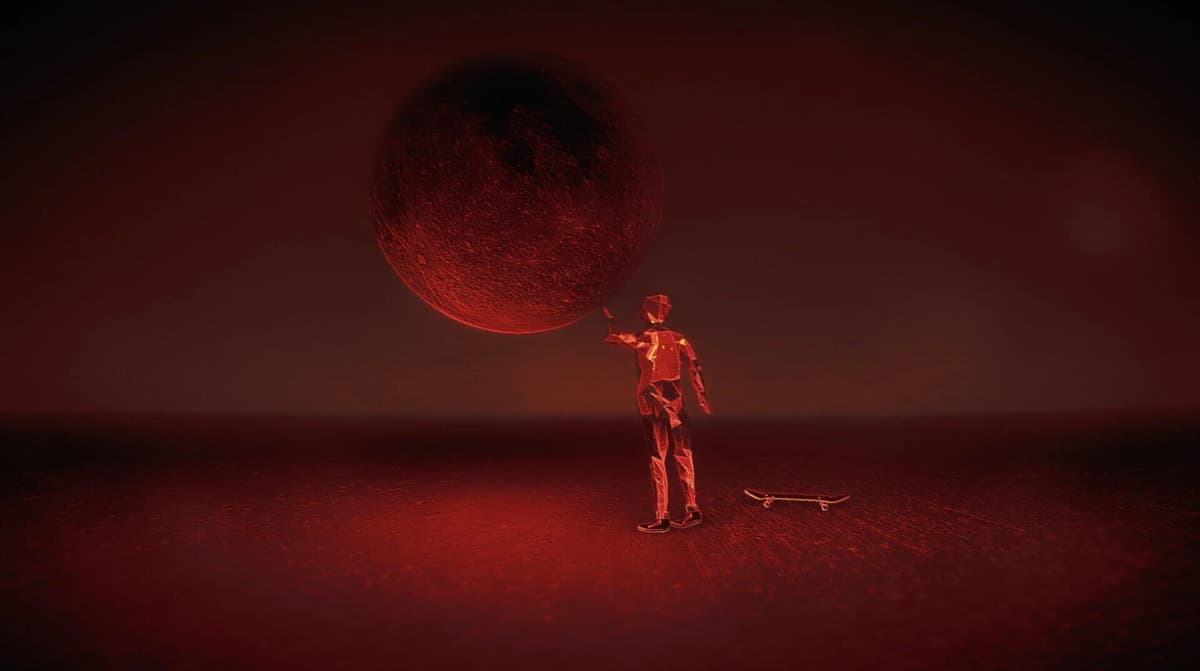
On paper, Skate Story sounds like a bit: you’re a glass demon in hell, skating through a fractured, liminal underworld to go eat the moon so you can finally get some sleep. In practice, it feels like a fever dream where Tony Hawk’s Pro Skater, an art school thesis film, and a late-night synthwave set all collided at high speed and shattered into something strangely coherent.
My first 30 minutes were mostly falling. I was overcorrecting my turns, bailing on simple rails, and slamming into geometry I hadn’t quite read correctly. But the way the board hums beneath you, the way the glass demon leans and carves, plus that pulse of deep synths in the background – it nudged me into “one more try” territory very quickly. Clumsy, yes. Boring, no.
What I didn’t expect was how quickly the game would stop feeling like “a skateboard game with a weird aesthetic” and start feeling like a full-on mood piece. Skating became the language, not the subject. Eating the moon stopped being a punchline and started to feel like a strangely sincere act of rebellion and self-preservation. That shift is where Skate Story quietly hooked me.
Key takeaways after living with Skate Story
- Skating feels awkward at first, but blossoms into a satisfying flow once you stop overthinking and trust the pared-back controls.
- The underworld is less “fire and brimstone” and more like a distorted, anxious city – with bizarre, grounded characters that stick in your head.
- Blood Cultures’ synth-heavy soundtrack and the prismatic visuals fuse into something closer to a concept album than a typical sports game.
- Difficulty spikes, visibility issues, and fragile-glass deaths can absolutely break the vibe if you’re not in the right headspace.
- If you want strict realism or pure score-chasing arcade skating, this might frustrate you – but if you like games like Journey or Sayonara Wild Hearts, it’s quietly remarkable.
From wobbly ollies to genuine flow
I came into Skate Story with a lot of muscle memory from Tony Hawk and EA’s Skate series. My thumbs instinctively reached for complicated button inputs and stick flicks. Skate Story doesn’t really care about that; its control scheme is stripped down, almost stubbornly so. Tricks are mostly about timing and commitment rather than complex inputs.
In the corner of the screen there’s a small spinning meter that shows your trick timing window. At first I treated it like a quick-time event, staring at it as I tried to nail perfect kickflips. That made everything worse. I was late, early, over-rotating, under-rotating – a highlight reel of scuffed landings and shattered demon limbs. After a couple of hours, I started ignoring the meter and listening to the rhythm of my own pushes, and things clicked.
That’s the magic trick: when you stop fighting the game and accept its limited, almost meditative move set, it rewards you with a sense of flow I haven’t felt since the first time I really “got” manuals and reverts in Tony Hawk 3. A sequence that felt impossible early on – weaving through a narrow tunnel, hopping a gap, grinding a rail, kickflipping off the end – became muscle memory later. I’d chain lines together through empty plazas and ruined highways just because it felt good.
Skate Story does have traditional structures: score challenges, combo requirements, and sections where you have to string tricks together without bailing. But they mostly feel like excuses to keep you in motion, not checklists in a career ladder. There’s no obnoxious coach yelling at you to prove yourself to sponsors. Instead, a philosopher demon named Phil mutters about meaning, and a pigeon gripes about his unfinished manuscript while you’re trying to hit a clean line past him.
The glass body is more than a cute visual gag, too. Falling doesn’t just mean “try again” – it’s a tiny emotional gut punch, the sound of crystal exploding into the void. Some sections ask you to thread through spike-covered tunnels or ride rails above an abyss, and that fragility makes every success disproportionately satisfying. I lost count of how many times I shouted “yes” out loud after finally landing something I’d been bottlenecked on for ten minutes straight.
Hell as a cracked mirror of real life
The version of hell in Skate Story isn’t lakes of fire or torture chambers. It’s closer to a liminal city seen through broken glass: overpasses that stretch into nothing, half-constructed office blocks, abandoned theaters, and laundromats staffed by sentient pillows who just want a day off. It feels uncomfortably familiar, like the mundane parts of our world have been tilted 30 degrees off-axis.
The cast you meet along the way drifts between surreal and painfully relatable. Phil, the philosopher demon, debates purpose while you’re literally grinding past them. The pigeon with writer’s block worries about finishing his manuscript and whether it will matter. The pillow running the laundromat is sick of the Devil’s laundry clogging the machines but also low-key dreams of closing up early and going for a walk. It’s absurd, but the dialogue is delivered with this flat, everyday tone that makes it feel grounded instead of quirky for its own sake.
Between chapters, the game drops little poems on you. Short, fragmented verses about desire, exhaustion, and the way routine can feel like a cage. I started looking forward to those breaks more than the next mechanical unlock. They reframe what you just did in this unexpectedly sincere way: that stretch of awkward, tense skating through spike tunnels suddenly feels like a metaphor for grinding through a job you hate or a relationship that’s outlived its joy.
Importantly, the story never fully dissolves into pretension. It never explains everything, and it doesn’t have a big “ah-ha, it was all a metaphor for X” twist. It’s content to be a vibe: a demon who’s tired of a sleepless moon, deciding the only logical answer is to eat it and help a few lost souls along the way. I left the game with more questions than answers, but also with lines of dialogue and poetry echoing in my head.
Sound and style: a skateable concept album
Skate Story is the rare game where screenshots undersell what it’s doing. In stills, it looks cool: a glass figure, sharp edges, neon streaks, a lot of black void. In motion, it becomes something else. Every push sends little shivers of light across your transparent body. Wiping out doesn’t just reset you; your demon explodes into fragments that catch the light like a busted chandelier, then reform as the music swells back in.
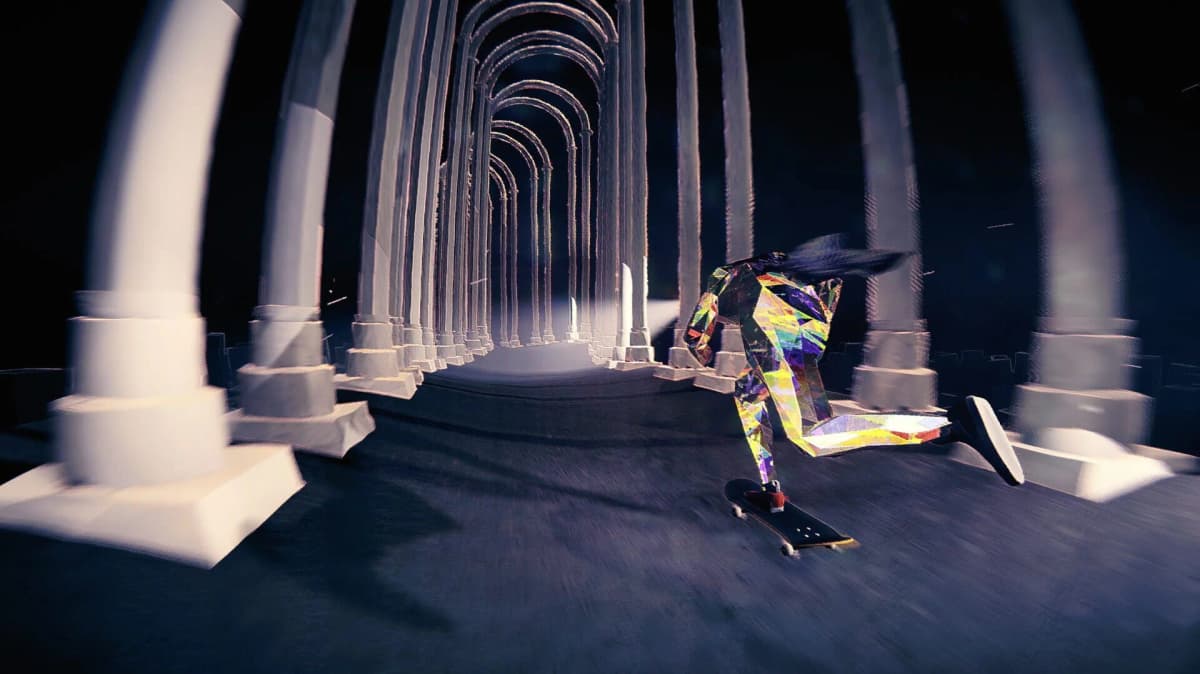
The palette is mostly deep blacks, reds, and blues, punctuated by shocking whites and occasional bursts of unreal color. Some levels feel like skating inside a broken mirror; others feel like drifting through the ruins of a forgotten mall. The camera hugs close enough to feel intimate but pulls back at the right moments to frame you as a tiny, fragile thing carving through an overwhelming space.
The soundtrack, anchored by Blood Cultures, deserves its own paragraph. Instead of the usual pop-punk and hip-hop rotation we associate with skate games, you get woozy vocals, heavy synth bass, and glitchy textures. Songs slide from dreamy to aggressive without warning. There are stretches of near-silence where you’re just listening to wheels on concrete, then out of nowhere a track drops with a thick, driving beat that makes you start taking bigger risks, going faster, pushing for that next line.
After a while, the whole experience feels less like “a game with a good soundtrack” and more like you’re performing the album. Your falls punctuate the songs. Your successful combos sync with the rises and crashes. I found myself replaying certain chapters just because I liked how a particular track fit with a specific set of gaps and rails. It’s rare that a game makes me think, “I’d happily just sit and watch someone else play this level with this song.” This one did.
Where Skate Story starts to lose its balance
For all the praise, the game isn’t some frictionless masterpiece. The same fragility and abstraction that make it special can also make it exhausting. There were nights where I booted it up, failed the same precision challenge a dozen times, and quietly alt-F4’d because I could feel the vibe souring in my head.
Difficulty spikes are a big part of that. The game mostly ramps up at a fair clip, teaching you one new mechanical idea at a time. Then it will occasionally drop a segment that feels tuned for people who spent their teenage years breaking fingers in skate sims. Narrow rail runs over instant-death pits, chicanes full of spikes with no room to recover, or score targets that feel just a bit too strict for how floaty and timing-based the tricks are.
Visibility can be an issue too. The art style is gorgeous, but the mix of deep shadows, bright highlights, and shimmering glass sometimes made it hard for me to read small obstacles or ledges in time. More than once I slammed into a low object I genuinely hadn’t seen, or misjudged a gap because the perspective made it look shorter than it was. When I was in the zone, I shrugged it off. When I wasn’t, it felt cheap.
There’s also a certain repetition baked in. You’ll be skating through similar-feeling stretches of underworld, chasing slightly higher scores or cleaner lines, and if the narrative beat or musical backing of that section doesn’t land for you, it can drag. The minimal UI and lack of explicit progression systems is refreshing, but it also means there are moments where you’re just… stuck, practicing the same run over and over without much sense of external reward beyond “you finally did it.” For some players, that will be the point. For others, it’ll be the drop-off.
Who this strange little skate odyssey is actually for
Skate Story sits in a weird pocket. If you come in wanting the tight, checklist-driven rush of the old Tony Hawk games, you might bounce off the slower, more deliberate pacing and fragile physics. If you’re a hardcore Skate or Session player hunger-starved for realism and technical depth, you’ll probably find the simplified controls and more forgiving trick system too soft.
But if you’re the kind of person who still thinks fondly about Journey, Gris, or Sayonara Wild Hearts – games that use movement as a kind of emotional language – Skate Story lives in that neighborhood, just with more concrete and fewer capes. It asks you to accept that sometimes you’re going to repeatedly smash your glass body into the ground, and that this is part of the story it’s telling about exhaustion, persistence, and wanting something different from the endless night.
I ended up playing it in bursts rather than marathoning. An hour or two at a time, late at night, lights low, headphones on. In that space, the game absolutely sang. The underworld felt like a reflection of my own burned-out brain, and landing a clean line through a nasty section felt less like “beating a level” and more like wrestling my own static into something graceful, even if just for a second.
FinalBoss // Gear
Level up your setup
01Top-rated gaming headsetson Amazon→02High-refresh gaming monitorson Amazon→03Gaming chairson Amazon→04Discounted game keyson Kinguin→Affiliate links · As an Amazon Associate, FinalBoss earns from qualifying purchases.
Want to Level Up Your Gaming?
Get access to exclusive strategies, hidden tips, and pro-level insights that we don't share publicly.
Ultimate Reviews Strategy Guide + Weekly Pro Tips