
Table of Contents (10)
A first run that spiraled out of control fast
The first time I hit “End Turn” in Slay the Spire 2, I was already dead. I just didn’t know it yet.
I was on the final fight of the first act, sitting on what felt like a safe stack of block, an Ancient power humming above my character, and a deck I was pretty sure was “cracked.” I’d leaned into a new mechanic that rewarded me for repeatedly using the same kind of card, and it had been melting elites all floor long. I queued up a neat little sequence of attacks, saw the enemy’s HP bar vanish, and relaxed.
Then the game quietly reminded me this is still the Spire. The boss didn’t just die. It transformed, shifted its pattern, and suddenly my carefully tuned deck was wrong for the fight I was actually in. The Ancient that had been carrying me flipped into a downside, and two turns later I was staring at the Defeat screen, wondering how I’d managed to walk straight into a problem I’d helped create.
That’s been my experience with Slay the Spire 2’s Early Access so far: instantly familiar if you lived in the first game, but constantly nudging you into new, sometimes nasty corners of the design. It looks like a sequel. It plays like a sequel. But it’s meaner about the ways you try to “solve” it.
Under the hood: what actually feels new?
Mechanically, calling this “Slay the Spire 1.5” would be selling it short. The basic loop is the same: you pick a character, climb through a branching map of fights, events, and shops, build a deck out of random cards and relics, and get slapped for your mistakes. The difference is how many of your old instincts the sequel quietly punishes.
The big structural additions are threefold: Ancients, Epochs, and a suite of new keyword mechanics and augments that reshape how you think about deckbuilding.
Ancients instead of boss relic autopilot
In the original game, you’d beat a boss and slam one of a few relics that often pushed your run into a clear direction. Slay the Spire 2 replaces that pillar with Ancients: larger, run-defining entities that feel more like you’re signing a pact than grabbing a passive.
In one run, I picked an Ancient that supercharged my damage if I kept playing the same card type, at the cost of making my deck clunkier whenever I “broke pattern.” In another, I took one that rewarded reckless HP trading with huge spikes of power – until I misjudged a fight and found myself one bad draw away from instant death for five floors straight.
Ancients make the run feel less like a straight-line power curve and more like a contract with weird, semi-divine weirdos who will happily ruin you if you misplay their terms. They’re a good example of what Slay the Spire 2 keeps doing: instead of just “more relics,” it looks for levers that change how you think about every turn.
Epochs: a meta-progression that’s more roadmap than story
Outside runs, instead of simple character unlocks and a vague sense of “beating the Heart,” you get a progression timeline called Epochs. Each Epoch adds modifiers, unlocks cards and relics, and sprinkles bits of lore about what’s actually happening with this endlessly mutating tower.
Right now, in Early Access, Epochs feel more like a smart menu system than a full-blown narrative hook. You scroll along a timeline, click into new conditions, and slowly widen the sandbox of stuff that can appear in your runs. It’s cleaner than the original’s “things just unlock in the background,” but it also feels a bit thin emotionally. The bones are strong; the meat isn’t all there yet.
Keywords, augments, and a nastier combat puzzle
Inside fights, the changes stack up quickly. Enemies have clearer identities and more tightly defined movesets, which means misreading them gets you hammered much faster. Some are all-in on building armor and reflecting your damage, others mess with your draw pile in ways that make sloppy deckbuilding feel unbearable.
Cards now lean harder on keywords and augments. A card that seems mediocre at first suddenly becomes the backbone of a build when you graft an augment onto it that, say, changes when it exhausts or how it scales. I had one run where a common attack became my entire game plan simply because an augment let it flood my hand with temporary copies whenever I killed something. The deck was hideous, unwieldy, and utterly broken until a single elite encounter exploited its one weakness and wiped me out.
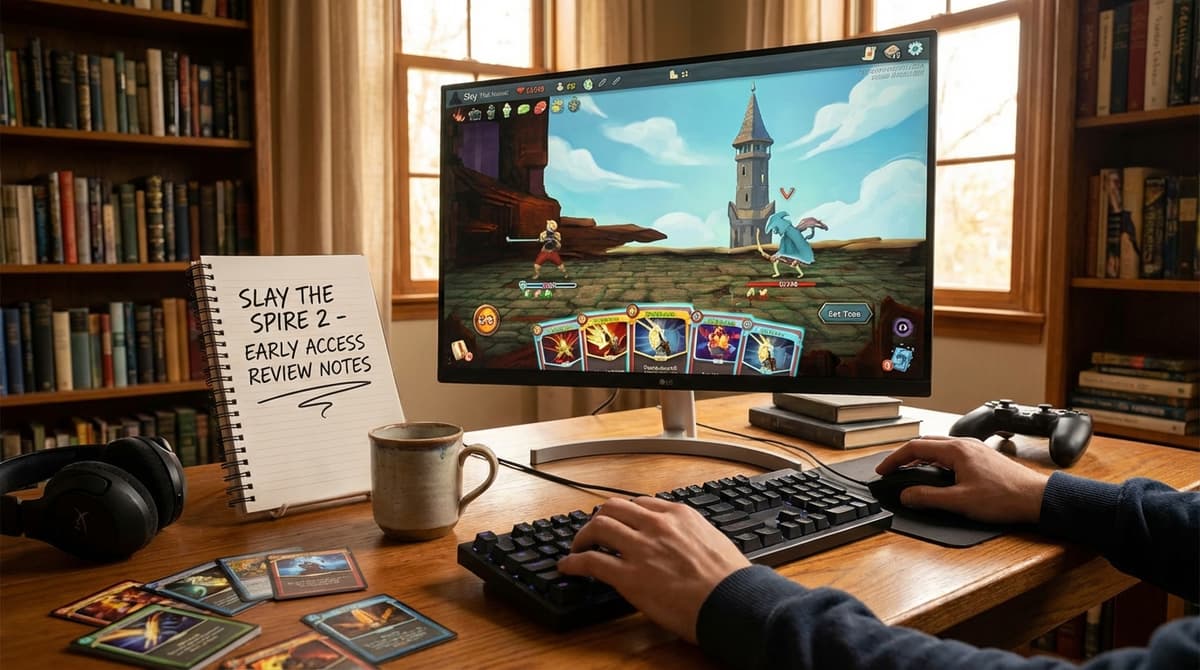
The point is, this isn’t just “more cards.” The sequel keeps pushing you toward synergies that are powerful but brittle. It wants you to chase greedier lines, then see if you can actually pilot them.
The roster: three old killers, two new freaks
The Early Access build ships with five characters: three returning faces from the first game and two newcomers. If you were worried they’d overhaul the original trio into strangers, they haven’t. They feel like the versions you remember, just tuned to fit the new systems and balance goals.
What’s interesting is how the new characters twist the usual Slay the Spire rhythm.
The Regent is the one that clicked hardest for me first. On paper, it’s a “regal” archetype, but in practice it plays like a high-risk tempo deck that wants to dance on the edge of losing control. Its kit leans into resource juggling, where you spend a turn or two feeling underpowered just to flip the board into your favor in a single explosive turn. Miscount once, misjudge an enemy intent, and that entire engine detonates in your face.
The other newcomer, the Necrobinder, is just… strange, in a good way. Its whole identity revolves around conjured weapons and a kind of mechanical necromancy. One of the headline mechanics here is the “forge” – essentially summoning and empowering a floating blade that sticks around between turns. Playing this character forced me to think about fights as multi-turn arcs instead of short sprints. You commit early to a game plan and then spend the rest of the combat trying not to regret it.
Compared to them, the returning trio feels like comfort food. That said, some changes from balance passes and the new card pool have stirred up controversy, especially around infinite-combo enablers getting toned way down or outright removed. If you lived for nonsense loops in the original, some of your favorite toys are gone or heavily altered here. Personally, I don’t miss them, but I get why players who spent hundreds of hours perfecting those lines are annoyed.
As a whole, the roster already feels bigger than the first game’s launch lineup in terms of how differently they make you approach the map. It’s not just five skins on the same ideas; switching character genuinely changes what events you’re excited to see, what relics you pray for, and which fights you dread.
Co-op: glorious disaster with friends
The headline feature you can’t ignore is official co-op for up to four players. This is something the community hacked together in the original, so seeing it baked in from day one feels huge.
Here’s how it works in practice: everyone has their own deck and hand, and turns are real-time free-for-alls. You all play cards during the same enemy turn window, piling damage and block onto the same board. There’s no strict turn order. If you’ve ever watched four people try to edit the same Google Doc at once, you know exactly how this can go wrong.
My first co-op run was pure chaos. I’d queue up a careful block sequence only to watch a teammate fire off three attacks first, overkilling an enemy and wasting my planned debuff. Someone else would chug a potion right before another player landed a killing blow. Half the time we were laughing at how badly we were stepping on each other’s toes; the other half, we were arguing about why nobody had read the enemy intents before dumping their hand.
With voice chat and a patient group, the mode shows real promise. You start calling lanes – “I’ll handle block, you burn adds, you set up scaling” – and the frantic card-slinging turns into something that actually resembles coordination. Without communication, it’s closer to a party game where misplays are part of the fun.
Right now, co-op still feels undercooked. The UI isn’t amazing at surfacing what everyone is doing in real time, and there are moments where latency or unclear feedback make it hard to tell whose card just resolved. But as an Early Access foundation, it’s already fun, and crucially, it feels different from just “doing solo runs on a call.” That’s more than a lot of games manage.
Difficulty, balance fights, and Early Access reality
One of the strangest things about Slay the Spire 2 right now is how divided people are on difficulty. Some reviewers and players swear it’s tougher than the first game, especially on standard runs where new mechanics punish sloppy planning. Others, particularly high-ascension veterans, say the current top-end challenge curve is actually softer than the original.
My own experience sits somewhere in the middle. The first dozen runs felt brutally punishing until I stopped trying to port over my old, comfortable deck archetypes. The moment I leaned into the new keywords and Ancients instead of mentally chasing my favorite STS1 combos, my win rate climbed noticeably. At that point, normal ascensions started feeling fair to slightly forgiving, while still demanding real focus.
Where you can really feel Early Access is in the ongoing balance surgery. The devs have already pushed patches that nerfed some beloved tools, including one zero-cost discard/draw card that used to be the backbone of all kinds of infinite turns. That sparked review bombing and angry forum threads about the game being “too hard” or “killing creativity.”
Two things can be true at once: some of the nerfs do feel like creativity taxes, and the game is obviously still stabilizing its balance. At the same time, the core loop is already extremely solid, and the system is healthier without easy infinites dominating the decision space. If you want a frozen design that perfectly respects your STS1 muscle memory, this might frustrate you. If you’re okay with a living, shifting meta, the back-and-forth is part of the fun.
Presentation and performance: the Spire glows up
Visually, this is very clearly the same world, just sharpened and fleshed out. The art has more personality across the board: events are framed with stronger character illustrations, enemies have clearer silhouettes and animations, and combat effects feel weightier without turning into noise.
That matters because of how often you’re parsing the screen. With more complicated enemy intents and status effects, you need the UI to be loud about what actually matters, and Slay the Spire 2 mostly nails this. There are still occasional moments where a specific icon or keyword explanation is easy to miss, but it never reached the point where I felt like I lost a run purely because the interface lied to me.
Performance-wise, the Early Access build I’ve been on has been surprisingly clean. Loads are quick, crashes have been nonexistent for me personally, and the only “early” feeling parts are a few pieces of placeholder art and some rough edges in co-op UI. Considering how many Early Access launches arrive with missing features and nasty bugs, this one feels unusually stable.
Roadmap and how it stacks up to the original
This is the big question: if you already sunk an absurd number of hours into the original Slay the Spire, is the sequel right now worth buying and learning, or is it safer to wait for 1.0?
Content-wise, the Early Access package is beefy. Five characters, three acts, hundreds of cards, relics, potions, Ancients, and the full co-op framework are already there. There’s no true “final” ending yet, and the Epoch meta-progression feels more like scaffolding waiting for story and big surprises, but this is not one of those EA releases where you’re paying for half a game.
The roadmap, based on how the devs are communicating, looks like a mix of new content (more events, relics, maybe additional characters or acts) and heavy iteration on balance, Epochs, and probably co-op UX. I wouldn’t count on the core design doing a 180; it already has a clear identity. Expect refinements, filling in the narrative gaps, and more toys to break yourself with.
Compared directly to the original, Slay the Spire 2 feels like what happens when a team that absolutely nailed a formula decides to risk tweaking its supporting pillars instead of just piling on content. The map routing is more interesting. Events are riskier and more expressive. Ancients and augments keep you from coasting on autopilot. The price you pay is familiarity: if you burned out on the first game, you may initially feel like you’re just replaying a sharper, meaner version of what you already know.
For me, the sequel’s greatest trick is making that familiarity feel like a trap. It lures you in with the comfort of old characters and familiar card archetypes, then quietly rigs the system so you have to rethink your assumptions. If you want a radical reinvention, this isn’t that. If you wanted “the same thing, but deeper and harsher in the right places,” that’s exactly what this is shaping up to be.
FinalBoss // Gear
Level up your setup
01Top-rated gaming headsetson Amazon→02High-refresh gaming monitorson Amazon→03Gaming chairson Amazon→04Discounted game keyson Kinguin→Affiliate links · As an Amazon Associate, FinalBoss earns from qualifying purchases.
Want to Level Up Your Gaming?
Get access to exclusive strategies, hidden tips, and pro-level insights that we don't share publicly.
Ultimate Reviews Strategy Guide + Weekly Pro Tips