
Table of Contents (14)
So Apparently GTA: Vice City Is the Brownest Blockbuster Game – and the Data Backs It Up
The moment I saw “Most brown game: Grand Theft Auto: Vice City” in the leaderboard, I had to stop and reread it. Vice City? The pastel-neon, synth-drenched, 80s fever dream? Browner than Gears of War, browner than all the grimdark World War II shooters, browner than the usual suspects we all like to drag when we moan about the 360/PS3 era?
On the flip side, the least saturated game in the dataset isn’t a cover shooter or some washed-out modern military sim either. It’s Resident Evil 2. And the darkest overall? Resident Evil 7, which honestly feels right if you’ve ever tried to navigate that house with the brightness turned down a notch too far.
This all comes from a frankly obsessive video essay that decided to stop arguing about whether “Gen 7 went brown” and actually measure it. Not vibes. Not cherry-picked screenshots. Every pixel of thousands of frames from the top-selling US games between 2000 and 2020, crunched into hard numbers: saturation, brightness, “brownness,” and “warmth.”
It’s the kind of project that sounds impossible when you first hear it – then you see the custom tools, the HSV cylinder visualiser, the spreadsheets, and you realise someone actually did the work most of us just joke about on forums.
And the punchline is: yes, there are brown and desaturated games, some of them exactly the ones you’d expect. But the data pokes serious holes in the idea that the 360/PS3 era uniquely “turned video games into a muddy mess.”
Before diving into the weird leaderboard highlights (Vice City! Just Dance 3! FIFA 13 of all things!), it’s worth laying out exactly what this analysis looked like, because the methodology is actually the star here.
Specifications
At a glance, that looks less like a YouTube side project and more like the outline for a small research paper. And that’s kind of what made it click for me: this isn’t “here’s a montage of brown screenshots,” it’s a genuine attempt to quantify a meme.
What Caught My Attention: Resident Evil vs. Vice City vs. Everyone’s Memory
There are a few headline results that immediately mess with your mental image of game history. The video lays out leaderboards across four dimensions: saturation, brightness, brownness, and warmth. Some of those charts fit the stereotype; others flip it upside down.
Least saturated game overall: Resident Evil 2, at just 13.6% saturation on average. If you’ve played the original or watched footage recently, this tracks: that game is all about washed-out greys and dingy, blood-spattered environments. Still, it’s funny how the data quietly snubs a decade of “ugh, military shooters are so grey” discourse and taps a classic survival horror instead.
Most saturated: Just Dance 3, at a blazing 77.4%. Not exactly a shock once you think about it – the Just Dance series is basically a moving rave flyer. Four different Just Dance entries hit the top 10 most saturated games, elbowing aside a lot of “serious” AAA fare. Right behind them you’ve got Cyberpunk 2077 (4th) and, brilliantly, Doom (2016) in 6th, reminding everyone that “dark” and “desaturated” are not the same thing at all.
Darkest average brightness: Resident Evil 7, at just 8.8% brightness. That one feels almost too on-the-nose. RE7 is a masterclass in “I can’t see anything, but in a good way” lighting design. Other dark outliers include The Witcher 3, Halo, Gears of War, and Diablo II – games you probably remember as moody, shadowy, or downright oppressive.
On the other end of the scale, brightest overall is Wii Fit, at 67.7% average brightness. Which, of course. If your UI is basically white void with Mii silhouettes, your histogram is going to be a lighthouse. Wii Play shows up for similar reasons, and then you’ve got the usual suspects: Pokémon and Super Mario titles rocking cheerful, high-brightness palettes.
Then we get to the brownness metric.
Least brown game: FIFA 13, at 0.6% brownness. Sports games in general really don’t register as brown; they’re mostly giant green fields with sky blues and team colours. The only non-sports outliers on the “least brown” list are Halo: Combat Evolved and Need for Speed: Carbon, both of which lean heavily into cool blue palettes instead.
And finally:
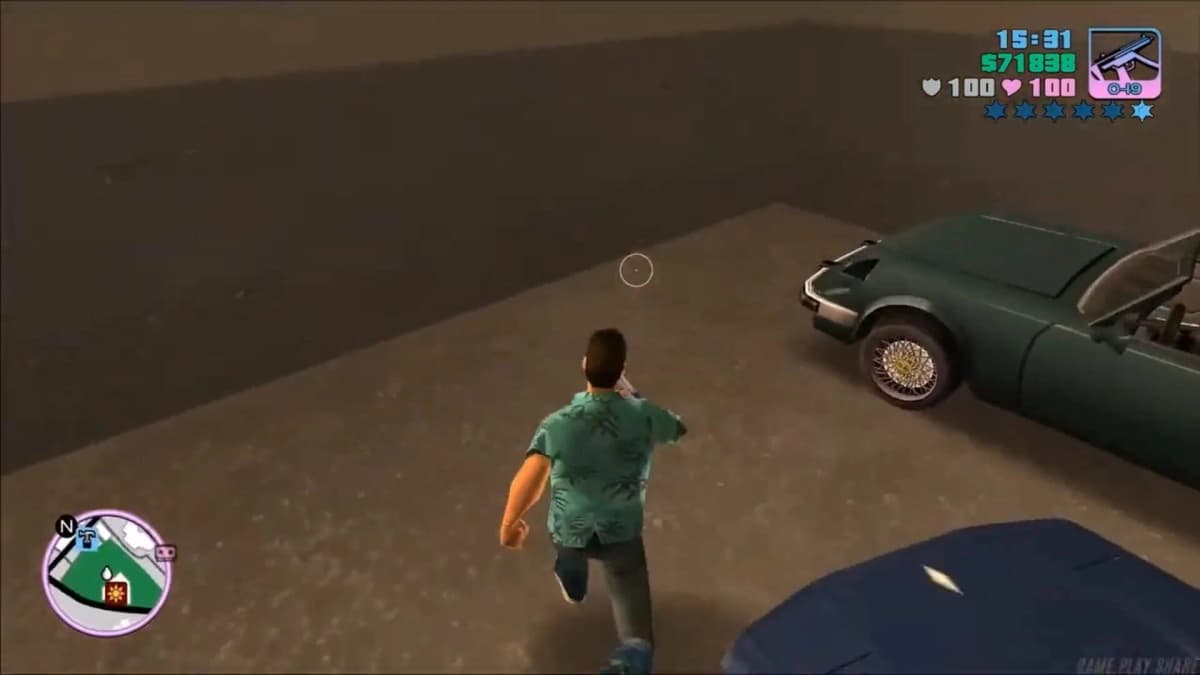
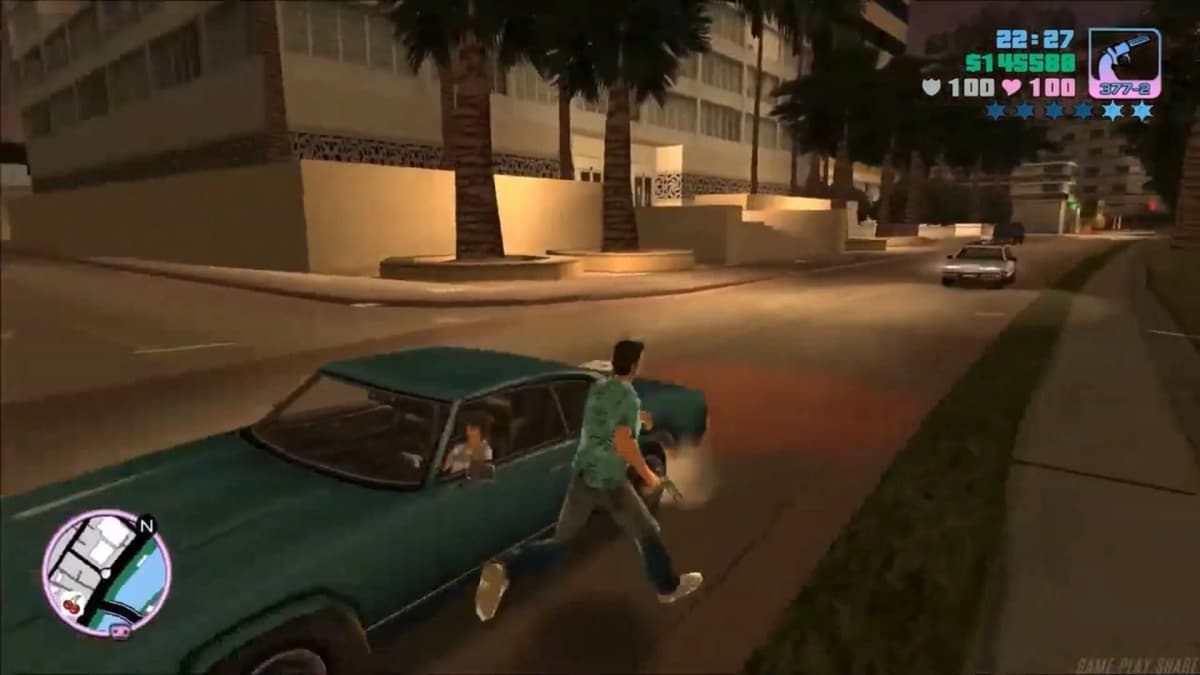
Most brown game in the entire dataset: Grand Theft Auto: Vice City, at 65.1% brown pixels. Not Gears, not Call of Duty, not some PS3 desert slog – Vice City. The explanation is weirdly satisfying once you hear it: the game’s lighting is relentlessly warm, and most of the underlying city geometry – roads, buildings, concrete – is grey. Add a heavy orange cast over neutral grey and, mathematically, you get a sea of brown.
It’s a perfect example of how our memory cheats. We remember the neon signs, the sunsets, the pink shirts; the data remembers every frame spent driving down tan-lit highways and standing on beige sidewalks. Both are “true,” but only one of them ends up dominating a spreadsheet.
Other high-brownness games are more intuitive: basketball titles with huge wooden courts that sit squarely in the brown zone, and games in arid or desert environments like some Assassin’s Creed entries or LEGO Indiana Jones.
So already, before we even touch trends over time, one thing is clear: the “brownness” story is broader and weirder than the standard “Gen 7 ruined colours” talking point. Brown showed up in places we conveniently forget – including one of the most beloved PS2 open-worlds ever made.

How Do You Turn “Games Went Brown” Into Data?
The conceptual challenge here is obvious: you’re trying to measure a ~20-year slice of gaming history across hundreds of games, each with hours (or hundreds of hours) of content. You can’t play them all, you can’t record them all, and even if you somehow did, manually rating colourfulness by eye would be hopelessly subjective.
The neat trick in this project is how it balances representativeness with practicality without totally giving up on either.
Picking What to Measure: NPD Charts and Their Biases
Instead of “all games,” the creator anchors the study to something concrete: the top 20 best-selling games in the US, per year, from 2000 to 2020, based on NPD charts. Then they strip out duplicates (since some hits chart across multiple years) and exclude handheld titles (Game Boy Color palettes are weird fixed outliers, and the DS/3DS dual-screen setup complicates clean capture).
Is that everything? No. But as a proxy for “what most people were actually playing,” it’s a defensible choice. It also bakes in some fascinating biases: you get an over-representation of sports titles (Madden shows up basically every year, often joined by NBA, NCAA, FIFA), big shooters, and whatever mega-franchises were dominating that era.
The video deliberately keeps the sports games in, even though the author clearly considered culling them. Cutting them because they’re “boring” would be textbook cherry-picking. Worst-case, they just dilute the overall trends a bit – lots of green grass, bright kits, blue skies. Best-case, they remind you that when we say “games went brown,” we’re really talking about a subset of genres, not literally everything people were buying.
From YouTube Longplays to Millions of Pixels
Actually getting footage is another nightmare. Recording your own captures for ~400 games would mean thousands of hours of play and months of setup. Instead, the analysis leans on a resource we all quietly rely on: YouTube longplays and full playthroughs.
That comes with caveats – you don’t always know if colour correction was applied, intros and overlays sometimes sneak into uploads, and certain genres (MMOs, sports, anything chronically online) don’t have neat start-to-finish longplays. But pragmatically, it’s the only way this project could exist without a lab budget.
The pipeline looks like this:
- Download the cleanest available longplay or extended gameplay video for each selected game.
- Use FFMPEG to extract frames on a schedule.
- Run a custom tool that iterates over every pixel of each sampled frame, converts to HSV, and tallies up several metrics.
Initially, the plan was to grab a frame every minute, but for games with absolutely enormous longplays, that still took forever. The final approach is much smarter: pick a fixed number of samples per game, spread evenly across the entire video, with a small buffer at the start and end to avoid menus and credits dominating the data.
Because extracting each frame is the slowest part, once you’ve got them, you might as well go all in. That’s exactly what happens: every pixel in every sampled frame gets processed. No additional subsampling. That makes the per-game averages surprisingly robust, at least within the constraints of the footage you’ve got.
Why HSV, and What Even Counts as “Brown”?
Most of us think in terms of RGB because every settings menu drills it into us: red, green, blue sliders, gamma, maybe contrast. But HSV (Hue, Saturation, Value) is a much more intuitive space for describing “is this colour warm, intense, or dark?”
The video nails a clean mental model: imagine a vertical cylinder. Hue is the angle around the circle (red all the way through blues and purples back to red). Saturation is how far out from the centre you go (neutrals like grey in the middle, intensely coloured pixels at the outside). Value is the vertical axis: black at the bottom, white at the top.
With that in place, defining metrics becomes a matter of carving out regions of that cylinder:
- Saturation: the average saturation of all pixels. If games got “more grey,” this should visibly trend down over time.
- Brightness: the average value component. If they got “grittier” and darker, that should show up here.
- Brownness: pixels that land in a specific H/S/V range that feels like the “heart of brown.”
- Warmth: a broader slice of hues from orange to yellow, picking up yellow filters and general warm casts.
The brown definition is surprisingly tight: Hue 5°–45° (not too red, not too yellow), saturation ≥ 20% (to avoid calling warm greys “brown”), and value between 10% and 60% (too dark and it’s nearly black, too bright and you drift into terracotta/orange territory). You could absolutely argue the exact thresholds – and the creator admits as much – but as long as they’re applied consistently, they become a useful comparative yardstick.
The “warmth” metric is deliberately looser: Hue 5°–65° and saturation of at least 10%. That wide chunk sweeps up oranges, yellows, and light browns, basically anything that would make a human viewer complain “ugh, yellow filter” when looking at a scene.
The 3D HSV Visualiser: A Color Map for Each Game
The raw statistics are great, but the part that made my nerd brain really happy was the custom 3D HSV visualiser. The tool plots all those hue/saturation/value counts into that conceptual cylinder as little cubes, with cube size corresponding to how common that colour is in the game’s footage. Then it spins the cylinder in 3D so you can see the game’s palette as a single, dense volume.
A platformer drenched in bright primaries ends up with heavy clusters near the top outer edge of the cylinder. A horror title sits lower, more central, with spikes in sickly greens or bruised blues. A “brown shooter” isn’t just an insult; you literally see a fat band of orange-brown hues wrapping around the middle of the cylinder like a ring of rust.
It’s one of those tools that feels overkill until you’ve seen it. Then every generic “I miss when games had colour” rant looks a bit flat by comparison.
So Did Gen 7 Actually “Go Brown”?
This is the big question the video keeps circling back to. We’ve all heard the story, and plenty of essays have repeated it: “It all started with Resident Evil 4, then by the time we hit Gears of War, the industry forgot what colour was.” Gen 7 (Xbox 360, PS3, Wii) gets painted as the era of grey-brown desaturation and sickly yellow filters.
The data doesn’t exactly exonerate that era – those bleak palettes we like to mock are very real – but it does show that the narrative is way more selective than we usually acknowledge.
First, brown and desaturation aren’t a Gen 7 invention. As the essayist points out, Quake was famously brown long before Marcus Fenix ever roadie-ran across a ruined courtyard. Early 2000s shooters set in World War II were already drenched in muddy, smoky palettes because that’s literally what they were depicting: bombed-out cities, trenches, overcast skies.
Second, if you focus on best-sellers, Gen 7 isn’t just Gears and Call of Duty. It’s also a ridiculous mix of party games, Nintendo’s Wii dominance, sports franchises, and bright platformers. All those titles matter to the averages just as much as that one grim shooter everyone remembers complaining about.
Third, the era after Gen 7 doesn’t magically “fix” everything in a clean line. The leaderboards already show that very recent games like Cyberpunk 2077 and Doom (2016) are aggressively saturated, while horror keeps doubling down on darkness and muted colour (see: Resident Evil 7). The trends are micro – genre-specific, even franchise-specific – not some single grand arc of colour drain and redemption.
And that’s really the core of what this project is saying: the meme is real in places, but not universal, and definitely not neatly bounded by a single console generation. If you slice the data the right (or wrong) way – say, by cherry-picking only third-person shooters between 2005 and 2010 – you can absolutely “prove” that everything went brown. But as soon as you zoom out to the actual marketplace, with Madden and Just Dance and Wii Fit crowding in alongside your prestige shooters, the picture looks much less like a monochrome wasteland.
Strengths, Weaknesses, and What This Actually Tells Us
As someone who’s spent too much time arguing about game aesthetics on the internet, I really appreciate what this essay is trying to do. It doesn’t “settle” the debate in the sense of giving you one magic chart that says “yes, games went brown on this date,” but it does upgrade the conversation from vibes to something at least semi-quantitative.
On the strengths side, the dataset is legitimately big enough – and the metrics carefully enough defined – that the per-game scores mean something. When the tool says Resident Evil 7 averages 8.8% brightness, that’s not a random single level; it’s a cross-section of the whole experience. When it calls Vice City a brownness monster, there’s a solid mathematical reason that survives past the initial “wait, seriously?” reaction.
And crucially, the author resists the temptation to game the input. The sports titles stay in, the handhelds are out for technical reasons, not aesthetic ones, and the colour thresholds are chosen with enough justification that you can see the thinking even if you’d nudge them differently.
On the limitations side, you’re still at the mercy of YouTube capture quirks – crushed blacks, boosted contrast, or subtle saturation tweaks could all nudge the numbers. Some longplays might linger on menus or HUD-heavy segments more than others. And one person’s “heart of brown” is always going to be another person’s “eh, that looks more orange to me.”
There’s also the basic fact that averages flatten nuance. A game with stark contrasts – think blinding desert sun followed by gloomy interiors – might average out to something misleadingly middle-of-the-road. Likewise, a horror title that uses colour very sparingly but extremely intentionally might look “boring” in a spreadsheet while being anything but in motion.
Still, as a big-picture sanity check on our collective memory, this kind of work is invaluable. It doesn’t tell you how a game feels, but it absolutely tells you whether your nostalgia for “colourful PS2 days” and your contempt for “brown 360 shooters” line up with the literal pixels.
✓ PROS
+
Large, market-based sample of 2000–2020 hits
+
Objective HSV metrics for saturation, brightness, brownness, warmth
+
Clever use of YouTube longplays and FFMPEG to make analysis feasible
+
3D HSV visualiser makes abstract data intuitive
+
Challenges the “Gen 7 ruined colour” meme with evidence
✗ CONS
–
Restricted to US NPD charts – no regional flavour or niche cult hits
–
Reliant on YouTube captures with unknown colour tweaks and compression
–
Handhelds excluded, which cuts out whole swathes of colourful games
–
Brown/warmth thresholds are necessarily subjective
–
Averages can hide level-to-level nuance and deliberate contrast
Why This Matters for How We Talk About Game Visuals
The most useful thing about this project isn’t that we now “know” Vice City is browner than Gears of War, or that Just Dance 3 is an assault of pure chroma. It’s that it exposes how easy it is to build a narrative from a handful of screenshots and a lot of repetition.
We like clean stories: games were colourful, then they went brown, then they got colourful again. “It all started with Resident Evil 4.” “The 360 era ruined everything.” These lines get repeated so often they start to feel like facts, even if they only describe a sliver of what was actually happening.
When you start plotting colour metrics across twenty years of best-sellers, those neat stories crack. You don’t get a single dip and recovery; you get overlapping waves: horror doubling down on darkness, sports sitting stubbornly in the bright-and-green corner, dance and party games exploding with colour in the middle of the supposedly “brown” era, and yes, shooters flirting hard with greys and yellows for a while.
It also reframes specific franchises. Resident Evil shows up at both extremes: Resident Evil 2 as the least saturated game in the whole set, Resident Evil 7 as one of the darkest. That’s not some generational quirk; it’s a series leaning hard into a visual identity that suits survival horror – sparse colour, deep shadows, and a general sense of grime. Meanwhile, Grand Theft Auto quietly tops the brownness chart with Vice City, precisely because its “vibe” clashes with its underlying lighting model and asset palette.
As players, it’s a good nudge to look past the memes. That 360-era shooter you remember as a miserable grey smear might actually be fairly saturated, but using a narrow band of colours. That PS2 classic you swear was colourful might, in reality, be bathing you in warmly lit concrete. Our brains latch onto key moments – the neon sign, the colourful logo, the bright skybox – and let the rest fade into a generic mental backdrop.
As developers and artists, this kind of analysis is a reminder that technical choices and rendering tricks have very real, measurable aesthetic fingerprints. Turn on a warm colour-grading LUT and suddenly your neutral city is, in the histogram’s eyes, a brown metropolis. Crush the blacks to hide compression artifacts and your game slides a little further into the “darkest” rankings, whether you intended it or not.
Where This Could Go Next
Honestly, the thing this video made me want most is more tools like this, pointed at different slices of game history. This run focuses on mainstream best-sellers, which is exactly what you want for testing “Gen 7 went brown,” but I’d love to see companion datasets:
- Only indie darlings from 2008 onward, to see how colour trends differ away from triple-A.
- Per-franchise colour evolution – imagine an HSV cylinder timelapse of Resident Evil from the PS1 era to modern RE Engine games.
- Genre-specific runs: horror vs. racing vs. platformers vs. tactical shooters.
Even in its current form, though, the work already raises the bar for what “data-driven game history” can look like on YouTube. This isn’t going to stop people from slapping a brown Gears screenshot into their “remember when?” segments, but it does give you something solid to point to when you want to push the conversation beyond clichés.
And if nothing else, it’s a great bit of trivia to pull out when someone waxes poetic about Vice City’s neon dreamland: statistically, it’s the brownest blockbuster in the room.
N/A
VERDICT
A meticulous HSV analysis of 2000–2020 best-sellers shows that the “games went brown” meme is only partly true. Brown, dark, and desaturated titles definitely exist – and Resident Evil and GTA land in some surprising extremes – but the broader marketplace was always more colourful and varied than the Gen 7 horror stories suggest.
FinalBoss // Gear
Level up your setup
01Best-selling Xbox Series X|S gameson Amazon→02Xbox controllerson Amazon→03Top-rated gaming headsetson Amazon→04Discounted game keyson Kinguin→Affiliate links · As an Amazon Associate, FinalBoss earns from qualifying purchases.