
Table of Contents (12)
Solasta 2 Early Access: A Tighter, Meaner Tactical CRPG That’s Still Half-Built
The first 30 minutes I spent with Solasta 2 were weirdly mundane. No apocalyptic vision, no flaming demon, no “you are the chosen one” nonsense. Just four siblings bickering their way through their mother’s funeral while I tried not to make any of them look like a melted candle in the character creator.
Fifteen-ish hours later, after exploding rock-men, a two-headed giant, harpies trying to mind-control my party off a cliff, and one disastrous world-map push where I ignored exhaustion for “just one more hex”… I’m quietly impressed. Not blown away. Not evangelizing. But impressed in that very Solasta way: lots of small improvements stacking into something that feels noticeably better to play, even if no single feature screams “sequel.”
If Solasta: Crown of the Magister was the scrappy tabletop DM who knew the rules backwards but wrote fanfic-tier dialogue, Solasta 2’s early access feels like that same DM turned up with better terrain, nicer minis, and a printed adventure they actually revised once.
Key Takeaways After 15 Hours
- Tactical combat is still the star, now with more meaningful weapon choices driven by D&D 2024-style rules tweaks.
- Full voice acting and noticeably better writing make the party banter and story beats much easier to sit through.
- The new hex-grid overworld and exhaustion timer create real tension about when to detour and when to rest.
- Character creation is more flexible and less “clown factory,” but faces still blend together and you’re locked in once you start.
- Early access jank is real: pathfinding issues, some overly strict rules interpretations, and missing class options.
- Roadmap promises-more classes/ancestries, co-op, crafting, deeper faction systems-could shift this from “very good tactics game” to “must-play CRPG.”
Four Siblings, One Funeral, and Writing That Finally Lands
Solasta 2’s premise is refreshingly grounded for a fantasy RPG: you play four adopted siblings dealing with their mother’s death, plus the mystery around what she was really involved in. Mechanically, the “adopted” part is a convenient excuse for why my family includes a halfling rogue, a human cleric, an elf ranger, and a dwarf fighter. Thematically, it lets the game lean into different upbringings and cultures colliding without needing some world-ending prophecy.
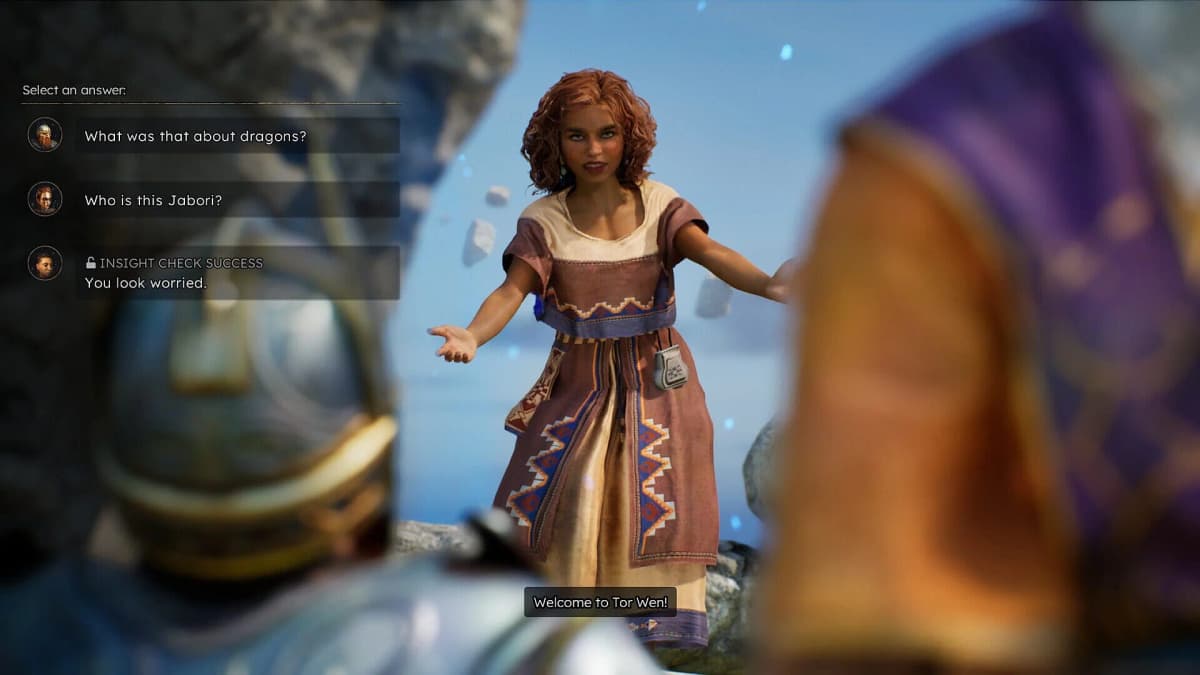
This already feels like a step up from the first game’s Saturday-morning-D&D tone. The banter is still light and sometimes cheesy, but it’s not relentlessly winking at the camera anymore. Some of that comes down to better writing-less meme-y, more grounded sibling snark—and some of it is absolutely the new voice cast. Your missing sister Deorcas is voiced by Devora Wilde (Lae’zel from Baldur’s Gate 3), and your brother Rickard is played by Ben Starr (yep, Clive from Final Fantasy 16). You can hear the difference immediately; line deliveries that would have been eye-roll material in Solasta 1 actually hit emotional beats here.
To be clear, this still isn’t a narrative powerhouse. The main plot takes its time getting going, and Solasta 2 is still very much a “combat first, story second” game. But I stopped skipping dialogue, which I absolutely did in stretches of Crown of the Magister. That alone is an upgrade.
Hex-Grid Road Trips and the Anxiety of “One More Tile”
The biggest structural change from the first game is the overworld. Gone is the simple node-based map where you just clicked from town to dungeon like a train schedule. Solasta 2 drops you onto a hex-grid map of Neokos dotted with question marks: potential encounters, landmarks, and side events. Some of these are permanent—little campfires of content that wait patiently until you’re ready. Others are temporary, disappearing if you don’t get there before your next long rest.
Mechanically, this interacts with an exhaustion system that ends up feeling like a risk/reward push-your-luck mini-game. Every time I saw a temporary icon two or three hexes off my main route, I had the same internal dialogue: “OK, we’ve already burned a chunk of supplies, the ranger’s down a hit die, but what if it’s a magic item or a lore tidbit I’ll never see again?”
On one memorable night, I pushed my party a little too far chasing one of those temporary markers. We rolled into a random battle against bandits with a level of exhaustion already stacked, no spell slots on my cleric, and half my healing potions gone. It turned a “trash” encounter into a palms-sweating, every-bonus-action-counts brawl. That’s when the new overworld structure clicked for me: this isn’t just a prettier loading screen, it’s a layer of strategic planning that bleeds directly into how hard your fights feel.
It’s not perfect—travel UI is still pretty plain, and some hexes feel empty—but as an evolution of Solasta’s tabletop-inspired exploration, it works. It finally feels like I’m managing a journey, not just a series of isolated dungeons.
Tactical Combat: Like Setting Up a Table of Minis Every Fight
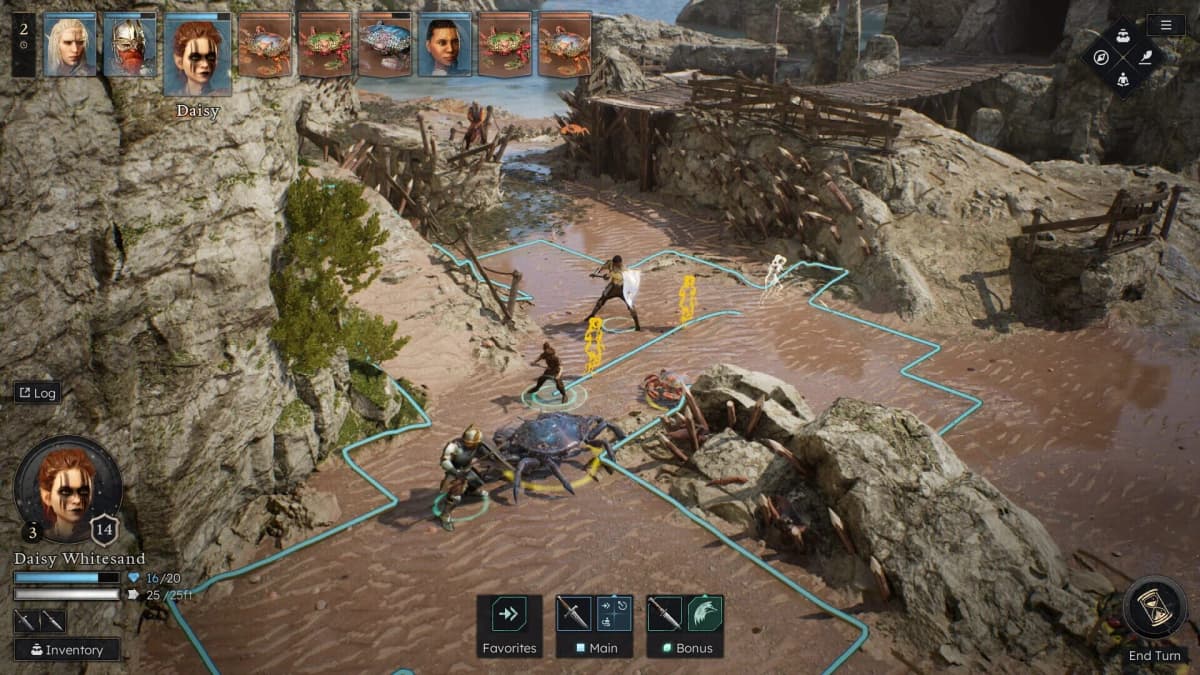
The reason you come to Solasta, though, is the combat. Solasta 2 sticks to that mission and quietly sharpens it with a rules update modeled on the 2024 D&D changes. The core feel is the same: tight, grid-based, turn-based fights where positioning, verticality, and line of sight matter more than raw stats. But this time, weapons and conditions matter in a way they just didn’t before.
Different weapons now apply distinct conditions on hit—things like “vexing” or “sapping.” I’ll be honest: even after 15 hours, I still sometimes mix up which one slows movement and which one gives disadvantage on attacks, and I’m constantly mousing over tooltips mid-fight. But once you start internalizing them, those tiny choices become a big part of your tactical identity.
My rogue, for example, usually stands in the midline: one turn using a vexing bow shot to hobble a distant archer, the next swapping (for free) to a pair of short swords to finish off a flanked melee enemy and drop a different debuff. That free weapon-set swap sounds small but changes the rhythm of turns; you’re encouraged to think of loadouts as “toolboxes,” not just “melee set” and “ranged set.”
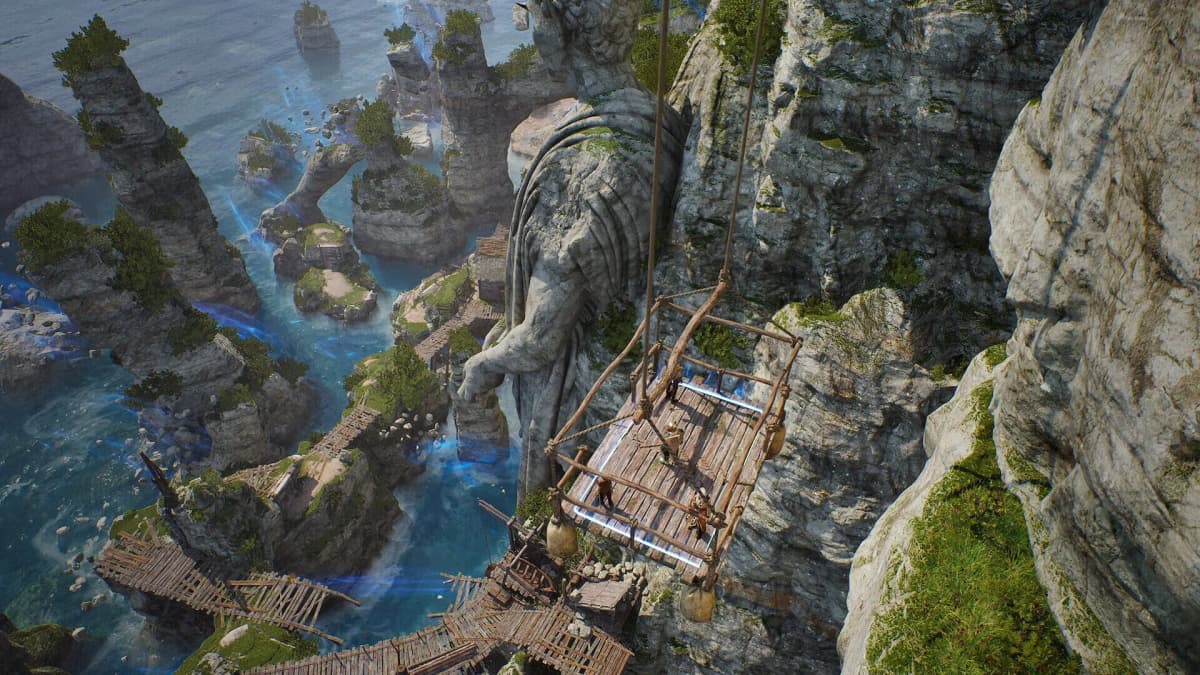
The fights themselves lean hard into terrain and verticality in a way that reminded me why I forgave the first game’s rough edges. In one early showcase battle, a town is literally crumbling and burning while you brawl with rock creatures that explode on death. It became a puzzle of shoving enemies off ledges, kiting them around chokepoints, and trying not to end my turn next to a living bomb.
Another standout encounter pitted my party against terror birds on the ground while their handlers peppered us from a ridge above. I burned precious spells not for damage, but to control the high ground and shut down the archers before the birds could tear my backline apart. Later on, harpies tried to peel my party apart with mind control, and my cleric’s Calm Emotions clutch-cast turned what would have been a wipe into a narrow win.
And then there was the glorious mess of a fight where I had to either side with a group of undead or a two-headed giant surrounded by traps. That battle turned into a slapstick climb up and down pillars, shoving enemies into caltrops and spike traps, re-evaluating turn order every round as allegiance shifts and terrain hazards compounded. It felt exactly like a well-run tabletop session with a DM who knows how to use a 3D battle map.
Not everything sings. I had a couple of fights where a few enemies seemed to forget I existed, lurking on the edge of the map while their friends charged in and died. Pathfinding sometimes gets awkward with vertical levels, and occasionally an enemy will spend their whole turn jogging in circles to find a way up a ladder they really should understand. But the foundational tactics are strong enough that even when the AI stumbles, I’m still enjoying the puzzle.
Not everything sings. I had a couple of fights where a few enemies seemed to forget I existed, lurking on the edge of the map while their friends charged in and died. Pathfinding sometimes gets awkward with vertical levels, and occasionally an enemy will spend their whole turn jogging in circles to find a way up a ladder they really should understand. But the foundational tactics are strong enough that even when the AI stumbles, I’m still enjoying the puzzle.
🎮 Get This Game at the Best Price
Compare prices instantly and save up to 80% on Steam keys with Kinguin — trusted by 15+ million gamers worldwide.
*Affiliate link — supports our independent coverage at no extra cost to you
Rules Stickler Clerics and the Stuff That’s Missing
Solasta 2 is still very proud of its rules fidelity, and most of the time that’s a good thing. Attacks of opportunity, cover, advantage/disadvantage, concentration spells—it all works the way your D&D brain expects, and that makes the tactics legible in a way some other CRPGs struggle with.
Sometimes, though, it feels a bit too much like playing with a pedantic DM. Clerics, for instance, can’t cast most of their spells with a shield in hand, and the game sticks to that interpretation strictly. There was a workaround in the first Solasta—engraving a holy symbol on the shield—so when I realized I couldn’t do that here, it felt like the sequel had taken a small but very real quality-of-life step backward. I’ve spent too many turns swapping from shield and mace to crossbow just to heal or bless under pressure.
There are also some conspicuous omissions in the current early access build. As of my playthrough, rogues don’t have access to hiding as a Cunning Action in quite the way I expected, which robs them of some of their mobility trickery. The level cap stops at four, so builds haven’t really matured yet. And the class and ancestry selection is noticeably slimmer than what was promised for launch in 1.0.
The good news is that Tactical Adventures has already laid out a roadmap: more classes and ancestries, co-op, crafting systems, an expanded faction layer, higher level caps, and the opening of Act 2 are all on deck. If they also use that time to loosen a few of the stricter rules interpretations in the name of fun, this could land in a very sweet spot between crunchy and playful.
Character Creation: Better, But Still a Bit Same-Face
I’m one of those sickos who can spend an hour in a character creator and then immediately restart a campaign because a single eyebrow slider is off by two points. Solasta 2 made a strong first impression here. Visually, everything is a clear step up from the first game’s Unity look—character models are sharper, lighting feels less waxy, and armor actually looks like metal and leather instead of colored plastic.
The creator itself draws on newer D&D philosophy: ability score bonuses have shifted from ancestries to backgrounds, which gives you more freedom to make “weird” builds without fighting the system. The UI is clearer, with role labels like “striker” and “support” giving newcomers a hint about what each class actually does.
There are still limitations, though. Since you’re building four siblings, the game seems a bit cautious about extreme differences in age and face shape. Even though there are wrinkle options, it’s surprisingly hard to make someone who looks convincingly old, which clashes a bit with the whole “we just buried our mother” setup. I also ran into the classic problem where my party looked fine in the creator, but once the fully voiced cutscenes started, I wanted to tweak voices and faces—and there’s no mid-campaign respec for aesthetics.
The devs have said they’re planning to improve character creation over the course of early access, and I hope that includes retroactive tweaking or at least a way to adjust voices and faces at a temple or something. Mechanically, I’m happy; visually, I’m “fine, I’ll restart my run when the next big patch hits.”
Performance, Presentation, and General Jank Factor
On my PC (RTX 3070, Ryzen 5, 32GB RAM), Solasta 2 runs solidly at 1440p with only occasional hitches during heavy spell effects. The shift to Unreal Engine gives the whole thing a more modern, cohesive look compared to the first game. It’s not trying to match Baldur’s Gate 3’s cinematic excess, and that’s smart—cities are smaller, environments more compact, but the spaces are built to serve the combat first.
The camera is less fussy than it was in Crown of the Magister. Vertical dungeons are still tricky, but I wrestled with it a lot less, and quickly swapping between tactical overhead and closer views helped parse complex arenas. UI readability is mostly good, though the sheer number of conditions and weapon properties means you’ll be hovering over icons constantly until your brain rewires.
As an early access build, you’re signing up for rough edges:
- Occasional AI derps where enemies refuse to climb a ladder or forget to engage.
- Bugs with character placement at the start of encounters.
- Minor audio issues—looping ambient sounds or a line cutting off slightly early.
- UI quirks, like filters resetting in inventory screens after battles.
I didn’t hit any save-corrupting disasters or progression-blocking bugs, but this is absolutely not in a “just like launch” state yet. It feels like an honest early access: very playable, clearly incomplete.
Who Should Jump In Now, and Who Should Wait
This is the part where I have to be brutally honest: Solasta 2’s early access is for a specific type of player.
- You should play it now if: you love tactical combat enough to replay Act 1 a couple of times as patches land; you enjoyed the first Solasta’s battles but bounced off the writing; or you’re hungry for a D&D-inspired CRPG that leans more into rules and tactics than romance arcs and branching cinematics.
- You should probably wait if: you want a fully voiced, complete narrative campaign before you invest; you hate restarting characters; or early access bugs and balance tweaks make you feel like your time is being wasted.
For me—someone who routinely abandons a 10-hour run because I realized my cleric would be cooler as a war domain instead of life domain—this is a sweet spot. I’m already mentally planning my next party composition for when co-op and higher levels arrive.
Bottom Line: A Very Promising 8/10… For Now
Right now, in early access, I’d call Solasta 2 a provisional 8/10. It’s not a radical reinvention of the series, but it meaningfully improves almost every part of the experience that actually matters to me:
- Combat is sharper and more expressive thanks to weapon conditions and smarter encounter design.
- The overworld hex map and exhaustion system add stakes to travel instead of being dead time.
- Writing and voice acting have taken a genuine step up, making the sibling dynamic feel human rather than caricature.
- Visuals and UI are cleaner, more modern, and easier on the eyes during long sessions.
Whether it climbs higher than that by 1.0 will depend entirely on the roadmap: how rich the new classes and ancestries feel, whether co-op is stable and fun, how deep the faction system goes, and whether Act 2 (and beyond) can maintain this level of encounter quality without resorting to filler.
But as someone who liked Solasta 1’s ideas more than its execution, Solasta 2’s early access feels like the version of that game I actually want to keep playing. If you’re the kind of CRPG player who cares more about nailing a perfect turn order than agonizing over romance choices, this is absolutely worth getting in on early.
TL;DR
- What it is: Early access tactical CRPG built on D&D 2024-style rules, focused on a four-sibling party and crunchy grid combat.
- What’s great: Excellent encounter design, meaningful weapon choices, improved writing and voice acting, strategic hex-grid overworld.
- What’s rough: Limited classes/ancestries and level cap, strict rules on things like cleric casting, occasional AI and pathfinding jank, no mid-campaign appearance tweaks.
- Who it’s for: Tactics-first CRPG fans who don’t mind iteration, restarts, and watching a game evolve during early access.
- Score (early access): 8/10 – already fun and smart, with real potential to become something special if the roadmap delivers.
FinalBoss // Gear
Level up your setup
01Top-rated gaming headsetson Amazon→02High-refresh gaming monitorson Amazon→03Gaming chairson Amazon→04Discounted game keyson Kinguin→Affiliate links · As an Amazon Associate, FinalBoss earns from qualifying purchases.
Want to Level Up Your Gaming?
Get access to exclusive strategies, hidden tips, and pro-level insights that we don't share publicly.
Ultimate Reviews Strategy Guide + Weekly Pro Tips