
The 2020 live-action Sonic redesign was an embarrassing marketing detour that became a useful warning: this character still has enough cultural weight to force a giant course correction. SEGA delayed the film, rebuilt Sonic’s design around the game version, and the finished movie earned about $320 million worldwide. Takashi Iizuka calls that release the biggest milestone in changing Sonic’s direction, after SEGA executives had considered cancelling the franchise during its worst period.
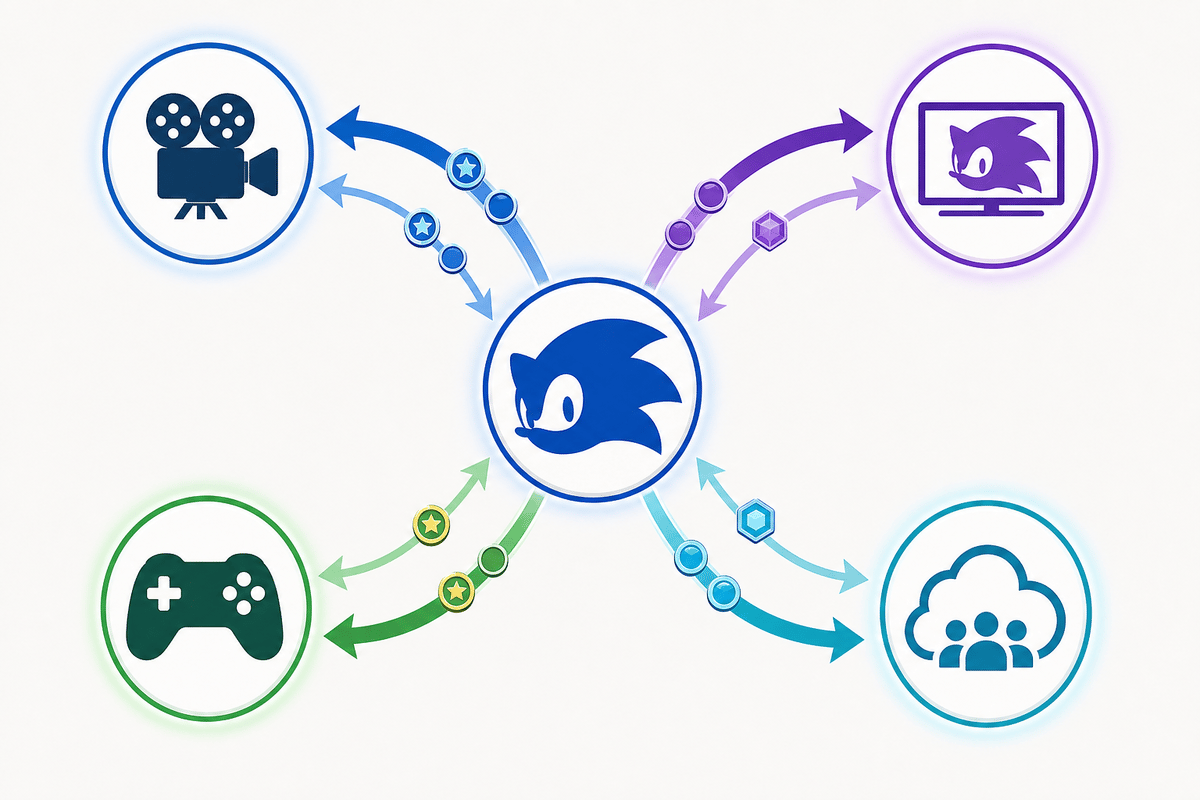
That is a genuine comeback story, and I understand why Iizuka sees a “resource circulation” loop in it. Movies and animation make Sonic more visible; visibility brings people to the games; stronger game sales give SEGA more room to fund future projects. The part I refuse to accept automatically is the final step. More resources only help players when they buy Sonic Team time, testing, stable staffing, and a sharper design target. If they instead buy a louder calendar full of tie-ins, online obligations, and release dates nobody is allowed to move, Sonic’s renewed popularity becomes another pressure source.
Table of Contents (6)
The movie saved confidence, not every development problem
Iizuka’s account of the near-cancellation matters because it explains why SEGA is pushing Sonic so hard across film, animation, consumer products, and global collaborations. A game-only franchise has to survive every bad release, every long gap, and every shift in platform tastes on the strength of its last game. Sonic now has a fourth film scheduled for March 19, a new Netflix animation series on the way, and an expectation of some form of Sonic media almost every year.
That gives the character a cushion. A major game can spend years in development without Sonic vanishing from public view. For a franchise built around speed, that breathing room is more valuable than another rushed anniversary product. Sonic’s home remains PC and consoles, including Xbox and Nintendo Switch, but films and streaming do the work of introducing the character to people who might never have picked up a controller.
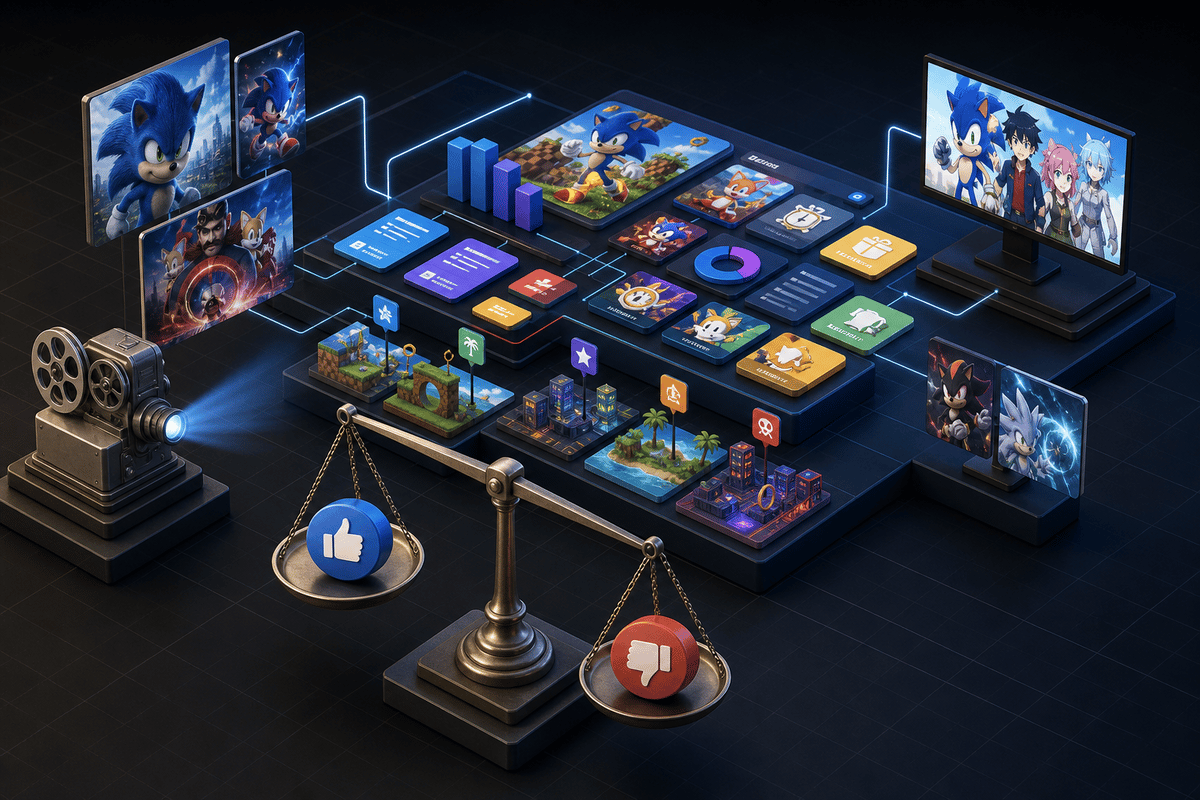
There is also a hard commercial reality beneath the cheerful talk about a positive cycle. A $320 million box office result does not become a $320 million game budget. Film production, distribution, marketing, licensing arrangements, and revenue sharing all take their cuts. The direct benefit to games is larger confidence inside SEGA: executives are more willing to keep investing in a character who can carry several businesses at once. That can preserve teams and greenlight projects. It cannot, by itself, make a bad camera, a weak stage, or a confused control scheme good.
This is why the transmedia strategy is a conditional win. Sonic’s survival no longer depends on one game landing perfectly. Players benefit from that security only if SEGA treats it as permission to let a game cook rather than permission to launch another product because the brand is hot.
Longer development helps only if the calendar stops dictating the game
Iizuka has said Sonic development has moved beyond the old two-year rhythm. Projects now take roughly three years, with some stretching to five. That is sensible. High-speed games are brutally exposed by weak fundamentals: a tiny collision problem becomes a launch into a pit, a bad camera angle turns a reaction test into guesswork, and inconsistent performance wrecks the entire point of moving fast.
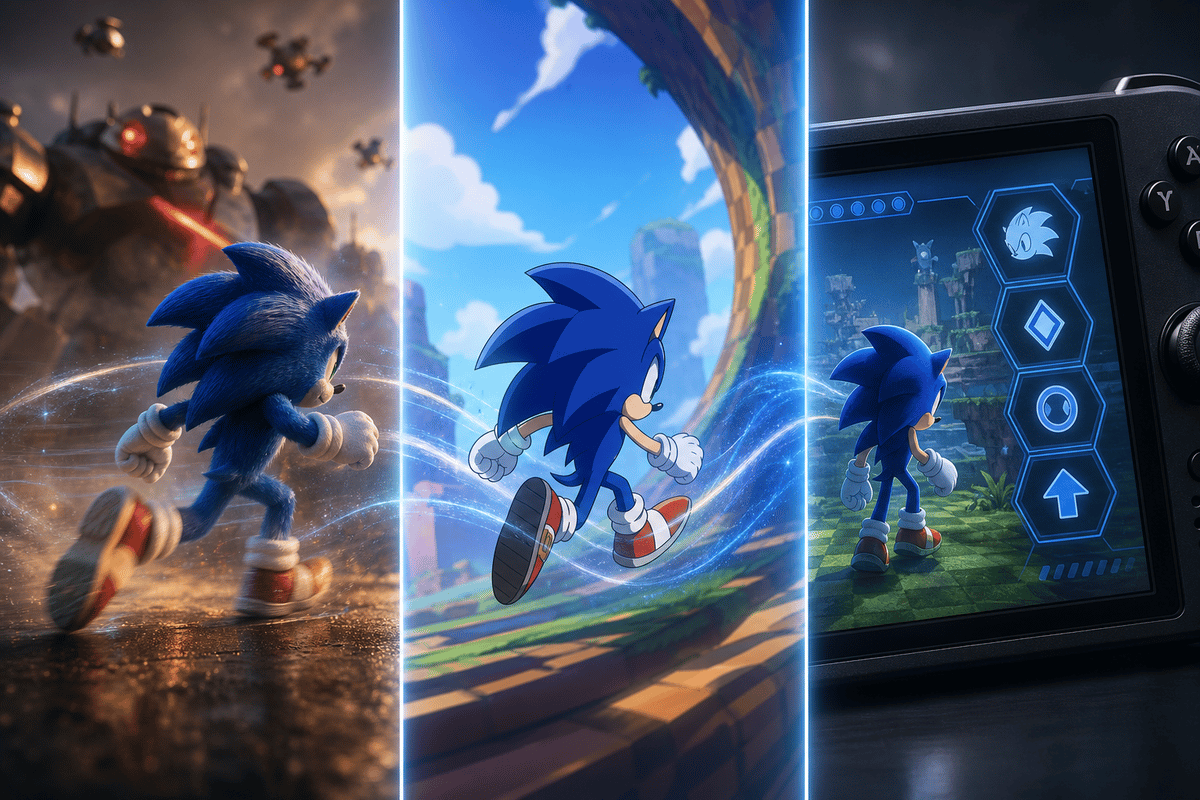
SEGA’s answer is multiple development lines running in parallel. If one game threatens to miss its schedule, other staff can support that team to protect both quality and release continuity. On paper, that is the grown-up version of franchise management. One team does not need to panic-build a huge game every year while Sonic disappears everywhere else.
But parallel production creates a different danger: the company can begin treating every open slot on the calendar as something that must be filled. A movie date, a streaming launch, a major collaboration, and a big anniversary are all tempting moments to attach a game announcement or release. Suddenly, a developer is not merely making the strongest possible Sonic game. It is making the Sonic game that has to be ready for the broader machine.
Iizuka says film and animation projects do not use game-development staff, which is reassuring as far as direct labour goes. Separate teams are still not a force field. Shared characters, senior approvals, brand plans, marketing beats, story expectations, and launch windows can influence a game without a single artist or programmer being transferred away from Sonic Team.
The absence of rigid, guideline-based instructions for films and anime cuts both ways here. Iizuka has said there is no fixed format for those productions and no established reference point from which to build universal rules. That flexibility is why Sonic can work in wildly different media. It also means each project has the potential to create fresh expectations around character tone, lore, and presentation. Flexibility is creatively exciting; it is terrible when it becomes a reason every game has to carry everybody else’s continuity homework.
Story and Shadow are useful additions, not substitutes for great movement
Iizuka wants future Sonic games to put more emphasis on story, to balance 2D and 3D play, and to use Shadow more often. I am broadly in favour of that direction. The films and animation have given a much larger audience reasons to care about Sonic’s relationships and world, and Shadow has obvious pull after becoming one of the franchise’s most durable characters.
Sonic’s own history explains the appeal. Shadow appeared to die at the end of Sonic Adventure 2, then returned in Sonic Heroes because the character had become popular. SEGA understands that strong character demand can keep a story thread alive. That is not cynical by default; fans connect with characters, and games should be allowed to build on that connection.
Still, more lore is not a replacement for the thing a Sonic game has to nail before anything else: movement that feels precise, readable, exciting, and worth mastering again after the credits. The worst possible response to Sonic’s film audience would be a game that assumes cinematic recognition can carry loose level design. A new player may arrive because they know the cast. They stay because the first run through a stage feels fantastic.
That is where the promised 2D-and-3D balance deserves scrutiny. It can produce variety and make the series more accessible across different skill levels. It can also become a compromise that satisfies neither camp if the game flips modes without a clear mechanical purpose. Sonic has enough history to prove that simply putting several ideas in one package is not a design philosophy.
GaaS planning is where this gets dangerous
Sonic’s transmedia growth does not prove that the next mainline game will become a live-service project. That claim would be premature. It does show why a service-minded future is attractive to SEGA. Sonic Racing: CrossWorlds has been positioned as a full cross-platform online multiplayer game, and Iizuka has described that kind of online feature set as a new direction for the series.
A constantly active film-and-animation pipeline is almost tailor-made for a game built around recurring online events. Every trailer, character spotlight, series launch, and crossover becomes a ready-made moment to bring people back. That is precisely why players should be wary of confusing a bigger audience with a stronger game. An online service demands servers, moderation, technical support, regular content planning, platform coordination, and a stable player population. Those needs can consume attention long after launch.
The risk is not multiplayer. Sonic can support competitive play, co-operative play, and online racing without betraying itself. The risk is a game arriving with a thin core because its creators expect the real shape of the experience to emerge later through updates. That model clashes with Sonic’s best quality: immediate, low-friction exhilaration. A player should not need a roadmap to find out whether the running, jumping, boosting, and stage design are worth their time.
What players should demand from the next announcement
The next major Sonic reveal will tell us plenty before anyone gets a controller in their hands. The useful signs are boring compared with a famous-character cameo, which is exactly why they matter. A serious game announcement should explain the game’s scope, its central mode of play, its performance targets, and whether its single-player experience stands complete on day one.
- Gameplay footage should show sustained movement through real stages, not only cinematic story scenes.
- The announcement should explain what the 2D and 3D structure is trying to achieve mechanically.
- Online features should be presented as additions to a clear core game rather than the entire reason the project exists.
- Longer development time should result in visible polish: stable performance, clean readability at speed, and stages built for replay rather than spectacle alone.
- Film and animation references should support the game’s identity, not become its identity.
The red flag is equally clear: a reveal built around cross-media characters, a giant long-term content promise, and almost no explanation of how the game feels to play. Sonic does not need another campaign that sells the franchise before it sells the game. The franchise is already selling itself better than it has in years.
SEGA has earned ambition; it has not earned blind trust
Iizuka’s Disney-scale ambition is understandable. Sonic is one of the few game characters with the recognition to sustain films, streaming, games, merchandise, and global partnerships at the same time. The first live-action movie helped stop a real decline in confidence, and that outcome matters. A franchise that was once being considered for cancellation now has the money, reach, and institutional backing to take bigger creative swings.
I want that to work. I also want SEGA to resist the most obvious corporate temptation: mistaking brand activity for game quality. Annual Sonic visibility is healthy. Annual pressure on developers is poison. The unresolved question hanging over every future Sonic project is whether the films and animation have bought Sonic Team the room to build something great, or whether they have created too many dates, expectations, and obligations for any game to breathe.
FinalBoss // Gear
Level up your setup
01Top-rated gaming headsetson Amazon→02High-refresh gaming monitorson Amazon→03Gaming chairson Amazon→04Discounted game keyson Kinguin→Affiliate links · As an Amazon Associate, FinalBoss earns from qualifying purchases.
Want to Level Up Your Gaming?
Get access to exclusive strategies, hidden tips, and pro-level insights that we don't share publicly.
Ultimate Gaming Strategy Guide + Weekly Pro Tips