
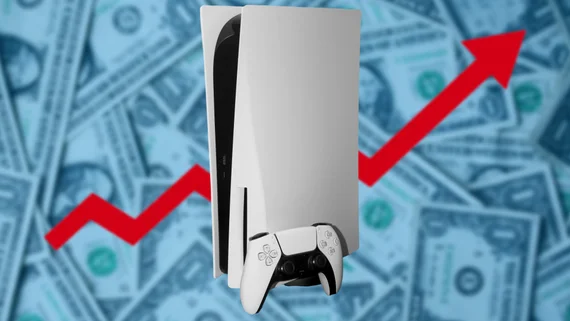
Sony just did the one thing console makers are never supposed to do five years into a generation: make the box more expensive. Not once, but again.
This isn’t just a bad headline for PlayStation fans; it’s a signal that the old console deal – “wait a bit and the price will drop” – is breaking under real-world component costs and a market that increasingly only works if you have money to burn.
Table of Contents (8)
Key takeaways
- From 2 April 2026, PS5, PS5 Digital Edition, PS5 Pro, and PlayStation Portal all get steep global price hikes – up to $200 more in some cases.
- This is the second PS5 price rise in under a year in the US, and the third in parts of Europe, reversing the decades-long trend of mid-gen cuts.
- Sony blames “continued pressures in the global economic landscape,” but the real driver is soaring component costs – especially RAM and storage hammered by AI demand.
- The result: consoles are drifting into “premium luxury hardware,” pushing lower-income players out and likely resetting what “normal” launch pricing looks like for PS6 and beyond.
What’s actually changing – and how hard it hits
On the surface, the blog post sounds standard corporate: Isabelle Tomatis, Sony’s VP of Global Marketing, cites “continued pressures in the global economic landscape” and frames the move as a “necessary step” to keep delivering “innovative, high-quality gaming experiences”. Underneath the phrasing is a pretty brutal new reality for anyone still on the fence about a PS5.
In the US, according to figures reported by The Verge, Push Square and IGN Brasil, recommended prices from 2 April look like this:
- PS5 (disc): $649.99 (up from around $549.99)
- PS5 Digital Edition: $599.99 (up from around $499.99)
- PS5 Pro: $899.99 (up from roughly $700–$750 depending on which earlier RRP you go by; outlets differ, they all agree on $899.99 as the new one)
- PlayStation Portal: $249.99 (up from $199.99)
UK prices, confirmed by Sony and echoed across TheSixthAxis and Push Square, jump to:
- PS5: £569.99 (previously £479.99)
- PS5 Digital Edition: £519.99
- PS5 Pro: £789.99
- PlayStation Portal: £219.99
That’s roughly a £90 increase on each console and £20 on the Portal in the UK. Mainland Europe sees similar jumps: €649.99 for base PS5, €599.99 Digital, €899.99 Pro, €249.99 Portal. Japan lands at ¥97,980 for the standard model, ¥89,980 for Digital, and ¥137,980 for Pro.
Some regions like Brazil haven’t had new RRPs confirmed yet – IGN Brasil notes local pricing is still “to be determined” – but Sony’s language is clear: this is meant to be a global correction where tariffs, taxes, or local economics allow.
Frame it against launch and it stings more. In 2020, PS5 came in at $499.99 / £449.99 / €499.99, with the Digital Edition at $399.99. We’re now in a world where the “cheap” Digital PS5 costs more than the original disc model, and the Pro – a mid-gen refresh, not a new generation – is pushing dangerously close to $900.
This isn’t just greed – it’s the end of the old console bargain
The uncomfortable bit Sony would rather you ignore: PS5 is already their most profitable console generation ever. As IGN Brasil reminds, Sony’s own CEO bragged in 2025 that PS5 had generated over $13 billion in profit, more than all previous PlayStation generations combined.
So why hike prices instead of eating some of the cost?
Because the old console model – “sell the box cheap, make it back on games and services” – assumes hardware naturally gets cheaper to make. That used to be true. Process nodes shrank, yields improved, RAM flooded the market, and mid-gen price cuts were just a question of timing.
This time, according to reporting from TheSixthAxis, Push Square, and The Verge, almost every major component inside a PS5 is getting more expensive, not less. Memory, storage, and GPU silicon are all under pressure, and there’s one major new villain in the story: generative AI.
AI is eating your RAM – and your console budget
Both TheSixthAxis and Push Square highlight the same core issue: RAM and other memory products are now at a premium. The same GDDR and DRAM that power consoles are being hoovered up by AI data centres and high-end GPUs. Demand is exploding faster than supply can respond, and prices are following.
Add in US tariff noise on electronics, general inflation, and shipping that still hasn’t fully normalised post-pandemic, and Sony’s bill of materials is moving in the wrong direction five years into a generation. That’s not normal. In a traditional console cycle, you’d be planning a price cut or at worst a stable RRP by now, not a second hike.
Analysts cited across coverage are already connecting these dots to the next generation. If memory and advanced nodes stay expensive, the PS6 and whatever Xbox is cooking might not just be delayed into 2027–2028; they may launch at price points that would have been unthinkable back when $399 felt standard.
In other words: this PS5 hike isn’t an isolated gouge, it’s a preview of what console pricing looks like in an AI-dominated silicon market.
Mid-gen price hikes hit the wrong players hardest
The reaction, unsurprisingly, is ugly. IGN Brasil describes “a mixture of anger and disappointment,” especially juxtaposed with Sony’s record profits. But buried in their piece is the quote that matters most for where this is going.
Analyst Mat Piscatella (Circana) points out that gaming is increasingly becoming “a hobby for high-income people” while lower-income segments “are really struggling.” Those players rely on holiday discounts, cheaper SKUs, and price drops a few years into the cycle to stay in the ecosystem at all.
Instead, those players are now staring at a base console that costs more than it did at launch, and a “budget” Digital model only $50 under the disc version in many markets. When your Digital Edition is bumping up against $600, the message is clear: if you’re not already deep in the ecosystem and spending on $70 games and subscriptions, you’re no longer the priority customer.
The PlayStation Portal hike seals it. This is a companion device that already targeted a niche – remote play diehards with stable home networks. Raising it from $199.99 to $249.99 / £199.99 to £219.99 turns a curious accessory into a straight-up luxury gadget.
The console market was already straining under $70 games, battle passes, and rising subscription costs. Pushing the entry fee up this aggressively just deepens the split: affluent players with Pro models, 120Hz TVs and day-one purchases on one side; everyone else stretching aging hardware and hunting sales on the other.
What this means for Xbox, Nintendo – and PS6
Sony isn’t operating in a vacuum. The Verge notes that Microsoft already raised prices on Xbox Series hardware, controllers, and some games last year, and Nintendo broke its own habits charging more for certain software and the Switch OLED. This is an industry-wide drift upward.
The difference is scale and timing. Mid-gen price cuts used to be a strategic weapon. Sony is now normalising mid-gen price hikes. If it works – if PS5 sales barely wobble and revenue holds – you can assume two things for the next cycle:
- PS6 and next Xbox won’t be shy about launching north of $600+ if the component math demands it.
- Cheaper, low-margin SKUs (digital-only, smaller SSDs, weaker GPUs) will be less about generosity and more about basic market access.
This also quietly gives platform holders another incentive to extend the current generation. If PS5 hardware can stay on shelves longer and at higher prices, there’s less rush to take on the risk of an even more expensive PS6 built on cutting-edge, AI-contested silicon.
If I had Sony’s PR team in front of me, the question would be simple: at what point does keeping your margins safe start actively shrinking the PlayStation audience you built PS5 on? Because the fans most likely to walk away over this aren’t the whales buying digital deluxe editions every month. They’re the new players who never quite get through the door.
What to watch next
- 2 April 2026 – the real test at retail: Watch how quickly retailers flip to the new pricing, and whether any major chains or regions quietly resist or discount old stock.
- Microsoft and Nintendo’s next move: If Xbox or Nintendo holds the line on hardware prices – or even undercuts – Sony suddenly looks exposed. If they follow, the new pricing norm is locked in.
- Holiday 2026 bundles: The first big sign this hike is hurting will be aggressive bundles (free games, PS Plus months, SSD upgrades) aimed at softening the sticker shock without touching the RRP.
- Next-gen timelines: Any credible reporting on PS6 or next Xbox slipping closer to 2028 will likely cite the same component and memory pressures Sony is now effectively admitting exist.
TL;DR
Sony is raising prices on PS5, PS5 Digital, PS5 Pro, and PlayStation Portal globally from 2 April, with jumps of around $100–$200 / £90 and equivalent in other regions. The company blames global economic pressures and rising component costs, especially RAM and storage being driven up by AI demand, breaking the old pattern where consoles got cheaper mid-gen. The verdict: this is less a one-off cash grab and more a reset of what consoles cost – and it risks turning high-end gaming into a luxury hobby unless someone in the industry decides to blink.
FinalBoss // Gear
Level up your setup
01Best-selling PS5 gameson Amazon→02DualSense controllerson Amazon→03PS5 SSD upgrades (M.2 NVMe)on Amazon→04Discounted game keyson Kinguin→Affiliate links · As an Amazon Associate, FinalBoss earns from qualifying purchases.
Want to Level Up Your Gaming?
Get access to exclusive strategies, hidden tips, and pro-level insights that we don't share publicly.
Ultimate Gaming Strategy Guide + Weekly Pro Tips