
Bloomberg’s report that Sony is cancelling PC versions of Ghost of Yotei and Saros didn’t just read like another strategy tweak to me. It felt like a line in the sand. After a few years where it finally seemed like PlayStation’s best single-player games might live beyond one box under your TV, Sony is slamming that door shut again – just as it’s asking people to swallow PS5 Pro pricing that’s pushing up towards the $900 mark in some regions and bundles.
I play on everything – consoles, PC, handhelds – and I’ve been around long enough to remember when “only on PlayStation” meant “hope you can afford another plastic rectangle this generation.” The PC ports era never made PlayStation feel less special to me. If anything, it made Sony look confident, like it believed its games were strong enough to stand on any platform. This new move? It looks like the exact opposite. It looks like panic dressed up as “protecting the brand.”
Table of Contents (8)
What Sony is actually doing by killing Ghost of Yotei and Saros on PC
To be clear on the facts: according to multiple reports, Sony has decided its big, narrative-driven, first-party single-player PS5 games are no longer coming to PC. That includes stuff like Ghost of Yotei – their 2025 samurai hit – and Saros, the new sci-fi project from the studio behind Returnal. Bloomberg’s piece also flagged other heavy-hitters like Insomniac’s Marvel’s Wolverine and Naughty Dog’s new IP, suggesting PC versions that were at least on the table are now off the roadmap.
Multiplayer and live-service titles are the exception. Helldivers 2, Marathon, Marvel Tokon Battle – those are still going day-and-date or at least day-one-ish on PC, for obvious reasons. Sony wants big player counts and recurring revenue there, and you don’t get that by walling off half the market.
Externally published stuff, like Death Stranding 2 and the sequel to Kena: Bridge of Spirits, is still PC-bound because those deals were always different. And Sony’s PC specialist studio, Nixxes, isn’t being shuttered – they’re just likely getting redirected toward those live-service projects instead of prestige single-player ports.
In other words: the games that built the modern PlayStation myth – carefully crafted, cinematic, single-player epics – are being turned back into hard console bait, while anything that prints microtransaction revenue stays multiplatform. That split tells you everything about where Sony thinks the money is. And it’s not where I want this industry to go.
“Just $300M in PC revenue” is not the flex Sony thinks it is
One figure that keeps floating around is that Sony only made something like $300 million from PC over three years. I’ve seen that thrown out as proof that “PC isn’t worth it” – which would be hilarious if it weren’t so revealing. Because even setting aside that some reporting points to the two God of War PC releases together clearing over a billion dollars in revenue alone, there are two problems here.
First, that PC number (whatever the exact figure is) exists on top of the console revenue, not instead of it. These are players who didn’t buy a PS5, or double-dipped because they wanted ultra-wide, mods, or 120fps. That’s additive money. If you’re disappointed the bonus revenue wasn’t bigger, that says more about how you structured your releases than about the platform itself.
Second, we now have data – like Newzoo’s breakdown via GamesIndustry.biz – showing just how much staggered ports kneecap PC sales. If you launch a game on console first, let the marketing blitz and word-of-mouth explode, and then wait years to drip-feed a PC version, you’re going to get a thin slice of that initial demand. Newzoo puts PC players at around 13% of total in the first three months after a console-first release, compared to 44% when a game hits PC and console simultaneously.
In other words, Sony engineered a setup where PC was always getting the leftovers, then turned around and said “look, there’s not that much food on this plate.” That’s not some iron law of the market. That’s a self-fulfilling strategy.
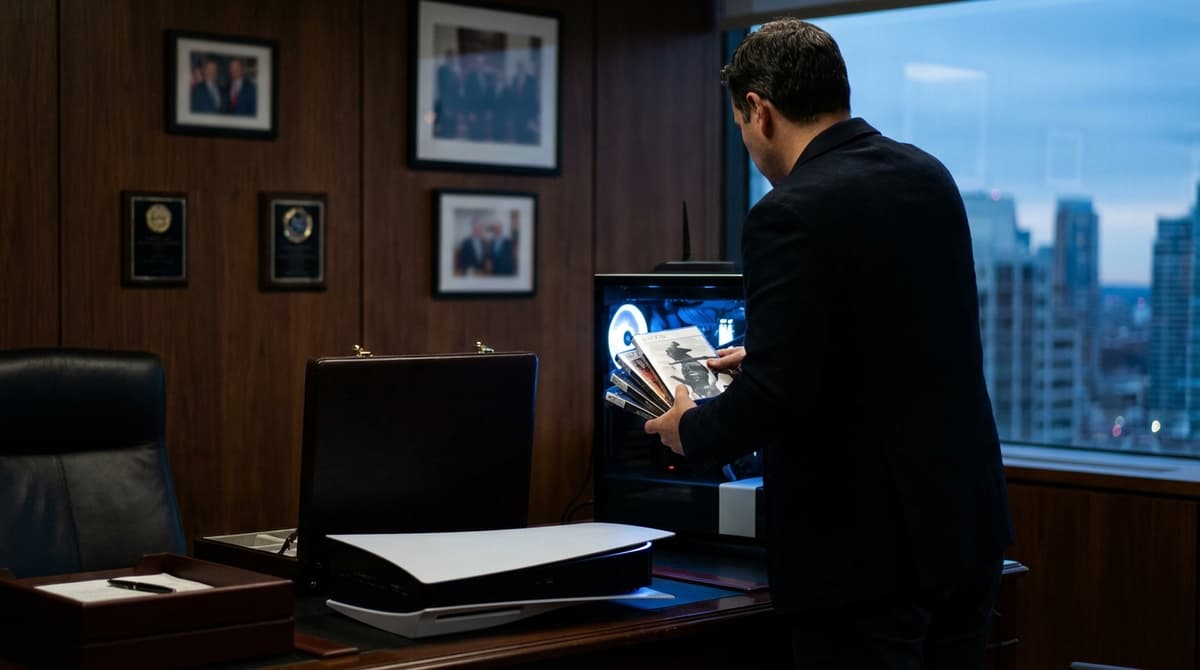
PS5 Pro at $900 and the fear of being compared to PCs
Now layer this decision on top of the PS5 Pro pricing. We’re talking about hardware that, once you account for regional markups and bundles, is brushing up against the $900 line. That is serious PC money. At that price, you’re automatically inviting a value comparison with mid-range PCs and handhelds whether you like it or not.
And this is where the panic shows. Because on raw flexibility, a locked-down console is always going to lose to a good PC or a handheld PC like the Steam Deck. You can’t mod, you can’t tinker, you can’t dip into twenty years of back catalogue sales at 80% off every holiday. The way consoles win that argument is by being cheaper, simpler, and having must-play software you can’t get anywhere else.
Sony seems to have decided that instead of leaning into value, it’s going to double down on that last point – exclusivity – and hope nobody does the mental math. “Sure, the PS5 Pro costs close to a decent PC, but Ghost of Yotei and Saros are trapped here, so what choice do you really have?” That’s not swagger. That’s a company that’s terrified you’ll realize just how good your other options are.
Steam Deck changed the baseline, and Sony’s acting like it didn’t
When the Steam Deck dropped, I didn’t think it would affect how I looked at consoles. Then I actually spent months with the thing. It’s not perfect, but it reset my expectations for what “a box that plays games in my living room or on my train commute” should offer.
For the price of a PS5 Pro, I can have a Steam Deck (or similar handheld PC) plus a decent monitor, or a compact gaming PC that runs Game Pass, my old library, indies, emulators, and most third-party AAAs. I’m not locked into anyone’s ecosystem. If I decide I hate a launcher or a subscription, I just uninstall it.
Sony’s answer to that is: pay close to PC money, accept that this box only plays what we allow, and we’re also cutting off any path for our flagship single-player games to reach your existing PC hardware down the line. That’s not competing with the Steam Deck and the broader PC space on merit. That’s trying to sidestep the comparison entirely by hoarding specific titles.
And the irony is that on the multiplayer side, Sony clearly understands the reality. Helldivers 2 being on PC is a big part of why it blew up. Bungie’s Marathon will live or die based on its total reachable playerbase, not on how many PS5s Sony moves. The company isn’t allergic to PC in principle – it’s just unwilling to share the part of its catalogue that sells consoles. Which tells you exactly what problem they’re trying to solve.
From Horizon on PC to Ghost of Yotei locked down: a self-inflicted reversal
When Sony first started experimenting with PC – Horizon Zero Dawn, Days Gone, then God of War – I remember the mood shift. People who were never going to buy a PlayStation suddenly had these games on their radar. My PC-only friends finally understood why I kept banging on about God of War 2018. It didn’t make me less interested in owning a console; if anything, it made the brand feel bigger than the hardware.
Now look at where we’re heading. Ghost of Yotei is one of the purest “prestige” PS5 titles Sony has shipped in years – a gorgeous, high-budget, single-player epic that screams “system seller.” Saros is a new IP from a studio that proved it can do weird, demanding sci-fi with Returnal. These are exactly the kinds of games that could have a long tail on PC: ultra-wide support, performance headroom, mod potential, endless YouTube and Twitch content.
Instead, Sony is effectively saying: if you weren’t willing to buy a PS5 in the first wave, you don’t matter for these games. The PC ports era let these titles have a second life. Killing that second life because the first wave was “good enough” is classic short-term thinking.
Counterarguments: does exclusivity actually protect PS5 sales?
I’ve seen the usual defenses already. “Exclusives are the whole point of a console.” “If people know a PC version will come later, they won’t buy a PS5.” “PC is a drop in the bucket anyway.” I understand the logic. I just don’t think it holds up when you look at who actually buys what, and when.
If you care enough about Ghost of Yotei or Saros to buy a PS5 for them, you were never waiting three years for a port. You’re either all-in on the ecosystem already, or you’re the sort of player who shrugs and moves on to something else. The PC ports helped with everyone outside that bubble – the people who might discover these games late, or who just refuse to own multiple platforms.
The reported billion-plus in revenue from the God of War PC releases alone suggests there is a serious audience there when the strategy lines up. Yes, some later ports underperformed – Spider-Man 2, The Last of Us Part II – but again, those were late arrivals after the hype cycle had burned out, sometimes with technical issues attached. You don’t look at a badly timed, badly executed launch and conclude “this platform is the problem.”
The more convincing read is that Sony doesn’t like how PC complicates its messaging. If you admit that your games can thrive off-console, you’re quietly admitting that the console itself isn’t the irreplaceable part of the equation. And that’s a risky admission when you’re about to ask people for premium-pro hardware pricing.
Single-player fans get walled in, live-service gets a free pass
The split between single-player and live-service is the part that bothers me the most personally. I’m the exact sort of player Sony used to court relentlessly: I sink dozens of hours into story-heavy games, chase platinums, talk about endings with friends. I’ll maybe get sucked into one or two live-service titles at a time, but I’m not living in battle passes.
Under this new approach, I’m the one being told “your favourite experiences only exist behind this specific paywall.” Meanwhile, the games designed to monetize me over months or years are the ones that get to live everywhere, because it’s more profitable that way. The market logic tracks. The message about what kind of player Sony values more is hard to miss.
If the concern was really about “protecting the PlayStation brand,” you wouldn’t be carving out exceptions for anything with a battle pass. You’d either commit to PlayStation as a walled garden across the board, or you’d embrace being a platform-agnostic content powerhouse. Instead we get the least consumer-friendly hybrid: maximum leverage on the prestige single-player stuff, maximum reach where there are recurring payments to be harvested.
Long-term risk: fewer risks, safer bets, and a shrinking audience
There’s also a quieter, slower risk baked into this decision. If Sony is serious about single-player epics being PS5-only forever, then those games now have to recoup their budgets almost entirely inside the console walled garden. No long tail from PC. No second wave of interest when a port drops with a “definitive edition” label. That pressure doesn’t make creativity easier.
It nudges everything toward safer bets. More sequels to known hits. Fewer weird, mid-budget experiments like Returnal – exactly the kind of project that, in a saner world, would quietly find a second audience on PC. When you’re leaning on a $900-ish box plus $70 games to make your numbers, you have less room to miss.
And let’s be clear: plans like this are rarely permanent. Insiders are already saying this policy could change in a few years if the numbers look bad or leadership changes. We’ve watched this industry ping-pong between “PC is dead,” “PC is everything,” and “PC is where we dump old console games” more times than I can count. But every time you slam that door shut, a few more players stop bothering to check if it might open again later.
I don’t think Sony is killing itself with this strategy. The next Naughty Dog game will still sell. Ghost of Yotei and Saros will still get their moment. But for someone like me – split across PC, handheld, and console – this shift makes PlayStation feel smaller and more defensive right when the rest of gaming is getting more flexible and open.
When a platform holder looks at a world of Steam Decks, mid-range PCs, cloud streaming, and cross-save and decides the best move is to lock the doors tighter and charge more for entry, I don’t read that as strength. I read it as fear that, if we’re allowed to compare everything on equal terms, the box under the TV might not win as often as it used to.
FinalBoss // Gear
Level up your setup
01Best-selling PS5 gameson Amazon→02DualSense controllerson Amazon→03PS5 SSD upgrades (M.2 NVMe)on Amazon→04Discounted game keyson Kinguin→Affiliate links · As an Amazon Associate, FinalBoss earns from qualifying purchases.
Want to Level Up Your Gaming?
Get access to exclusive strategies, hidden tips, and pro-level insights that we don't share publicly.
Ultimate Gaming Strategy Guide + Weekly Pro Tips