
Table of Contents (9)
The moment I realised the Zone had no women
It didn’t hit me during my first firefight, or even the first time I got shredded by an anomaly. It hit me at a campfire.
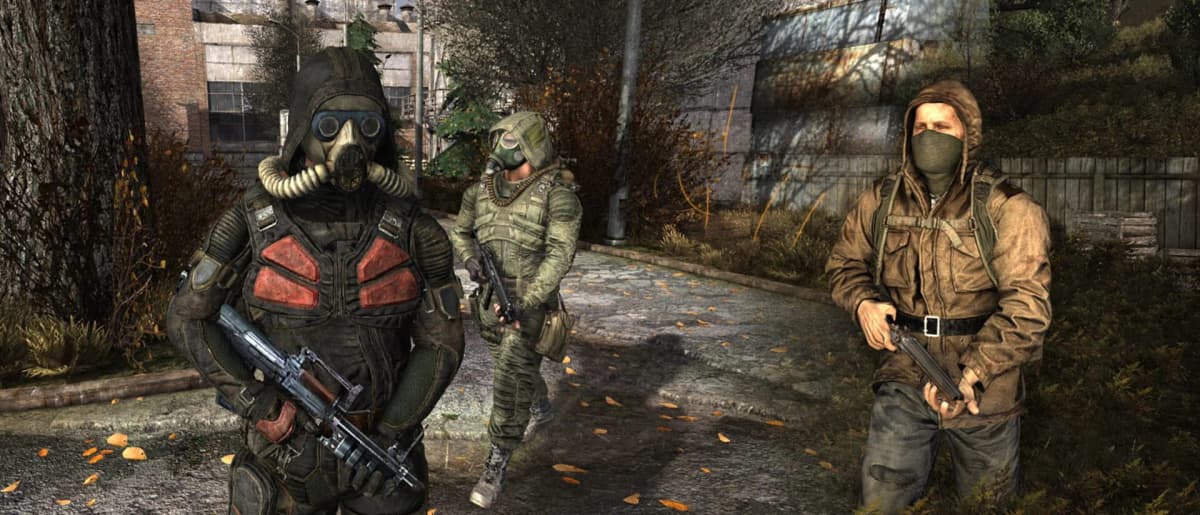
You know the scene if you’ve played S.T.A.L.K.E.R.: a handful of guys in track suits and mismatched gear, guitar in hand, smoke curling up into the ruin-thick air. Jokes, song, that tired-but-content body language that says, we survived another day. I remember sitting there, listening to the idle chatter, and suddenly realising: there isn’t a single woman anywhere in this world. Not in the outposts, not in the bars, not wandering down the road. Not even as a bored voice on the radio.
Once I saw it, I couldn’t unsee it. The Zone wasn’t just post-apocalyptic Ukraine; it was a sealed-off, boys-only apocalypse. A wasteland carefully curated so that every face, every body, every joke, every story belonged to a man.
That’s the thing that stuck with me long after the gunplay and the emissions. Not just that S.T.A.L.K.E.R. was full of men, but that it seemed to be for men in a way that went deeper than the usual “gritty shooter” marketing. Years later, when I read an Unwinnable dialogue where two women call the Zone a “miasma of masculinity,” I felt my brain click. Yes. That. That’s the smell of it.
So with S.T.A.L.K.E.R. 2 finally stepping out of development hell, adding a Ukrainian dub and – gasp – actual women, I’ve been asking myself something that goes way beyond “yay, representation”: does this new game actually change the DNA of the Zone, or are we just sprinkling a couple of women into a world that’s still fundamentally built as a male fantasy?
The Zone as a boys’ club apocalypse
The original S.T.A.L.K.E.R. trilogy doesn’t just lack women by accident. It constructs the Zone as a heterotopia, a space literally and metaphorically fenced off from normal life. You’re not just stepping past barbed wire and checkpoints; you’re stepping out of a world where care work, domesticity, and family ties exist, and into a place where only one social relationship matters: men bonding with other men under pressure.
It’s the same fantasy you see in Westerns: leave the town, leave the wives, leave the rules, form a posse, ride into lawless territory. The Tarkovsky film Stalker already makes this gender line pretty explicit – women and children wait outside the Zone while the men go in. The games pick that up and run with it, then quietly erase the waiting women altogether. You still get the all-male pilgrimage into danger; you just delete the reminder that anyone else ever existed.
In practice, that means:
- Every named NPC you quest with? Male.
- Every random loner you see in the distance? Male.
- Every corpse you loot, every bandit you drop, every voice shouting over gunfire? Male.
- Women are, at best, disembodied: a mother back home, a girlfriend mentioned in a throwaway line.
When you saturate a world like that, it stops feeling like an oversight and starts feeling like intent. The key feature of this fantasy wasteland is that the modern world — including women, children, messy social obligations — has been scorched away. What’s left is pure male camaraderie and male violence. The Zone is the circle of guys in the parking lot at midnight scaled up to continental disaster: smoke, laughter, risky games, no one else allowed in.
I don’t say that as someone who hates those moments. I’ve felt the pull of that campfire too. There’s a line in the Unwinnable piece where a character remembers that glow as “a sense of unity,” and I get it. It’s intoxicating precisely because it’s exclusionary. The absence of women isn’t just a bug; it’s a feature that lets that kind of brotherhood crystallise without interruption.
Psychosexual weirdness in the Zone (yes, really)
Once you start pulling this thread, the Zone gets a lot weirder. Call it over-reading if you want, but the psychosexual stuff is baked in deep.
The stalkers themselves are almost comically phallic: armed, aggressive, constantly advancing into hostile territory, their only real power being to shoot, stab, blow up. They pour into the Zone like desperate spermatozoa toward an impossible prize. What’s that prize? The Wish Granter, buried in the Sarcophagus at the heart of the disaster, an unknowable core that creates things.
The stalkers destroy. The Wish Granter creates. You don’t need a gender studies degree to see how that lines up with old psychoanalytic ideas about womb envy. These men obsess over a mysterious, forbidden centre that can manifest their desires, rewrite reality, give birth to a different life. They invade; it produces. They’re terrified of it, but they also can’t stop chasing it.
The Zone itself plays into that tension. It’s inviting and lethal at the same time, full of “holes” and anomalies that suck you in and tear you apart. There’s a reason people reach for language like vagina dentata and yonic imagery when they try to describe it. The Zone lures men in, chews them up, spits out artifacts and corpses. It’s a sinister womb they can’t stop throwing themselves at.
But there’s another axis here that’s less Freudian and more nuclear. The Chernobyl disaster is not some alien visitation; it’s us. Our hubris. Our experiments. As Georges Bataille would put it, radiation is a form of excess, a core of energy blown out beyond containment. The Zone is a human-made sun-anus belching lethal abundance in every direction. It’s not a natural, fertile feminine principle; it’s a man-made wound that never closes.
So you end up with this bizarre fusion: a masculine pilgrimage into a space that feels coded as feminised danger, but whose original sin is unequivocally male — industrial, militaristic, technocratic. Men built the reactor. Men screwed up the safety culture. Men covered it up. Men militarised the site. Then men turned it into a playground for other men to prove themselves in. “Miasma of masculinity” suddenly feels painfully literal.
When Stalker 2 finally shows me a woman, it’s jarring
This is why the faint trickle of women into S.T.A.L.K.E.R. 2: Heart of Chornobyl hits so strangely.
Early coverage and that Unwinnable dialogue mention characters like Agatha and some female merchants. Nothing wild: a few women running shops, doing science, existing in the margins. But if you’ve lived in the Zone as a purely male soundscape for years, that tiny change lands like a jump-scare.
There’s a moment described in that piece that I’ve experienced versions of myself: you open a drawer or look at a wall, and there’s a photograph of a woman. Not a monstrous mutant, not a propaganda poster, just a woman’s face cutting through all the rust and decay. It feels wrong at first, almost like a glitch, because the games have trained you to read the entire Zone as a man-only reality. A woman’s face suddenly becomes uncanny.
I’ve had that same gut reaction the first time I heard a female voice in spaces that had been coded male for years — the shock is a damning indictment of how completely we accepted their erasure. It’s not that women don’t “fit” the Zone; it’s that the Zone has been deliberately sculpted to pretend they never existed.
So yes, seeing a woman there “changes everything” on one level. It snaps the spell. It proves the old “well actually, maybe there just wouldn’t be women there” excuses were always nonsense. The developers themselves have admitted there’s no lore reason women couldn’t be in the Zone; the old games didn’t have them because of time, budget, pipeline, priorities. In other words: they didn’t care enough to put them in.
But the second you find out who these new women are, the limits of this shift show up fast.
But the second you find out who these new women are, the limits of this shift show up fast.
🎮 Get This Game at the Best Price
Compare prices instantly and save up to 80% on Steam keys with Kinguin — trusted by 15+ million gamers worldwide.
*Affiliate link — supports our independent coverage at no extra cost to you
Vendors, scientists… but never stalkers
Here’s the uncomfortable reality: making a woman stand behind a counter is the absolute lowest bar for “representation” in a game like this. It alters the visual texture without touching the fantasy’s core.
The core fantasy of S.T.A.L.K.E.R. has never been “run a shop near Chernobyl.” It’s always been:
- Traverse the wilderness.
- Face down anomalies and mutants.
- Scavenge artifacts from forbidden places.
- Share war stories and vodka at the campfire afterward.
In other words: to be a stalker. To claim the Zone for yourself as an explorer, a scavenger, a mercenary, a believer. That’s the role that carries mythic weight. And from everything we’ve seen and what that dialogue points out, the women in S.T.A.L.K.E.R. 2 are not that. They’re not the silhouettes you see trudging along railway lines. They’re not the bodies you find in ravines. They’re support staff.
I don’t care how cool Agatha’s dialogue is if she only exists as an exposition machine to send yet another guy into yet another ruin. That’s not dismantling the “miasma of masculinity”; that’s piping a bit of femaleness in through the vents while keeping the atmosphere the same.
And the thing is, this isn’t some immutable law of the fiction. There’s no Zone treaty that says women can’t pick up a Geiger counter. The devs have been clear: this was pipeline and priorities. Which is exactly my problem. When your resource crunch hits, the first thing to go is “anyone who isn’t a guy with a gun.” Artists have to make male rigs and outfits first. Writers default to male names and pronouns. Casting calls grab male voice actors because that’s what all the combat barks are written for.
That’s not lore. That’s bias given budgetary cover.
Ukrainian voices, wartime trauma, and messy masculinity
Here’s where it gets complicated, though. S.T.A.L.K.E.R. 2 isn’t being made in a vacuum by some faceless Western studio guessing at Chernobyl vibes. It’s being made by Ukrainians whose country is literally at war, whose studio has had to relocate, whose creative director talks about the game as part of Ukrainian cultural resilience.
This is the first entry with a full Ukrainian dub instead of defaulting to Russian. That alone re-anchors the whole thing. The “miasma of masculinity” is no longer just gamer-bro fantasy; it’s entangled with how a nation processes disaster, militarisation, and survival. When you hear Ukrainian soldiers on the news and then load into a game full of Ukrainian voices in combat gear around a ruined power plant, the line between “representation” and “reflection of reality” gets blurry.
War narratives, by their nature, skew male because armies skew male. There really are predominantly male spaces in that context: trenches, forward positions, special forces units. So when people say “but that’s just how it is there,” they’re not entirely wrong in terms of imagery. The problem is when you take that starting point and turn it into a totalising rule for who gets to have stories, fear, longing, or even just background existence.
I don’t want to flatten what Ukrainian devs are doing into some tidy Western feminist checkbox exercise. The Zone is carrying layers now: Chernobyl trauma, Soviet history, present-tense invasion, personal loss. Masculinity in that molten mix is going to be complicated — wounded, defensive, heroic, toxic, all at once. I get why, under that pressure, “add women stalkers” might not top the priority list.
But here’s the uncomfortable truth: global players don’t experience S.T.A.L.K.E.R. as a local war memorial. They experience it as an entertainment product and a power fantasy. If you sell me a world where only men get to embody risk and agency, you’re still telling me — consciously or not — that everyone else’s role is to watch, patch up, or wait.
Can the Zone ever stop being a male space?
Right now, structurally, the answer is no. S.T.A.L.K.E.R. is built from the ground up as a world of men doing things to other men’s bodies in a landscape scarred by men’s mistakes. Dropping a few women into outposts doesn’t overturn that. It barely even pokes it.
That doesn’t mean the only solution is “50% of all stalkers must now be women.” I don’t want a demographic spreadsheet any more than I want another faceless dude in a gas mask. What I want is for the series to actually interrogate who the Zone is for. To admit that those circles around the campfire exclude someone, and then decide whether that exclusion is something the fiction wants to question or just quietly enjoy.
Imagine, for a second, a S.T.A.L.K.E.R. where:
- You run into a veteran woman stalker whose body carries different scars and different stories about what she had to prove to be there.
- You meet non-combatant women in the Zone who aren’t just scientists or vendors, but smugglers, guides, cultists, fanatics.
- Campfire conversations occasionally shift register because there’s more than one kind of life experience in the circle.
- The Wish Granter isn’t just a stand-in for male envy of creation, but something that confronts you with whose wishes get heard in a world like this.
This isn’t about making the Zone “nice” or “inclusive” in some corporate brochure sense. It’s about making it truer to the messy, contradictory ways gender, power, and violence actually intersect in the wake of disaster. A Zone that admits women exist is already more honest than the one we had. A Zone that lets them claim it on their own terms would be something else entirely.
Why I’m still going back into the Zone — and what I’ll be watching
I’m not boycotting S.T.A.L.K.E.R. 2. I care about this series too much, and I care about Ukrainian devs surviving and shipping their work. I love the oppressive ambience, the jank, the quiet walks under dead power lines, the way a distant dog bark can make my stomach clench. The Zone has lodged itself under my skin in a way very few fictional spaces ever have.
But I’m done pretending I don’t notice who gets to exist there. Once you’ve tasted that “miasma of masculinity,” you can’t go back to seeing the original trilogy as neutral survival horror. It’s gendered to the bone. S.T.A.L.K.E.R. 2 putting a handful of women into the frame doesn’t erase that; it just makes the contrast more obvious.
So as I pick my way through anomalies in Heart of Chornobyl, here’s what I’ll be watching for:
- Do we ever see a woman in a stalker suit out in the wild, not just behind a desk?
- Do any female characters have arcs that aren’t purely in service to a male protagonist’s journey?
- Do updates, patches, or DLC expand women’s presence beyond set dressing, or is this it?
- Does the Ukrainian dub bring in women’s voices in ways the English/Russian tracks don’t?
If the answer to most of that is “no,” then I’ll enjoy the game on its own brutal terms, but I’ll keep calling the Zone what it is: a meticulously crafted male playground built on the ruins of a real-world catastrophe that hurt everyone.
If the answer starts leaning toward “yes,” then we might be watching something more interesting happen — a series trying, that said awkwardly, to let a different kind of body step through the barbed wire and claim the Zone as theirs too.
Until then, every time I sit at a campfire listening to men swap stories under the irradiated sky, I’ll feel that familiar pull… and also the absence humming in the spaces between their voices.
FinalBoss // Gear
Level up your setup
01Top-rated gaming headsetson Amazon→02High-refresh gaming monitorson Amazon→03Gaming chairson Amazon→04Discounted game keyson Kinguin→Affiliate links · As an Amazon Associate, FinalBoss earns from qualifying purchases.
Want to Level Up Your Gaming?
Get access to exclusive strategies, hidden tips, and pro-level insights that we don't share publicly.
Ultimate Gaming Strategy Guide + Weekly Pro Tips