
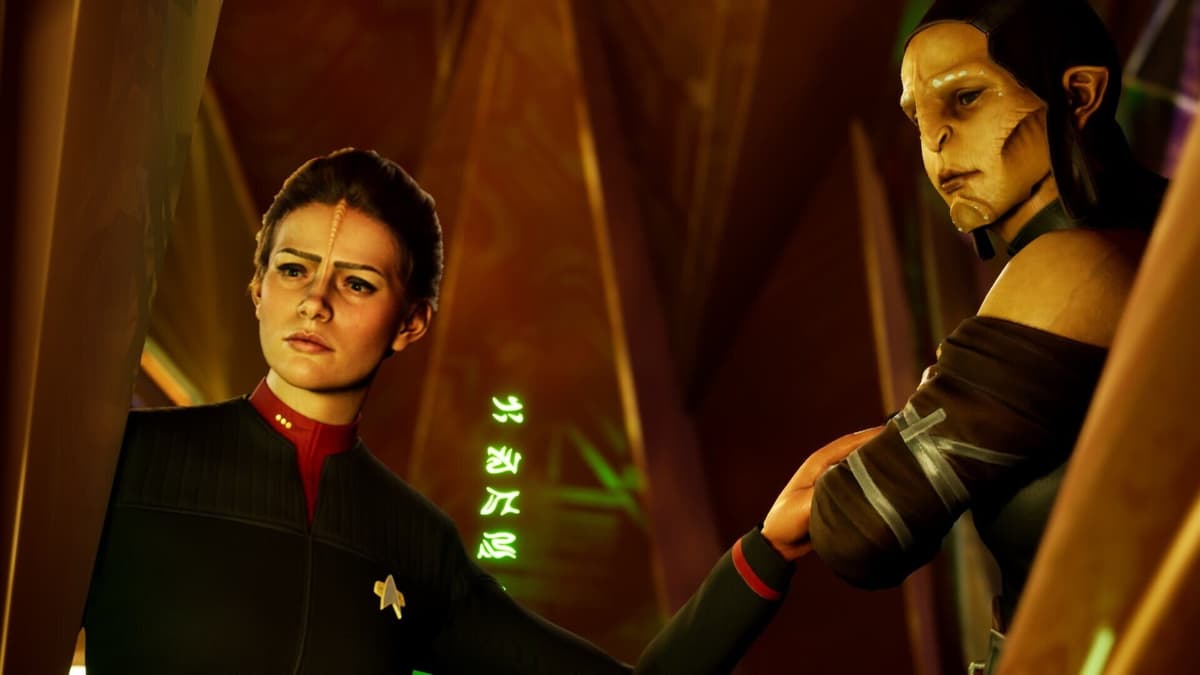
Star Trek: Resurgence hides its most important consequences inside ordinary-looking dialogue. A line that feels like simple roleplay can lock a trophy, change who shows up in a later scene, or quietly close a branch you needed. If you are chasing completion, the problem is not difficulty — it is that the game rarely tells you when you are standing at a fork that counts.
Table of Contents (10)
The short version
- Shields vs Disruptor (Chapter 4): an early-mission choice with two separate trophies — Shields Up and Disruptor. Pick one per playthrough; you need both runs (or chapter select) to clean up.
- Miranda relationship: one choice, two mutually exclusive trophies — Lower Decks Dalliance (pursue the romance) and Platonic Vibes (stay friends).
- Killing Miranda: the gun / Deuterium route in The Hammer or the Anvil — after which Edsilar kills Miranda — is the action that feeds the related secret achievement path. This is a later chapter, not the same scene as Shields vs Disruptor.
- First Officer nomination (endgame): a hard route divider. The candidates are Westbrook, Bedrosian, and Urmott — decide before you reach the scene.
What a choices guide is actually for here
This is not a game where a “best build” carries a run. There is no combat optimization to solve. A choices guide is a route planner, and it answers three questions: which decisions are tied to trophies or mutually exclusive scenes, which ones only change dialogue tone, and how you keep a completion run efficient instead of replaying whole chapters blindly.
The trap is that Resurgence presents most of these forks as character moments. You make an in-character call — compassionate, cautious, loyal — and only later discover it gated a trophy. So the goal is simple: know which branches are mechanical before you reach them, and treat those scenes as routing, not roleplay.
The choices that actually move trophies
Shields vs Disruptor (Chapter 4)
This early-mission choice splits into two distinct Chapter 4 trophies: Shields Up for raising shields and Disruptor for the aggressive option. Each playthrough can only register one. This is the clearest example of a fork that does not change the broader story but still stamps a separate completion flag — so you cannot grab both in a single run. Pick the one you are collecting, and plan a second pass (or chapter select) for the other.
One thing to get straight up front: this is not the same decision as the Miranda climax. Older write-ups sometimes lump the two together, but Shields vs Disruptor is an early Chapter 4 beat, and the Miranda life-or-death choice comes much later in a different chapter.
The Miranda relationship: Lower Decks Dalliance vs Platonic Vibes
There is a single Miranda relationship choice, and it yields two mutually exclusive trophies. Pursue the romance for Lower Decks Dalliance; keep it strictly friendly for Platonic Vibes. There is no separate “second dating chance” you have to refuse for a bonus — it is one decision, two outcomes. Decide which trophy you want before the conversation, because you will need the opposite choice on another run to complete the pair.
Killing Miranda (The Hammer or the Anvil)
The climactic Miranda decision sits in the chapter The Hammer or the Anvil, not in Belly of the Beast. Choosing the gun / Deuterium route leads to Edsilar killing Miranda, and that outcome feeds the related secret achievement path. This is the choice where roleplay instinct clashes hardest with completion: a player making the compassionate call closes off the branch the achievement route expects. If you are routing for it, take the lethal option deliberately rather than improvising the moment.
The First Officer nomination (endgame)
Near the endgame you nominate a First Officer, and the candidates are Westbrook, Bedrosian, and Urmott — that is the correct in-game spelling for the second name, despite the “Bedorian” typo that floats around community posts. The nomination is a clean route divider: the scene feels like crew politics, but it functions as a hard split between outcome sets. Do not reach it without already knowing which path you are on.
How to run it without burning a playthrough
- Decide your goal first. Pure roleplay run, or trophy run? If it is trophies, commit to a route from the start instead of cleaning up later.
- Track the four flags as you go: Shields/Disruptor (Ch. 4), the Miranda relationship, the Miranda lethal choice in The Hammer or the Anvil, and the First Officer nomination.
- Plan two passes for the mutually exclusive pairs. Shields Up / Disruptor and Lower Decks Dalliance / Platonic Vibes each need opposite choices, so you cannot finish them in one run — use chapter select where you can.
- Treat flagged relationship scenes as mechanical. A romance line is not “just flavor” when it carries a trophy.
Common mistakes
- Assuming Shields vs Disruptor and the Miranda life-or-death choice are the same scene — they are in different chapters.
- Trying to get both halves of a mutually exclusive pair in one playthrough.
- Making the Miranda climax call by gut instinct when you are routing for the secret achievement.
- Reaching the First Officer nomination without deciding the candidate in advance.
- Trusting the “Bedorian” spelling — the in-game name is Bedrosian.
Practical takeaway
Think of a Star Trek: Resurgence choices guide as a navigation chart, not a verdict on which captain-style call is morally right. The trophies hinge on a small, knowable set of forks: Shields Up vs Disruptor in Chapter 4, the Miranda relationship split between Lower Decks Dalliance and Platonic Vibes, the lethal Miranda choice in The Hammer or the Anvil, and the First Officer nomination among Westbrook, Bedrosian, and Urmott. Decide each one before you reach it, plan two passes for the exclusive pairs, and you will finish without replaying chapters blind. If you want the full chapter-by-chapter run, pair this with our Star Trek: Resurgence walkthrough, and if you are picking your bridge crew, the best teams guide covers the strongest story routes.
FinalBoss // Gear
Level up your setup
01Top-rated gaming headsetson Amazon→02High-refresh gaming monitorson Amazon→03Gaming chairson Amazon→04Discounted game keyson Kinguin→
Affiliate links · As an Amazon Associate, FinalBoss earns from qualifying purchases.
Want to Level Up Your Gaming?
Get access to exclusive strategies, hidden tips, and pro-level insights that we don't share publicly.
Ultimate Guide Strategy Guide + Weekly Pro Tips