
Table of Contents (11)
The exact moment Stardew’s music got its hooks in me
I remember the exact moment I realized Stardew Valley’s soundtrack was doing something most “cozy” games completely whiff on. It wasn’t some big story beat or a tense dungeon run. It was me, chopping wood on a dumb little pixel farm at the tail end of Spring, when that hopeful, slightly awkward banjo line kicked in over a soft flute, and I just stopped moving.
Not to check stats. Not to min-max a crop layout. I just stood there and listened. The music didn’t feel like “background ambiance” anymore; it felt like the game looking me in the eye and saying: “This is what this season feels like. This is what this place is.”
That’s when it clicked for me: Stardew Valley isn’t just a great cozy farming sim with a cute soundtrack. It’s one of the rare games where the music and the world feel like they were born from the same brain-because they literally were.
Most cozy game soundtracks blur into one big lo-fi soup
I’m going to be blunt: a lot of cozy game soundtracks are boring as hell once you step away from the game.
And I say that as someone who lives on game music. I play fighting games competitively; I grew up with Shenmue humming in the background of entire weekends. I care about soundtracks. But the modern “cozy” wave? Too often it’s just slightly-warm lo-fi beats with all the edges sanded off. Pleasant. Harmless. Completely forgettable.
You boot up some new pastel farming sim and the audio brief might as well have been: “Search ‘lofi beats to study to’ and do that, but looped forever.” It’s safe. It doesn’t offend. It also doesn’t stick. I finish these games and couldn’t hum you a single bar if my life depended on it.
That’s the trap cozy games fall into: they think relaxing has to mean anonymous. The music is there to “not get in the way,” so it ends up with no identity of its own. You’re left with a vibe playlist, not a score.
Stardew Valley dodges that trap so hard it basically makes everything else look lazy. It’s soothing and stupidly memorable, and that balancing act is way harder than people give it credit for.
Eric Barone didn’t just make a game, he scored a life
Here’s what makes Stardew’s soundtrack hit different: Eric Barone-ConcernedApe himself-composed the entire thing. No formal musical training, no outsourcing to a “we do indie scores” studio assembly line. He sat in Propellerhead Reason, poked at stock instruments, followed his ear, and somehow ended up with over two hours of music that people are still streaming a decade later.
I can’t overstate how much this matters. When the same person is designing the farm layouts, writing the NPCs, and writing the music, the audio isn’t just slapped on at the end. It becomes baked into the core of what the game is trying to say.
Barone has talked about how he didn’t start with “this is a farming sim, I need generic fields-and-birds music.” He started from emotions and seasons. Spring needed to feel hopeful and new—so we get that chiming, almost childlike energy. Summer needed to feel energetic and alive—so we get brighter synths, more pronounced rhythms. Fall is melancholy without being miserable. Winter is lonely, but not cold-hearted.
He wrote music to capture the soul of each season before he even fully built out all the scenes that would use them. That’s a music-guided process, not an afterthought, and you can feel it in every step you take through Pelican Town.
Stardew’s secret weapon: music that respects silence
There’s another tiny detail that shows how much thought went into this: the outdoor seasonal tracks don’t just loop endlessly until your brain turns them into mush. They rotate. Sometimes it’s a full theme, sometimes it leans more into ambient soundscapes. They come and go in a way that feels like weather patterns, not a jukebox.
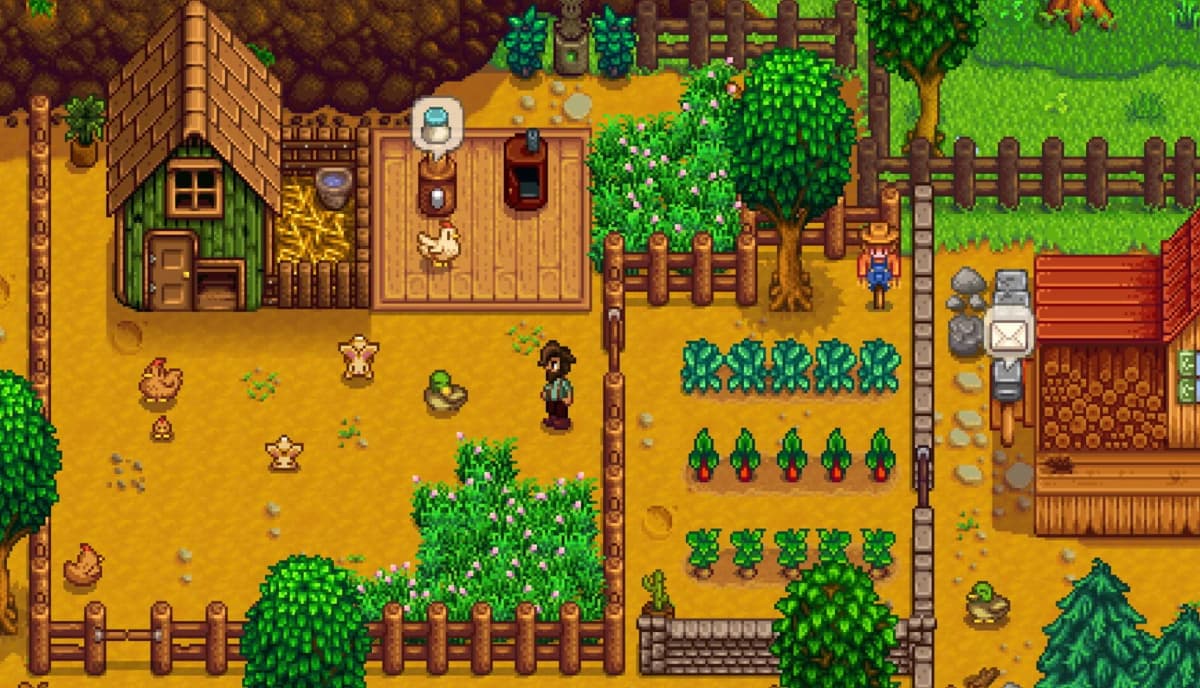
That’s crucial. So many games confuse “immersion” with “never shutting up.” Stardew trusts its own ambience—the footsteps on dirt, the thud of a pickaxe in the mines, the rain on your roof—to carry some of the emotional load. The music appears, says something specific, then steps back.
As someone who’s sunk embarrassing hours into open-world games where the same 30 seconds of music loops like auditory waterboarding, Stardew’s restraint feels luxurious. It’s the difference between someone talking at you for hours and someone who actually knows how to hold a conversation.
From ragtime saloon chaos to quiet winter nights
What I love most is how unapologetically specific Stardew’s musical choices are. You walk into the Stardrop Saloon and it doesn’t give you some vague “cozy bar” pad. It hits you with this cartoonishly on-the-nose ragtime piano that sounds like it escaped from an old-timey cabaret. It’s borderline goofy—and absolutely perfect.
That’s confidence. That’s a tiny game made by one dude daring to have flavor in a space where everyone else is terrified of being anything but “chill.” The Saloon theme tells you in two bars that this is a place where time doesn’t matter, where NPC schedules fizzle out into beer and games. It has character.
Then you contrast that with the quiet of Winter. The drums thin out, melodies become fragile, like they’re afraid to echo too loudly over the snow. It doesn’t feel like a playlist shuffle; it feels like someone who has actually lived with these winters and knows they’re not just “blue-tinted version of Fall.”
That range—goofy saloon ragtime, dreamy main theme, seasonal shifts—is exactly why this soundtrack works outside the game. I can work to Winter’s themes, walk to the Spring ones, and let the Saloon track crash into my headphones when I need to feel like an NPC wasting the night away.
“Dance of the Moonlight Jellies” and the power of gentle drama
Let’s talk about the obvious star of the show: “Dance of the Moonlight Jellies.” It’s the most-played track from the game on Spotify, and for once the algorithm actually has taste.
The festival itself is simple: you stand on a pier at night, watching glowing jellyfish drift through the water like tiny, lost ghosts. Mechanically? It’s nothing. No choices, no skill checks, no big story twist.
But then that soft, floating melody begins, and suddenly this low-stakes pixel event feels unreasonably profound. The chords are gentle but slightly bittersweet, the instrumentation is airy without being saccharine. It’s not trying to wring tears out of you like a manipulative indie film; it just sits with you in a weird, quiet awe.

I’ve come closer to tearing up in that scene than during some “prestige” AAA story moments, and that’s not an exaggeration. It’s the purest example of what Stardew’s soundtrack does best: elevate the mundane. Take a modest festival and make it feel like a sacred little memory you’ll actually carry with you after you turn off the game.
There’s a reason that track keeps getting streamed ten years on. It isn’t just nostalgia bait. It’s good, full stop. If it dropped as a track on some ambient album with no game attached, it would still stand out.
Stardew’s OST lives a whole second life outside the game
Here’s where you really see the difference between “functional” game music and a real-deal soundtrack: how often do you listen to it when you’re not playing?
For me, Stardew’s soundtrack has become part of my actual life rotation. Writing? Throw on the Spring and Fall tracks. Late-night chill session? “Dance of the Moonlight Jellies” and some Winter themes. I’ve gone through phases where I listen to at least one Stardew song every single day for months. There are albums from big-budget composers that don’t get that kind of mileage from me.
And it’s not just me. We’ve had a full-on lullaby remix album, Prescription for Sleep: Stardew Valley, that reimagines Barone’s themes as gentle sleep music. There’s been a dedicated concert tour, Festival of Seasons, literally built around playing this OST live. A symphonic project, Symphony of Seasons, is in the works. This is a soundtrack from a single indie farming game, not a decades-long JRPG franchise.
That kind of footprint is what most triple-A scores dream about and never hit, even with entire marketing machines behind them. Stardew did it with one guy in Reason trusting his instincts.
Why having the creator as composer hits differently
I’m not saying every game needs its director to also be the composer; that would be a nightmare in most studios. But Stardew is proof that when it does happen, you can get something that’s hard to replicate any other way.
The soundtrack feels so closely tied to Barone’s personal idea of what “comfort” and “escape” mean that it ends up feeling intimate in a way that outsourced scores rarely do. Every track sounds like it was written by someone who wasn’t guessing at the heart of the game—they are the heart of the game.
There’s no weird dissonance you sometimes get in bigger productions, where the art direction is pulling one way, the marketing wants a certain vibe, and the composer is wedged in the middle trying to please all of them. Stardew’s music answers to one person’s taste, and it shows.
Honestly, this is where I start calling bullshit on how some studios treat music. It’s insane that we still see projects where the soundtrack is clearly commissioned at the last possible moment, slapped over whatever’s there, and forgotten the second the trailer’s out. Stardew proves you can treat music as a core pillar of design from day one, even on a microscopic budget, and end up with something people cherish a decade later.
Cozy doesn’t have to mean creatively safe
If anything, Stardew Valley has made me way less patient with lazy cozy-game soundtracks. When I boot up a new life sim and it’s just “generic piano and rain 01” on repeat, I bounce off it so much faster now. Not because I need everything to be bombastic, but because I’ve seen what’s possible when a cozy game actually swings for the fences with its music.

Cozy doesn’t have to mean frictionless. Stardew’s music has edges. The synths have that deliberate, slightly retro video game flavor instead of trying to hide it. Some tracks are almost weirdly propulsive for how chilled-out the actual farming is. The Saloon theme is borderline clownish, in the best way. These are choices. They give the world texture.
And that’s where a lot of the competition just flops. They chase a vibe, not an identity. You can feel the design doc: “players will want to relax, so make it soft and loopable.” Stardew’s design doc, intentional or not, feels more like: “what does this place sound like? What does this season sound like?” That distinction is everything.
Ten years on, this soundtrack still shapes how I play
We just hit Stardew Valley’s 10th anniversary, and it’s wild how much the game has grown—updates, multiplayer, 50 million copies, the whole thing. But for me, the thing that keeps pulling me back isn’t the content drops or the mods. It’s that I know the second that main theme fades in on the title screen, I’m going to feel my shoulders drop a little.
After long sessions grinding rank in fighting games, I’ll boot Stardew almost as an excuse to hear the music in its natural habitat again. I could just open Spotify, sure, and I often do. But hearing those tracks in context—timed to the sunrise, the festivals, the lazy evenings in the Saloon—reminds me why I fell in love with this medium in the first place.
It’s not the farming loop alone. It’s not the NPC heart events alone. It’s the way the music quietly threads through all of it, turning a bunch of systems into somewhere that feels like a second home.
What other devs should actually steal from Stardew’s music
If other developers want to rip off Stardew Valley—and let’s be honest, a ton already have—the thing they should be copying isn’t “farming plus dating equals profit.” They should be copying the way the soundtrack is treated as fundamental, not optional.
Steal this part: write music as early as you can, even if it’s rough. Let it inform the tone of your art and writing. Ask “what does this place sound like?” instead of “what genre do we throw on top?” Build seasonal or area-based identities that are so strong I could tell where you are in the game with my eyes closed.
Don’t steal this part: chasing “cozy” as an excuse to be bland. If your soundtrack could be swapped into five other games and no one would notice, you’ve already lost. Stardew’s music isn’t great because it’s cozy. It’s great because it’s personal, and it isn’t afraid to sound like a video game instead of an anonymous Spotify study mix.
As someone who’s been playing games long enough to watch soundtracks go from bleeps to full orchestras to algorithm-bait background mush, Stardew Valley feels like a reminder of what this medium can do when one obsessed creator is allowed to just make what feels right.
Ten years later, Eric Barone’s little Reason project hasn’t just stood the test of time—it’s quietly raised the bar. And yeah, it ruined a lot of lesser cozy game soundtracks for me. But honestly? I’m glad it did. If a solo dev can deliver a score this warm, this memorable, and this cohesive, nobody else has an excuse anymore.
FinalBoss // Gear
Level up your setup
01Top-rated gaming headsetson Amazon→02High-refresh gaming monitorson Amazon→03Gaming chairson Amazon→04Discounted game keyson Kinguin→Affiliate links · As an Amazon Associate, FinalBoss earns from qualifying purchases.
Want to Level Up Your Gaming?
Get access to exclusive strategies, hidden tips, and pro-level insights that we don't share publicly.
Ultimate Gaming Strategy Guide + Weekly Pro Tips