
Here’s the blunt version: Starship Troopers: Ultimate Bug War! is much better at being Starship Troopers than it is at being an all-timer shooter. That still matters. A lot, actually. Auroch Digital clearly understands the fantasy people show up for here: loud propaganda, bigger bug piles, giant maps, soldiers pouring onto a battlefield, and just enough retro grime to make it feel like a lost shooter from the turn of the millennium. For stretches, that is more than enough.
The problem is that the game’s strengths announce an even better version that never arrives. The maps look like they were built for old-school Battlefield-style chaos. The objectives feel made for drop-in co-op. The bug-side missions hint at a more playful asymmetrical war. Yet this is a strictly single-player package, and once the novelty of the first few deployments wears off, the repetition starts marching to the front.
Tested on PS5 and PC, and finished in roughly eight hours across the main human missions and the shorter bug detours, Ultimate Bug War! left me split in a very specific way. I had a good time. I also kept thinking about the more ambitious game hiding underneath it. That tension defines the whole review.
Table of Contents (9)
Key takeaways
- This is a smart retro riff on late-90s and early-2000s objective shooters, not a modern cinematic campaign.
- The FMV briefings and propaganda framing capture Starship Troopers far better than most licensed games manage.
- Combat is lively, readable, and stable on PS5 and PC, with big maps, vehicles, turrets, mechs, and constant bug pressure.
- Mission design repeats itself too often, the bug campaign feels like a side dish, and the lack of co-op or multiplayer is the game’s biggest miss.
A license that actually understands the movie
Auroch already proved with Warhammer 40,000: Boltgun that it knows how to grab a beloved universe and translate it through retro shooter language instead of sanding it down into generic blockbuster mush. Ultimate Bug War! follows that same instinct, but it pulls from a slightly later era. This is not a corridor sprint in the Doom mold. It reaches for the feel of those sprawling, objective-based shooters from the late 90s and early 2000s, the kind of games where a battlefield felt like a place rather than a shooting gallery.
The presentation sells that choice almost immediately. You get campy FMV briefings from Johnny Rico and the new Major Sammy Dietz, wrapped in a game-within-a-game propaganda setup where this “official” product is meant to get the youth excited about military service. That is exactly the kind of ridiculous, smiling militarism the source material lives on. The tone lands because it is played straight enough to be funny and fake enough to feel like recruitment theater. It is one of the few modern licensed shooters that seems to know Starship Troopers should feel a little tacky, a little loud, and a little suspect.
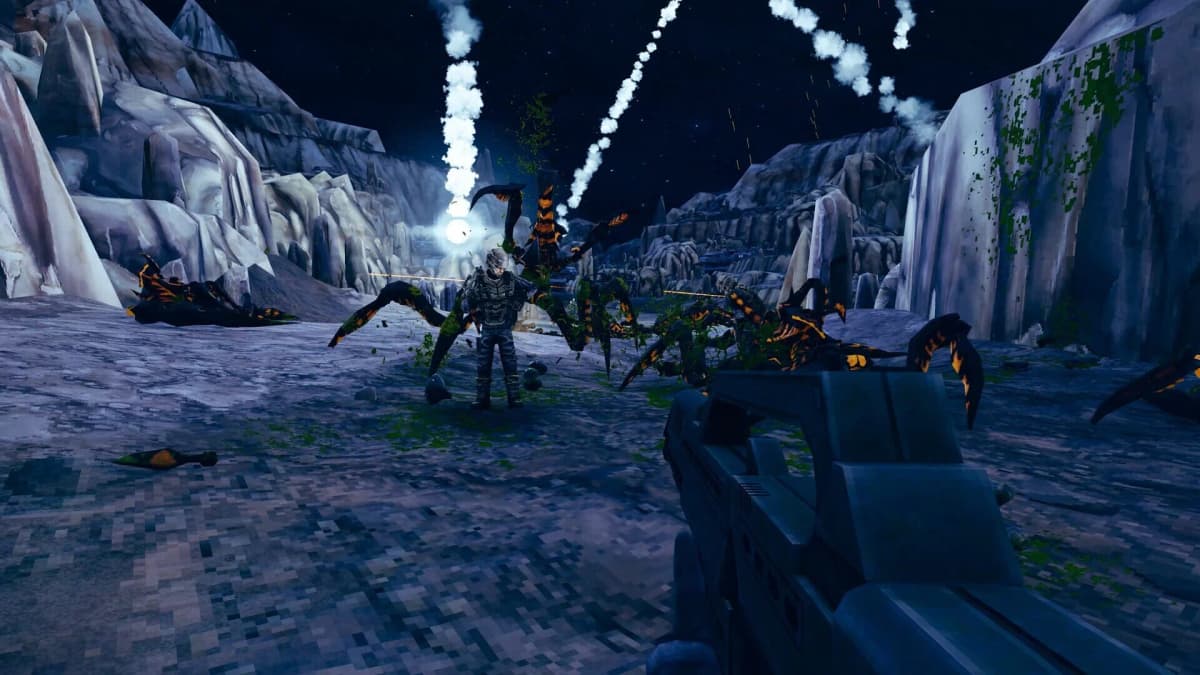
Visually, the game lands in a pleasing middle ground between eras. The environments are full 3D spaces, wide and colorful, but many of the moving elements are rotating 2D sprites in that old 2.5D tradition. Rather than feeling cheap, it gives the whole war a crunchy arcade texture. Soldiers, bugs, and vehicles spill across large maps in a way that instantly recalls early Battlefield, Battlefront, or even Tribes-style battlefield fantasy, minus the networked chaos. It is a good look. More importantly, it is the right look.
When the battlefields click, they really click
The core mission loop is simple and easy to read. You get dropped into a large combat zone, usually after a skippable landing sequence, and then you start working through objectives like clearing a landing zone, destroying bug anti-air defenses, holding a position, or surviving a final extraction wave. Human and bug reinforcements keep flowing in, so even simple travel between objectives has some heat to it. That constant pressure is where the game finds its pulse.
The best part is the sense of scale. You are not just pushing down a corridor while scripted enemies pop out on cue. You are cutting across open terrain, spotting points of interest, deciding which objective to chase first, hopping on a turret, or climbing into a mech when the map allows it. The game does not drown you in systems, but it gives you enough toys to stop the combat from feeling flat in the short term. There is also a practical rhythm to survival: shoot, move, panic a little, call in the aerial supply drop, reload, keep moving.
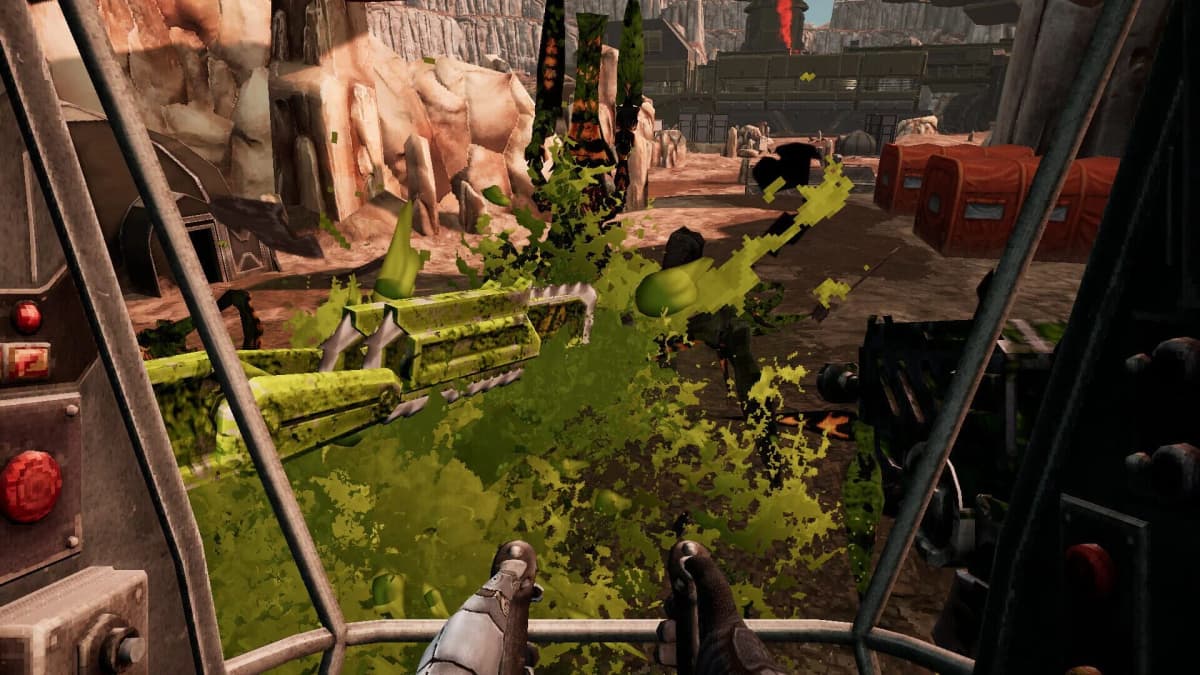
That supply drop mechanic ends up being one of the better little ideas here. On paper it is just a cooldown-based resupply for weapons, ammo, health, and armor. In practice, it becomes a lifeline because bug encounters chew through resources fast. You are constantly weighing whether to burn through what you have, knife smaller threats to save bullets, or throw down a resupply before the next push. The arsenal itself is not huge, but it has enough punch, especially when the game lets you point out mini-nuke targets or use map-specific heavy options.
The post-mission scoring helps more than expected, too. Since kills and destruction feed into your overall rating, there is a nice arcade edge to each deployment. It does not transform the campaign into a deep score-chaser, but it gives clean runs a little extra flavor. That matters in a game like this, where the immediate satisfaction of a firefight carries more weight than narrative complexity.
Then the repetition starts chewing through the fantasy
Freedom inside a mission is not the same thing as variety across the campaign, and Ultimate Bug War! learns that lesson the hard way. Once you have seen the structure a few times, the beats start to blur together. Land. Sweep. Blow something up. Hold out. Extract. The maps are broad enough to keep that loop from becoming miserable, but not inventive enough to stop it from feeling familiar far too soon.
This is where I started missing the sharper edge of Boltgun. That game had a cleaner tempo and a more aggressive identity from encounter to encounter. Ultimate Bug War! is broader and looser by design, which fits its inspiration, but it also means weaker missions have more room to feel empty. The game wants the atmosphere of big war stories without always having the mission scripting to back it up. The result is enjoyable in bursts and samey over an entire campaign.
The bug missions are a perfect example. There are five of them, they are short, and the basic idea is funny: you control a bug commander that can switch between ground and flight states, wreck human structures, tear through soldiers, and summon more insects to your side. As a novelty, they work. As a meaningful second campaign, they do not. They feel more like a break from the main loop than a fully formed counterpoint to it.
Replayability is also thinner than the battlefield scale suggests. Higher difficulties help, and there are a few cheat-code secrets tucked away for the curious, but this is still a relatively lightweight package. Once the campaign is done, you are mostly replaying for better scores or because you liked the vibe. Some players will absolutely do that. Others will finish the game, nod, and move on.
The missing multiplayer is not a side complaint
This is the criticism that hangs over everything else. A game built around huge objective maps, swarming enemies, vehicles, turrets, faction flavor, and battlefield scale feels almost bizarre without co-op or multiplayer. The absence is not just disappointing because more modes are always nice. It hurts because the game’s whole structure keeps reminding you how naturally social this could have been.
Those old large-map shooters were not memorable just because of their terrain or objective lists. They worked because human unpredictability turned simple goals into stories. A desperate hold at an extraction point. A stupid vehicle rescue that somehow succeeded. A messy flank that collapsed into total panic. Ultimate Bug War! has the bones for that kind of chaos, but AI soldiers cannot replace the feeling. They fill the field, they sell the scale, and they keep the war loud. They do not create the same magic.
That makes the single-player-only decision feel less like a focused artistic choice and more like the game’s most obvious missed opportunity. Even basic co-op would have changed the whole equation. As it stands, the campaign is fun enough to finish, but it never stops sounding like a rehearsal for the version people will keep wishing existed.
PS5 and PC hold up nicely, which helps the whole throwback pitch
The good news is that the tech stays out of your way. On PS5, performance stayed stable even when maps got crowded with bugs, soldiers, explosions, and vehicle noise. On PC, the game also ran cleanly across stronger and weaker setups in our testing, which fits the overall impression that this is a lightweight shooter by modern standards. No big drama. No constant hitching. No obvious collapse when the screen gets messy.
That matters because the visual style depends on readability more than spectacle. The retro presentation is not chasing bleeding-edge fidelity. It is chasing battlefield clarity, old-school charm, and the sensation of too many targets spilling across a map at once. The colorful biomes help keep missions from turning into one long smear of gray military rubble, and the sprite-heavy enemy presentation gives combat a deliberate stylization that fits the era Auroch is pulling from.
In a strange way, the smooth performance almost sharpens the design critique. There is very little technical friction here to blame when the momentum dips. The game runs well. It looks coherent. It gets the source material. When it drags, it is because the mission design or feature set runs out of road, not because the machine falls apart underneath it.
Who should enlist, and who should stay on the transport
If you love Starship Troopers, miss chunky objective-based shooters, and want a breezy single-player campaign that understands camp better than most licensed adaptations, this is easy to recommend with caveats. There is genuine fun in the firefights, the FMV is charmingly ridiculous, and the whole package has that specific “lost game from another timeline” energy that retro shooter fans chase.
If you want deep weapon variety, mission design that keeps reinventing itself, or any kind of co-op and versus ecosystem, the ceiling here is lower than you probably want. The same applies if you were hoping Auroch would top Boltgun. This does not. It is a smaller pleasure, rougher around the edges, and more dependent on affection for its setting.
There is also a broader Auroch Digital point here. In a year where the studio is leaning hard into classic-IP reinterpretations, Ultimate Bug War! shows both the appeal and the limit of that strategy. Auroch is very good at finding the right retro grammar for a license. The harder part is building enough depth around that grammar to make the result stick.
Bottom line
Starship Troopers: Ultimate Bug War! is a fun, faithful, occasionally scrappy throwback shooter that absolutely nails the mood of bug extermination propaganda. The big maps, constant reinforcements, FMV silliness, and strong performance on PS5 and PC give it an easygoing charm. For a few hours, that charm carries everything.
Then the objective design starts repeating, the bug-side novelty fades, and the lack of multiplayer becomes impossible to ignore. That does not sink the game, but it does cap it. FinalBoss verdict: 7/10. Good license work, good battlefield energy, and one very obvious missing piece that keeps it from becoming something much harder to forget.
TL;DR
Starship Troopers: Ultimate Bug War! gets the look, tone, and large-scale bug warfare right. It runs well, moves fast, and makes smart use of retro FPS language. It also repeats itself too often and leaves a giant hole where co-op or multiplayer should be. The game in front of you is enjoyable. The version haunting it is better.
FinalBoss // Gear
Level up your setup
01Top-rated gaming headsetson Amazon→02High-refresh gaming monitorson Amazon→03Gaming chairson Amazon→04Discounted game keyson Kinguin→Affiliate links · As an Amazon Associate, FinalBoss earns from qualifying purchases.
Want to Level Up Your Gaming?
Get access to exclusive strategies, hidden tips, and pro-level insights that we don't share publicly.
Ultimate Reviews Strategy Guide + Weekly Pro Tips