
Table of Contents (9)
The Core Shift: From Bigger Maps to Persistent Worlds
State of Decay 3 is scheduled for 2027 on PlayStation 5, Xbox Series X|S, and PC, with day-one availability on Xbox Game Pass. Undead Labs has confirmed the sequel runs on Unreal Engine 5, features a playable map roughly four times the size of State of Decay 2, and shifts the series toward a persistent shared-world co-op model supporting up to four players. The critical change is not merely scale. It is the move from session-based survival to an asynchronous persistent state where player actions can alter the map for others across separate play sessions.
| Release Window | 2027 |
| Engine | Unreal Engine 5 |
| Platforms | PlayStation 5, Xbox Series X|S, PC (Steam, Microsoft Store) |
| Map Size | Approximately 4x State of Decay 2 |
| Multiplayer Model | Persistent shared-world co-op, up to 4 players |
| Subscription Launch | Xbox Game Pass (day-one) |
What 4x Scale Actually Demands from UE5
A fourfold increase in playable landmass is not a simple multiplier. In Unreal Engine 5, managing that volume requires World Partition, a system that divides the map into streaming cells rather than loading the entire environment into memory at once. As players move, the engine loads the relevant cells and unloads distant ones. On paper, this allows for seemingly seamless open worlds, but the practical cost is a constant balancing act between memory budget, storage I/O speed, and CPU overhead.
The State of Decay 2 map was already substantial, so quadrupling that space means thousands more cells to manage. If Undead Labs maintains the same density of buildings, resources, and navigable interiors, the raw number of persistent entities in the world increases proportionally. Even with UE5’s optimized rendering pipeline, the game must stream higher-resolution assets over longer sightlines while maintaining a stable simulation tick. On consoles, where memory is fixed, this likely forces aggressive level-of-detail scaling and careful culling of dynamic objects beyond a certain radius. The PlayStation 5 and Xbox Series X fast SSDs will help, but the Xbox Series S has less memory and bandwidth, making it the de facto optimization floor for cell complexity and streaming speed.
Scale also changes traversal design. A larger map means longer distances between points of interest, which pushes vehicles and base placement to the center of the gameplay loop. If the world is four times larger but filled with empty wilderness, the technical achievement becomes a navigational chore. The engine can handle the geometry; the design must justify the space.
How Persistent Shared-World Changes the Rules
In State of Decay 2, co-op was session-based. A host loaded their personal world, and visitors joined temporarily. Visitors retained some loot and experience, but the world state itself belonged to the host. When the session ended, the visitor’s impact on the map largely disappeared. State of Decay 3 abandons that model for a persistent shared-world framework where the map itself is communal property.
Technically, this means the game must treat the world state as a database rather than a local save file. Every significant alteration- a fortified structure, a depleted cache, a destroyed bridge, a cleared infestation-must be serialized, stored, and synchronized. When Player A logs off and Player B logs on hours later, the server or designated authority must present the same altered world. This asynchronous persistence is what separates a shared-world survival game from traditional drop-in co-op. It creates long-term consequences: resources stay gone, bases remain built, and tactical decisions made by one player shape the experience of another.
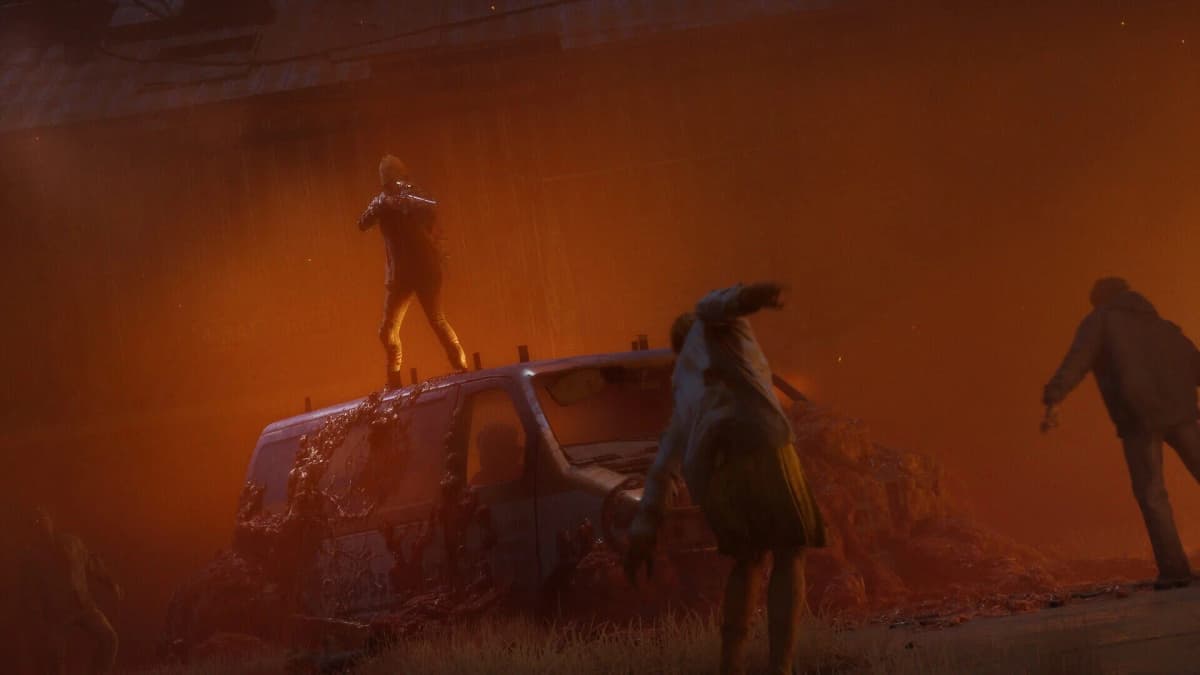
The architectural implication is significant. The game requires either dedicated server infrastructure or a robust host-authority system with cloud-based save migration. If the session owner leaves, the world cannot simply evaporate for the remaining players. Host migration in a persistent world is notoriously complex because the entire simulation state-loot tables, zombie spawns, vehicle positions, construction data—must transfer cleanly to a new authority without desyncing the clients. Undead Labs has not detailed the server topology, but the feature set strongly implies an always-online requirement for the shared world, even if a private offline mode exists separately.
Performance and Network Tradeoffs
Combining a 4x map with persistent state introduces a memory and bandwidth tax that scales with player behavior. In a static open world, the engine only needs to stream geometry and actors within a predictable radius. In a persistent shared world, the server must track which objects have been altered across the entire map, not just the active play zone. If four players scatter to opposite corners of the map, the simulation must maintain authority over distant zones where base-building or resource exhaustion continues to matter.
Unreal Engine 5 provides replication graph systems to limit network updates to relevant actors per connection, but persistent world data complicates that optimization. A wall knocked down by Player A in the north must still be replicated to Player B when they travel north hours later. The client cannot simply generate that state procedurally; it must retrieve the delta from storage. This creates potential hitches when entering heavily modified cells, as the client downloads not just the base map geometry but the cumulative changes applied since the world was created.
There is also the question of conflicting edits. If two players have the authority to alter the same base or resource node simultaneously, the system must resolve the conflict without crashing or creating divergent timelines. Standard UE5 replication handles real-time positional updates well, but asynchronous structural changes—removing a wall, claiming an outpost—require transactional state management. The more granular the persistence, the larger the save-state payload and the greater the risk of desync when clients reconnect.
What Only Builds and Benchmarks Can Verify
Until hands-on builds are available, several critical technical questions remain unanswered. Frame-rate stability during four-player co-op while streaming new World Partition cells is unknown. The density of persistent, player-alterable objects per cell has not been disclosed, and that density directly impacts both memory usage and network overhead. It is unclear whether the game uses a single seamless map or invisible zoning for major regions, which would change the technical evaluation entirely.
Network performance is another open question. The latency of retrieving persistent map deltas from cloud storage, the tick rate for world-state replication, and the behavior of the simulation during host migration all need measurement. Storage requirements are also unconfirmed; a world that tracks thousands of granular player changes can produce save files and cache data that grow rapidly over time. Finally, the difference between PlayStation 5, Xbox Series X, and Series S implementations—particularly regarding texture streaming and population density—will only become clear through direct comparison.
Platform Context and Practical Expectations
State of Decay 3 launching on PlayStation 5, Xbox Series X|S, and PC with day-one Xbox Game Pass access broadens the player base but also locks the development target to current-generation hardware. That is good news for UE5 feature utilization, as the CPU and I/O upgrades over last-generation consoles allow for more ambitious streaming and simulation. However, the Xbox Series S remains the baseline. Its reduced memory pool and GPU performance mean the 4x map cannot be presented with identical fidelity across all platforms. Expect lower rendering distances, reduced shadow quality, or more aggressive NPC culling on the Series S to maintain playable frame rates in a persistent multiplayer environment.
For players, the practical upshot is a survival game where communal effort produces lasting results. Groups of up to four can build, scavenge, and degrade a shared space over weeks rather than single evenings. That continuity is exactly what the genre needs, but it comes with the cost of online dependency and the risk that server instability or host migration failures could undermine the experience. Solo players should watch for confirmation on whether an offline, non-persistent mode exists with full feature parity.
Pros and Cons
Pros
- 4x larger map offers significantly more exploration space
- Persistent shared-world creates long-term co-op stakes
- Unreal Engine 5 provides a modern foundation for large-scale streaming
- Cross-platform launch on PS5, Xbox Series X|S, and PC
- Day-one Xbox Game Pass availability lowers entry cost
Cons
- 2027 release window is distant with no firm date
- Persistent shared-world likely requires always-online connectivity
- Host migration and server architecture remain unproven
- Performance on Xbox Series S is a practical concern
- 4x scale risks sparse content if density does not match size
FinalBoss // Gear
Level up your setup
01Top-rated gaming headsetson Amazon→02High-refresh gaming monitorson Amazon→03Gaming chairson Amazon→04Discounted game keyson Kinguin→Affiliate links · As an Amazon Associate, FinalBoss earns from qualifying purchases.
Want to Level Up Your Gaming?
Get access to exclusive strategies, hidden tips, and pro-level insights that we don't share publicly.
Ultimate Tech Strategy Guide + Weekly Pro Tips