
Table of Contents (10)
SteamBoy Shrinks a Steam Deck LCD Into a 32 mm Game Boy-Style Build
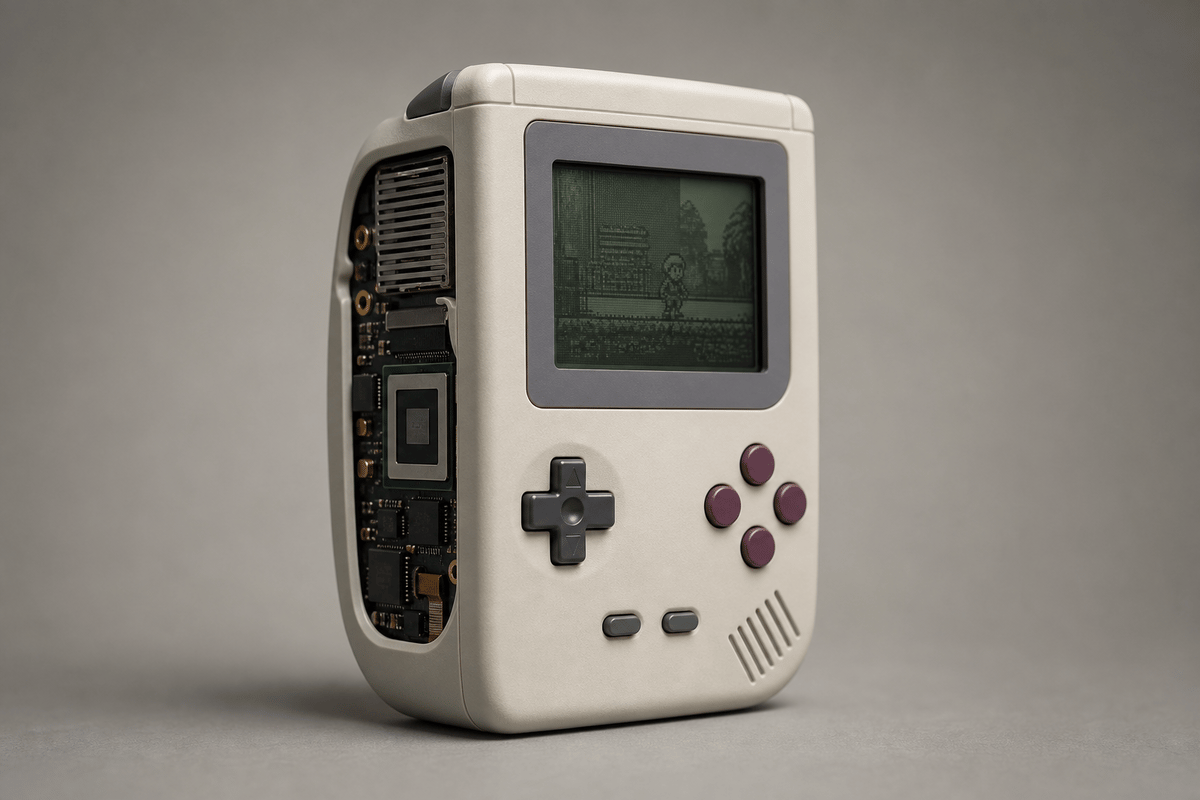
The SteamBoy project takes the motherboard, battery, speakers, and control hardware from an LCD Steam Deck and compresses them into a vertically oriented, 3D-printed handheld shell. The reported chassis is around the footprint of an original Game Boy and approximately 32 mm thick. That is a serious packaging exercise for hardware designed around the far wider Steam Deck enclosure.
Created by Reddit user u/PhyFawkes, SteamBoy is a proof of concept rather than a finished handheld. The system hardware can run, but its planned 1200 × 1080 AMOLED display remains unfinished. That distinction matters. The shell looks close to a completed product from the outside; internally, the display connection is still the project’s largest engineering problem.
Its appeal is easy to understand. A Game Boy-shaped PC handheld combines a familiar vertical form factor with native Steam Deck hardware and SteamOS behavior. The harder reality is that every part of Valve’s original physical design — airflow, battery placement, screen cabling, board spacing, controls, and heat dissipation — has to be reconsidered.
| SteamBoy build element | Reported implementation | Why it matters |
|---|---|---|
| Donor platform | Steam Deck LCD | Retains the Deck motherboard and associated original hardware rather than using a generic mini-PC board. |
| Enclosure | Custom 3D-printed, Game Boy-inspired vertical shell | The case has to hold a dense vertical stack of PC hardware, battery, controls, and cooling parts. |
| Reported thickness | 32 mm | Compact for a Steam Deck-class handheld, although thicker than the classic device inspiring the shape. |
| Target display | 1200 × 1080 AMOLED panel intended for VR hardware | Provides a compact square-ish display format, but remains electrically unfinished. |
| Cooling | 30 × 7 mm fan, heatsink, and custom printed fan mount | Limited enclosure volume sharply restricts airflow and heat-spreader size. |
| Thermal tuning | Approximately -50 mV CPU and GPU undervolt | Reported to keep gaming temperatures around 70-80°C in the constrained shell. |
The Main Build Choice: A Full Steam Deck Motherboard Transplant
SteamBoy’s defining decision is retaining the Steam Deck LCD motherboard. That preserves the original platform rather than approximating it with a different handheld PC board. The controls, speakers, battery, and Steam Deck power behavior remain tied to hardware Valve designed as a complete system.
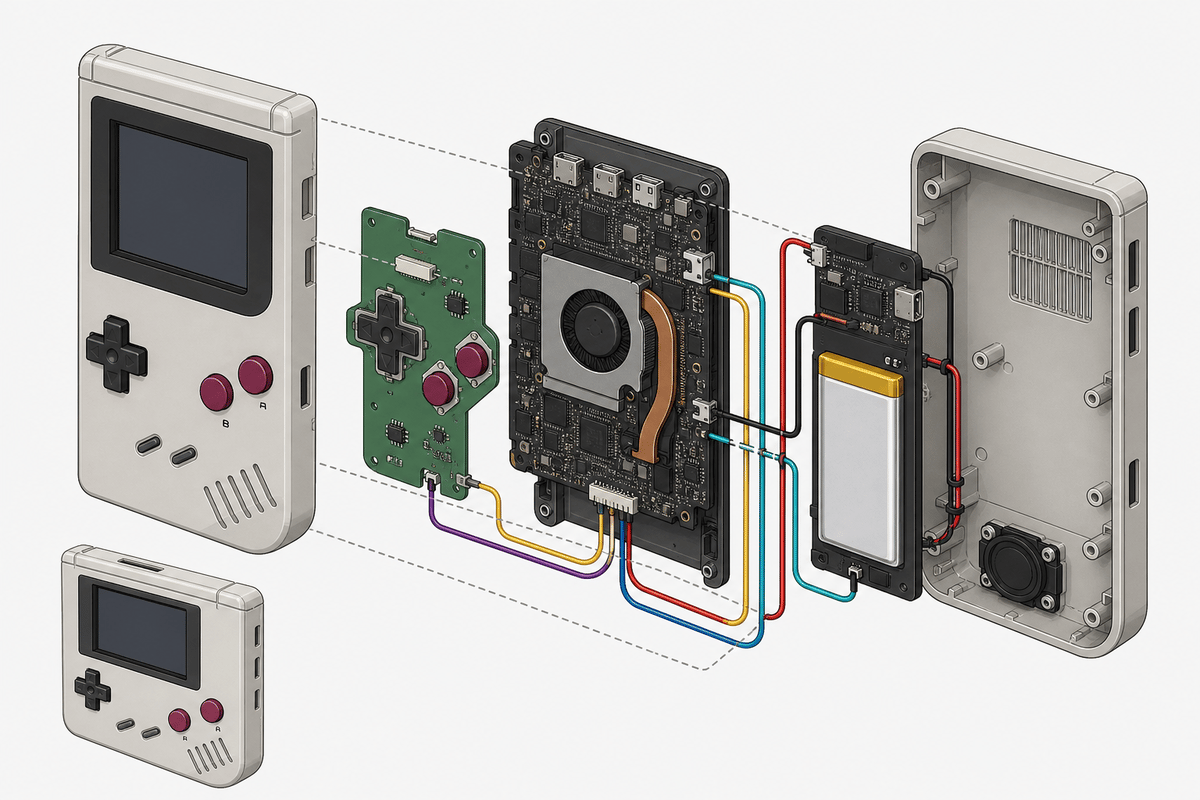
The cost of that decision is physical. A standard Steam Deck has space for its board arrangement, broad cooling assembly, battery, screen, and side-mounted controls. SteamBoy has to fit those elements into a narrow vertical “sandwich.” The case is therefore structural hardware, not decoration. It needs mounting points that prevent board flex, clearance for button mechanisms, protected cable paths, battery retention, and a usable intake-and-exhaust route for the fan.
This is why a simple reshell approach will not produce a SteamBoy. Reusing the Deck’s internals means rebuilding its physical architecture. Small errors in standoff height, ribbon-cable bend radius, pressure on a connector, or battery clearance can turn an otherwise clean-looking 3D model into a non-functional handheld.
The AMOLED Panel Is the Project’s Actual Blocker
The planned panel is a 1200 × 1080 AMOLED display originally intended for VR use. It suits the compact vertical housing far better than the Steam Deck’s native 7-inch 1280 × 800 panel, but panel dimensions are the easy part. A display also has to accept the Deck’s output signaling, pinout, voltage requirements, timing behavior, and firmware configuration.
The intended display path involves an adapter board between the AMOLED panel and the Steam Deck ribbon interface, alongside BIOS-level work similar to other replacement-screen projects. That is well beyond swapping a laptop panel or installing a standard controller board. The screen connection must fit physically, communicate correctly, initialize reliably, and remain stable through sleep, wake, boot, and in-game resolution changes.
For a replica build, the display should be treated as the first problem to solve, not the last detail after printing a shell. A case designed around an incompatible panel is an expensive plastic prototype. The practical order is to validate the panel, adapter, ribbon routing, and firmware behavior on an open bench before committing to a final enclosure.
Cooling Is Constrained by Volume, Not Ambition
The SteamBoy uses a 30 × 7 mm fan, a heatsink, and a custom 3D-printed mount. That is a remarkably small cooling system for Steam Deck hardware. The original Deck has a much larger chassis to move air through and spread heat away from the APU. SteamBoy sacrifices much of that volume in exchange for its Game Boy-like proportions.
The reported solution includes roughly a -50 mV undervolt on both CPU and GPU. With that tuning in place, temperatures are reported in the 70-80°C range during play. Those figures are workable for a handheld PC, but they leave little thermal headroom. The goal is sustained stability, not chasing a benchmark result inside an enclosure with almost no spare air.
Undervolting also changes the design brief. A stock Steam Deck thermal profile assumes Valve’s original fan, heatsink, vents, and internal air volume. SteamBoy requires a thermal profile designed around its smaller fan and restricted exhaust path. Fan noise, hotspot behavior, battery heat, and long-session temperature drift all need validation after the chassis is assembled.
Power, Battery Placement, and Ergonomics Compete for the Same Space
Keeping the original Steam Deck battery avoids the work of building a custom power system, but it also locks SteamBoy into a substantial component that must sit beside the motherboard, cooling hardware, speakers, and controls. The battery cannot be treated as leftover space. Its dimensions and cable routing shape the entire internal layout.
That creates the core SteamBoy compromise: a compact vertical handheld still needs the power delivery and thermal capacity of a modern PC. The shell may resemble a classic portable console, but it carries a far more demanding motherboard. A few millimeters removed from the body can mean less heatsink area, a tighter cable turn, weaker airflow, or buttons positioned too close to internal hardware.
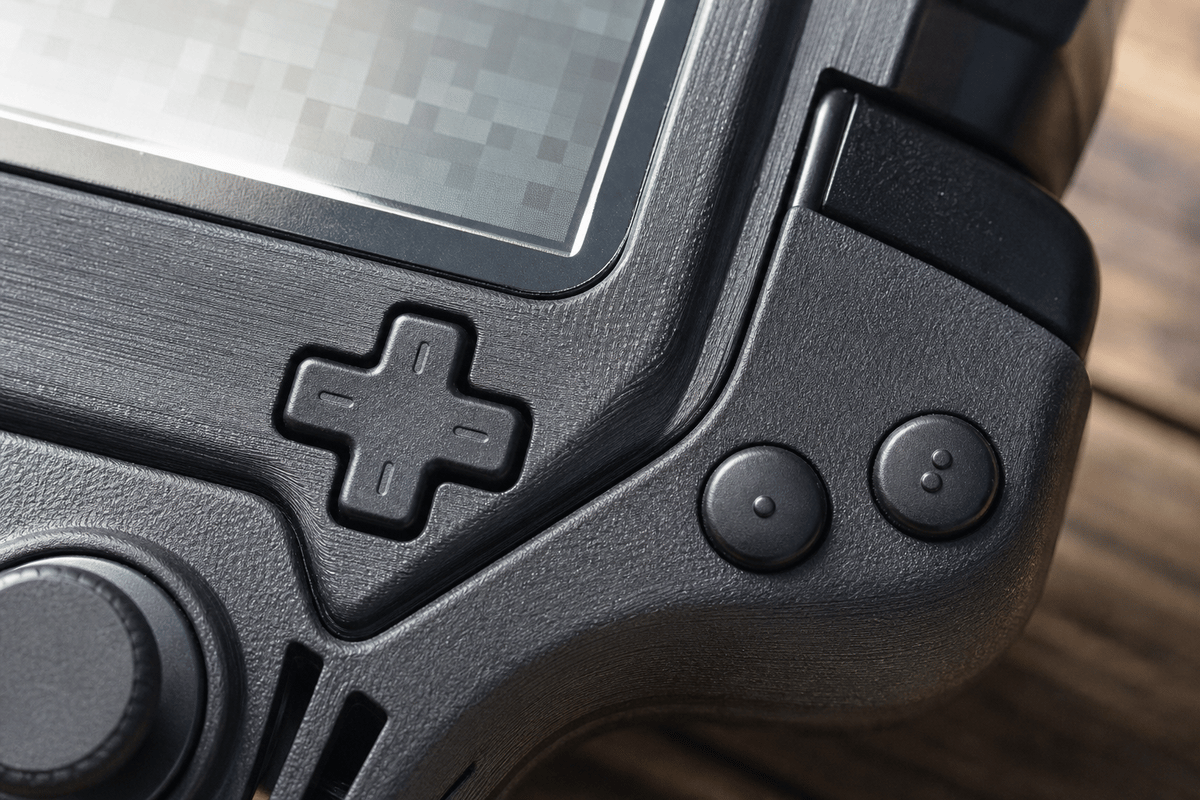
The finished form factor also has to remain usable. A vertical shell can place the D-pad and face buttons naturally, yet the Steam Deck’s sticks, trackpads, triggers, and other control hardware were designed for a wider grip. SteamBoy demonstrates that the parts can be physically condensed; long-term comfort and control spacing are separate design tests.
Replication Checklist: The Skills a SteamBoy-Style Build Requires
- A sacrificial Steam Deck LCD: the donor must be fully disassembled, and the project relies on reusing its original motherboard, battery, speakers, and controls.
- 3D CAD and printing capability: the shell needs precise internal mounts, ventilation, fan retention, battery support, button guides, and safe clearances around boards and cables.
- Micro-soldering and PCB adaptation experience: the custom AMOLED panel requires display-interface work rather than a direct plug-in connection.
- Firmware confidence: the display route may require BIOS modification before the panel can function correctly with Steam Deck hardware.
- Thermal validation tools: a small fan and heatsink need repeatable temperature testing after every major enclosure or fan-curve change.
- Patience for multiple enclosure revisions: board placement, fan ducts, button travel, battery fit, and shell thickness are linked variables rather than isolated tasks.
Where SteamBoy Succeeds — and Where the Build Remains Incomplete
✓ PROS
+
Genuine Steam Deck LCD hardware transplant
+
Compact 32 mm Game Boy-inspired vertical form factor
+
Retains original battery, speakers, controls, and native platform behavior
+
Practical thermal approach using a heatsink, 30 × 7 mm fan, and undervolting
✗ CONS
–
1200 × 1080 AMOLED display remains unfinished
–
Display integration requires adapter and firmware work
–
Cooling headroom is narrow at reported 70-80°C gaming temperatures
–
High-risk build requiring donor hardware, PCB skills, and repeated custom-case revisions
The strongest part of SteamBoy is the systems-level thinking behind it. It does not merely make a Steam Deck look retro. It attempts to keep the original handheld PC intact while changing its physical geometry almost completely. The compact fan assembly, vertical motherboard arrangement, retained battery, and targeted undervolt show the kind of compromises a small PC handheld actually demands.
The unfinished screen prevents it from being a ready replication project. Until the AMOLED panel has a validated adapter and firmware path, the build remains an advanced hardware blueprint with an unresolved core subsystem. A completed shell is meaningless if the display cannot reliably boot and operate through normal Steam Deck use.
Practical Takeaway
SteamBoy is worth studying for its mechanical layout and thermal strategy, particularly the use of a 30 × 7 mm fan, heatsink, and approximately -50 mV CPU/GPU undervolt to keep a Steam Deck-class PC within a 32 mm body. It is unsuitable as a first handheld modification. The sensible route for experienced modders is to validate display electronics and cooling performance outside the case, then design the final shell around proven components rather than forcing untested hardware into a finished Game Boy-shaped enclosure.
FinalBoss // Gear
Level up your setup
01Graphics cardson Amazon→02Gaming laptopson Amazon→03High-refresh gaming monitorson Amazon→04Discounted game keyson Kinguin→Affiliate links · As an Amazon Associate, FinalBoss earns from qualifying purchases.
Want to Level Up Your Gaming?
Get access to exclusive strategies, hidden tips, and pro-level insights that we don't share publicly.
Ultimate Tech Strategy Guide + Weekly Pro Tips