
Table of Contents (9)
My Weekend in Vegas With Strip Law
I went into Strip Law expecting yet another streaming cartoon chasing the Rick and Morty dragon. You know the type: loud, sweary, neon-soaked, desperate to convince you it is edgy. Two episodes in, sometime between a Vegas montage scored to Cleveland Rocks and a courtroom bit that spirals into a full-on existential meltdown, I realized I was watching something different.
Across one long weekend I tore through all 10 episodes of the first season, screeners on one monitor, notes on the other. By the time the credits rolled on the finale, it felt like my brain had been put through a slot machine and somehow paid out instead of seizing up. Strip Law is noisy and dense, absolutely, but it is also precise in a way most “anything goes” cartoons never are.
Showrunner Cullen Crawford (a veteran of The Late Show with Stephen Colbert) builds the whole thing around a deceptively simple idea: a straight-laced lawyer forced to practice in a version of Las Vegas that runs on spectacle instead of statute. That core keeps the show from flying apart even as it throws late ’90s and early 2000s pop culture, surreal visual gags, and viciously sharp satire into the mix at frightening speed.
Strip Law is not another Rick and Morty clone. It feels like the first adult animated comedy since that show’s debut that is genuinely carving out its own weird corner of the medium.
Key Takeaways
- Strip Law’s pilot lands with fully formed characters and dynamics from the first scene, avoiding the usual “shaky first season” problem.
- The humor is hyper-referential and extremely online, but those references always serve character and theme rather than cheap cutaway gags.
- Its Vegas is a surreal ecosystem of mascots, magicians, horny claymation icons, and deranged judges that recalls classic Adult Swim chaos with a tighter emotional core.
- The pace can be exhausting and will absolutely leave some viewers behind, especially anyone not steeped in late ’90s and early 2000s pop culture.
- If Rick and Morty felt like a sci-fi earthquake for adult animation, Strip Law feels like the legal-comedy aftershock that finally finds a new frequency.
The Premise: By-the-Book Lawyer Meets Weaponized Vegas Chaos
The anchor of Strip Law is Lincoln Gumb, played with weary precision by Adam Scott. Lincoln is the son of Vegas’ biggest celebrity lawyer, a woman whose face essentially functions as a billboard across the city. When she dies, her sleazy partner Steve Nichols, voiced by Keith David with the exact mix of gravitas and slime you are imagining, kicks Lincoln to the curb.
Lincoln is painfully by-the-book. He cares about precedent, procedure, and the actual written law in a city that treats television ads and spectacle as binding legal documents. In Crawford’s version of Vegas, the law is less a system and more a vibe. If your commercial jingle is catchy enough, the jury nods along. If your courtroom stunt trends, the judge shrugs and rules in your favor.
Enter Sheila Flambé, a street magician played by Janelle James, who sweeps into the show like a human glitch in the legal system. Sheila is all razzle-dazzle and hustle, equal parts washed-up illusionist and ruthless self-promoter. She understands Vegas, because she is Vegas: all surface, all show, and yet secretly way sharper than everyone expects.
Lincoln provides the legal spine, Sheila provides the flash, and the show builds an entire season on that friction. She wants billboards, viral clips, and courtroom tricks so outrageous they burn themselves into the collective consciousness. He wants to win because the case actually matters. Strip Law milks this tension constantly, and it works because their push-and-pull reads as recognizably human rather than just a setup for punchlines.
Backing them up is a small firm of instant standouts. Irene, Lincoln’s weight-lifting niece and investigator (Aimee Garcia), is the kind of character many shows need half a season to figure out; here she arrives with a clear drive, physicality, and game from minute one. Then there is Glem Blorchman, played by Stephen Root as the requisite disgusting old man of the office, a walking HR violation with just enough pathos peeking through his filth to keep him interesting.
From the jump, Strip Law knows who everyone is and what they want, and that clarity pays dividends once the show starts to really throw them into the fire.
Comedy at the Speed of Doomscrolling
The first thing that hits you is the pace. Strip Law moves like a cursed Twitter feed possessed by a late night writers’ room. Jokes, cutaway gags, visual bits, side characters wandering through frame, background signage packed with nonsense, all pile up in a way that feels less like watching 22 minutes of television and more like binging old Vine compilations in cartoon form.
Crucially, though, this is not Family Guy style reference salad. Strip Law absolutely loves its pop culture deep cuts, but it wields them with intent. That Cleveland Rocks montage in the pilot is not there simply so you can point at your screen and remember The Drew Carey Show. It establishes Vegas as a city that cannibalizes mid-range American nostalgia, and it tells you a lot about how Lincoln sees the place he grew up in.
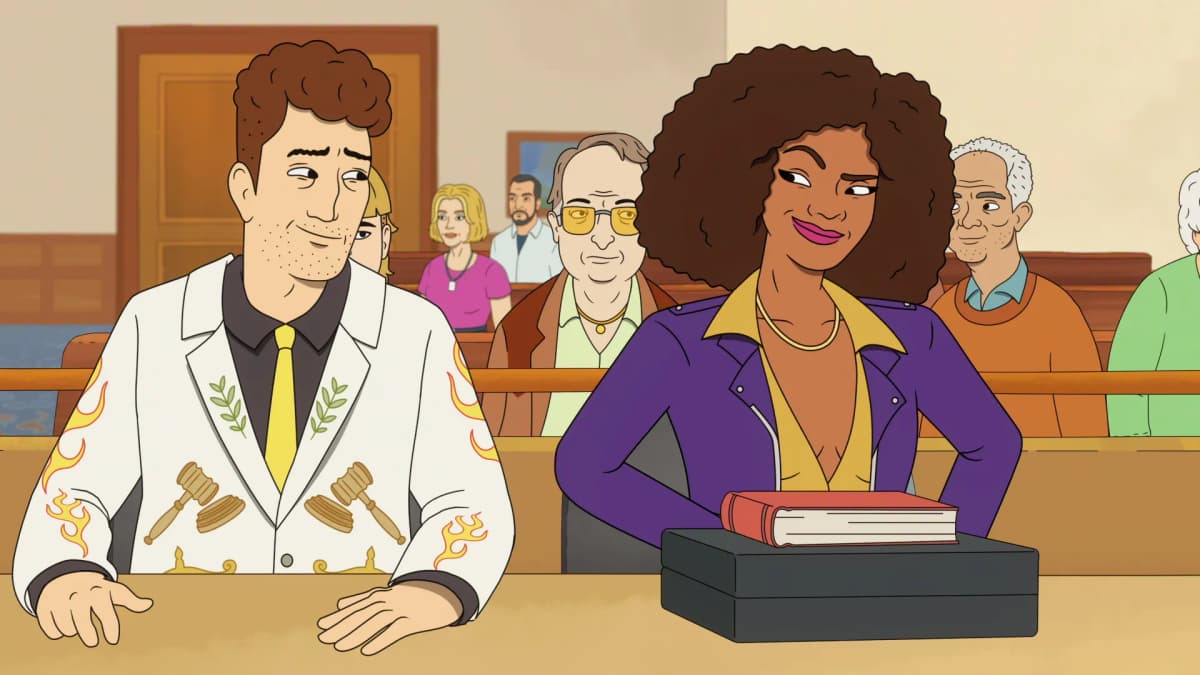
Crawford and the writers lean heavily into late ’90s and early 2000s ephemera. Old sitcom themes, defunct websites, the kind of advertising language that lived between cable TV and the early internet all get ground up into the show’s satire. If you grew up in that era, the show feels laser-targeted, like it crawled out of your rewired brain after too many nights doomscrolling.
One episode strands the entire firm in a mandatory virtual HR seminar run by a grotesque AI mashup of the Rat Pack, while the rest of Vegas tears itself apart outside over an update to a set of horny claymation mascots called the Hot Dates. It sounds like nonsense written on a dare, and in lesser hands it would be. Strip Law uses this setup to poke at corporate risk management, nostalgia reboots, and mob mentality, but never forgets that what really matters is how Lincoln and Sheila try to exploit or escape the situation.
The show is constantly playing this game. Big, wild conceits get introduced in seconds, built up just long enough for you to lock into them, then either subverted or smashed straight into another idea. On paper it sounds overwhelming, and at times it is. Binge-watching the season in two sittings, I occasionally had to hit pause just to let a sequence land before the next avalanche of jokes.
Still, I prefer this slight overload to the alternative. The worst sin for a comedy is dead air, and Strip Law never leaves a corner of the frame empty if there is any chance a gag can live there.
Characters First, Even When Everything Explodes
The big shared thread with Rick and Morty is not portal guns or sci-fi riffing; it is how quickly both shows establish their main pair and their emotional rules. Rick and Morty’s pilot tells you immediately that Rick will bulldoze everyone around him and that Morty will get dragged along, broken and learning. Strip Law does the same for Lincoln and Sheila.
Within the first episode you understand Lincoln’s insecurity about following in his mother’s footsteps, his irritation with Vegas’ disregard for the actual law, and why he still clings to that law anyway. You also grasp Sheila’s mix of opportunism and buried disappointment, the sense that Vegas promised her something and never fully delivered, so she turned herself into a one-woman show out of spite.
Because that groundwork is so firm, the show can get incredibly strange without losing you. An episode about mega churches and faith-based films in Vegas turns into a scathing critique of cynical religious entertainment and empty spectacle, complete with a deranged live-action trailer embedded inside the animation. Yet the heart of the story is Lincoln’s attempt to reconcile his own yearning for moral clarity with a city that sells salvation like bottle service.
Another case drags the team through a judge obsessed with collecting world records for most cases tried, turning the courtroom into a bureaucratic speedrun. On the surface, it is just a torrent of procedural jokes; underneath, it digs into how Lincoln’s obsession with doing things properly smashes against a system that rewards volume over justice.
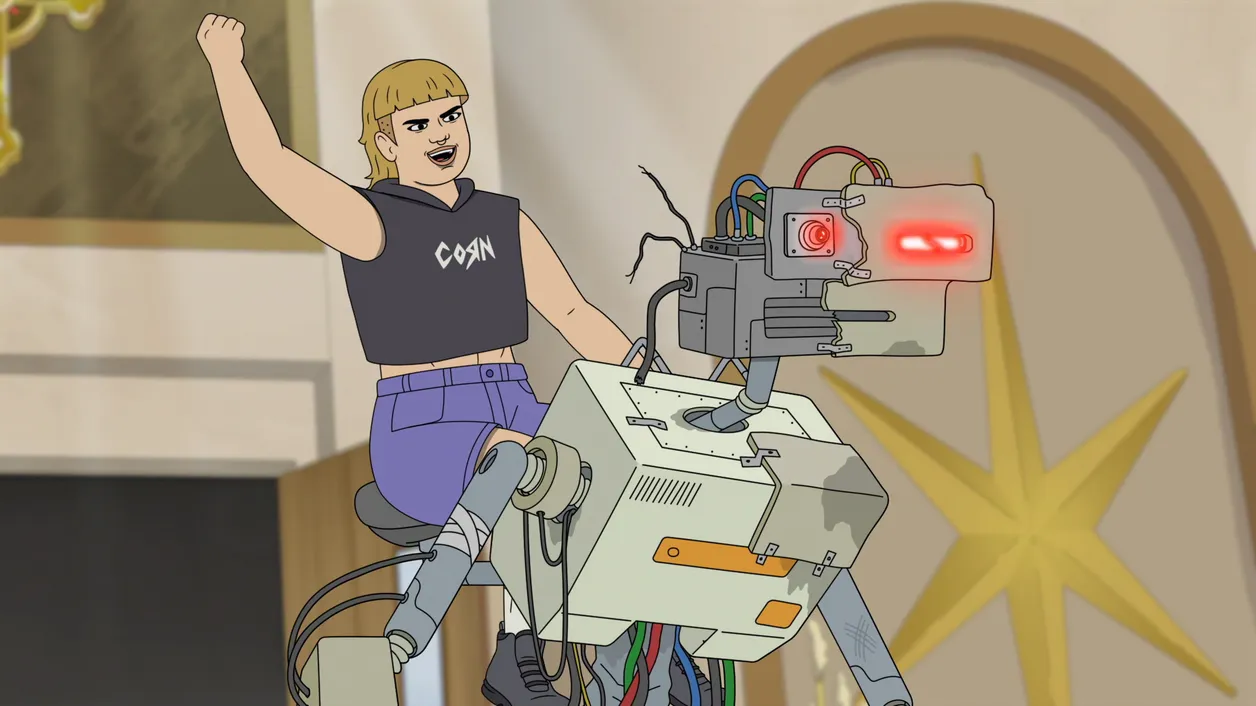
These episodes work because Strip Law never loses track of who is in the room and why they act the way they do. Even the side characters feel like they have interior lives. Irene’s intensity and dedication, Glem’s mix of creep and competence, recurring Vegas oddballs like a stripper named Lunch Meat or judges more invested in Halloween than sentencing, all of them feel specific in a way that suggests you could build a whole spinoff around most of them.
Visual Mayhem With Invisible Guardrails
Strip Law’s look lands somewhere between polished streaming cartoon and the looser, weirder vibe of classic Adult Swim, like Harvey Birdman: Attorney at Law collided with a Netflix budget. It is bright and lurid without ever quite tipping into pure eye-searing neon. Character designs are just exaggerated enough to sell the absurdity of the world but grounded enough to carry real expressions when the show slows down for an emotional beat.
What I appreciated most is how disciplined the visual chaos actually is. Backgrounds are full of signage jokes and sight gags, but the staging almost always keeps your eye on the story beat that matters. Compared to something like High on Life’s sequel in the game space, which sometimes drowns its own punchlines in clutter and noise, Strip Law feels tightly storyboarded, even when it pretends to be an unhinged mess.
There is an “anything goes” spirit that will immediately remind long-time animation fans of Space Ghost Coast to Coast or other early Adult Swim experiments, but there are clear, if invisible, guardrails. The show knows when to hold on a character reaction instead of cutting to yet another gag, and those pauses give heavier lines room to breathe.
From a pure craft perspective, this is the kind of show that rewards rewatching. On my second pass through the pilot, I noticed background bits that completely flew past me the first time: tiny visual motifs about Lincoln’s mother’s omnipresence in the city, signage that sets up later jokes, and small animation flourishes that define how Vegas bends around Lincoln and Sheila rather than the other way around.
Satire, Not Just Parody
Strip Law sits firmly on the satire side of the line. It does not just imitate pop culture; it uses it as raw material to say something about people and systems. When the show goes after religious entertainment, it does not merely recreate the look of those movies. It interrogates the hollow marketing behind them, the way they flatten complex beliefs into merchandisable slogans, and the damage that can do.
When it skewers Vegas stage shows or the cult of celebrity lawyers, it consistently ties those jokes back to Lincoln’s grief, Sheila’s hustler survival instincts, or the public’s addiction to sensation over substance. It is still often immature, gross, and gleefully juvenile, in the same way that early Rick and Morty or the most deranged High on Life bits can be, but the rage is aimed carefully.
Because of that, Strip Law avoids the trap many reference-heavy comedies fall into. It does not feel like a quiz about how many shows and ads you remember. It feels like the work of writers who have lived inside that media soup for decades and are finally coughing it back up into something pointed.
How It Stacks Up Against Rick and Morty and Adult Swim Royalty
Comparisons to Rick and Morty are inevitable. Both shows arrived in a landscape of tired adult cartoons and immediately felt sharper, louder, and more emotionally coherent than almost anything around them. Both slam together big genre ideas with very personal character work, and both are unafraid to stare directly at the emptiness under the jokes.
In practice, though, Strip Law feels closer in spirit to Harvey Birdman: Attorney at Law. The courtroom framing, the parade of freak clients, the way cases become excuses to deconstruct whole corners of pop culture, all echo that series. The difference is that Harvey Birdman mostly riffed on preexisting cartoon characters, while Strip Law invents its own ecosystem of mascots, celebrities, and Vegas grotesques to tear apart.
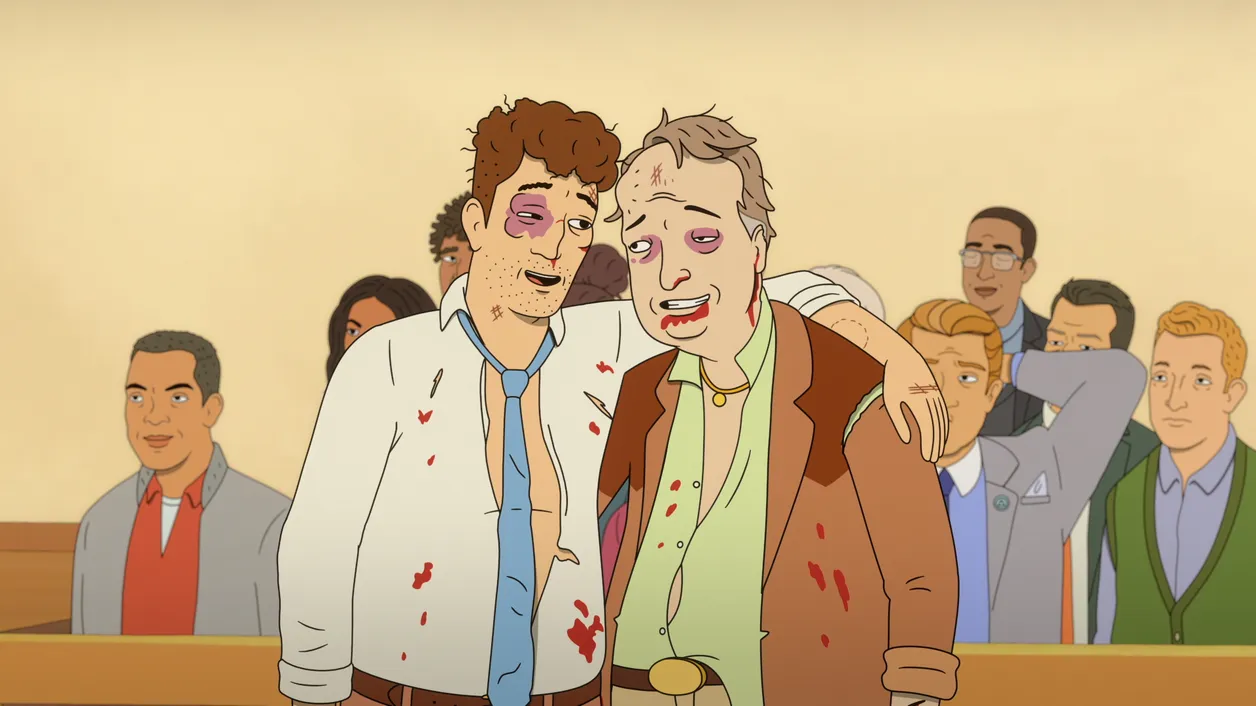
What makes Strip Law feel genuinely new is its tempo and its target. Rick and Morty is a sci-fi show at heart, interested in obsession, trauma, and the abyss under the multiverse. Strip Law turns its attention to commerce, advertising, and the way a city like Vegas grinds human desire into content. It is about how institutions and individuals sell themselves, and what gets lost in that transaction.
Within the broader adult animation landscape, it slots nicely next to the more unhinged corners of Adult Swim but with a more accessible Netflix sheen. It feels less like it expects a chemically altered audience at 2 a.m. and more like it expects you to be overstimulated by your phone all day and ready for a cartoon that mirrors that feeling.
Where Strip Law Stumbles
For all my enthusiasm, Strip Law is not a perfect ride. That whiplash pace that kept me glued to the screen also occasionally numbed me. During a straight binge, later episodes start to bleed together, especially when the show leans a little too hard into big concept over smaller, character-driven beats.
Viewers who are not tuned into late ’90s and early 2000s media are also going to miss chunks of the texture. The show still works without recognizing every reference, because the core character writing is strong, but there is no denying that some jokes land harder if you spent your formative years mainlining network sitcoms, early viral video culture, and cable infomercials.
There are also moments where the show’s willingness to go for the loudest possible gag undercuts its own emotional stakes. A particularly sharp scene about Lincoln facing his mother’s legacy will jump straight into a grotesque visual bit that, while funny, slightly blunts the impact. Rick and Morty learned over time when to let an episode end on a quiet, devastating note. Strip Law occasionally flinches away from that kind of stillness.
None of these issues torpedo the season, but they are the rough edges that keep it shy of instant-classic status for me.
FinalBoss // Gear
Level up your setup
01Top-rated gaming headsetson Amazon→02High-refresh gaming monitorson Amazon→03Gaming chairson Amazon→04Discounted game keyson Kinguin→Affiliate links · As an Amazon Associate, FinalBoss earns from qualifying purchases.
Want to Level Up Your Gaming?
Get access to exclusive strategies, hidden tips, and pro-level insights that we don't share publicly.
Ultimate TV Shows Strategy Guide + Weekly Pro Tips