
Table of Contents (7)
The Silence After the Upload
I was three hundred meters down in the Crimson Desert, my tank hissing at seventy-two percent, when I pulled the Sonic Resonator from my belt and aimed it at a wall of crystallized ore. The blast didn’t summon a leviathan. No shadow peeled off the seafloor to swallow me whole. Instead, the stone fractured into a glittering cascade, and beyond it lay an Alien Ruin so pristine it looked like it had been waiting specifically for me. That was the moment I understood Subnautica 2 was playing a different game than its predecessor-one less interested in making me scream and far more committed to making me wonder what the hell I was looking at.
This time, I am not a survivor clawing my way out of a starship’s wreckage. I am a consciousness, uploaded and piped into a synthetic body by Alinea Analytics, guided by an AI voice that sits in my helmet like a calm, intrusive thought. The premise sounds sterile when you read it on a loading screen, but beneath the waves it feels deeply personal and faintly sinister. When the AI marked those ruins on my HUD, I didn’t feel like I was checking off a quest log. I felt like I was being led somewhere I wasn’t supposed to go, which is exactly the kind of unease I want from this series.
Familiar Currents, Sharper Edges
Make no mistake: if you played the first Subnautica, you already know the rhythm of this sequel. I spent my opening hour grabbing titanium outcrops, repairing my scanner, and praying I had enough bladderfish-derived water to make it back to my lifepod. The core loop of exploration, survival crafting, and base building is intact, and Unknown Worlds saw no reason to fix what wasn’t broken. But after about four hours, the refinements started stacking up in ways that made the original feel slightly clumsy by comparison.
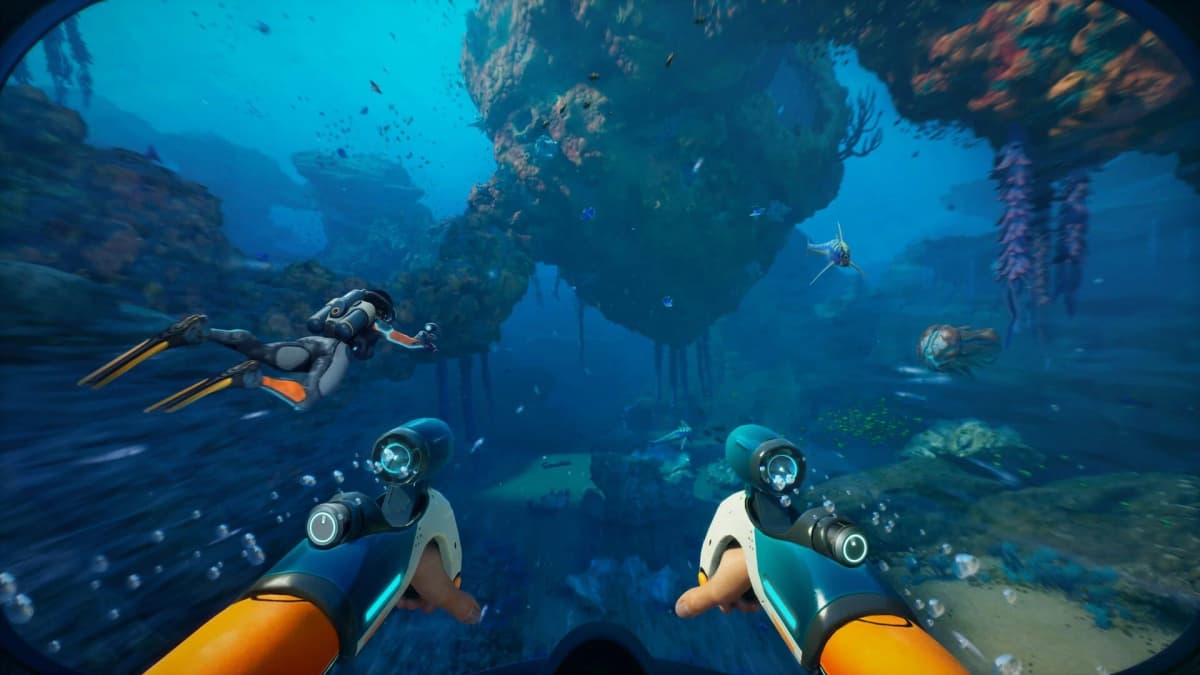
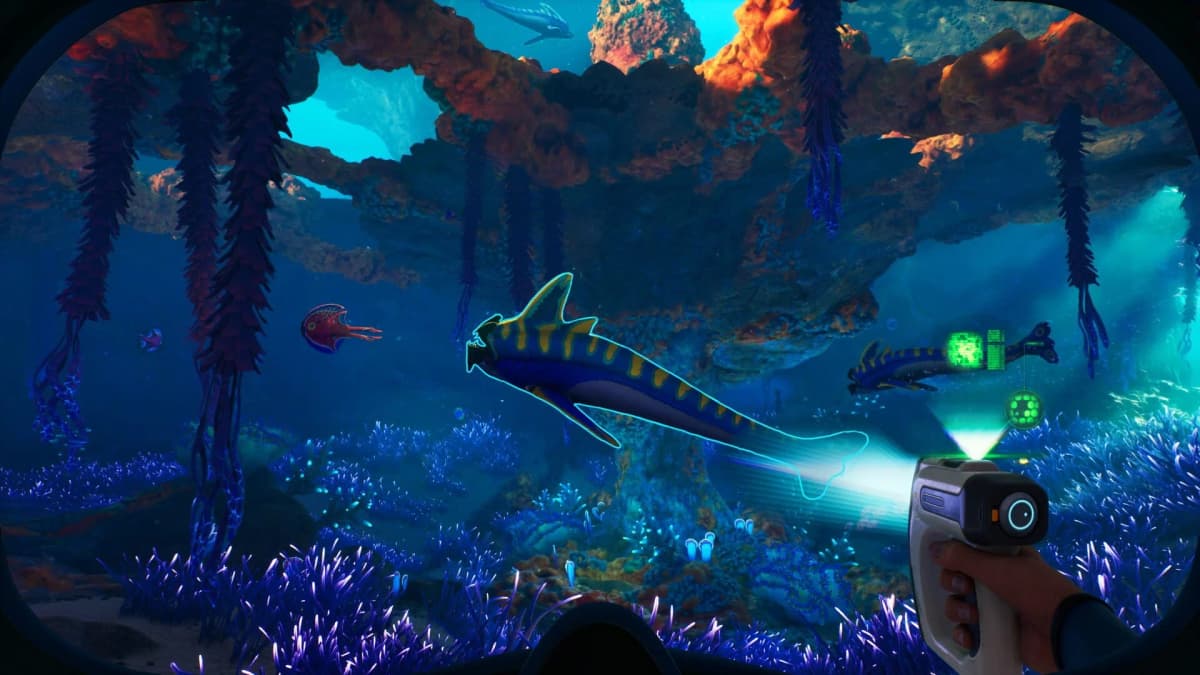
The graphical upgrade hit me immediately on PC. Light shafts cut through kelp forests with a density I could practically feel on my skin. Bioluminescence on deep-sea flora doesn’t just glow; it pulses with its own alien logic, turning the Crimson Desert into a cathedral of muted reds and violet shadows. Water physics around cave mouths actually push your body now, and the draw distance lets you see biome transitions from hundreds of meters out. I distinctly remember cresting a ridge and watching a field of Angel Combs sway in a distant thermal current, their translucent ridges catching light like living stained glass. I stopped to take it in and forgot to check my oxygen. That kind of environmental pull is rare.
Crafting itself remains tactile and satisfying, but the UI has been cleaned up with genuine care. Blueprint organization no longer feels like a scavenger hunt through nested tabs. Resource scanning is faster, and the fabrication animations have a heavier, more mechanical weight to them. Building a seamoth equivalent-sorry, I still call it that in my head-felt less like assembling a toy and more like bolting together a machine that could actually survive the pressure. These are small touches, but after twenty hours in the first game, the reduced friction is noticeable.
The Ghost in My Helmet
Where Subnautica 2 genuinely distances itself is in its narrative ambition. The current early-access build gave me roughly six to eight hours of structured story, and I finished that arc feeling like I had experienced something more cohesive than the original’s full release. The consciousness-upload premise isn’t just a sci-fi wrapper; it reshapes how information is delivered. Instead of stumbling across abandoned PDAs and piecing together tragedies after the fact, my Alinea Analytics handler fed me objectives that threaded directly into the environment. I wasn’t scavenging lore from corpses. I was the experiment, and the ocean was the laboratory.
The AI guidance could have been patronizing, but it toes a careful line. It gives you direction without suffocating your curiosity. I always knew where to head next for the main path, yet I repeatedly ignored the marker to chase strange acoustic signatures or map uncharted trenches. When I finally did follow the breadcrumb trail into the deeper Alien Ruins, the payoff landed harder because I had chosen to go there, not because the game had trapped me. That explicit mission structure is a massive leap forward. It respects your time while preserving the isolation that makes the franchise special.
There is a moment about four hours in where the AI goes quiet for a stretch, and the silence becomes its own character. I was descending through a thermocline into a dark basin, and the absence of that voice made me realize how much I had started relying on it. The game weaponizes comfort against you, and I loved that.
Construction Therapy
Base construction, in particular, feels more developed this time. Snap points are cleaner, power routing is more intuitive, and the new module variety had me redesigning my main habitat three separate times just because the tools finally matched the ambition of my architectural fantasies. I built a sprawling observation deck specifically to watch Angel Combs drift past the reinforced glass like living wind chimes, and for ten minutes I did absolutely nothing productive. That is the Subnautica magic intact.
I also appreciate that the game rewards verticality more than before. Multipurpose rooms stack with fewer headaches, and I actually used glass tunnels as transit rather than just aesthetic flourishes. My final base layout in this build had a production floor, a moonpool garage, and a top-deck greenhouse staring directly into the Crimson Desert’s craggy overhangs. It felt like a home, not just a storage closet with a bed.
Swimming With Strangers
I roped a friend into the co-op for a handful of sessions, and I need to be blunt about what we found. Cooperative play is present, functional, and welcome, but it is limited. Tethering another player to your session doesn’t turn the ocean into a shared sandbox playground. It feels more like a buddy system with a leash. We shared resources, built complementary base wings, and definitely yelled at each other when oxygen got low, but the infrastructure isn’t there yet for sprawling, independent multiplayer. If you are buying Subnautica 2 primarily to run a persistent underwater colony with three friends, temper those expectations now. For pairs who want to explore side-by-side and trade off piloting vehicles, it works. Don’t expect Sea of Thieves with subs.
Predators That Ignore You
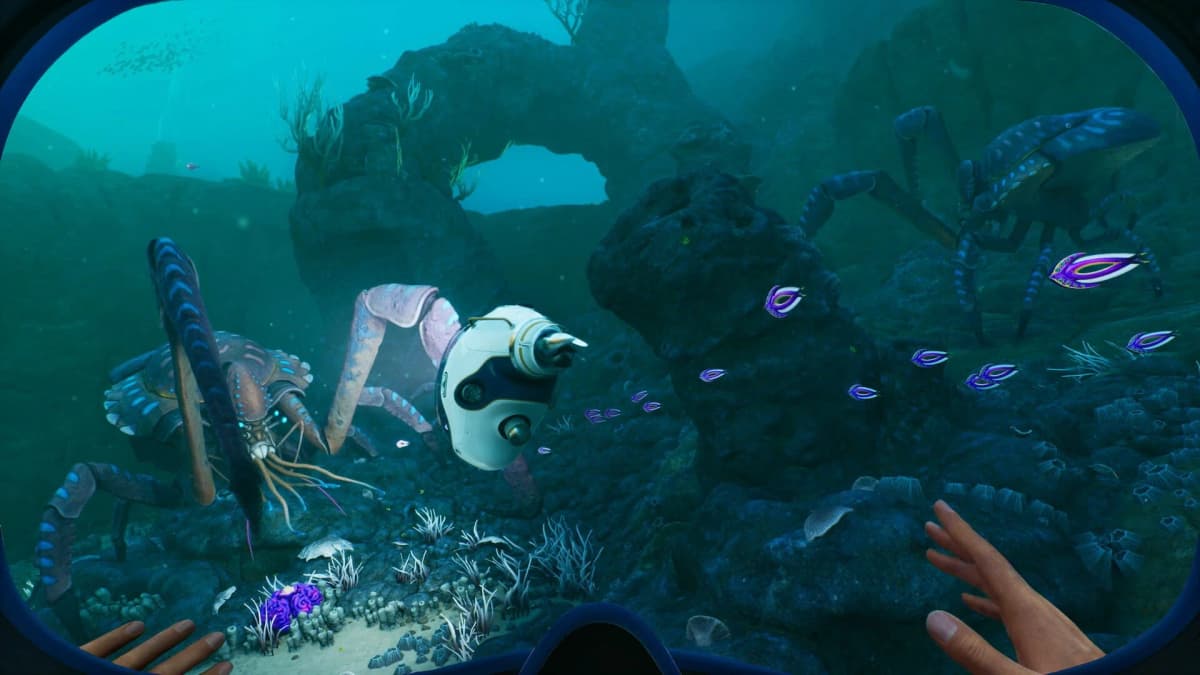
The most divisive choice Unknown Worlds has made in this early slice is dialing back the aggression of the fauna. I swam alongside creatures that, by all visual logic, should have bitten my face off. They didn’t. They watched me, or drifted past, or hunted smaller prey while treating me like a curious ghost. This fundamentally changes the survival tension. In the first Subnautica, every dive carried a low-grade panic. Here, the panic is replaced by something closer to awe.
I spent twenty minutes in a cave system observing a pack of mid-sized predators corral glowing plankton, and not once did they aggro on me. Later, I parked my vehicle on the lip of a trench and watched what I can only describe as a whale-shark hybrid glide overhead, its mouth wide enough to swallow a bus, and it simply didn’t care that I existed. For anyone who lived for the terror of the abyss, this tone is a betrayal. I understand that impulse. But in my hours with this build, the shift let me actually see the game. I remembered the architecture of biomes instead of just sprinting through them. I studied creature behavior because I wasn’t treating every shadow like a death sentence. The survival mechanics are still present—oxygen is still a merciless god, and depth crushes—but the hostility of the wildlife has been tuned to serve contemplative exploration rather than constant adrenaline. Right now, I find it refreshing, if a little safe.
The Early Access Ceiling
I have to address the oxygen tank in the room: this is an early-access release, and the story stops abruptly after that six-to-eight-hour arc. I reached the current endpoint and felt a familiar hollow thud, the kind that comes from reading a great novel with the last chapter torn out. The foundation is undeniably strong—the Sonic Resonator upgrades, the base-building depth, the visual fidelity, the narrative setup—but anyone jumping in today needs to know they are buying a polished vertical slice, not a complete meal. I rebuilt my main base three times and scoured every corner of the map for secrets, but when the screen simply told me I had reached the end of the current early-access content, I felt the absence of closure sharply.
The build itself is remarkably stable for early access. I encountered one physics bug where my vehicle clipped through a cave ceiling, and a single crash-to-desktop over eight hours. Compared to the jank I tolerate in other survival early-access launches, Subnautica 2 feels unusually respectful of your time.
FinalBoss // Gear
Level up your setup
01Top-rated gaming headsetson Amazon→02High-refresh gaming monitorson Amazon→03Gaming chairson Amazon→04Discounted game keyson Kinguin→
Affiliate links · As an Amazon Associate, FinalBoss earns from qualifying purchases.
Want to Level Up Your Gaming?
Get access to exclusive strategies, hidden tips, and pro-level insights that we don't share publicly.
Ultimate Reviews Strategy Guide + Weekly Pro Tips