
Table of Contents (10)
The night I realised Romeo is a Dead Man secretly turns into Resident Evil
I didn’t go into Romeo is a Dead Man looking for horror. I went in looking for Suda51 nonsense: neon blood sprays, bad decisions, stupidly cool swords, zombie weirdos, interdimensional melodrama, and at least one scene that would make me say “sure, why not?” out loud to my TV.
At the same time, I’d just started chewing through Resident Evil: Requiem. On one side of my brain: Capcom’s latest “serious” prestige horror, all immaculate over-the-shoulder framing and glistening gore. On the other: Grasshopper Manufacture’s loud, trash-chic action game where you literally absorb blood from enemies to power up stylish special attacks, summon zombie-like allies, and carve your way through arenas to noisy rock tracks.
So when Romeo is a Dead Man quietly snapped into being an unapologetic Resident Evil parody in the middle of a psych ward, I had to pause the game and laugh. Then, a bit later, I had to admit something uncomfortable:
This ridiculous, grotesque side trip inside a “brawler first, questions later” action game understood modern Resident Evil almost too well. Maybe a little too well.
From blood-drenched hack-and-slash to powerless meat in a hallway
For anyone who hasn’t touched it yet: Romeo is a Dead Man is primarily a stylish hack-and-slash. You juggle enemies, dash around arenas, and literally drink in the carnage – downed foes pump up your special gauge so you can trigger area-of-effect blasts, speed buffs, or other over-the-top moves. It’s loud, colourful, and aggressive in that very Suda way, bouncing between visual styles, VHS filters, comic panels, and surreal cutscenes like the game itself is on something.
That’s the baseline. Sword out, music blaring, waves of freaks running at you. It’s closer to a blood-drenched character action game than anything you’d call “survival horror”. Even the zombies – or the game’s bastardised, mascot-like versions of them – are more toys than threats most of the time. They’re something you weaponise, stack, exploit, not something you’re afraid of.
Then the psych ward chapter hits, and the game just rips all of that away in one move.
The camera, which usually sits pulled back to give you maximum information and stylish framing, suddenly snaps into that familiar modern Resi position: tight over-the-shoulder, just high enough that you’re aware of what you can’t see. Your movement slows. The bright, saturated palette drains into sickly institutional greens and washed-out fluorescents. And, crucially, your weapons are just gone.
No sword, no crowd control moves, no blood-fuelled supers. You’re dumped into an echoing corridor with nothing but a clumsy sprint and a camera that suddenly feels way too close to your back.
Sound design does most of the work from there. The soundtrack devolves into this low, uncomfortable hum, more like an electrical fault than music. Somewhere behind a wall, something metallic drags across the floor. An object falls in a room you can’t yet access. Every noise sounds like a threat you’re about to meet, not a set dressing.
For a while, there’s basically no combat. Just exploration, locked doors, bad lighting, and the pressure of knowing the game wouldn’t strip everything away unless it intended to make you suffer with it. It’s a direct, deliberate lift from Resident Evil’s playbook – the “you thought you were the hunter, but actually, you’ve been prey the whole time” manoeuvre – and it works almost embarrassingly well.
The invincible flesh monster in the hallway
Eventually, the game introduces the only real “enemy” in this section: a stitched-together flesh colossus that patrols the main corridor. It’s not a boss you fight. It’s more like a walking level hazard, a mutant Mr. X or Lady D analog that exists purely to remind you that you’re fragile now.
You can’t kill it. You can’t even really slow it down. All of those early-game lessons about aggression, about dashing into danger because your kit lets you brute-force through mistakes, are suddenly useless. You are forced into classic survival horror behaviour: listening for its footsteps, peeking around corners, memorising routes to hiding spots. You’re playing a Suda51 game like it’s a Resi 2 remake mod.
What keeps it from feeling like a half-hearted homage is that the thing is genuinely unnerving. It looks like someone sewed together every leftover enemy model and then left it to cook under bad hospital lighting. It trudges around with this awful weight to it, all meat and inevitability, and that’s the point: you’re not supposed to think about fighting it, you’re supposed to think about where you’ll be when it rounds the corner.

This is where the game proves it actually understands horror rhythm. The patrol loop is just long enough that you start to get cocky, darting between rooms or pushing your luck on a puzzle, and then it turns up behind you and the whole mood flips. Not subtle, but effective.
The corpse-face puzzle: grotesque, stupid, and exactly on brand
The real Suda energy kicks back in with the “puzzle” that anchors the ward: a set of corpses strapped to chairs, skullcaps removed, two metal rods jammed into their exposed brains. Next to each body is a photo of the person’s face when they were alive, a normal expression, frozen mid-life.
Your job, because of course it is, is to grab the analog sticks and prod those brain rods until the corpse’s facial muscles twist into something that roughly matches the cheerful photo on the table. Grimace, smile, whatever. You puppeteer the dead until they look alive again.
On paper, it’s juvenile. In practice, it’s both absolutely grotesque and kind of brilliant. Before I even understood what the game was asking me to do, I had that instinctive “oh, that’s nasty” reaction. Then, once the mechanic clicked, the horror tone just… dissolves into pitch-black slapstick.
And here’s the thing: that undercuts the fear, but it doesn’t ruin the section. It recontextualises it. The ward goes from being an earnest Resi riff to a commentary on how absurd these places are in games. The overused “creepy asylum” trope is literally turned into a toy box where you’re mashing dead people’s faces around to solve a lock.
It’s the same kind of tonal swerve Suda’s been doing for years – in No More Heroes when heartfelt speeches are interrupted by toilet humour, in Killer7 when political assassination is played like arthouse theatre. In Romeo is a Dead Man, horror isn’t sacred. It’s just one more prop he’s willing to break for a gag.
The dumbest jumpscare I’ve seen in years, and why it’s genius
Once the puzzle is solved and the monster has done its job of stressing you out, the section winds down. You walk the corridor. There’s some story. The audio design stays nasty, but the tension drains away. You know – by instinct, by gamer training – that the “scary bit” is basically over. You’re already mentally back in hack-and-slash mode, waiting to get your toys back.
That’s when the game hits you with what might be the most primitive jumpscare possible: an ugly green face slams onto the screen with a screech, like one of those ancient shock flash videos people used to prank each other with in 2003.
That’s when the game hits you with what might be the most primitive jumpscare possible: an ugly green face slams onto the screen with a screech, like one of those ancient shock flash videos people used to prank each other with in 2003.
🎮 Get This Game at the Best Price
Compare prices instantly and save up to 80% on Steam keys with Kinguin — trusted by 15+ million gamers worldwide.
*Affiliate link — supports our independent coverage at no extra cost to you
No buildup. No narrative tie-in. No clever twist. It’s not your dead lover, not the flesh monster lunging through the wall, not a lore flashback. It’s literally just a screamer.

I should have hated it. If a straight horror game pulled that stunt, I’d be rolling my eyes into the next dimension. But in Romeo is a Dead Man, right there, it landed harder than any elegant slow-burn scare because of how nakedly stupid it was.
What sold me was the timing. The devs intentionally waited until the atmosphere had peaked, then flattened out into boredom. They proved across the whole ward that they could wring tension the “proper” way – through lighting, audio, camera work, and that lumbering flesh tank. Then, at the exact moment you start thinking “okay, cool, we’re done here”, they deck you with a joke straight out of a cursed-chain-email era.
It’s trolling as design. It’s also a quiet flex: “we could do refined horror all the time, but we’re choosing not to, because it’s funnier to yank the rug while we’re already halfway out the door.” The psych ward plays like a fever dream capped with a punchline, and that punchline is there to jolt you back into the game’s true identity: this is not a horror title, this is a chaos title that borrowed horror for a bit and is now tossing it back in the box.
Playing this alongside Resident Evil Requiem was surreal
The wild part is how closely this parody accidentally lines up with Resident Evil: Requiem. Both games lean on a psychiatric facility. Both use over-the-shoulder framing, lurid medical imagery, and oppressive institutional layouts. Both love an invincible pursuer that turns exploration into cat-and-mouse.
The difference is intent. In Requiem, the clinic is a pillar of the narrative. It’s part of the marketing image: the latest meticulously tuned Resi experience, prestaged for spoiler podcasts and lore breakdown threads. In Romeo is a Dead Man, the ward is more like a band’s weird experimental track in the middle of an otherwise punchy album.
Sitting with both in the same week highlighted how safe mainline AAA horror has become in comparison. Requiem absolutely nails its craft, but it can’t afford to throw the tone completely off a cliff for a single throwaway gag. It has to live up to the franchise, satisfy fans, sustain the brand. It can be campy, but in a controlled, franchise-approved way.
Suda, on the other hand, can drop a thirty-to-sixty-minute survival horror detour into a game that’s otherwise about stylishly mulching enemies and summoning zombie minions like they’re gross Pokémon, then end that detour on the gaming equivalent of a whoopee cushion, and walk away. If it alienates some players, so be it. He’s never traded on consistency; he trades on audacity.
Playing them back-to-back made me realise how much I miss that in big-budget horror. The parts of classic Resident Evil that stuck with me were never the perfectly paced set pieces – it was the bizarre detours, the melodramatic monologues, the moments that felt like the dev team snuck a joke in after hours. Romeo is a Dead Man distils that spirit and exaggerates it, then points at it and laughs.
Horror works better as a spike when the rest of the game is loud
What really convinces me this section is more than a gag is how well it takes advantage of contrast. In a full horror game, you get used to the fear. You normalise corridors, slow walks, scarcity. The horror curve flattens. In an action game like Romeo is a Dead Man, tension is a rare event – which means when it arrives, it spikes hard.
When you’ve spent hours tearing through arenas at high speed, bathing in hit sparks and blood particles, the sudden removal of speed and power hits like a brick. It’s not just “now it’s spooky”; it’s “everything that made you strong is gone, good luck”. That’s why this single psych ward sticks in my memory more than some entire horror campaigns: it’s the one chunk where the game weaponises your learned confidence against you.
I’ve seen other genres flirt with this idea – the Library level in the original Halo, the sudden horror shifts in some JRPG dungeons, the haunted house detours in otherwise goofy platformers – but Romeo is a Dead Man leans into it with zero shame and a ton of personality. It doesn’t just toggle “spooky lighting” on; it reconfigures the whole control philosophy for that stretch.
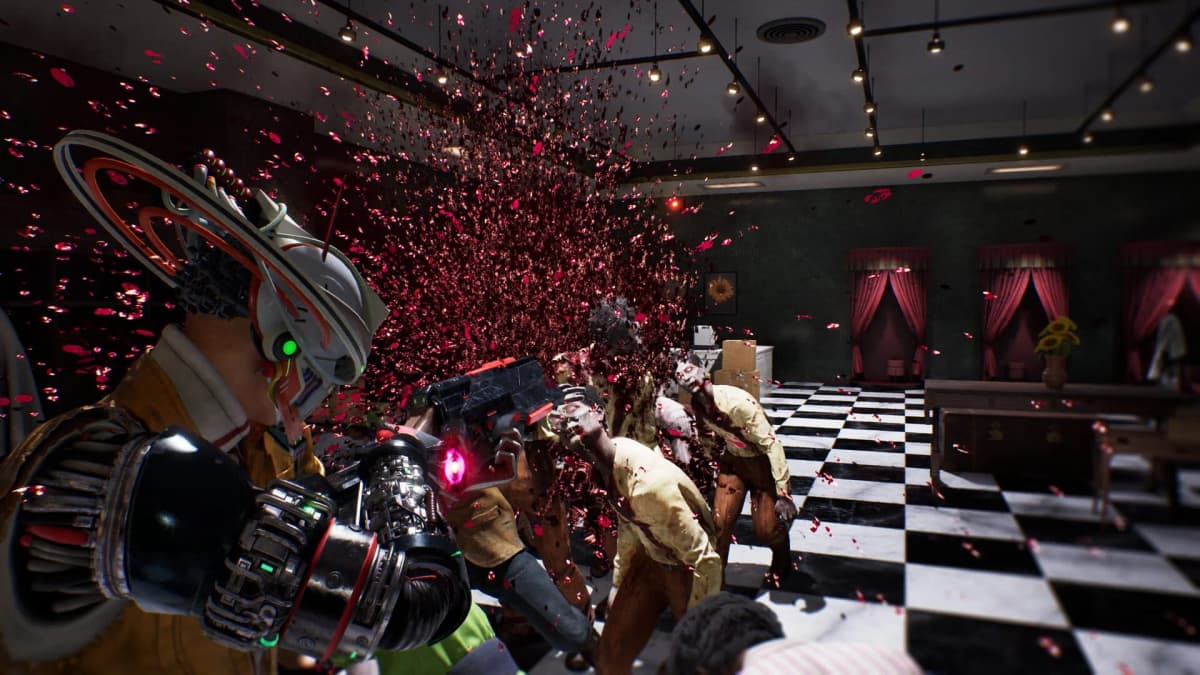
And then, crucially, it gives you your toys back. You don’t stay in survival horror land long enough for the mechanics to overstay their welcome. You survive the meat hallway, endure the screamer, crack a grim smile at the corpse puppetry, and you’re booted back into arenas full of enemies to carve up on PC, PlayStation, Xbox, or Switch like the whole thing was a nightmare Romeo had between combo strings.
Suda51’s chaos vs. genre labels
Suda’s work has always been allergic to tidy genre boxes, but Romeo is a Dead Man might be the purest expression of that “why not both, and also neither” philosophy. One chapter feels like a revenge sci-fi story, the next like a Twin Peaks fever dream, the next like you’ve wandered into a Hellraiser spin-off. The psych ward just happens to be the chapter where he borrows survival horror’s clothes for a while.
In an industry obsessed with categorising everything – “Is it roguelite or roguelike?”, “Is it immersive sim or just stealth?” – Romeo is a Dead Man throws a full Resident Evil-style sequence into what is ostensibly an action game and dares you to argue with the box art. Streamers jump from joking about their “zombie pets” in one scene to quietly sweating through a chase in the next, and it all still feels like one coherent, deranged universe because the authorial voice never changes.
That’s the piece I keep turning over in my head: the psych ward works not just because it’s well-executed horror, but because it’s unmistakably Romeo is a Dead Man horror. The grotesque puzzle, the throwaway screamer, the way the monster is threatening but also a bit pathetic – it all feeds back into the game’s central tone of “violent, sincere, and absurd, all at once.”
Genre boundaries don’t really survive contact with that kind of confidence. You can call it hack-and-slash, you can call it horror-adjacent, you can call it a Suda game and be done with it. The label matters less than the fact that, for one mid-game stretch, it quietly out-Resi’s Resi when it comes to capturing the series’ mix of tension, camp, and cruelty.
The Resident Evil game hiding inside Romeo is a Dead Man
After finishing both the psych ward and a big chunk of Resident Evil: Requiem, I kept thinking about which specific parts had actually lodged themselves in my brain. Requiem has the budget, the polish, the refined systems. Romeo is a Dead Man has jank, repetition, and an almost self-sabotaging desire to throw new mechanics at you whether you’re ready or not.
And yet, that single, self-contained ward sequence in Romeo sticks with me as strongly as entire acts of Requiem. Not because it’s better made – it isn’t, technically – but because it feels like someone who loves Resident Evil to death decided to put their own bootleg version in the middle of another game just to see if they could get away with it, then undercut it with the dumbest joke possible.
That’s what I’ve ended up valuing more as I get older: not the smoothest execution, but the sharpest identity. Requiem will inevitably get dissected to death, patched, speedrun, ranked against every prior entry. Romeo is a Dead Man will probably never be that big. But years from now, when someone mentions it, my brain is going straight back to that corridor, those corpses, that meat giant, and that idiotic green face screaming over my TV.
I don’t need every action game to pull a hard-left into survival horror. I don’t even think most studios could land it without feeling like they shipped two half-finished games taped together. But Romeo is a Dead Man proves that when a developer commits to the bit – when they’re willing to fully inhabit another genre for a moment and then tear it down – you can end up with something that says more about both genres than a safe, “pure” version ever would.
There’s a full-blown, deeply broken little Resident Evil living inside Romeo is a Dead Man, stitched between its hack-and-slash ribs. It shouldn’t work. It does. And it quietly embarrasses a lot of bigger, safer games by showing how far you can push horror when you’re not scared of looking ridiculous.
FinalBoss // Gear
Level up your setup
01Top-rated gaming headsetson Amazon→02High-refresh gaming monitorson Amazon→03Gaming chairson Amazon→04Discounted game keyson Kinguin→Affiliate links · As an Amazon Associate, FinalBoss earns from qualifying purchases.
Want to Level Up Your Gaming?
Get access to exclusive strategies, hidden tips, and pro-level insights that we don't share publicly.
Ultimate Gaming Strategy Guide + Weekly Pro Tips