
Table of Contents (9)
Belabel Park is the best Mario party I’ve had in years… and still the “wrong” DLC for Wonder
Super Mario Bros. Wonder did not need saving. On my Switch, it never really left rotation after 2023. It’s the game I throw on when family visits, when I’m sick of service games yelling at me, when I just want to remember why jumping on a Goomba still feels good in 2026.
So when Nintendo dropped Super Mario Bros. Wonder – Nintendo Switch 2 Edition + Vamos ao Parque Belabel, I wasn’t looking for a redemption arc. I was looking for an excuse to fall back into one of the best 2D platformers ever made… and maybe, just maybe, a fresh batch of levels to get lost in.
What I got instead is a fascinating split: a slick visual update that makes Wonder look the way it has always felt in my head, and an expansion that turns the game into a chaotic, inventive mini-game park. It’s joyous, it’s clever, it’s going to live at the center of a lot of family gatherings. But after a weekend on Switch 2, I couldn’t shake the sense that Nintendo gave Wonder more sides when what I really wanted was another main course.
Wonder in 2026: still the 2D king
Before touching Belabel Park, I forced myself to replay a chunk of the base game on Switch 2, just to see if the magic was still there or if nostalgia was doing the heavy lifting.
It’s not nostalgia. Wonder’s level design is still absurdly tight. You can feel the invisible grid of “Nintendo math” under every jump and enemy placement. There’s a reason seasoned designers have publicly gushed about how precise these stages are: almost every level feels like it’s been iterated on to death until there’s no fat left.
The thing that always strikes me isn’t the difficulty curve, it’s the mood curve. One level has you riding stampeding hippos like you’re in a playable GIF, the next is a stealthy Boo house that rewrites the rules for a couple of minutes, and then you’re suddenly in a musical setpiece where pipes and piranha plants behave like a rhythm game. It’s constantly playful without ever feeling random.
On my Switch 2, docked to a 4K TV, that playfulness lands harder. The art direction in Wonder was already strong enough to survive the original Switch’s softer image. Sharpen it, and you notice details you used to just “feel”: the tiny stretch in Mario’s face right before a sprint, the way background clouds subtly bob with the music, the clean edges on those gorgeous, chunky tilesets.
The important part: it still runs at 60fps, and in my time with it there were no obvious dips, even in the more chaotic Wonder Flower setpieces. Loading into levels is snappier, but this is an upgrade, not a remake. If you’re expecting some radical reimagining of the campaign, that’s not what this edition is. It’s Wonder, cleaned up and running like it always wanted to.
What the Switch 2 Edition actually changes
I played side-by-side: original Wonder on my launch Switch in handheld, and the new edition on Switch 2, docked and undocked.
Here’s what stood out in actual play, not spec-sheet talk:
- Sharper image, same art style: Levels look crisper, especially on big TVs. Backgrounds pop more, characters read more clearly in busy moments, but nothing about the look has been “modernized” in a way that breaks the aesthetic.
- Stabler feeling 60fps: Wonder was already very smooth, but the Switch 2 Edition feels more locked-in, even in four-player chaos or Wonder Flower sequences that spawn a million things onscreen.
- Faster in-and-out of action: Boot, level loads, retries – all a bit quicker. It’s the difference between “I’ll play one more” and “okay, one more
quick one.” - Co-op feels less muddy: With the sharper image, I had fewer “where the hell is my character?” moments when four of us were bouncing around as different Yoshis and Elephants.
If you already loved Wonder, the Switch 2 polish feels like a victory lap. If you bounced off it before, this isn’t going to change your mind by itself. That’s where Belabel Park comes in.
A day trip to Belabel Park
The new expansion is framed as a literal theme park bolted onto the Flower Kingdom. Once you clear the opening stage of Wonder, a new entry point opens on the overworld. On the original Switch it’s just another node; on Switch 2, the extra crispness makes the park’s signage and decorations feel like a proper attraction.
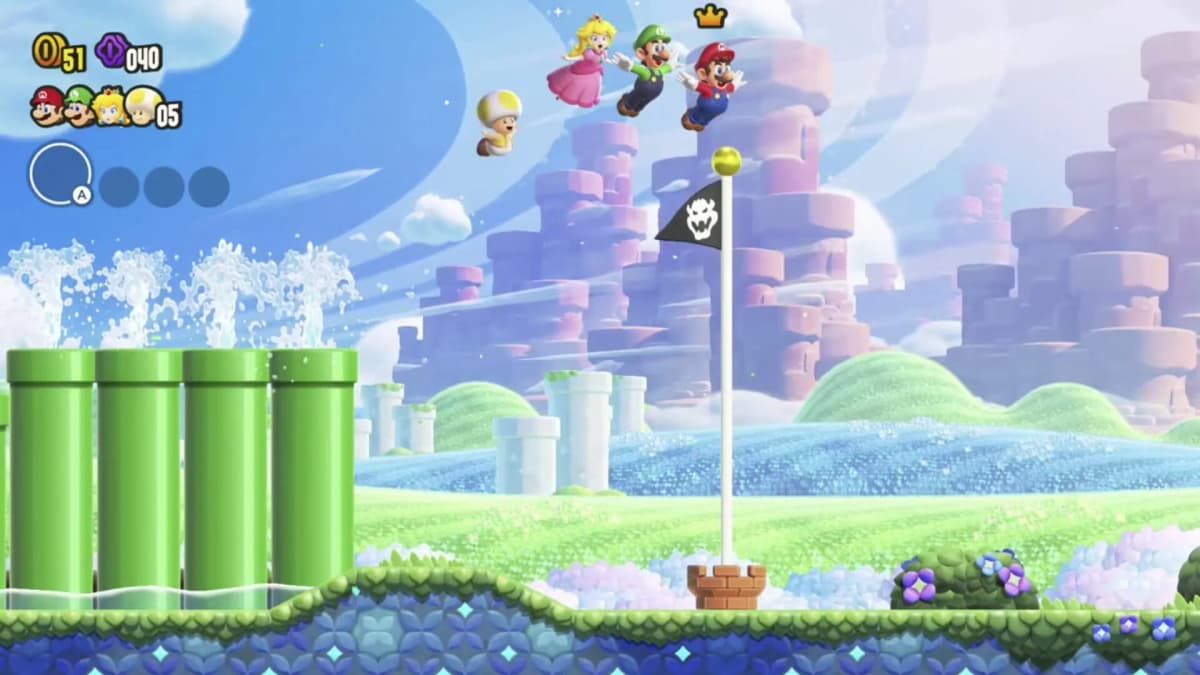
Inside, Belabel Park is broken into a few key areas:
- The Local Multiplayer Plaza – 17 attractions you can play with up to four players on a single console.
- Game Rooms – six larger-scale attractions for up to 12 players, but only online.
- Gincanas – essentially gauntlets, chaining mini-games in random order for score-chasing runs.
- The Camp Area – remix-style challenges layered onto existing campaign levels.
The smart thing Nintendo did here is build almost everything out of Wonder’s existing verbs. This isn’t a separate physics sandbox; it’s a playground built from blocks you already know. That means you can sit your non-gamer cousin down in front of it and, as long as they know “jump” and “run,” they’re in.
My first full night in Belabel Park was three people on one couch – me, an 8-year-old, and someone who mostly plays puzzle games. Within 10 minutes, they all understood the rules of the park: short rounds, quick failures, instant restarts, big laughs.
Local chaos: 17 attractions built for the couch
The Local Multiplayer Plaza is where Belabel Park justifies its existence.
The headline is “17 attractions,” but what matters is how many of them feel like they could stand alone as “one more round” games. A few highlights from our sessions:
- Hide-and-seek with Mario murder: One player hides, the others hunt. It starts cute and turns vicious faster than any Mario mode since stealing stars in classic Mario Party. One badly timed stomp and that fragile family truce is gone.
- Boo’s freeze-tag coin rush: Everyone scrambles for coins, but you have to freeze whenever a gigantic Boo “wakes up” and looks your way. Watching my nephew skid to a halt mid-air and plummet because he panicked at the last second was pure slapstick.
- Baby Yoshi feeding frenzy: You’re clutching a tiny Yoshi and racing to grab as much food as possible. It’s basically Mario’s answer to those fall guys “collect the stuff” modes, but with the added cruelty of being able to body-block each other at key jumps.
- Co-op bomb hauling: You and your friends need to escort a bomb to the goal without letting it fall or explode. It’s the kind of mode that turns normally calm players into shouty, arm-flailing backseat drivers.
The important thing: these aren’t throwaway micro-games. They feel tuned. The arenas are built with the same care as main stages, just repurposed for frantic scoring instead of calm exploration.
By the end of the night, Belabel Park had quietly shifted what Wonder was in my living room. It used to be “let’s beat a few levels together.” Now it’s “let’s jump into the park and see who survives Hide-and-Seek without a grudge.” The base game is the journey; Belabel is the drop-in destination.
Online-only FOMO: the 12-player Game Rooms
Then there are the Game Rooms: up to 12 players, six attractions, online only.
This is where my feelings get messier. On paper, these are some of the best ideas in the whole park – bigger arenas, more chaos, more bodies flying everywhere. In practice, your enjoyment lives and dies by Nintendo’s online ecosystem and your tolerance for matchmaking roulette.
I had a couple of great sessions: twelve tiny Marios racing through obstacle courses, scrambling for a single power-up, people failing jumps in perfect comedy timing while usernames popped in and out. Lag was present but manageable – the core platforming still felt responsive enough that missed jumps felt like my fault, not the network’s.

The problem is simply this: some of these modes are good enough that it hurts they’re locked to online. There were two mini-games in particular – a frantic platform control tug-of-war and a race where the ground literally drops out under the worst performers – that my couch crew immediately wanted to play locally. You can’t.
If you already pay for online and have a decent connection, the Game Rooms are a fantastic bonus, and they give Wonder a weird little “party-game MMO lobby” energy I didn’t expect. If you play mostly offline or in a family setting without online subs for every console, you’re going to feel like you’re staring at the best rides in the park through a fence.
Rosalina and Luma: Wonder’s new safety net
Alongside the park, the other headline addition is Rosalina and Luma as assist-style options for the main game.
Functionally, they sit in that same design space as Yoshi and Nabbit have in recent Mario games: characters that make the experience gentler without totally automating it. In my household, Rosalina quickly became the go-to for the least experienced player, with Luma functioning like an extra layer of forgiveness for mistakes that would normally mean instant death or a heavy setback.
What I appreciate is that it doesn’t feel like a “baby mode” stuck in from a settings menu. Rosalina and Luma fit the world, they animate beautifully, and they let Nintendo quietly widen Wonder’s accessibility. Watching a younger player survive sections that used to be absolute brick walls for them because they had that extra bit of support was more exciting than any frame-rate graph.
For solo veterans, Rosalina is mostly a novelty unless you really love her as a character. For mixed-skill groups, though, she’s a small change that unlocks the game for people who were previously just along for the ride.
The hole in the middle: where are the new levels?
Here’s the sticking point that never left my brain while I was loving Belabel Park:
All of this creativity is built on top of a campaign that hasn’t actually grown.
The Camp Area throws new challenges into existing stages, and replaying them with Rosalina and Luma gives you a slightly different flavor of the same greatness. But at the end of a long session, I realized I was still running the same routes I’d been running since 2023.
Mario has been here before. New Super Luigi U took the New Super Mario Bros. U template and flipped it into a full alternate campaign. Super Mario Odyssey never got a giant paid expansion, just the Balloon World side mode. Belabel Park feels spiritually closer to Balloon World: a smart, playful extension that plays with what’s there, rather than building something new on top.
The problem is that Wonder is so good it creates its own hunger. Running through Belabel’s mini-games kept reminding me how much I’d kill for a “World 8.5” or some totally new Wonder Flower concepts. By the time I hit the end of the Gincanas and looped back through favorite attractions, I felt a bit like someone standing in front of a perfect cake, being offered more and more frosting.

I don’t want to undersell what’s here: the amount of mini-game content is generous, and a lot of it is strong enough to live in its own spin-off. But if you’re coming back to Wonder hoping for a new map full of mystery levels, that’s not this expansion’s pitch.
Performance, polish, and who this is really for
Across both my original Switch and Switch 2 play, Belabel Park ran as smoothly as the base game. Four-player local was chaos in the good way, not the technical way. Inputs feel instant, hitboxes are predictable, and I never had a moment where I blamed the hardware for a loss.
On Switch 2 specifically, the advantages compound in multiplayer: the sharper image makes it far easier to track your character when twelve people are bouncing around online, and shorter loads mean failed Gincanas turn into rapid rematches without dead air.
Who actually gets the most out of this package?
- Families and local co-op players: Huge winners. Belabel Park might quietly become the go-to Mario experience for mixed-skill groups because of how fast, forgiving, and silly the attractions are.
- Online-focused players: If you’re willing to dive into the Game Rooms and you already pay for online, the 12-player chaos gives Wonder a replayable hook beyond just re-running worlds for 100% completion.
- Solo platforming diehards: You’ll appreciate Rosalina and the Switch 2 upgrade, but the lack of new campaign levels means this is more “deluxe definitive edition” than “essential second chapter.”
FinalBoss // Gear
Level up your setup
01Best-selling Switch 2 gameson Amazon→02Switch 2 accessorieson Amazon→038BitDo controllerson Amazon→04Discounted game keyson Kinguin→Affiliate links · As an Amazon Associate, FinalBoss earns from qualifying purchases.
Want to Level Up Your Gaming?
Get access to exclusive strategies, hidden tips, and pro-level insights that we don't share publicly.
Ultimate Reviews Strategy Guide + Weekly Pro Tips