

Table of Contents (8)
The Working Pipeline Order for Every DLC Fluid
The reliable build order in The Alters: Last Variable is simple: establish an Extractor on a valid geyser, run one short processing line for Phased Rapidium, then extend that same infrastructure as Proxylium and Mega Fluid unlock. The important part is placement. An Extractor only works when it is built directly on a fountain-like geyser slot inside a marked Rapidium or Mineral extraction zone.
Raw Rapidium leaves the Extractor as a liquid, while Mineral deposits produce a slurry or stream through pipes. For the DLC’s rare-fluid chains, the Extractor is the fixed starting point; Phasers, Mixers, a Doubler, and storage tanks are the pieces that change as production advances.
Specifications
Start With the Extractor, Not the Processing Buildings
A marked resource zone tells you where the deposit is, but the geyser slot determines where the Extractor can go. Build the Extractor directly on one of those visible steam-fountain points before placing the rest of the line. Dropping processors first tends to create the exact kind of messy pipe layout that has to be torn up once the real extraction point is located.
From the Extractor, link a pipe to the input of the first processing building. Each processor’s output feeds the next processor’s input, and the final output feeds an allocated storage tank back at the home base. Think of the tank as the finish line for that material. A line with no valid final storage is an unfinished production chain, no matter how many expensive buildings are sitting along the route.
The cleanest practical layout keeps the Extractor nearest the geyser, places processors in their required order, and leaves enough room to add modules on the end of the line. That spare space matters once Mega Fluid enters the picture, because its chain needs a Doubler plus a second Phaser and a second Mixer.
Phase One: Phased Rapidium
Phased Rapidium is the first fluid-production target and the foundation for everything that follows. The chain is:
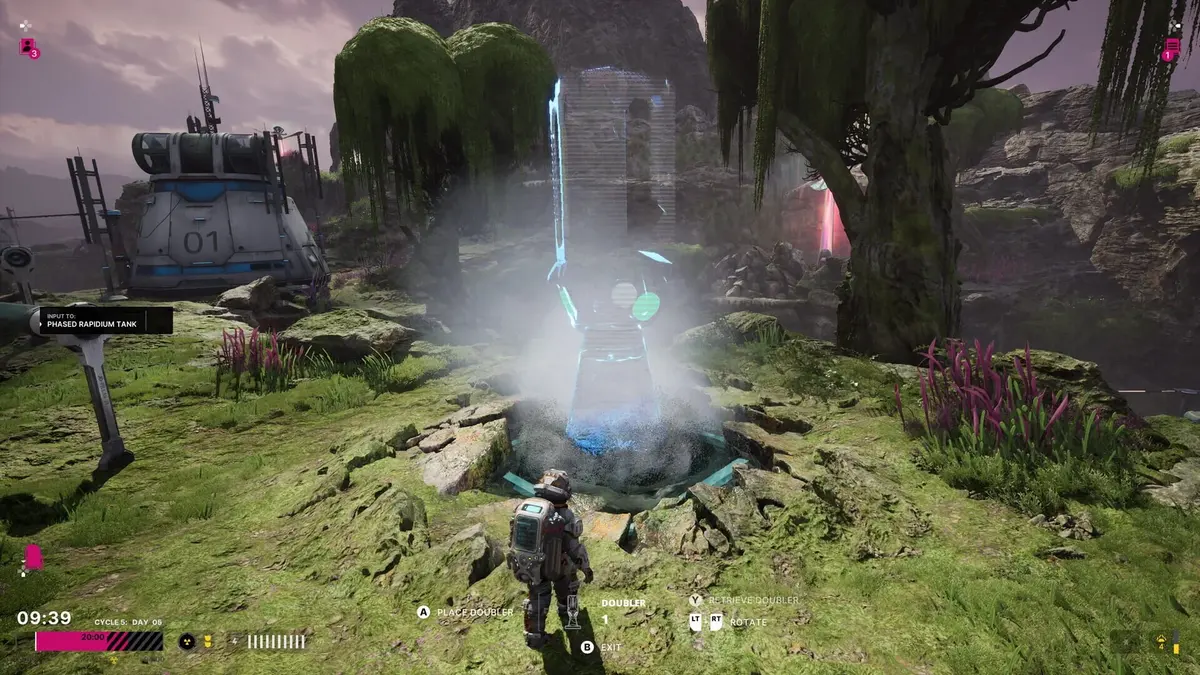
- Build an Extractor on a geyser slot in a Rapidium extraction zone.
- Run a pipe from the Extractor to a Phaser.
- Connect the Phaser’s output to an allocated storage tank.
Keep this first run compact. The Phaser is the first conversion step, so it belongs immediately after extraction. There is no value in stretching a long pipe across the surface before the initial line is proven and storage is assigned.
Phase Two: Proxylium Adds a Mixer
Proxylium becomes available only after the Field Lab finishes another sleep cycle. That timing matters because the field infrastructure can be ready before the material itself is unlocked. Leave room beside or after the Phaser rather than treating the Phased Rapidium build as a finished, permanent shape.
The Proxylium route adds one building to the established chain:
- Extractor → Phaser → Mixer → Proxylium storage
The Mixer belongs after the Phaser. Run the Phaser output into the Mixer, then pipe the Mixer’s output to the tank allocated for Proxylium. This is where a staged layout pays off: the Extractor and first Phaser remain useful, while the new Mixer extends the system instead of replacing it.
Field Lab research normally takes 10 hours. Assigning the Chemist cuts that to 6 hours and 15 minutes; that specific research-speed reduction belongs to the Chemist alone. The DLC eventually provides the Physicist, Geologist, Chemist, and Biologist at the same time, which makes it easier to keep the lab moving without abandoning the rest of the base’s workload.

Phase Three: Mega Fluid Needs the Full Chain
Mega Fluid is where the pipeline stops being a short conversion run and becomes a proper processing line. Its production requires the existing extraction and conversion infrastructure, then adds a Doubler, a second Phaser, a second Mixer, and a dedicated Mega Fluid storage tank.
The full connection order is:
- Extractor → first Phaser → first Mixer → Doubler → second Phaser → second Mixer → Mega Fluid storage tank
Build outward from the existing Proxylium line. The Doubler sits after the first Mixer, followed by the second Phaser and second Mixer. Finish with the Mega Fluid tank. Placing the additional processors in this order keeps the sequence readable at a glance and prevents a pipe network from becoming an opaque knot of identical links.
Build Where the Pipeline Can Survive Cryosleep
Terraforming changes the value of a build location. Structures inside a terraformed area survive the transition to the next cycle. Structures left outside terraformed ground are destroyed unless they are collected before cryosleep. A long rare-resource line is exactly the sort of construction worth anchoring in protected terrain, particularly once it includes duplicate Phasers and Mixers.
Cryosleep itself requires the cryochamber, a base kept in good condition, and enough organics. Plan the pipeline around that transition rather than assuming surface infrastructure can be ignored between cycles. The first cycle lasts 14 days, while later cycles can bottom out at roughly six to seven days, so a system that survives intact saves meaningful rebuild time.
FinalBoss // Gear
Level up your setup
01Top-rated gaming headsetson Amazon→02High-refresh gaming monitorson Amazon→03Gaming chairson Amazon→04Discounted game keyson Kinguin→
Affiliate links · As an Amazon Associate, FinalBoss earns from qualifying purchases.
Want to Level Up Your Gaming?
Get access to exclusive strategies, hidden tips, and pro-level insights that we don't share publicly.
Ultimate Tech Strategy Guide + Weekly Pro Tips