
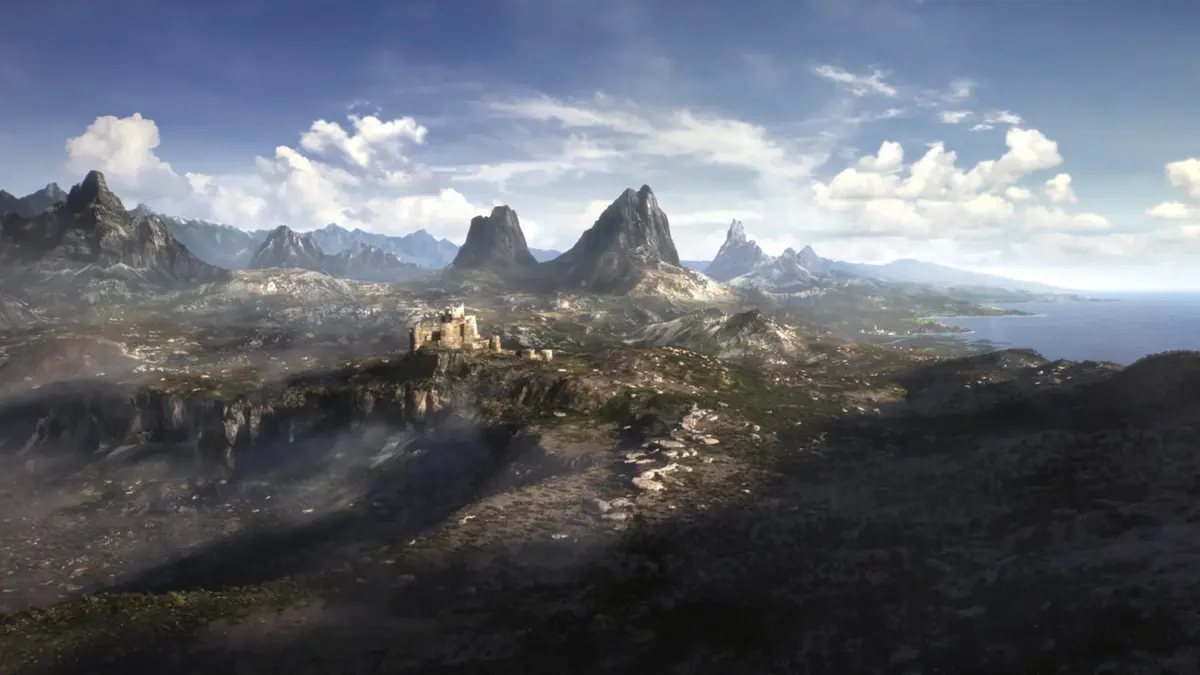
An internal live playthrough of The Elder Scrolls VI at Bethesda Game Studios should have been uncomplicated good news. It confirmed that a playable build exists inside the Rockville, Maryland studio, even with no public trailer, release date, or platform details attached. Instead, that encouraging detail landed beside hundreds of red flags outside the same office, a giant inflatable rat named Scabby, and workers protesting the latest Xbox cuts while Xbox CEO Asha Sharma visited.
Those two images belong together. Bethesda is making progress on The Elder Scrolls VI. Bethesda is also dealing with a workforce that sees recurring layoffs as part of life under Microsoft. I refuse to pretend the first fact cancels out the second. A game can be playable internally while the team responsible for polishing, testing, revising, and finishing it is being asked to work through another round of instability.
That makes the “Save Our Devs” protests more than a labor story for people who only follow industry headlines. They are a player story. The Elder Scrolls VI has become the clearest test of whether Microsoft’s ownership can give Bethesda the stability needed to finish an enormous role-playing game properly, or whether it will keep cutting into the institutional memory that games of this scale depend on.
Table of Contents (5)
Scabby Is Theater, but the Numbers Are the Indictment
The giant inflatable rat outside Bethesda’s Rockville office was deliberately loud. Scabby is a traditional union symbol aimed at scab labor and at employers perceived to be undermining collective action. It was built for photographs, which is exactly why it worked. Microsoft and Xbox leadership could not walk into Bethesda to inspect The Elder Scrolls VI without seeing a physical reminder that workers were being cut while the company’s biggest future project remained unfinished.
The visuals would be easy to dismiss as protest-pageantry if the underlying numbers were small. They are not. Microsoft announced roughly 3,200 Xbox job eliminations on July 6, 2026. Around 440 affected roles were tied to union-represented workers across Bethesda Game Studios, ZeniMax Online Studios, id Software, ZeniMax Workers United QA, and ZeniMax corporate. This was described as the fifth round of mass layoffs at Xbox in three years.
That is the part Microsoft cannot smooth over with a polished internal build or a carefully staged executive visit. A fifth mass layoff round in three years is a management pattern. Calling it “business reality” does not make the human and creative damage disappear. It means staff have to decide whether the studio they committed their careers to will still have a place for them when the next spreadsheet lands.
OneBGS and the Communications Workers of America made the point in the most direct way possible: they raised red flags outside Bethesda, using them to represent Xbox employees laid off under Sharma’s leadership. Nathan Hahn, a OneBGS-CWA member, said the action was intended to force leadership to confront the human cost behind mass cuts affecting developers and testers. Hahn also said management stopped workers from placing protest posters so they faced outward from office cubicles. That small detail says plenty. The company could restrict the view from inside the building. It could not stop workers from bringing the issue to the street.

“Yearly Layoffs” Is a Union Charge, but Instability Is Already a Fact
Bethesda workers have framed the Microsoft era as a shift from a “no-layoff culture” to a yearly tradition of cuts following Microsoft’s 2021 acquisition of ZeniMax. The exact calendar rhythm matters less to me than the lived reality behind that phrase. Workers are describing an environment where layoffs have become expected often enough that they organize multi-city demonstrations around them. That is a culture change, whether the cuts arrive on the same month every year or not.
Alex Nguyen, a Bethesda artist, put the cost in terms that should make any player uneasy. Nguyen said layoffs began after Bethesda came under Microsoft and became “yearly layoffs.” More importantly, Nguyen explained what vanishes when a handful of experienced people leave: sometimes only five workers know why a system functions the way it does, how a stubborn pipeline was fixed, or which compromise prevented a larger problem six months ago. Remove those people, and the org chart may still look healthy. The game team is poorer where it counts.
That is why I have little patience for the usual headcount defense. A corporation can hire replacements. It cannot instantly replace trust between departments, a tester’s memory of a recurring issue, an artist’s understanding of a legacy workflow, or the confidence that years of work will not be rewarded with a termination notice. Teams building games carry their history in people, not in a staffing spreadsheet.
Nguyen also pointed to Fallout 76 and The Elder Scrolls Online as examples of games that needed sufficient labor and time to reach successful places. That should be obvious, yet Xbox’s treatment of its studios keeps acting as if scale is optional. Games recover, expand, and improve because people stay around long enough to learn the work, own the problems, and keep pushing after launch. Layoffs turn that patience into a luxury.
The Elder Scrolls VI Has No Room for Disposable Expertise
No public release window has been announced for The Elder Scrolls VI. Bethesda has not shown public gameplay. There is no confirmed feature list, launch-platform breakdown, edition structure, or technical target for Xbox and PC players to judge. The internal playthrough proves development is moving; it does not tell us how far the game is from a public reveal, let alone release.
No delay, feature reduction, or platform change has been announced. That limits what can be claimed today; it does not erase the production risk. The July cuts touched ZeniMax Workers United QA, and quality assurance continuity is the most immediate player-facing concern. QA is where a large, complicated game gets tested repeatedly across changing builds, where regressions are caught before they become launch-day disasters, and where a team builds the accumulated knowledge required to distinguish an odd edge case from a broken system.
I am not predicting that The Elder Scrolls VI will launch broken. That would be cheap speculation dressed up as concern. I am saying the conditions that help prevent a rough launch — stable staffing, retained expertise, healthy morale, and enough time for iteration — are being placed under pressure. Anyone who cares about the game should treat that as a serious warning rather than an abstract workplace dispute.
The Elder Scrolls VI is also too important to be managed as a proof-of-concept for Microsoft’s cost-cutting discipline. Bethesda has been given years to make it. Players have spent those years waiting for evidence that the studio can deliver its next major single-player world at the quality level the name demands. If Microsoft turns the final stretch into a cycle of cuts, reshuffling, and morale damage, it will be gambling with the one resource a project this large cannot rapidly rebuild: experienced people who know how to finish it.
Players Should Watch Output, Not Executive Optics
The “Save Our Devs” campaign has already moved beyond one afternoon outside Rockville. OneBGS organized protests in Rockville, Austin, Dallas, and Montreal on July 15. On August 18, the campaign expanded across nine cities in the United States and Canada: Irvine, Austin, Dallas, Seattle, Albany, Rockville, Hunt Valley, Montreal, and Minneapolis. The movement also reached Twitch, turning a local workplace dispute into a public argument about what Microsoft’s ownership is doing to the people making its games.
Still, Scabby and red flags cannot tell players whether The Elder Scrolls VI is healthy. The useful test is what happens next. Players should look for concrete production signals rather than settle for executive reassurance or panic over every protest image.
- A real public milestone: an official gameplay trailer, a dated showcase, a public hands-on demonstration, or a release window would show Bethesda moving from internal review toward external accountability.
- Stable platform and scope messaging: any sudden change to the announced Xbox and PC plan, major feature promises, or the game’s public cadence would be a warning that production is under pressure.
- What happens to QA and unionized workers: further cuts affecting testers, repeated protests from OneBGS or ZeniMax Workers United, and unresolved labor disputes would point to ongoing instability inside the studios.
- Evidence of recovery: staffing restoration, a contract settlement, or reversals of layoffs would carry far more weight than corporate language about confidence and momentum.
The internal live playthrough matters because it confirms Bethesda has something tangible. The flags matter because they show the people building that tangible thing do not feel secure. Microsoft gets to decide which of those stories becomes the dominant one by the time The Elder Scrolls VI is finally ready to face players.
Microsoft Has to Prove Bethesda Is More Than a Line Item
I can accept that a giant publisher will make painful financial decisions. I cannot accept the idea that a fifth mass layoff round in three years should be treated as normal stewardship of the studios responsible for Xbox’s future. That standard is insulting to the workers who make the games and to players who are being asked to wait patiently for them.
The most cynical outcome would be predictable: Microsoft preserves the appearance of progress with internal milestones and executive visits while the people carrying crucial knowledge leave, morale deteriorates, and players eventually receive a thinner, later, less confident version of what Bethesda could have made with a stable team. The most hopeful outcome remains available, but it requires more than a playable build behind closed doors. It requires Microsoft to stop treating recurring cuts as a routine operating cost.
Until Bethesda’s workers see stability and The Elder Scrolls VI reaches players with clear, sustained proof of healthy production, the red flags outside Rockville deserve more attention than the executive visit inside it.
FinalBoss // Gear
Level up your setup
01Top-rated gaming headsetson Amazon→02High-refresh gaming monitorson Amazon→03Gaming chairson Amazon→04Discounted game keyson Kinguin→Affiliate links · As an Amazon Associate, FinalBoss earns from qualifying purchases.
Want to Level Up Your Gaming?
Get access to exclusive strategies, hidden tips, and pro-level insights that we don't share publicly.
Ultimate Gaming Strategy Guide + Weekly Pro Tips