
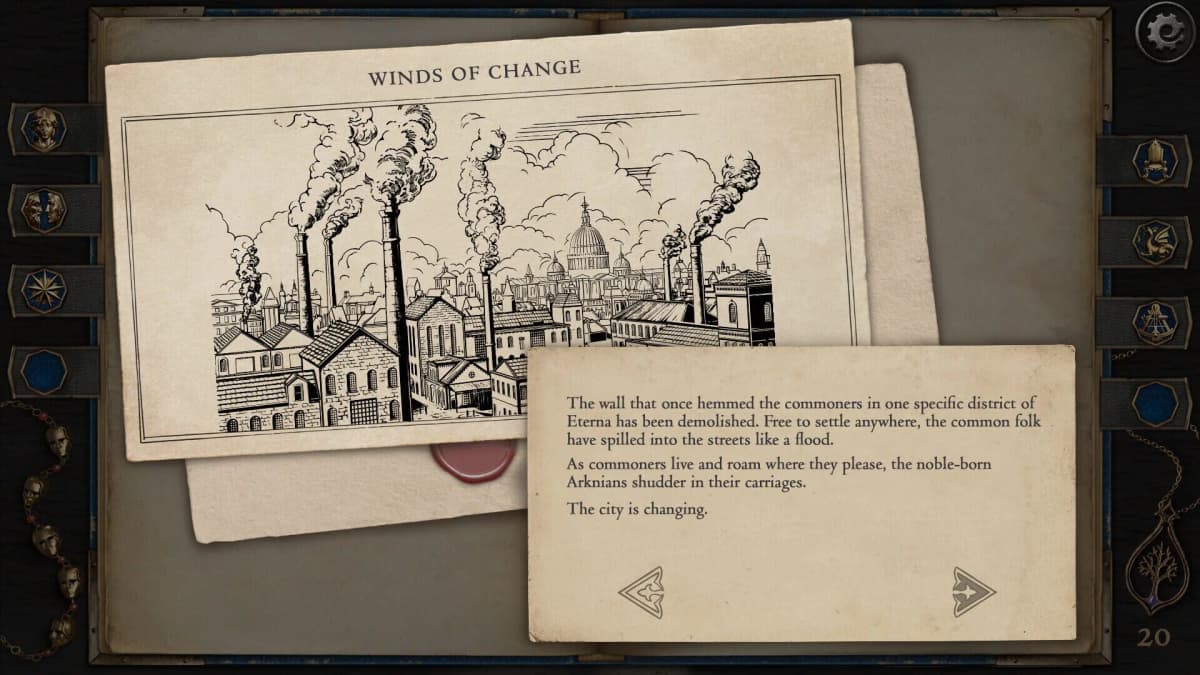
Plan your intended ruler before Chapter 1 begins. The Life and Suffering of Prince Jerian starts tracking Jerian’s personality, faith, sanity, relationships, and political direction long before the Empire’s major governing parameters fully matter. The cleanest first route is a Reformer build: protect Reason and Sanity, avoid heavy Dogma and Elitism spikes, then steer Chapter 3 decisions toward Progress, Equality, and Law.
The trap is treating every early scene as harmless roleplay. A small dialogue nudge usually is safe, but repeated decisions that favor repression, rigid divine authority, or estate privilege can leave you trying to satisfy incompatible late-game thresholds. Keep a separate save at the start of every chapter and before major political decisions.
Table of Contents (16)
Choose Your Political Direction Before Chapter 1
Prince Jerian’s early chapters are about keeping useful doors open. You can change course later, but a consistent opening makes the route far easier to manage once the Empire’s political sliders become central in Chapter 3.
- Reformer: Build toward Progress, Equality, and Law. This is the strongest route for players who want broad political agency and the documented reform-focused ending requirements. The eventual targets are Progress 8, Equality 8, and Law 8.
- Traditionalist Monarch: Favor Tradition, noble loyalty, and a more hierarchical Empire. This route can support Law, but it should not chase aggressive Progress or Equality at the same time.
- Theocrat: Lean into Dogma, divine legitimacy, Old Faith support, and Law. Expect Equality to fall behind as religious authority becomes the core of your rule.
- Iron-fisted Autocrat: Prioritize Law, control, and repression while accepting low Equality. This route can use some Progress, but treats the estates as tools to manage rather than partners to persuade.
For a first serious playthrough, commit to the Reformer line. It gives you a clear long-term target and punishes careless extreme choices less often than trying to improvise between every faction. If you prefer a harsher ruler, make the commitment early rather than mixing severe political orders with equality-focused reforms.
What Counts as a Safe Choice and What Creates a Route Problem
Early choices fall into two useful categories: experiments that slightly shape Jerian, and commitments that point the entire run toward a political identity.
Safe experiments
- Dialogue responses that make small personality adjustments without pushing an axis to an extreme.
- Minor relationship gains or losses with figures such as Martha, Cornelius, and Emil.
- Small Year-Long Affairs adjustments, especially choices that only add a modest amount to Progress, Equality, or Law.
- Skill investments that improve access to future checks without abandoning every other useful skill.
These choices are good places to explore alternate characterization, provided you check your broader direction at each chapter break. A single severe response does not automatically ruin a Reformer run; a pattern of severe responses followed by anti-equality political decisions can.
Choices that demand a follow-up plan
- Heavy censorship or harsh punishment: These decisions pull Jerian toward an Autocrat or Theocrat identity. Continue into high Law, then decide whether the next priority is Dogma for a theocratic rule or direct control for an autocratic rule.
- Repeated defense of fixed Lots and divine hierarchy: This supports a Dogma-heavy route. Follow it with faith-aligned choices and do not expect a clean Equality-focused pivot without deliberate counterweight later.
- Repeated protection of noble privilege: This helps a Traditionalist ruler. Reinforce estate loyalty and Tradition instead of spending later choices trying to maximize Equality.
- Political indecision during major affairs: This is the quiet dead-end. You may preserve short-term comfort while failing to build enough of any parameter to reach a strong final route.
The practical rule is simple: after any major commitment, take the next two or three relevant choices in the same direction. That is enough to form a route. Do not expect one dramatic scene to carry an entire political build.
Chapter 1: Obscurity — Set Jerian’s Personality and Faith Base
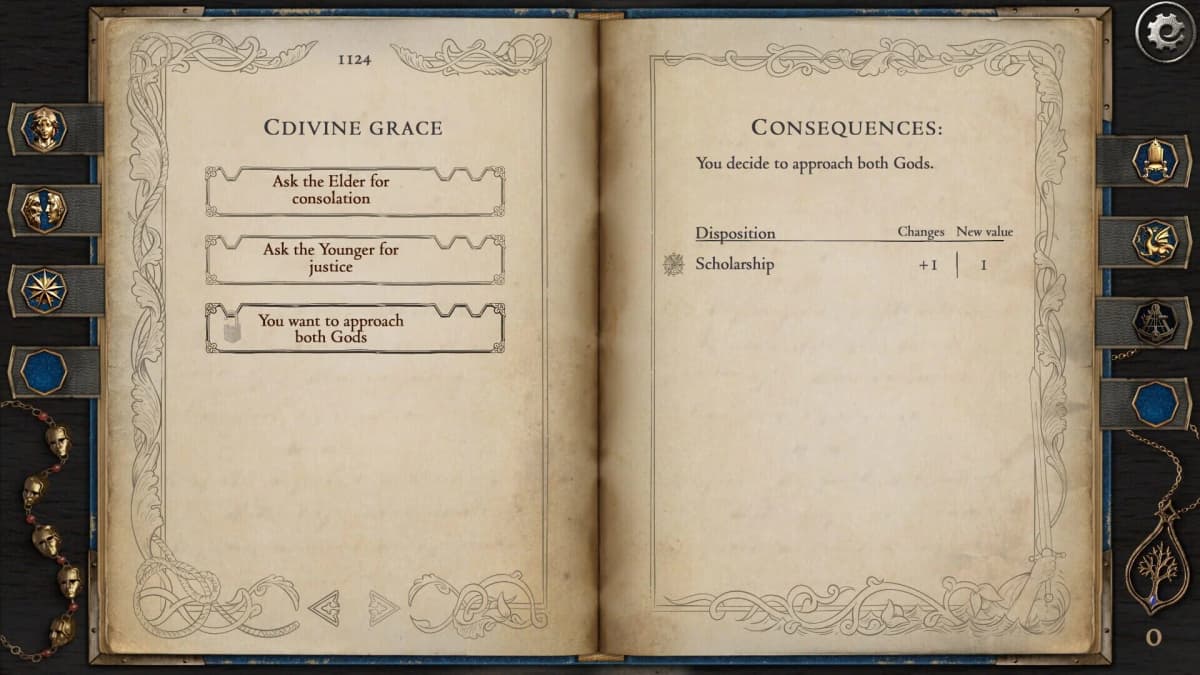
Chapter 1, “Obscurity,” is the foundation chapter. Jerian is still a child, but the Divine Grace events, Martha’s lessons, and early responses to the Empire’s system of Lots establish how he understands authority, faith, and his own exceptional position.
What to prioritize in Obscurity
- Keep Reason healthy if you want flexibility, composure, and a Reformer-friendly starting point.
- Protect Sanity whenever possible. Low Sanity turns later crises into much harder decisions.
- Treat miracles as political and personal leverage, not free solutions. Reckless use can damage Jerian’s standing under the divine pact.
- Use Martha’s lessons about Lots to decide whether Jerian will accept hierarchy, reform it, or use it as a source of authority.
If you want a Reformer route
Choose responses that leave room for reform, rational judgment, and compassion toward people constrained by their Lot. You do not need to reject every religious idea in Chapter 1. The important part is avoiding a chain of choices that makes divine hierarchy and rigid social order Jerian’s only political language.
If you take a faith-leaning response because it helps a relationship or fits a scene, follow it with choices that preserve Reason and mercy. That keeps the choice as a character detail instead of allowing it to become an early Dogma spike.
If you want a Traditionalist, Theocrat, or Autocrat route
A Traditionalist should frame hierarchy as stability and cultivate respect for established estates. A Theocrat should consistently support the divine order and accept Dogma as a central political resource. An Autocrat can favor severity and obedience, but should still manage Sanity carefully; a ruler who cannot handle pressure loses control of crucial later scenes.
Chapter 1 checkpoint: At the end of Obscurity, check whether Jerian’s attitude toward Lots and divine authority matches the ruler you intend to become. If it does not, this is the least expensive place to reload. You have not yet built enough political momentum for a full route lock, but the next chapter will strengthen whatever base you carry forward.
Chapter 2: The Heir — Build Skills for Future Checks
Chapter 2, “The Heir,” turns childhood attitudes into practical preparation. Jerian’s education, tutors, social scenes, and discussions shape the skills that later determine whether you can take the answer you actually want when a crisis arrives.
Skills are gates, not trophies. A high number only matters when it clears a check, so avoid dumping every investment into one stat while leaving the rest of your planned route unsupported. Management, Scholarship, and Diplomacy all matter as tools for navigating the Empire rather than as scores to maximize for their own sake.
Use a focused but broad skill plan
- Choose the skills that best support the political answers you expect to take.
- Bring your main focus skills to roughly 10-12 points by the middle of Chapter 2.
- Keep enough secondary development to avoid failing every alternative dialogue or management check.
- Do not sacrifice Sanity merely to force a short-term result; Chapter 3 puts more pressure on Jerian’s ability to stay composed.
If you chose a Chapter 1 direction, do this next
- If Chapter 1 leaned toward Reason, mercy, and skepticism of fixed hierarchy: Use study and social choices to reinforce Jerian as a capable, reform-minded heir. Keep relationship choices from dragging him into extreme Dogma or Elitism.
- If Chapter 1 leaned toward noble duty and inherited order: Strengthen ties that support estate loyalty. Avoid spending every educational or social choice on reformist values, because that creates an unfocused Traditionalist run.
- If Chapter 1 leaned toward divine favor and strict hierarchy: Continue supporting religious legitimacy and prepare for a Law-and-Dogma political identity. Do not chase Equality as a core objective.
- If Chapter 1 leaned toward severity and command: Build the competence needed to enforce decisions later. You are preparing for high Law and low Equality, so stop trying to preserve a fully open Reformer path through every choice.
Chapter 2 is also where a passive run starts to fail. Picking whatever sounds polite or emotionally satisfying can leave Management, Scholarship, Diplomacy, and the political axes too scattered to meet future conditions. You do not need every door open; you need the doors that belong to your chosen ruler open.
Chapter 3: The Great Censor — Turn Intent Into Politics
Chapter 3, “The Great Censor,” is where the political build becomes visible. By this stage, Jerian is old enough for decisions to affect the Empire’s direction through Progress versus Tradition, Equality versus Elitism, and Law versus Dogma. Small choices now matter because they accumulate toward the route thresholds that define later outcomes.
Reformer route through The Great Censor
Prioritize outcomes that advance Progress, Equality, and Law. Your objective is not to make every faction happy. It is to build a state that can reform without collapsing into either inherited privilege or divine control.
- Take reform-oriented Year-Long Affairs when they offer Progress, Equality, or Law.
- Prefer legal structures and accountable governance over arbitrary punishment.
- Avoid using sweeping censorship as an easy stability button.
- Keep Reason and Sanity stable so later crisis choices remain available.
- Counter any unavoidable Dogma or Elitism increase with later choices that clearly support reform and equal treatment.
The Reformer route requires all three political parameters to reach at least 8 by the ending. Chapter 3 is too early to panic over one imperfect result, but it is far too late to keep choosing against all three and expect a clean recovery.
What to do after a censorship or punishment decision
Harsh censorship and punishment are the decisive fork in this chapter. If you impose broad repression, stop treating Equality as your main target. You have pushed the run toward an authority-first ruler, and your next choices should establish which kind.
- For a Theocrat: Pair repression with Dogma, Old Faith support, and divine legitimacy. Keep Law high, accept low Equality, and make religious authority the justification for state control.
- For an Autocrat: Pair repression with high Law and direct administrative control. Keep the estates manageable rather than equal, and use authority as the basis of Jerian’s rule.
- For a Traditionalist: Use authority selectively to preserve inherited order and noble support. Do not overcommit to radical Progress or equality reforms afterward.
- For a Reformer: Reload if the decision was a major, avoidable crackdown. If it was unavoidable, immediately favor legal safeguards, equality-focused affairs, and progress-oriented policy to prevent the run from drifting further into repression.
Sanity, Miracles, and the Divine Pact: Keep Them in the Route Plan
Sanity and the divine pact are easy to treat as side systems until a major crisis makes them the difference between a controlled response and a forced compromise. Jerian’s miracles can solve immediate problems, but frequent reckless use or choices that offend the divine order can create problems that remain long after the scene ends.
- Use miracles when they support a clear political or personal objective.
- Do not spend Sanity to rescue every uncomfortable scene.
- Maintain enough composure to handle Chapter 3’s political pressure without being pushed into an unwanted extreme.
- For a Reformer, preserve divine standing without allowing Dogma to replace Law as the foundation of the Empire.
- For a Theocrat, divine legitimacy is an intended resource, but Sanity still needs protection.
End-of-Chapter 3 Checklist
- Confirm that your personality choices support your intended ruler rather than contradicting every political decision.
- Keep a permanent save at the start of each chapter and another before major state decisions.
- For Reformer runs, verify that Progress, Equality, and Law are all moving upward rather than relying on one strong parameter to carry the route.
- For Traditionalist, Theocrat, and Autocrat runs, stop spending major choices on Equality unless you have a specific reason to offset an earlier extreme.
- Check that your focus skills are developed broadly enough to clear future gates.
- Protect Sanity before entering the later chapters, where weak composure creates costly forced outcomes.
FinalBoss // Gear
Level up your setup
01Top-rated gaming headsetson Amazon→02High-refresh gaming monitorson Amazon→03Gaming chairson Amazon→04Discounted game keyson Kinguin→
Affiliate links · As an Amazon Associate, FinalBoss earns from qualifying purchases.
Want to Level Up Your Gaming?
Get access to exclusive strategies, hidden tips, and pro-level insights that we don't share publicly.
Ultimate Guide Strategy Guide + Weekly Pro Tips