
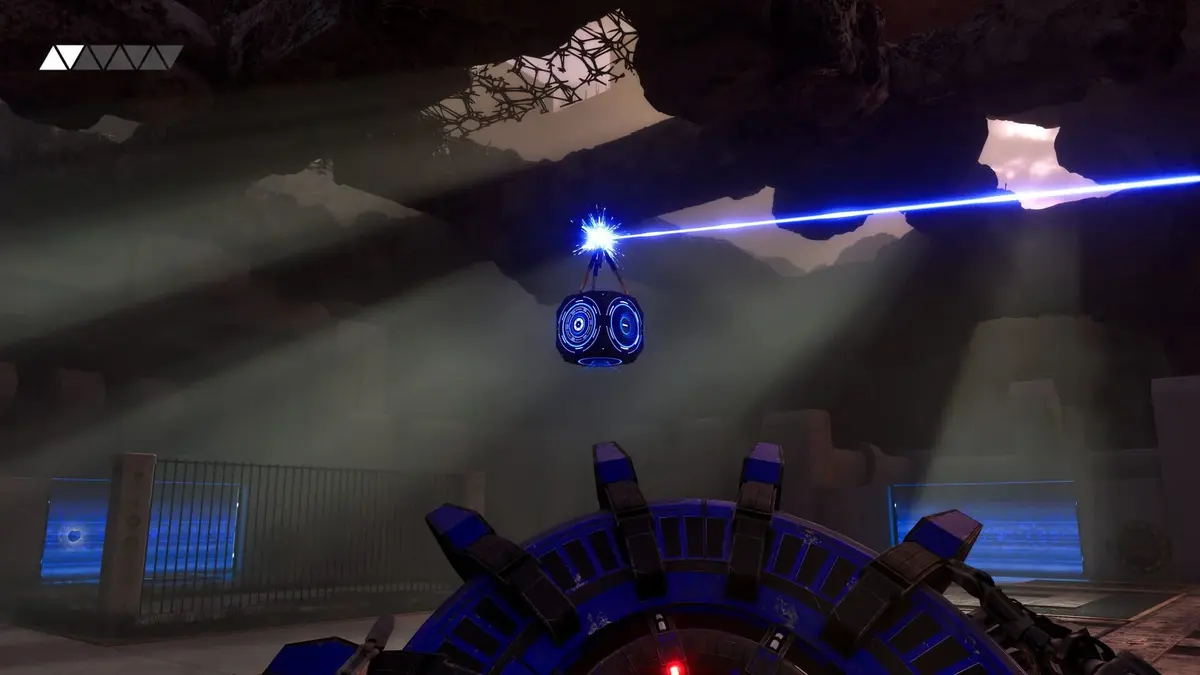
The Talos Principle 3 writers are right to treat the current AI gold rush as a creative-labor threat, because publishers are not primarily chasing large language models to make better art. They are chasing them to make more content with fewer paid people.
That is the fight the writers are describing, and the industry keeps trying to blur it with cheery talk about “tools.” A tool belongs in the hands of a creator who retains control, credit, and a paycheck. A labor-replacement system exists to swallow work made by creators, generate passable substitutes at industrial scale, and turn experienced writers, narrative designers, localization teams, and artists into low-paid cleanup crews.
I have no problem with software that helps someone find a typo, organize an approved internal archive, or handle an ugly repetitive task without stripping authorship from the person doing the creative work. What I refuse to accept is the dishonest leap from that limited assistance to the fantasy that a publisher can prompt its way to a world worth caring about.
Verena Kyratzes put the problem with brutal clarity when she described current large language models, or LLMs, as “incredibly intelligent versions of the autocorrect” on a phone and called them a “plagiarism machine that makes people lose their jobs.” The phrasing is sharp because the business model around this technology is sharp. It runs straight into copyright, consent, attribution, and, in the writers’ view, eventually payroll.
Table of Contents (6)
“Advanced Autocorrect” Is Not a Writing Room
LLMs can produce sentences that look competent. That is their trick. They predict plausible words from patterns in enormous amounts of existing text. They do not possess a point of view, a sense of responsibility for a character, or an understanding of why a line needs to land after six hours of player choices instead of six minutes of exposition.
Game writing is full of decisions that executives waving around an AI demo love to pretend are automatic: when a mystery should withhold information, when a companion should stay silent, when a joke earns its place, when a translated line needs rebuilding rather than literal conversion, when a quest should end before it exhausts the player. Those decisions are craft. They come from writers who understand the game, the team, the player, and the consequences of every compromise.
A machine can imitate the outer texture of that work. It can spit out a hundred item descriptions, ten versions of an NPC greeting, or an ocean of generic lore entries before lunch. Volume is precisely the danger. A publisher that values volume over authorship will always find an excuse to call this output “good enough,” then hand the human writer a pile of machine sludge and ask for a quick polish at a lower rate.
That is how quality gets flattened. The first drafts become statistically familiar, the revisions become time-starved, and the odd little choices that give a game an identity get filed down because the pipeline is built to keep producing. Players can feel this even when they cannot trace it to a particular tool. Dialogue starts circling the obvious. Quests sound interchangeable. Every voice carries the same gray, frictionless rhythm.
And this is exactly why the “it still needs human editing” defense is so flimsy. Human editing is not some magic shield that turns bad process into authorship. If the writer’s job has been reduced from creating a voice to sanding down machine output on a deadline, the work has already been degraded. So has the career path. Junior writers do not learn a craft by becoming janitors for autocomplete.
Jonas Kyratzes is also correct to frame this as a labor issue. The immediate problem is not whether a model can write a convincing paragraph. The immediate problem is that owners hold the money, set the production targets, and can use technology as leverage against workers whose bargaining power is already too weak. A company does not need a machine to equal its best writer. It only needs leadership willing to accept weaker work in exchange for fewer salaries.
The “Plagiarism Machine” Charge Has Teeth
Calling an LLM a plagiarism machine does not require every generated line to be a word-for-word copy of a novel, quest, script, or lore entry. The uglier problem is opacity. If a commercial model ingests creative work without permission or disclosure, nobody can reliably tell whether the generated result is genuinely fresh, substantially similar to existing work, or built from patterns taken from people who never consented to become raw material.
That uncertainty poisons the relationship between creators and publishers. Writers cannot negotiate over the use of their work if they cannot learn whether it was used. They cannot challenge unauthorized training if no usable record exists. They cannot protect their credit if a studio hides behind an “AI-powered” label that says nothing about the data, the prompts, the human revisions, or the final author.

The Writers’ Guild of Great Britain called for the basics back in September 2023: permission from rightsholders and creators, transparency about training material, clear labels for AI-generated content or decisions, and accessible logs of ingested data. The Authors Guild has made the same essential demand for public disclosure of datasets and records of the works used to train commercial models.
Those are not radical demands from people frightened of a spellchecker. They are the minimum rules required when a company’s product may depend on other people’s copyrighted labor. Anyone dismissing them as anti-technology is protecting a system that wants the benefits of creative work without the inconvenience of asking, paying, or crediting the people who made it.
There is also a practical reason the provenance question matters so much. Plagiarism risk is not only about obvious copying. It is also about derivative reuse, substantial similarity, and the basic impossibility of checking where a line, image, or asset really came from once it has been laundered through a black-box model. That is terrible for creators, terrible for studios, and eventually terrible for players who are asked to trust a product with a deliberately obscured chain of authorship.
There Is a Clear Line Between Assistance and Replacement
The AI debate gets deliberately muddled because “all AI use” is easy to defend and easy to attack. The real standard is much more practical. What work did the system do, what material trained it, who had final creative control, and did human workers keep their jobs, credit, and bargaining power?
- Human-led assistance: A credited creator uses approved tools for narrow support, retains control of the work, and produces the final authored material. Verdict: Fine, provided the tool’s role is disclosed where it materially affects the work.
- Limited generative use with disclosure: A studio identifies the system, explains where it was used, documents training-data provenance, and keeps paid humans responsible for final decisions. Verdict: Demanding, but defensible. Accountability has to be real.
- Opaque content substitution: A company feeds unknown data into a model, generates dialogue, art, localization, quests, or voices at scale, then cuts staff or hides the process. Verdict: Unacceptable. That is creative extraction dressed up as innovation.
That third category is where the backlash belongs. I do not care how many executives describe it as inevitable. “Inevitable” is the favorite word of people who want workers to surrender before negotiations even begin.
It is also where the supposedly simple “AI can assist” line falls apart. Assistance without disclosure becomes camouflage. Assistance without consent becomes appropriation. Assistance without human control becomes substitution. If a studio wants the public to accept any AI involvement at all, the burden is on that studio to explain what the system did, where it was used, and whether humans still owned the final creative call.
That standard is not extreme. In adjacent writing fields, disclosure is already treated as a baseline. If someone used an AI system and prompts to help prepare published work, readers increasingly expect that to be stated plainly. Games should not get a special exemption just because publishers think the label might make the marketing department sweat.
Contracts Are Already Telling Us Where This Is Going
No-generative-AI clauses have become increasingly common in contracts over the past two to three years. They are moving toward boilerplate because lawyers understand the risk even when executives pretend the rules are still too fuzzy to matter.
Haley MacLean of Voyer Law laid out the nightmare scenario cleanly. Imagine an outdoor level containing AI-generated trees. Someone else could potentially use AI-generated tree assets in another game, while the original developers may struggle to prove ownership of those trees. The model’s training history may be opaque, the source material may be impossible to identify among thousands of artists, and the person requesting the output may face difficulty claiming they legally made it.
That is a spectacularly stupid foundation for a creative industry. Studios spend years trying to establish a game’s identity, then risk muddying ownership of the very assets they paid to create because somebody wanted a faster asset pipeline. The legal mess arrives later, after the production deadline has passed and the people who raised concerns have been ignored or laid off.
And the problem does not stop at a courtroom door. MacLean also warns that even where AI use is disclosed, future disputes and community backlash can still follow. Of course they can. A store-page label does not answer whether the training data was permissioned, whether paid creators were displaced, or whether the studio can defend authorship if challenged. Disclosure cannot clean a dirty pipeline. It can only stop a dirty pipeline from hiding.
That is why the contract language matters. It is the legal system quietly admitting what marketing copy refuses to say out loud: the risk is not theoretical enough to ignore. Companies want protection because generative AI can copy copyrighted works, complicate proof of authorship, and create a pile of headaches that nobody wants to sort out after launch.
The Talos Principle 3 Needs a Public Standard Before 2027
The Talos Principle 3 was announced on May 13, 2026, as the grand finale of the saga, with a 2027 release window on PlayStation 5 and PC. Its official public material does not confirm any AI implementation, AI-assisted production pipeline, or AI-content policy. That is not proof either way. It simply leaves Croteam and Devolver Digital with an opportunity that too many studios will probably waste: publish a clear standard before release rather than scrambling to explain themselves after a backlash.
That distinction matters. The series can use AI as a philosophical theme without telling us anything about the real production pipeline behind the game. In-universe ideas are not labor policy. A story about artificial intelligence is not the same thing as a disclosure about whether generative systems touched the writing, art, localization, or assets. Those are separate questions, and players should insist on keeping them separate.
Players deserve a direct disclosure that covers the parts of development where generative systems create the greatest trust problem:
- Whether generative AI was used for dialogue, narrative text, quests, lore, or item descriptions.
- Whether it was used for concept art, production assets, voices, localization, moderation, or customer support.
- Whether any external model was trained on licensed, permissioned, or otherwise documented material.
- Whether credited human creators held final authorship control over player-facing creative work.
That is a short list. Any publisher capable of shipping a major game can answer it. The refusal to answer it would say more than a polished FAQ ever could.
There is already a measurable cost attached to this issue. A June finding showed that AI disclosures reduced the number of reviews a game received by 53%, while the reviews that remained became more negative overall. Publishers may read that as a reason to hide behind vagueness. I read it as a warning that players are sick of being treated as the final checkpoint for an experiment they never agreed to fund.
And if a publisher thinks silence is safer, silence has a cost too. When no one knows where AI was used, every suspiciously flat line of dialogue, every odd bit of promotional art, every strangely anonymous asset becomes its own accusation. Trust does not survive that kind of fog for long.
Players Should Not Reward the Cheapest Possible Future
Jonas Kyratzes warned that profit-driven companies will use AI for stupid things in pursuit of huge returns before the companies themselves collapse. That sounds harsh, yet it matches the pattern everybody can see. The hype does not center on giving writers more time to write. It centers on replacing labor, accelerating output, and convincing audiences that a machine’s imitation of creativity should carry the same value as creative work made by people.
I want games with authored voices, strange ideas, deliberate pacing, and people behind them who can build careers instead of being asked to supervise a text generator for less money. That future requires studios to disclose AI use, obtain permission for training data, maintain searchable records, credit human creators, and keep human authorship in charge of the work players actually experience.
It also requires players to stop accepting the weakest possible standard. “Some AI may have been used” is not transparency. “AI-powered” is not transparency. A buried clause in a contract is not transparency. If AI touches writing, art, voice, or localization, the public standard should be simple: what was used, where it was used, and who retained final authorship control.
The Talos Principle 3 writers have identified the real threat. LLMs become dangerous to games when publishers treat scraped creativity as free fuel and talented people as an avoidable expense.
FinalBoss // Gear
Level up your setup
01Top-rated gaming headsetson Amazon→02High-refresh gaming monitorson Amazon→03Gaming chairson Amazon→04Discounted game keyson Kinguin→Affiliate links · As an Amazon Associate, FinalBoss earns from qualifying purchases.
Want to Level Up Your Gaming?
Get access to exclusive strategies, hidden tips, and pro-level insights that we don't share publicly.
Ultimate Gaming Strategy Guide + Weekly Pro Tips