
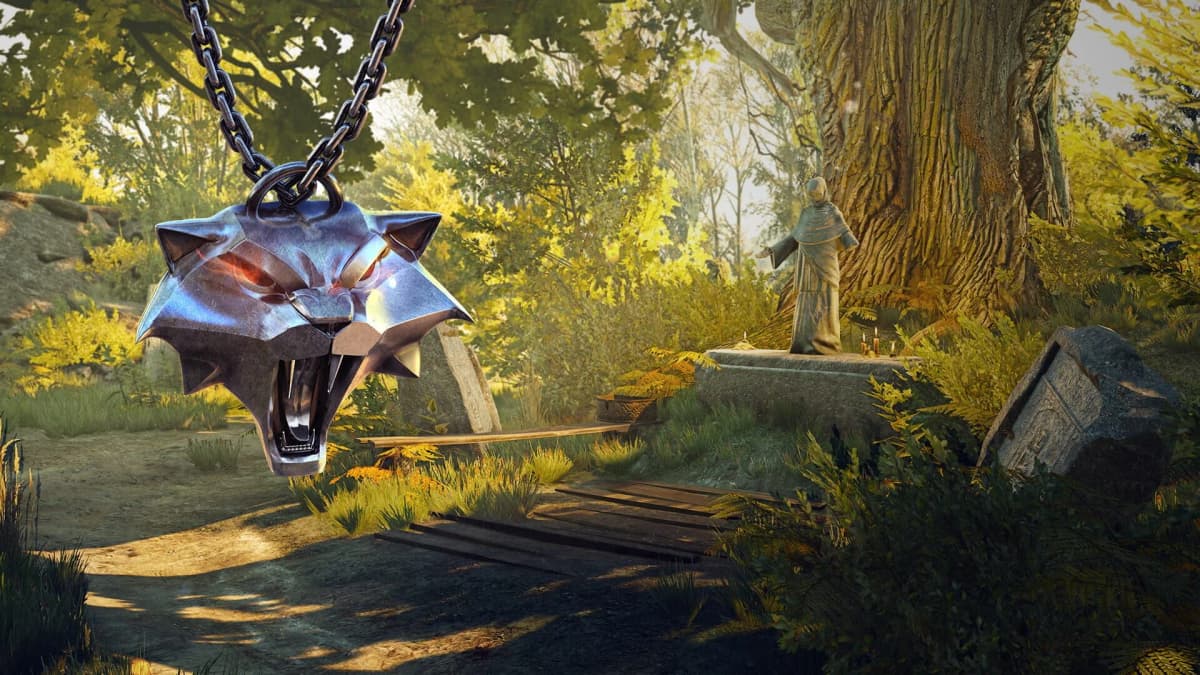
The Witcher 3: Wild Hunt’s remastered visual debate has a simple answer: some scenes do look worse than the original, and dismissing that reaction as nostalgia misses the actual technical changes on screen. The December 14, 2022 Complete Edition update increased detail, added ray tracing options, expanded PC settings, and modernized lighting. It also altered the carefully controlled atmosphere that made certain swamps, forests, interiors, and overcast landscapes feel so distinctive.
My position is straightforward. The newer version is the better technical package, especially after its post-launch fixes. It is not automatically the better-looking version in every frame. The original game’s lighting had a strong authored mood: deep fog, sharp contrast, saturated environmental color, and reflections that could make ugly places feel threatening. The remastered update sometimes replaces that mood with cleaner visibility and more physically minded light behavior. Cleaner is not always more evocative.
That is the part people talk past each other on. One side hears “some scenes look worse” and assumes the complaint is anti-technology nostalgia. The other side hears “the remaster is better” and assumes nobody is looking carefully at atmosphere. Both readings are too lazy. The Complete Edition changed the image in ways that absolutely can improve fidelity while still weakening the emotional read of a location. In a game as dependent on weather, gloom, and mood as The Witcher 3, that trade-off matters more than it would in a cleaner, brighter open-world game.
Table of Contents (7)
The swamp comparison exposes the real problem
The most useful comparison is the swamp sequence where Geralt of Rivia faces drowned monsters and casts Igni near the water. That footage has become a flashpoint because the original version uses dense fog and darkness to compress the scene. The distance is obscured, the water feels murky, and the fire draws the eye through the gloom. It is ugly in the exact way a swamp should be ugly.
The remastered version opens that scene up. Visibility increases. The fog coverage is reduced. The lighting is broader and less theatrical. Igni’s reflection on the water reads differently. Detail becomes easier to inspect, but the location loses some of its oppressive density. Players responding to that change are reacting to an actual shift in the image, not inventing one because they prefer an older build.
The complaint is not merely that the remaster is brighter. It is that the old scene used low, dirty fog and concentrated darkness to create a hierarchy. Your eyes moved from Geralt to flame to water to the shapes emerging from the marsh. In the newer presentation, the scene can become easier to parse all at once. That is useful for visibility. It is less useful for dread. If the original looked like a place where monsters should live and the remaster looks like a place you can inspect more comfortably, then something meaningful changed.
That distinction matters. A technical upgrade can produce more accurate light simulation while weakening the visual hierarchy an artist built around limited visibility, rich color separation, and exaggerated darkness. The Witcher 3 was never a sterile rendering benchmark. Its best environments were designed to feel painted, hostile, damp, and slightly unreal. Fog was doing heavy narrative work.
Ray tracing changed the game’s mood, not only its fidelity
Patch 4.00 introduced ray-traced global illumination and ray-traced ambient occlusion on supported hardware, with ray-traced reflections and shadows on PC. The short version is simple: the update changed how light bounces, how shadows gather around objects, and how reflective surfaces behave. That is enough to shift a scene’s entire personality even before anyone starts counting texture detail or foliage density.
In a game built around constantly shifting weather and time of day, that means familiar locations can acquire an entirely different emotional read. A formerly warm tavern may look cooler and dimmer. A gloomy outdoor scene may become flatter because the newer light spreads more evenly through the environment. A forest can gain physical depth around its branches and roots while losing the harsh contrast that made the original image feel dangerous.
This is where the “more realistic equals better” argument falls apart. Real-world light does not automatically create better game art. The original rendering often cheated for drama, and those cheats were valuable. They pushed the player toward Geralt, a torch, a patch of wet stone, or a distant silhouette. The remastered lighting can make those same scenes more coherent in engineering terms while making them less memorable as compositions.
That is also why some battle footage gets criticized for looking duller rather than merely different. If the fire reads less orange, the surrounding space looks cooler, and the environment stops punching back with strong contrast, the entire shot can feel less alive. You are not imagining that because you spent too long with the 2015 version. You are noticing that the scene’s old visual aggression has been softened.
Ultra+ settings added detail, but detail was never the disputed asset
PC received the largest settings expansion. Ultra+ affects background characters, shadow quality, grass density, texture quality, foliage visibility range, terrain quality, and water quality. Those upgrades are real. Longer grass draw distances, fuller vegetation, stronger terrain detail, and cleaner assets improve the game when the camera pauses long enough to notice them.
Yet screenshots rarely fail because a distant bush has insufficient density. They fail because the sky is too flat, the fog is too thin, the water lacks the right reflection, or the contrast no longer sells the location. A battle scene can have denser foliage and sharper textures while looking duller than its older equivalent because its color tone has become restrained and its shadows have lost their punch.
That is the uncomfortable truth for upgrade discourse. Technical abundance and visual force are not identical things. You can absolutely have a richer asset set and a weaker image. The remaster wins many objective fights around geometry, settings flexibility, and rendering options. It does not automatically win the subjective but still very real fight of whether a place feels cursed, wet, hostile, feverish, or haunted.
The remastered update also added updated sky textures and a new Gray Sky weather type. That is significant. Sky color controls the entire palette of an open-world scene. A colder sky affects grass, water, armor, faces, stonework, and the apparent depth of distant terrain. Players comparing a specific sunset or overcast scene are often comparing a materially different lighting and weather presentation, not a like-for-like texture pass.
Some ugly results were bugs, and CD Projekt Red had to fix them
The strongest version of the “looks worse” argument does not rely solely on atmosphere. Some visual regressions were concrete technical defects. Patch 4.01, released in February 2023, improved screen-space reflections in ray-tracing modes. Reflections became higher-resolution, sharper, cleaner, and more accurate than they were at the launch of patch 4.00.
Patch 4.03 addressed further visual problems: grid-like light spots could appear on ground and walls during certain weather with ray tracing enabled; spider webs could change color when the camera moved; cutscene textures could partially fail to render; and the mist in Poisoned Valley during “Through Time and Space” could show up pink when it should have been white.
Later updates also acknowledged fog that could look two-dimensional in certain locations, plus missing sky reflections on water in parts of White Orchard, Velen, and Toussaint with ray tracing enabled. That history matters because it proves the launch-state image was not a settled artistic statement. Some bad comparisons captured broken rendering behavior. Players who saw flat fog or incomplete water reflections were looking at genuine faults.
That does not mean every complaint can be explained away as a patch issue. It means the debate has two layers. One layer is taste: do you prefer the original’s dramatized mood or the remaster’s cleaner, newer lighting model? The other layer is software reality: some of the remaster’s least flattering moments were not matters of taste at all. They were bugs, and they needed fixing.
The original comparison is often more flattering than people admit
The remastered version should not get a free pass, but the original also benefits from selective memory. A carefully chosen 2015 screenshot can make its heavy contrast and dense fog look deliberate and immaculate. A moving camera through the original game exposes older shadow behavior, lower-detail vegetation, less stable reflections, and environmental shortcuts that the Complete Edition improves substantially.
The honest comparison is not “old game versus new game” in the abstract. It is a matched location, weather state, time of day, camera angle, patch number, platform, and graphics preset. Without those controls, a side-by-side turns into a color preference contest dressed up as technical analysis.
It also matters whether somebody is comparing the remaster to the base 2015 presentation or to a carefully tuned memory of it. The Witcher 3 has lived long enough for remembered mood to become its own form of post-processing. People do not always remember the exact shadow behavior, the exact vegetation quality, or the exact water rendering. They remember how Velen felt at dusk, how a swamp encounter pressed in on them, how torchlight and fog did half the storytelling. That remembered force is real, even when the underlying image was doing all kinds of older tricks to create it.
That does not rescue every remastered scene. It clarifies why the argument keeps circling back to atmosphere. The original’s strongest image traits were not always technically advanced; they were visually forceful. The Complete Edition improves the world’s physical detail while occasionally sanding down the aggressive visual character that players remember.
Platform and mode change the answer
The label “remastered visuals” is too broad to be useful. The image differs sharply depending on platform and settings. A player using a 60 FPS performance preset is not evaluating the same presentation as someone using ray tracing at 30 FPS. PC users can vary the image even further through Ultra+, ray-traced shadows, reflections, DLSS 3, and AMD FSR 2.1.
| Platform | Key visual choice | What changes most |
|---|---|---|
| PlayStation 5 | Ray Tracing Mode targeting 30 FPS or Performance Mode targeting 60 FPS | Lighting depth, shadows, image clarity, and responsiveness |
| Xbox Series X | Ray Tracing Mode targeting 30 FPS or Performance Mode targeting 60 FPS | Global illumination, ambient depth, and the balance between visual density and motion |
| Xbox Series S | Quality Mode or 60 FPS Performance Mode, without ray tracing | Resolution, general fidelity, and frame-rate priority rather than RT lighting |
| PC | Ultra+, RTGI, RTAO, RT reflections, RT shadows, DLSS 3, and FSR 2.1 | The widest possible variation in fog, water, shadowing, vegetation, and overall tone |
PC is where the debate becomes most chaotic because the settings stack can transform the result. Ray-traced reflections can make wet streets and bodies of water look substantially better, especially after the early reflection fixes. Ray-traced shadows and ambient occlusion can also make dense environments feel heavier and more grounded. At the same time, those same settings can deepen interiors, cool overcast scenes, and alter the high-contrast readability that the original used so effectively.
That is why upgrade advice has to be annoyingly specific. The Complete Edition was a free update for existing owners on compatible platforms, but “free” does not mean visually uniform. A console player choosing between performance and ray tracing is making one kind of compromise. A PC player toggling reflections, shadows, upscaling, and Ultra+ is making several at once. When people argue about whether the remaster looks worse, they are often not even arguing about the same image.
What players should check before judging the upgrade
- Check the exact patch version. Patch 4.00, 4.01, and 4.03 do not produce identical results, and later fixes also addressed fog and reflection issues.
- Compare the same weather, time of day, camera position, and location rather than relying on unrelated screenshots. A Gray Sky scene and a warmer sky scene are not evidence of a clean before-and-after by themselves.
- Use the swamp combat clip as a test case: watch Geralt cast Igni at the drowners and look specifically at two things at once. First, the original shows thicker low ground fog close to the marsh. Second, the original shows orange fire reflecting more strongly in the water, while the remastered shot reads differently. If those two cues matter to you, you are judging atmosphere, not only sharpness.
- Check a battle scene for color tone rather than raw detail. If the remaster gives you cleaner assets but the fire feels less vivid and the whole encounter looks cooler or duller, that is the exact vibrancy complaint driving a lot of this debate.
- Inspect foggy swamps, rain, wet roads, reflective water, forests at dusk, dark interiors, and cutscenes. These are the places where the remaster’s strengths and weaknesses are easiest to spot.
- If you are on PC with ray tracing enabled, visit bodies of water and horizon-heavy locations in White Orchard, Velen, and Toussaint and look for missing sky reflections on water. Also pay attention to whether fog layers look volumetric or strangely flat. Those are not abstract image-quality arguments; they map directly to known problem areas.
- On PlayStation 5 and Xbox Series X, compare the 30 FPS ray-tracing option against the 60 FPS performance option before deciding which image is preferable. The visual trade-off is big enough that one mode can change your opinion of the whole update.
- On PC, test Ultra+, ray-traced global illumination, ambient occlusion, reflections, and shadows separately. A single preset label hides too much, and one setting can improve water while another changes the entire mood of a forest or interior.
- Judge atmosphere separately from detail. A sharper texture and a moodier scene are different successes, and The Witcher 3 has always depended more on mood than on sterile technical cleanliness.
The right standard for The Witcher 3’s remastered update is demanding rather than sentimental. The game deserved higher-quality reflections, stronger draw distances, denser environments, improved character detail, and modern rendering support. It also deserved to keep the visual force of its bleakest locations. When the new lighting enhances that force, the Complete Edition is the version to play. When it turns a haunted swamp into a clearer, flatter landscape, the original’s uglier tricks still win.
That is why the visual debate has lasted beyond the launch patch. The update did not replace one image with an objectively superior one. It created a technically stronger version of The Witcher 3 that sometimes trades authored atmosphere for rendering sophistication. Players who value mood over pixel density have a legitimate reason to scrutinize every fog bank, every grey sky, and every patch of water before calling the remaster an unquestionable upgrade.
FinalBoss // Gear
Level up your setup
01Top-rated gaming headsetson Amazon→02High-refresh gaming monitorson Amazon→03Gaming chairson Amazon→04Discounted game keyson Kinguin→
Affiliate links · As an Amazon Associate, FinalBoss earns from qualifying purchases.
Want to Level Up Your Gaming?
Get access to exclusive strategies, hidden tips, and pro-level insights that we don't share publicly.
Ultimate Gaming Strategy Guide + Weekly Pro Tips