
Table of Contents (8)
A luxury car seat for your battlestation… with warning lights on the dash
The Hbada X7 Smart Ergonomic Chair is the first chair that’s ever made me feel slightly embarrassed about how much tech is under my butt. AI-powered lumbar that moves on its own, a dual-core mechanical massage system, graphene heating with red light therapy, active cooling fans in the seat, posture memory, sedentary reminders – it reads like someone grafted a Mercedes massage seat onto an office frame and said, “Sure, gamers will buy this.”
The weird thing is, a lot of it actually works. When everything is firing correctly, the X7 is one of the most comfortable, therapeutic chairs I’ve sat in at a desk. My lower back felt better at the end of long sessions than it does in most “normal” premium chairs. But the longer I used it, the more two things nagged at me: how complex and failure-prone this much hardware feels, and how short the three-year warranty looks next to the price tag, which hovers around $1,500-$1,600 before discounts.
So the X7 is both the most “next-gen” seat I’ve used and a product I’d think twice about recommending to everyone. It’s a genuinely impressive bit of ergonomic tech with some very real asterisks attached.
Unboxing a tank: build, assembly, and my three-chair saga
The X7 arrives in a single massive box that looks like it was shipped by a small logistics boss. It’s roughly 30 x 21 x 20 inches and about 80 pounds. You don’t casually drag this thing up a staircase – it’s one of the heaviest “chair in a box” experiences I’ve had. The good news is (from what I saw) it’s very tightly packed with plenty of foam, so even if the outer cardboard gets scuffed, the components inside have a good chance of surviving.
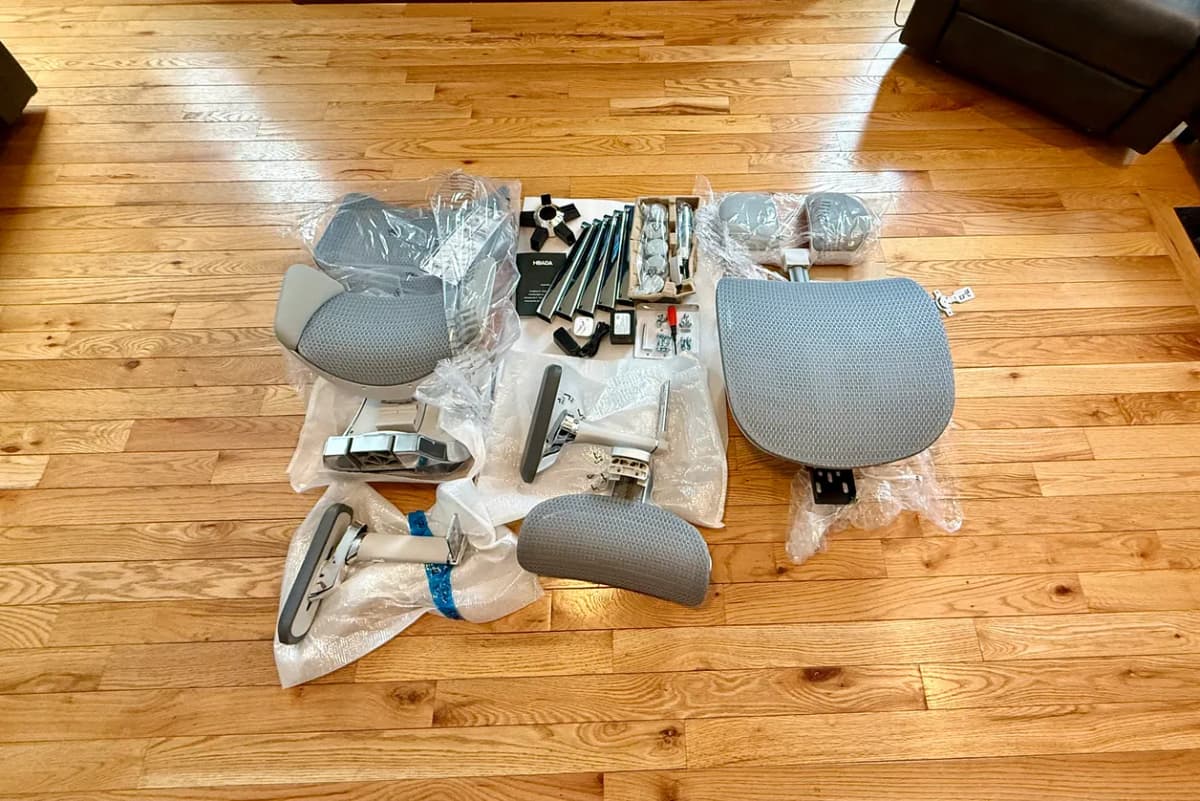
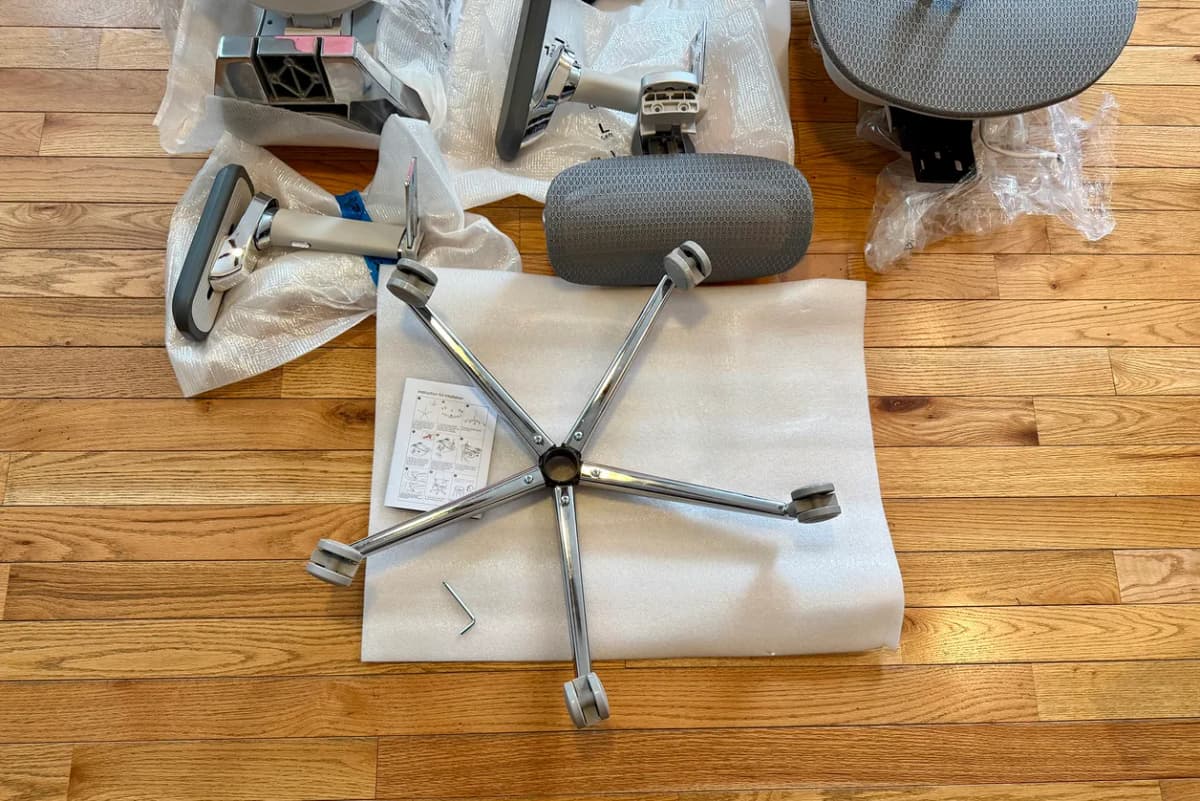
Assembly is mercifully simple, because most of the electronics are pre‑assembled in the seat and back. You’re basically putting together the base and gas lift, bolting the armrests to the seat, connecting the back to the seat, then dropping the whole thing onto the cylinder and adding the headrest. The only fiddly part is the wiring: threading the lumbar system connector into the backrest interface in the right orientation felt like doing surgery inside a black plastic cave. Lining up the headrest screws with the bracket holes is also more annoying than it should be.
On paper, it’s a one-person job. In reality, if you’re not used to handling heavy furniture, you’ll want a second set of hands when you lift the assembled seat and back onto the base. I did it solo, but I would not call it graceful.
The bigger story for me, though, was build reliability. I went through three units:
- The first chair’s main issue: the battery interface wouldn’t behave. Features that were supposed to run off the internal battery only worked properly when the chair was plugged into the wall.
- The second unit: the backrest refused to lock securely into place, which is a hard no for something you’re supposed to lean into every day.
- The third chair finally worked as advertised and has stayed solid so far.
To Hbada’s credit, once you’ve got a “good” X7, the frame feels sturdy and the whole thing gives off “serious piece of equipment” vibes rather than cheap RGB toy. But burning through two duds on a chair in this price bracket set off every reliability alarm in my head.
Also worth noting: the X7’s warranty is three years. That’s fine for a standard office chair. It feels very thin for a product with motors, sensors, fans, heating elements, a battery, and a control board all living under your spine. When brands like Herman Miller are backing their (non-smart) chairs for 12 years, that comparison is hard to ignore.
Looks and feel: gamer mech suit meets office mesh
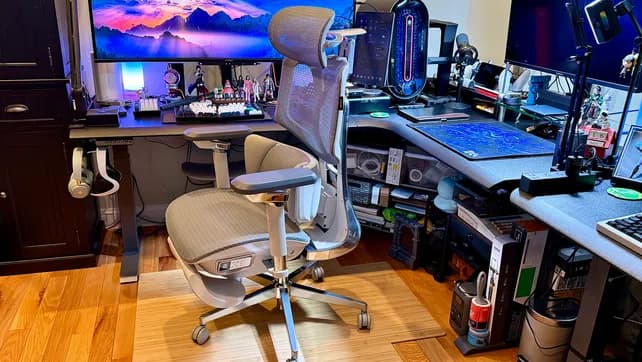
You can get the X7 in grey or black; both use a tightly woven DuPont mesh instead of foam and leather. Mesh is always a bit of an acquired taste, but this one feels on the firm and slightly rough side. It doesn’t feel fragile at all – more like something you’d find on a premium task chair that’s built to last – and it does a great job of letting air and heat move through it. You won’t be sliding around, and you won’t sink into a cushion either; the support stays consistent.
Visually, it’s not subtle. All the embedded tech – lumbar module, motors, battery compartment, cable channels – gives the back a thick, armored look. From behind, it has more in common with a high-end car seat than a minimalist office chair. Whether that’s appealing or not depends on your setup. In a clean, white, airy office it might look aggressive. In a battlestation with big monitors, LEDs, and a hulking PC, it fits right in.
Adjustment range: almost everything moves, sometimes when you don’t want it to
Ignoring the electronics for a second, the X7 is a deeply adjustable chair:
- Headrest: height and angle adjustable.
- Lumbar module: moves up/down and in/out, plus the auto-tracking mode.
- Seat: height and a small amount of depth adjustment (about two inches of slide forward/back).
- Backrest: reclines up to around 140 degrees with an auto‑gravity mechanism.
- Armrests: wild “720°” multi‑axis armrests that can twist, pivot, and angle in frankly ridiculous ways.
The quoted fit range is approximately 4’11” to 6’5” with a max load of 330 lbs. I’m around the middle of that, and the only dimension that really felt constrained was seat depth. Even at the furthest extension, my thighs would have liked a little more support. If you’re on the very tall side with long legs, that shallow slide could be a real limitation.
My other gripe is a classic “premium chair” problem that the X7 doesn’t solve: the armrests and headrest don’t lock as firmly as I’d like. Because the armrests can pivot and tilt so much, they’re also easy to knock out of your preferred position just by grabbing the chair to move it or pushing down on them when you stand up. I’ve had multiple moments where I went to push myself up and the armrest suddenly dipped, which is the kind of mini-jump-scare you don’t expect from a four-figure chair.
I get that ultra-flexible armrests are great for things like supporting a Steam Deck or tablet at chest height, and the X7 is legitimately excellent for that. I just wish there were a gearbox-style “lock” mode for when you’ve finally dialed them in.
Also, there’s no tension adjustment knob for the recline. The back has one preset resistance. It feels tuned reasonably well for average builds, but if you’re very light or very heavy, being able to dial that in would have been nice at this price.
Smart lumbar and massage: gimmick on paper, surprisingly legit in practice
The headline feature is Hbada’s “AI Smart Lumbar-Tracking” system. In reality, what it’s doing is reading pressure from your lower back and using small motors to slide the lumbar pad forward or backward to maintain contact. Lean back and it follows you; scoot forward and it comes with you. You can tweak how aggressively it reacts or just turn the tracking off and park the support where you like it.
Is it “AI” in any meaningful sense? Not really. It’s reactive, not predictive. But in terms of how it feels, I ended up liking it more than I expected. That little servo whir as the lumbar pad nudges itself into your lower back when you sit down is oddly satisfying, and over long sessions, I noticed myself slouching less simply because the support was always just… there, following me around instead of disappearing when I changed posture.
Is it “AI” in any meaningful sense? Not really. It’s reactive, not predictive. But in terms of how it feels, I ended up liking it more than I expected. That little servo whir as the lumbar pad nudges itself into your lower back when you sit down is oddly satisfying, and over long sessions, I noticed myself slouching less simply because the support was always just… there, following me around instead of disappearing when I changed posture.
🎮 Get This Game at the Best Price
Compare prices instantly and save up to 80% on Steam keys with Kinguin — trusted by 15+ million gamers worldwide.
*Affiliate link — supports our independent coverage at no extra cost to you
Built into the lumbar unit is the dual-core mechanical massage system. You can trigger it manually via the remote or let the chair poke you after 45 minutes of sitting as a “sedentary reminder.” There are three intensity levels, and even the middle one feels like more than a gentle buzz. At full power, it legitimately kneads your lower back muscles rather than just vibrating.
As someone who tends to tense up during long ranked sessions or writing marathons, I ended up using the massage more than I expected – five to ten minutes during matchmaking queues or between tasks. Over the course of a day, that adds up, and my back did feel less knotted by evening compared to most chairs that just sit there passively judging my posture.
Heating, red light therapy, and the shockingly good cooling seat
The X7’s party tricks don’t stop at moving plastic. In the backrest, Hbada uses a graphene heating element combined with what it markets as medical-grade red light therapy in the 630–750nm wavelength range. The red light claims – boosting circulation, helping cellular recovery – are difficult to verify casually, and I’m always a bit skeptical of big promises there.
What I can say is that the actual heating works very well. It ramps from roughly 113°F to around 129°F in three steps. On the highest setting, it’s toasty but not scalding, exactly the kind of warmth that makes your lower back sigh after a long day. I found myself flicking it on in short bursts instead of leaving it running constantly, using it almost like a targeted heat pack when my lumbar muscles started complaining.
The other side of the climate system lives in the seat itself: dual fans under the mesh that push air upward through the cushion. I’ve tried ventilated seats before that basically feel like someone politely breathing near you. The X7 is different. On the highest of its three levels, the airflow genuinely feels like a tiny AC unit pointed straight at you. In a warm room, it’s instantly noticeable.
The tradeoff is noise. On low and medium, the fans fade into the background hum of a typical PC setup. On high, you’re absolutely aware the seat is on. It’s not obnoxious, but in a dead-silent office you’ll hear it. Personally, I was happy to run it on medium most of the time – enough to avoid that sticky “chair swamp” feeling during longer gaming sessions without sounding like a laptop in turbo mode.
Between the mesh and the directed airflow, this is the first chair where I’ve felt like the cooling wasn’t just a marketing bullet point. If you live in a hot climate or have a PC that doubles as a space heater, this matters more than it sounds on paper.
Battery, controls, and daily use quirks
All of this tech runs off an internal 5200mAh battery that lives under the seat. Hbada includes a power brick with a magnetic tip that snaps onto the charging port – nice touch – and there’s a USB‑C port next to it so you can top off a device while the chair’s plugged in. The battery itself can also be removed and charged via its own USB‑C port.
With moderate use of the massage, heating, and fans, I could get around three days of mixed work-and-play out of a charge before I started worrying about it. If you’re constantly blasting the highest heat and max fan, expect less. You can always just run it plugged in, but that sort of undermines the clean, cable-free look.
Control-wise, everything is handled by a hardwired remote that lives on the left side of the seat. From there you can power the system on and off, toggle auto lumbar tracking, cycle massage/heat/fan levels, and fine-tune lumbar intensity. It’s all button-based with clear icons; after the first day, I didn’t have to look down to remember what was what.
One thing I kept thinking about while using the X7 is long-term failure modes. If the gas lift dies on a normal chair, you replace it. If an armrest cracks, you can often live with it. With the X7, if the lumbar module fails out of warranty, you’ve lost not just massage and auto-tracking, but also the ability to manually adjust that support. Same for the fans or heating elements. When a product builds this much of its value proposition on powered features, the risk of losing them matters more.
FinalBoss // Gear
Level up your setup
01Top-rated gaming headsetson Amazon→02High-refresh gaming monitorson Amazon→03Gaming chairson Amazon→04Discounted game keyson Kinguin→Affiliate links · As an Amazon Associate, FinalBoss earns from qualifying purchases.
Want to Level Up Your Gaming?
Get access to exclusive strategies, hidden tips, and pro-level insights that we don't share publicly.
Ultimate Reviews Strategy Guide + Weekly Pro Tips